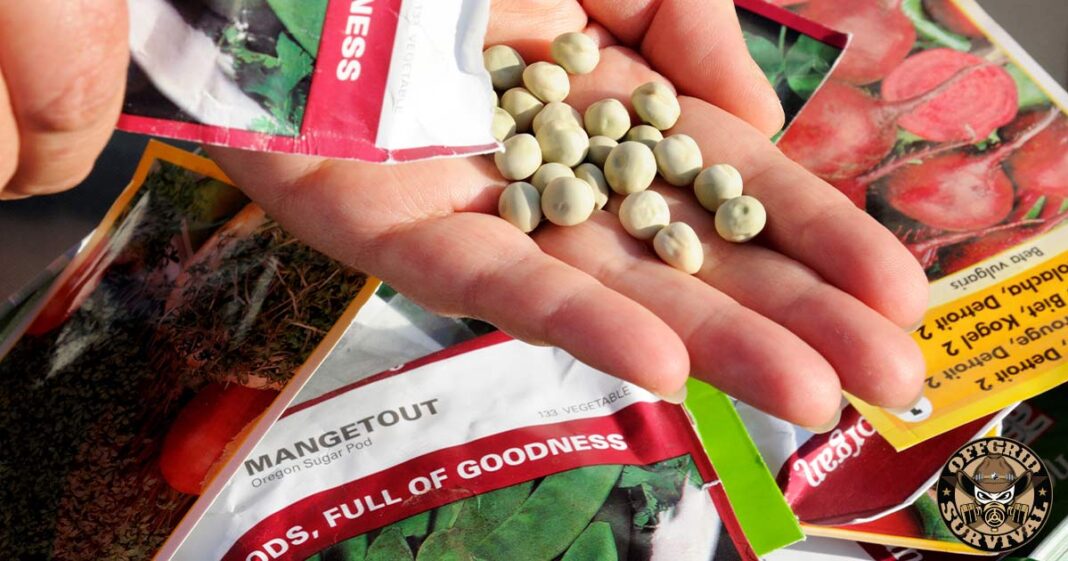
I think having survival seeds is an essential part of any long-term survival plan, but there are a lot more things to take into account than just buying a bucket of seeds and calling it done. Most of what’s sold as a “survival seed vault” online is a marketing package, not a survival plan. Here’s everything you actually need to know before you build one.
1. Not All Seeds Are Created Equal
You need to be very careful when picking out which types of seeds to buy. At the very least, your seeds should be organic; but you also need to make sure you are buying them from a reputable dealer.
Heirloom, hybrid, and GMO are not the same thing, and the difference matters for a survival garden.
- Heirloom (open-pollinated) seeds are varieties that have been passed down for generations — most growers use a 50-year cutoff, though many heirlooms are far older. They’re pollinated naturally by wind, insects, or self-pollination, and they “breed true”: save the seed from this year’s tomato and next year’s plant will be the same variety. This is the only category of seed worth stockpiling for long-term self-sufficiency, because it’s the only one that lets you regrow your seed bank from your own harvest, year after year, indefinitely.
- Hybrid (F1) seeds are created by deliberately cross-pollinating two different parent varieties to combine specific traits — better disease resistance, more uniform fruit, faster maturity. This isn’t genetic engineering; it’s the same controlled cross-breeding gardeners have done by hand for centuries, just done by professional breeders. The catch: hybrid seeds don’t breed true. Save seed from an F1 hybrid and the next generation will revert toward one of the original parent plants, with unpredictable results. Hybrids are fine for this year’s dinner, but they’re a dead end for a self-sustaining seed bank.
- GMO (genetically modified) seeds are altered at the genetic level in a lab, not through breeding. They’re a different process entirely from hybrids, and they’re almost exclusively sold to commercial farms growing crops like corn, soy, and canola — not something you’ll find in a home garden seed rack.
On “terminator seeds”: You’ll see a lot of prepper content warning that seed companies sell genetically sterilized “suicide seeds” designed to prevent saving. This claim is outdated and, as commonly stated, false. The technology — formally called Genetic Use Restriction Technology (GURT) — was developed by the USDA and a seed company in the 1990s, but it was never commercialized. The patents have expired, no GMO seed sold today is sterile, and Monsanto pledged in 1999, and repeated since, not to release seeds with this trait. There’s been a de facto international moratorium on the technology under the UN Convention on Biological Diversity since 2000, and it remains unlifted as of 2025. The real risk with hybrid seeds isn’t sterility — it’s that the second-generation seed won’t grow the variety you expect. That’s a much more boring problem, but it’s the actual one.
2. Know Your Climate Before You Buy Anything
When buying seeds, you are probably better off staying away from those pre-packaged “one year supply” survival buckets sold by mail order. You really want to individualize your personal seed bank by buying seeds that are suited for your specific climate. What grows well in the Midwest may not do well in Florida or the desert Southwest, and a 30-variety bucket assembled for a national audience is, by definition, not optimized for your backyard.
Find your USDA Plant Hardiness Zone first. The USDA Plant Hardiness Zone Map is the standard tool gardeners and growers use to determine which plants are most likely to thrive at their location, based on the average annual extreme minimum winter temperature, shown in 10-degree zones and 5-degree half-zones. You can look up your zone for free at planthardiness.ars.usda.gov by entering your zip code. Once you know your zone, every seed catalog and seed packet you buy will tell you whether that variety is suited to it.
Your hardiness zone only tells you about winter cold tolerance, though — it doesn’t account for your soil type, your frost-free growing season length, your summer heat, or your rainfall. For that level of detail, your local agricultural extension office (every state has one, usually tied to a land-grant university) and your nearest independent garden center are worth more than any national seed catalog. They know what actually survives in your specific dirt.
3. Will You Actually Eat It?
Just like building up your food storage, you need to think about what foods you and your family will actually eat. A field of beautiful heirloom corn is worthless prep if nobody in the house will touch corn. This sounds obvious, but it’s the single most common mistake in pre-assembled survival seed kits — they’re built for a generic household, not yours.
It also matters for calories, not just preference. A garden can produce an enormous amount of green vegetable mass without producing much food energy. Lettuce, herbs, and most leafy greens are nutritionally useful but calorically almost irrelevant in a real food-security scenario — you’d need an unreasonable volume of lettuce to replace a day’s calories. If your goal is a garden that could actually keep your family fed, not just supplement a grocery-store diet, calorie density per square foot has to be part of the seed-buying decision:
- Potatoes are the standout. Multiple independent estimates put potato yields around 90 lbs and roughly 30,000+ calories per 100 square feet — among the highest calorie return per square foot of any temperate crop, and they store for months in a root cellar without any processing.
- Corn is also strong on a calorie-per-area basis, commonly cited around 30,000 calories per 100 square feet, though it needs more space between plants, draws heavily from soil nitrogen, and is far more vulnerable to deer, raccoons, and (where present) feral hogs raiding the patch before harvest.
- Dry beans (pinto, lima, kidney) store almost indefinitely once dried and add real protein alongside calories — lima beans run around 217 calories per cooked cup.
- Winter squash and pumpkins store for months without canning or freezing and add meaningful calories, though less per square foot than potatoes or corn.
- Sunflowers, grown for seed and pressed for oil, are a less obvious but legitimate calorie crop — oil is one of the hardest calorie sources to produce in a small garden.
A reasonable rule of thumb, echoed across multiple gardening and food-security sources: aim for roughly 70-80% of your growing space in calorie-dense staples (potatoes, dry beans, winter squash, corn) and the remaining 20-30% in nutrient-dense crops (greens, tomatoes, peppers) to cover vitamins a pure starch-and-protein diet would miss.
4. Practice Growing Before You Need To
Growing food well is a skill that takes years to develop, and your first season will not go perfectly no matter how good your seeds are. Don’t wait until things go bad to find out you don’t actually know how to grow a tomato to harvest. Start a small garden now and learn how to grow the specific foods you’re planning to depend on.
This isn’t just about technique — it’s about discovering, while it still doesn’t matter, things like: which varieties actually thrive in your soil versus which ones the catalog just claimed should; how your local pest pressure behaves; how much water your specific plot actually needs in your specific summer; and how long your real frost-free window is, as opposed to the zone-map average. None of that shows up until you’ve run a season.
5. Know How Long Your Seeds Will Actually Last
This is the part most “survival seed” marketing glosses over completely, and it’s where a lot of money gets wasted. Seed viability isn’t indefinite, and it isn’t the same across crops.
The science in brief: Most common vegetable seeds are “orthodox” seeds, meaning they tolerate drying and store best when kept cool, dry, and dark — moisture and heat are what kill viability, far more than time alone. A simple rule of thumb is that the sum of the storage temperature in Fahrenheit and the percent relative humidity should be under 100. Keep seeds around 40°F at low humidity and they’ll outlast seeds left in a warm, humid shed by years.
Realistic viability by crop, under average cool-dry home storage (not refrigerated):
- About 1 year: beans, broccoli, carrots, corn, most herbs, leeks, lettuce, okra, peas, peppers
- About 2 years: beets, cabbage, cauliflower, cucumbers, eggplant, kale, melons, pumpkin, radish, squash, Swiss chard, tomato, turnip
That’s under ordinary “cool, dry place” storage — a drawer or closet, not a fridge. Refrigerated, properly dried seed in a sealed container can push well past that; some long-term studies have shown specific species holding strong germination rates for 20+ years at sub-freezing temperatures, but that’s a controlled research environment, not a kitchen cabinet.
What this means practically: a “10-year survival seed bank” sitting in a basement, in its original paper packets, is mostly aspirational. Paper is porous — it absorbs ambient humidity instead of blocking it. If you actually want multi-year shelf life:
- Dry your seeds thoroughly before storing them (well below the moisture content they’d have fresh off the plant).
- Store in something genuinely airtight — a sealed mason jar or a heat-sealed mylar bag, not the paper envelope they came in.
- Add a desiccant (silica gel) if you’re in a humid climate, to actively pull moisture out rather than just blocking more from getting in.
- Keep them cool — a refrigerator beats a closet, a closet beats a garage or shed.
- Label everything with the crop, variety, and the year you packed it. “Mystery seeds, unknown age” is a problem you can avoid for the cost of a marker.
Test before you trust. You don’t have to guess whether old seed is still good — you can know. Take 10 seeds from a lot, lay them on a damp (not soaked) paper towel, fold it over, seal it in a loosely closed plastic bag so air can still reach them, and keep it somewhere around 70°F. Check every few days and count how many sprout within the timeframe on the original packet. If 8 of 10 sprout, you’ve got roughly 80% germination — plant normally. If 3 of 10 sprout, that seed isn’t dead, but you’ll need to sow two to three times as thick to get a normal stand. Most fresh vegetable seed runs 75-95% germination; if your stored seed is testing well under half that, it’s time to replace it, not stretch it.
6. Learn to Save Your Own Seed — and Do It Right
The single best long-term seed bank isn’t something you buy once. It’s a habit: grow heirloom varieties, save seed from your best-performing plants every year, and your seed stock gets progressively better-adapted to your specific soil, climate, and pest pressure with every generation. This is also the only renewable option — buy hybrids and you’re back at the store every spring; save heirloom seed correctly and you never have to buy that variety again.
The catch is cross-pollination. If you’re growing more than one variety of the same crop and want true-to-type seed, you need isolation — distance or a physical barrier between varieties so their pollen doesn’t mix.
- Self-pollinators are the easy entry point. Tomatoes, beans, peas, and lettuce pollinate themselves before the flower even fully opens, so they rarely cross. Tomatoes generally need about 10 feet of separation from other tomato varieties to stay true, and self-pollinating annuals like beans, peas, and lettuce need only about 10 to 20 feet from a different variety of the same crop. These are the best crops for a beginning seed-saver.
- Wind- and insect-pollinated crops are much harder. Corn pollen can travel a quarter mile or more on the wind, which makes distance alone unreliable for keeping varieties pure — serious seed savers hand-pollinate corn instead. Squash varieties that easily cross are generally isolated by a half mile when grown for seed, or hand-pollinated as an alternative. Onions, beets, cucumbers, radishes, and rye fall into this same higher-difficulty category.
- One variety per crop is the simplest fix. If you only grow one variety of squash, one variety of corn, there’s nothing nearby for it to cross with, and you can skip the isolation math entirely.
This year’s eating crop and next year’s seed crop don’t have to be the same plants — you can let your best, most vigorous specimens go to seed at the end of the season specifically for saving, while harvesting the rest normally for the table.
7. No Yard? Your Seed Bank Still Works in Containers
Everything above assumes you’ve got a plot of dirt to put these seeds in, but a lot of people building a seed bank are doing it from an apartment, a rental with no yard, or a balcony. That doesn’t disqualify you — it changes which varieties you prioritize and how you grow them out.

Compact and dwarf varieties of heirloom tomatoes, peppers, bush beans, and leafy greens all perform well in containers, and calorie-dense crops like potatoes do surprisingly well in grow bags — a single seed potato in a properly sized container can produce a meaningful harvest with no garden bed at all. The seed-saving and isolation-distance principles from section 6 still apply on a balcony; if anything, they’re easier to manage in containers, since you control exactly what’s growing within isolation distance of what.
If you’re working with limited space, our full breakdown of container gardening for a survival garden covers container sizing by crop, soil selection, and how to keep a container garden productive without a yard.
8. A Seed Bank Is Not a Backup Plan — It’s Step One
Growing your own food is genuinely hard, and a one-size-fits-all seed bucket does not make you prepared, even if you’re an experienced gardener. There are too many variables to rely on a garden alone:
- It takes time to start producing food. From seed to first harvest is, at minimum, weeks; for many staple crops, it’s months. You need food stocks built up that will carry you until the garden starts producing, not after.
- The future is unpredictable. Flood, fire, drought, an early frost, a pest outbreak — any one of these can wipe out a season’s harvest regardless of how good your seeds or your technique are.
- You need a backup for when growing isn’t possible. That means a real emergency food supply, the skills to hunt and trap game, and knowledge of the edible plants native to your area and how to prepare them safely.
A seed bank is one layer in a much larger food security plan — not a replacement for the rest of it.
9. What “Seed Vaults” Actually Are (and Aren’t)
You’ll see prepper marketing reference the Svalbard Global Seed Vault as if it’s something you could access or contribute to personally. It isn’t, and it’s worth understanding what it actually is so you don’t build false confidence around it.
The Svalbard Global Seed Vault is a long-term backup storage facility for duplicate seed samples from the world’s crop genebanks — not a public seed bank, not a doomsday stockpile for individuals, and not something that distributes seed to anyone. Seed collections stored inside remain the property of the depositing institutions, and the Seed Vault does not distribute seeds — it exists so that national and international genebanks can recover lost material if their own collections are ever damaged or destroyed. It’s kept at -18°C, with permafrost and thick rock ensuring the seeds stay frozen even without power. It’s an insurance policy for institutional crop diversity, not a resource for the general public.
The organization that does work directly with home gardeners is Seed Savers Exchange, a US nonprofit. They maintain a genebank at their Heritage Farm in Iowa, regrow select heirloom varieties every year to keep seed supplies viable, and distribute seed to gardeners and farmers around the country who help preserve those varieties by growing them — and they also back up their own collection at Svalbard, same as national genebanks do. If you want a real, traceable source for heirloom seed suited to long-term saving, that kind of organization — or a regional seed library, many of which exist at public libraries now — is a far better bet than a generic “doomsday seed vault” sold online.
A real seed bank isn’t a bucket you buy once and store in a closet. It’s heirloom varieties chosen for your specific climate and your family’s actual diet, stored properly enough to still be alive when you need them, tested periodically so you’re not gambling on dead seed, and backed by the skill — practiced now, not later — to actually grow them to harvest. The seeds are the easy part. Everything around them is the actual prep.




I definitely think you should have a collection of seeds and the knowledge of how to grow them. Buying a “emergency seed vault” is stupid IMHO, since you get seeds that other people think you will want to grow and eat. I’ve also yet to see someone actually open one of these emergency seed vaults and plant the seeds, so who knows if they will germinate and produce.
My recommendation is to make a list of the vegetables you like, find heirloom seeds for varieties that will grow in your area and then put in the time and effort needed to grow them. I’ve made a lot of mistakes to date with my garden, though I’ve learned a crap load in the process!
I won a drawing that Rourke had on ModernSurvivalOnline and received a pack of survival seeds. There were about 40 small packages of seeds. It was not a good selection of vegetables. Too much emphasis was put on what I would call non-essential plants. What would I need with 1000 dill plants? Or 1000 lettuce seeds? They included four or five types of beans but only about 30-50 seeds of each. There weren’t corn or onion seeds. There were several types of root vegetables.
If I was putting together my own survival seeds package I would not include what they had in this set. If you want to put your own survival seeds together, get what you use, keep them in their packages and put them all into a mylar bag and seal the bag. Or better yet, collect seeds each year from what you grow. These seeds will also last 8-10 years if you store them properly.
Having well stored, heirloom seeds on had is definitely a good idea. Call it a “seed vault,” call it a stash, whatever you like, not a stupid idea. If you shop around, there a bundled vaults, or develop your own. Some companies do a little better job of packaging than one might be able to do on one’s own.
I agree with Whatif that you need not have 1000 dill seeds. You have to plan for what folks (and you) really need. Some dill might be nice, but corn, beans, grains, some veggies…. all as heirloom varieties will come in handy either for your own garden, or as a means of trade to others. Variety is always a key ingredient, so obtain some odder items. There is virtually no storage cost.
I have a large variety, in deep freeze, all sealed tight. I will begin using these (no matter the world’s events) in the next two years for my own garden, and then replace those stores as I use them. Rotating these stores in important. They can last a long time in freezer IF stored correctly. And, not all seeds last equally well.
I am interested in what the proper storage method is. I see many articles that state “if stored properly” but do not provide any information on how to do that. Could you provide me with some insight on how to properly store my seeds?
Why wait until the SHTF, plant the garden now! Each generation of collected seed will be more and more suited to your particular area!
One crop I MUST recommend for any gardeners in Florida or the southeast are Black Eyed Peas. They grow well in poor soil, can tolerate high levels of heat, and continually add nitrogen to the soil as long as they’re alive. The longer they’re there, the better your soil gets. Got mine “seeds” right from the grocery store.
The biggest problem I see with a survival garden is NOT growing but DEFENDING it. Once the seeds sprout you will have to guard it 24/7 from those who did not prepare…It’s not like you can hide it!
Great point, Connie. I was thinking that same thing…
I agree protecting your food supply will be paramount. That is why food storage is necessary. If SHTF happens, I would not plant any type of garden for at least 6 months if not longer. I would want to help anyone I could but if you are not in a community that is working together what would be the point. Could you really say shoot someone from stealing from the garden. I don’t think I could. After 6 to 8 months, the people that are around would probably have things in hand I would think. Anyhow, just my opinion.
If you can not grow the seeds you have were others can not find the food you need to spend more time learning to do so. We practice this over and over by going to separate place’s and planting and then swapping place’s to see if we can find where the other has planted seeds and do not go look once we do this for months. You need to be able to do this in plain sight. You need to understand you will not be going to this spot every day and leaving a walking path for others to follow to your food.Check the web for info and videos on this will help.Stay safe out there my friends
I have growing my garden from my own seeds for four years now and know what does well and what does not.why wait till year two to know if you will be able to eat or not.and you can hide your plants with just a little thought.pot growers have been doing it forever and you must be smarter than a bunch of stonies (no offence intended to some good friends)
First grow it then collect your seeds then repeat til you get it right, even if you do it a whiskey barrel planter
Heirloom or open pollinated seeds are what you want. These produce true, some hybrids are labeled “organic” but do not reproduce the same plant.
Many seeds do not need to be used immediately, some store well for years. Research, research, research.
IMO, the prepackaged seeds are inappropriate (rip-off) as they are not customized to your area, containing seeds YOU may not be able to grow and are WAY over priced. Practice makes perfect, if you don’t garden now, you will probably not have a good garden when TSHTF.
I have a question about heirloom seed, do you need butterflies or bees for pollination? Or am I supposed to trust the breeze to do the heavy lifting?
Thanks
dusty:you can pollinate most plants by hand with a little thought and research. squash is a very good example
not to mention the pathogens that love to grow on rye and especially corn, without proper storage you would end up killing yourself.
We have been growing the organic garden for many years. Seeds for new varieties of heirlooms come from reputable seed companies…get their catalogs and choose seeds for your Zone. The climate changes are unpredictable here in the Plains, and former choices in tomatoes and cukes for example did not do well for two years, as neighbors found out. We planted those that called for a “cooler climate” like Russian Orange and Black Seaman tomatoes…even this year of heavy humidity (river flood) and high heat, they did great. Butternut squash, giant pumpkins and cantaloupes were prolific, but watermelons took all summer and only now in Oct. ripened. Last Spring was too cool and ground heated slowly. Actually, we had No Spring!
Okra was planted later and did well. Still harvesting 6 kinds of chili peppers and small round white eggplants. Look for varieties! Grew 6 kinds of tomatoes, lots to can this year.
A P.S.: Start your seedlings indoors in a cool climate Spring, and use a good grow lamp system.
Also, not to worry too much about “invaders” of your garden.
A friend pointed out that looters want the packaged goods, and have no patience waiting for the garden to ripen. Think about that.
We have found that more recent seed packages are loaded with duds. So you MUST get some heirloom seeds that you can learn to harvest yourselves.
Heirloom tomato plants reseed themselves (from fallen fruits) and several dozen free plants will spout in various areas of the garden. That’s how you know you have a strong seed stock.
Beware of planting foods that you are allergic to, or goitrogenics, such as collards and other cruciferous vegetables, which when not cooked well can cause severe depression in some folks with compromised thyroids.
Try all your foods first before you invest your $$ in foods that can make your life worse. (You could always barter with them or give them to others in need).
Vegetables such as Collards, Kale, Mustard Greens and Swiss Chard make a beautiful stealth garden, where you are not allowed to plant in your yard. Try parsley and cilantro, too. A hedge of Collards can be harvested most of the year, and some Kale love the snow. Swiss Chard comes in many colors, as well as Kale, which has many shapes, too. Throw in a few flower seeds and the neighbors won’t know what you have growing there. I won’t waste garden space on these plants because they grow heartily as a hedge at the borders of the property. Beware, deer love Swiss Chard, bean plants, and beet leaves (which you can eat). Some lettuce plants grow very well but do not seem to do well at the table because they are limp and tasteless. Squash flowers are edible and are like a mild artichoke heart in some respect. You can fry them in eggs. By eating the flowers you can control the overgrowth of zucchini too. There are 5-ft-long-zucchini bearing plants which can grow on a wall trellis that have a leaf that is milder than spinach and tastes wonderful in spaghetti sauce with Italian sausage. That squash is good to eat too, only several feet long! The leaves can be frozen.
We get our seeds from seed savers exchange, which features organic, heirloom seeds that can be saved from that years produce and planted again and again. Each year you save seeds from your best producing plants you develop seeds that are genetically fit for your garden. Learning to save seeds is a valuable skill for when SHTF scenarios, seeing as how obtaining seeds from other sources, let alone ones suitable to your particular area and climate, is going to become extremely difficult.
The critical thing about a survival garden is growing enough calories. Yes, I can grow zucchini, cucumbers, and radishes until the cows come home, but they are extremely low-calorie foods. You have to learn to grow calorically-dense food. Think corn, beans, potatoes and sunflowers (to press seeds into oil). Also, while you can use organic gardening techniques, having a quantity of pesticides on hand in case of an infestation can be the difference between life and a slow, starvation death.
Who are the reputable seed distributors?
I guess consider quality, seeds offered, other information offered, who owns that company (hopefully not Papa Company, making bank on screwing people over elsewhere in the consumer world) and so on.
It’s important to remember the rule of 3. A seed stash is a good 1 but make sure you have at least 2 other sources for food.
As regards the “thousand dill plants”, you must learn HOW a specific plant propagates. Dill, for example, must be planted in clumps–several seeds per pot or spot. Not all of the seeds will germinate. When planting your garden, you have to remember the medicinal values of your plants. Dill can be used as baby dill to freshen a plain salad, spruce-up potatoes, but also acts as a digestive aid. In times of turmoil, I know I get the “belly curdles”. Dill is invaluable for gas,indigestion and belly aches. Plus, you can’t think of your garden as having its value just during the growing season; you have to think of what you are going to need BEYOND harvest time. Dill has a relatively short growing season (for leaves), then you can look forward to the seeds, which you will need to pickle those cucumbers for winter. The bottom line is, always think past the “grocery store-availabilty” of your garden. You are going to have to learn the old ways.