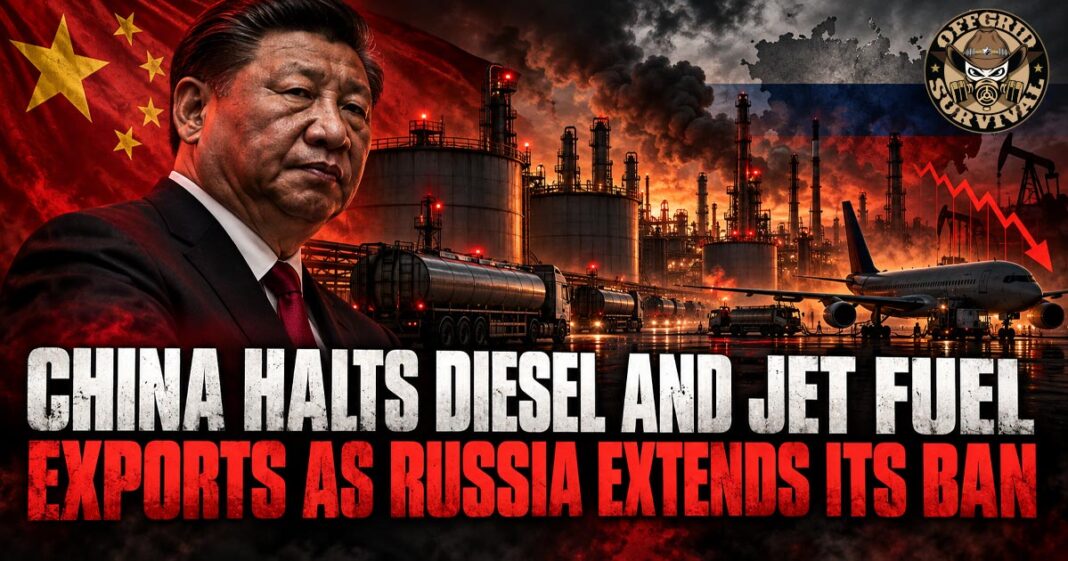
The countries the world counts on to cover a fuel shortage just stopped selling. On Thursday, China’s refiners halted exports of gasoline, diesel and jet fuel to everywhere except Hong Kong and Macau, and Beijing gave no date for when they can start again. PetroChina, the country’s biggest state oil company, had already cancelled most of the cargoes it planned to ship in October. The day before, Russia extended its ban on diesel exports through October 31.
That leaves almost nobody with spare fuel to sell. The Iran war has choked off most traffic through the Strait of Hormuz since late February and left Gulf refineries running well short of normal, while Ukrainian drones keep knocking Russian refineries offline. China was one of the last big suppliers still shipping extra fuel into that gap. Now it’s keeping that fuel at home, and everyone who buys on the open market, including Europe and the U.S. East Coast, is left bidding over whatever is left.
For you, it means the diesel crisis that’s already bankrupting truckers is about to get worse, right as winter starts. U.S. diesel averages about $6.38 a gallon, and stocks heading into heating season are about 13% below normal, nearly a third below on the East Coast. Diesel moves the trucks that stock your grocery store and the tractors bringing in the harvest. In the Northeast it also heats a lot of homes, and if supplies keep shrinking, the worry this winter is whether your heating oil company has any to deliver at all.
Beijing Already Did This Once, Back in March
This is the second time this year China has pulled its fuel off the market. Six days into the Iran war in March, it told its top refiners to stop exporting diesel and gasoline and to cancel deals they’d already signed. It eased up over the summer, and by August China was exporting more fuel than it did before the war, with jet fuel exports hitting a record. For a few months, China was one of the suppliers covering for the missing Gulf barrels.
That’s over, at least for October. China’s week-long Golden Week holiday started Thursday without any export approvals, and nobody knows if they’ll come after the holiday ends October 7. Traders say it depends on China’s own fuel stocks, which have dropped to multi-year lows. Kpler, a firm that tracks tanker shipments, estimates China’s diesel stocks are about 20 million barrels below the level Beijing wants before it lets refiners sell abroad.
The timing is hard to miss. The halt came less than a week after President Trump asked President Xi in Washington to help steady global fuel supplies.
Markets reacted right away. In Asia, diesel now sells for about $75 a barrel more than the crude it’s made from. A barrel holds 42 gallons, so that’s roughly $1.79 a gallon going to refiners before anyone pays for taxes or trucking. U.S. crude jumped from about $88 to about $91.50 on the news.
Russia’s Ban Runs Through October 31
I don’t blame China for feeding its own people first. Everybody’s doing it. Russia says its ban is about harvest demand and rebuilding stocks after Ukrainian drone strikes on its refineries. Before the bans started, Russia shipped about a tenth of the world’s seaborne diesel.
Gulf refineries are still exporting well below pre-war levels, and indirect talks with Iran in New York stalled this week. Until there’s a deal, Hormuz traffic stays far below normal, which means the fuel China and Russia just pulled back has nowhere obvious to come from.
Diesel Topped Out at $5.82 in 2022, and We’re Already at $6.38
In 2022, after Russia invaded Ukraine, sanctions knocked Russian diesel out of Western markets and the whole system tightened. U.S. diesel hit a record of about $5.82 a gallon that June, truckers paid it, and the fuel surcharges showed up in grocery bills. It took about a year for prices to come back down. This time we’re starting much higher. The national average is about $6.38, more than $2.60 above a year ago, and East Coast diesel and heating oil stocks hit a record low in late August.
The 1973 oil embargo is the other one worth remembering. Arab producers cut off shipments to the U.S., oil prices roughly quadrupled, and people waited in gas lines for hours under odd-even rationing. The lesson then was that once fuel turns political, it stops going to whoever pays the most. Nobody is targeting the U.S. on purpose this time. Each major supplier is holding back to protect its own market, and for buyers the effect is much the same.
East Coast Diesel Stocks Are Down Nearly a Third
On its own, a one-month pause from China would be a headache. It’s landing on a U.S. market that was already stretched thin.
- U.S. distillate stocks, which cover diesel and heating oil, were about 105 million barrels in the week ending September 25, roughly 13% below the five-year average. On the East Coast they’re about 31% below normal, according to EIA data.
- Prices are worst on the coasts. California is averaging over $8 a gallon for diesel, and New England is above $6.50.
- U.S. diesel set record highs in mid-September after a drone attack knocked Saudi Arabia’s East-West pipeline offline. We reported Monday that diesel had hit $6.53 with the country heading into winter about 600 million gallons short. The weekly average has slipped a little since, but not much.
- The damage is already hitting jobs. Texas declared a diesel disaster this week after 16 trucking companies went bankrupt.
- The Fed has been raising rates to fight the inflation this is feeding, which makes borrowing more expensive for every farm and trucking company already getting squeezed on fuel.
Washington’s plan so far is to ask the European Union to release its emergency diesel stocks and to talk about limiting U.S. diesel exports. Wood Mackenzie has warned that an export ban could backfire by forcing U.S. refineries to cut runs, which would push gasoline prices up. Nothing has been decided, and the midterms are November 3.
A Truck Fill-Up Now Costs $780 More Than Last Year
The first person to pay was the worker at MRPL who didn’t go home Wednesday. Refineries all over the world are being run past their limits to cover the shortfall, and that’s what happens when you push equipment that hard for that long.
The people in charge here keep calling this a temporary disruption. Asking Europe to drain its emergency tanks is not a plan. It’s a hope that nothing else breaks before the election, and it’s a hell of a bet to make when every major fuel supplier on the planet is holding back at once.
Here at home, it lands on you. A semi with two 150-gallon tanks now costs about $780 more to fill than it did a year ago, and that cost goes into the price of groceries and nearly everything else that rides on a truck. Farmers are paying it right now at harvest. If you heat with oil in the Northeast, you’re about to buy a winter’s worth out of the tightest supply on record.
What You Should Be Doing Right Now
If this keeps getting worse, most Americans aren’t going to experience it as an empty gas station overnight. You’re going to feel it through higher prices, longer delivery times, more expensive groceries and businesses quietly adding fuel surcharges to everything they sell.
That means the smart move isn’t panic buying. It’s getting ahead of the things that become expensive or difficult to replace when diesel stays above $6 a gallon.
Watch two dates. October 7 is when China’s holiday ends and Beijing decides whether refiners can export again. October 31 is when Russia’s diesel ban runs out, and it’s already been extended more than once. If both get extended, expect diesel and heating oil to keep climbing into November. If China reopens, you may get some breathing room before the cold sets in.
Start with food and household supplies you already use. Nearly everything in your grocery store arrives by truck, and a lot of it gets moved several times before it reaches the shelf. Meat, dairy, canned goods, bottled water, paper products, pet food and cleaning supplies all carry freight costs. If you’re going to use it anyway and it stores well, keeping an extra few weeks on hand makes more sense than waiting until another round of price increases hits. When you’re ready to go further, Long-Term Food Storage: What Actually Lasts 25 Years shows what actually keeps.
If you rely on heating oil, don’t wait until the first real cold snap. This is one of the biggest immediate risks, especially in the Northeast. Heating oil comes out of the same distillate pool as diesel, and East Coast inventories are already well below normal. Check your tank now, call your supplier, ask about delivery lead times and find out whether they are limiting fills or accepting new customers. Waiting until everybody else realizes there’s a problem is exactly when you’re going to have the fewest options.
Fill up at half a tank, not on empty. China stopped exporting gasoline too, not just diesel, and U.S. gas stocks dropped last week. When supply gets tight, some stations run out for a day or two between deliveries, and you don’t want to be on fumes when yours does. Bundle your errands and cut the extra trips.

Buy the heavy stuff before freight surcharges hit. The things that cost the most to truck are the bulky ones: feed, fertilizer, lumber, driveway salt, cases of water. If you’ve got a winter project or animals to feed, price it out now instead of in December.
If diesel is part of your emergency plan, have another way to make power. A diesel generator is useful right up until diesel becomes expensive, rationed or unavailable locally. If that’s your only backup, look at adding propane, gasoline or a small battery and solar system capable of keeping refrigeration, communications, lights and basic electronics running. You don’t need to power the entire house. You need enough redundancy that one fuel shortage doesn’t knock out your entire preparedness plan. Our breakdown of real solar setups under $1,000 shows what a basic system actually costs.
Related OFFGRID Survival Coverage
- Texas Declares a Diesel Disaster as 16 Trucking Companies Go Bankrupt and Consumer Confidence Hits a 12-Year Low
- Diesel Hits a Record $6.53 as America Heads Into Winter 600 Million Gallons Short
- Fuel System Is Cracking: Refinery Dark, Saudi Pipeline Burning, Wall Street Gives Up
- Are We Headed for a Global Recession, Food Shortages and Riots? Here’s What I’m Watching
- “Repeated And Persistent Supply-Side Shocks” Are Here To Stay
- Britain Rewrites Its War Book and Tells Families to Stockpile Food as Global War Risks Grow