Most people picture urban survival like some Hollywood disaster movie. Smoke rolling through the streets, cars burning, mobs running around and some guy with a rifle slung across his chest trying to fight his way home.
That is probably not how it starts.
It starts on a Tuesday afternoon when the traffic lights suddenly stop working. Your phone still shows five bars, but nothing loads. The gas station has a handwritten CASH ONLY sign taped over the card reader, traffic is backing up for miles, and you’re eleven miles from your kids with no way to tell them whether you’re coming home.
That is what a real urban emergency looks like in the beginning, and it doesn’t require the end of civilization to get there. A serious cyberattack can do it. A hurricane can do it. A major power outage can do it. So can a controversial verdict, a police shooting caught on video, or some viral incident that sends thousands of pissed-off people pouring into the streets.
The important thing to understand is that a city is basically a giant machine. Millions of people live stacked on top of each other because electricity, water, communications, fuel, transportation, police, sanitation and a dozen other systems quietly keep everything moving. Most days you never think about any of them.
Start pulling a few of those systems out, though, and the same neighborhood that felt perfectly normal at noon can become a very different place after dark.
Cities Don’t Collapse All at Once
One of the biggest misconceptions about disasters is that somebody is going to announce when things have officially gone bad.
That isn’t how it works. There probably isn’t going to be an alert!
Systems start failing one at a time, and most people don’t react because the first few failures are still easy to explain away. Maybe the internet is down. Maybe the card reader isn’t working. Maybe traffic is screwed up because of an accident. Nobody wants to be the guy who overreacts, so they wait until the problem reaches something they personally depend on.
By then, everybody else is reacting at the same time.
When the power goes, it takes a lot more with it
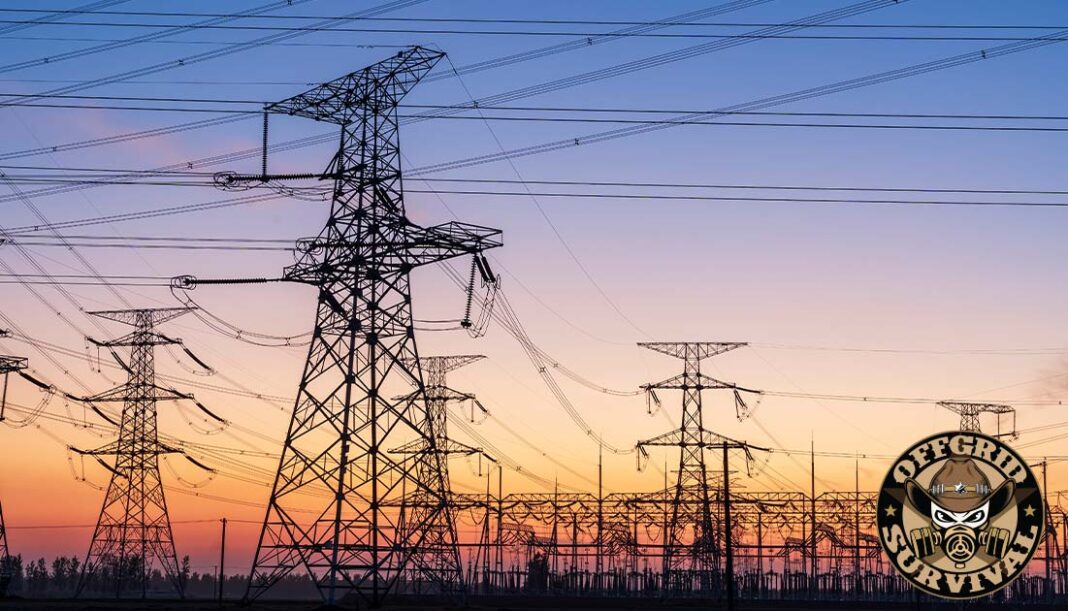
Power usually goes first, and it takes a lot more with it than people expect. Traffic signals die and a major city gridlocks in about half an hour at rush hour. In the 2003 Northeast blackout, people in Manhattan walked home across the bridges because that was genuinely the fastest option available to them. Gas stations can’t pump, because the fuel is in the ground but the pumps run on electricity. Card readers stop. ATMs stop. Electric gates and garage doors either fail open or fail locked and you have no idea which until you’re standing in front of one.
Traffic signals shut down, and during rush hour that alone can lock up major parts of a city surprisingly fast. Gas stations may still have thousands of gallons of fuel sitting underground, but most pumps need electricity. Card readers stop working. ATMs go dark. Electric gates, parking garages, elevators and security systems start behaving unpredictably depending on how they were designed and whether backup power is available.
The real problem isn’t simply sitting in the dark. It’s that electricity is underneath almost everything else you depend on.
Communications usually fail from congestion before they fail from damage
People tend to imagine cell towers physically going down. More often, the first problem is that everybody tries to use the network at the same time.
One hundred thousand people calling spouses, checking social media, refreshing news feeds and trying to figure out what’s happening can overwhelm a network that was working perfectly fifteen minutes earlier. Cell sites have backup systems, but backup batteries don’t last forever, and generators only help if someone can keep fuel getting to them.
Your phone may show full signal while being nearly useless.
Water becomes a serious problem much faster than most people expect
Municipal water systems depend heavily on pumps, treatment systems and electricity. Some systems have enough gravity-fed storage to buy time, but that doesn’t mean every neighborhood or building will continue getting normal pressure.
High-rise residents have another problem. Upper floors often depend on booster pumps inside the building, which means the guy living on the second floor may still have water while somebody fifteen floors above him gets nothing.
When municipal water eventually returns, you may also be dealing with contamination or a boil-water order. That’s not particularly useful if your electric stove doesn’t work and you never bothered storing fuel for another heat source.
Cash has a window of usefulness
Preppers love saying cash is king, and during the first phase of a power or communications failure they’re right. Small bills can buy fuel, food, bottled water or a ride when electronic payments aren’t working.
But cash only matters while somebody still has something to sell you.
If the store shelves are stripped, the pumps don’t work and the guy behind the counter has no idea when another delivery is coming, your stack of twenties becomes a lot less impressive. The useful window for buying your way around shortages can be shorter than people assume.

Sanitation is where things get ugly
Nobody likes talking about sewage, which is probably why it gets ignored in so many survival discussions.
Lift stations need electricity. Apartment plumbing can back up. Toilets become unusable once water service disappears, and now multiply that problem across thousands of apartments packed into a few square miles.
A couple days without functioning sanitation isn’t merely disgusting. It becomes a legitimate public-health problem.
That is part of why I put civil unrest and infrastructure failure in the same category. One can trigger the other, but once enough systems begin failing, the problems start feeding each other.
The Criminal Calculation Changes When the System Breaks
We’ve spent a lot of time on this site talking about how criminals actually select victims.
If you’ve read how criminals actually pick a target or our interview with a career criminal, you already understand the basic calculation.
Risk. Reward. Effort.
Most predators run some version of that calculation whether they’re consciously thinking about it or not. On a normal Tuesday afternoon, the risk side of that equation is loaded heavily against them. There are witnesses everywhere. Cameras are hanging off buildings and sitting in everybody’s pocket. Somebody can call 911 almost instantly, police may be only minutes away, and there’s an entire functioning criminal-justice system waiting on the other side.
Now remove some of that.
Turn off the streetlights. Overload 911. Put half the city’s cops downtown dealing with riots or guarding critical infrastructure. Knock out cameras, communications and electronic access systems.
The criminal didn’t suddenly become ten times tougher. The environment changed the math.
Behavior that would have been ridiculously risky on Monday afternoon can look very different to him two nights into a major blackout.
Then you have another group to worry about: people who aren’t criminals at all but are becoming desperate. Three days without water, medication, air conditioning, food or a way to help a sick child can make otherwise normal people do things they never imagined doing. I covered that problem in the human threats you’ll face in a real SHTF collapse.
Desperate and evil are not the same thing, but either one can become dangerous.
This is why everything we’ve talked about regarding situational awareness and not looking like an easy target becomes more important when normal systems begin failing. You can’t personally restore police response times or turn the streetlights back on, but you can control your route, your posture, your pace and how much attention you’re drawing to yourself.
Your First Big Decision: Stay or Move?
This is where a lot of people screw themselves.
Something happens, adrenaline kicks in, and suddenly everybody decides they need to “bug out.” They jump in the car with no real destination and become part of a giant wave of people trying to leave at exactly the same time.
Your default in most situations should be staying where you are until there’s an actual reason not to.
I’ve written before about why bugging out to the national forest can be a good way to die slowly, and the urban version of that mistake is blindly joining the evacuation.
When tens of thousands of people decide to leave simultaneously, highways, bridges, tunnels and arterial streets become parking lots. Now you’re sitting in a stationary vehicle surrounded by other frightened people while burning fuel you may not be able to replace.
Your house or apartment may actually be a much stronger position. You have walls, a locking door, your supplies, your clothes, stored water and hopefully neighbors who recognize you.
The time to move is when your location becomes the problem, not simply because something bad is happening somewhere in the city.
Reasons to leave can include:
- Fire, flooding, gas leaks or structural damage
- Your building or immediate neighborhood becoming the focus of unrest
- A prolonged water failure that is exhausting your stored supply
- A medical need you cannot handle where you are
- Dangerous indoor heat or cold that you cannot mitigate
- Reliable information suggesting conditions around you are deteriorating and you still have a safe window to leave
That final one is always going to involve judgment.
The rule I would remember is that early usually beats fast.
Leaving two hours before everyone else can feel like you’re overreacting. Leaving eighteen hours later, when everybody finally realizes what is happening, can turn that same drive into a nightmare.
If you’re at work and your spouse or kids are across town, the problem changes again. Now you aren’t really bugging out. You’re trying to get home.
And that starts with knowing your city far better than most people do.
Learn Your City’s Choke Points Now
Here’s homework worth more than any gear purchase you’ll make this year. Pull up a map and find your choke points. You can do something this weekend that will probably be worth more than buying another five hundred dollars worth of survival gear.
Grab the map and look at how you actually move through your city.
Every urban area has terrain even if the place looks completely flat. Bridges, tunnels, railroad tracks, drainage channels, freeway embankments, rivers, campuses and giant developments all create barriers that funnel people through specific streets.
Those are your choke points.
Look for:
- Bridges and tunnels between where you work and where you live
- Main arterials everybody else will naturally use
- Smaller residential streets running parallel to those arterials
- Railroad crossings and freeway underpasses
- Places where only one practical route gets you through
- Stadiums, government buildings, courthouses, campuses and transit stations
- Neighborhoods you wouldn’t want to walk through after dark on a normal night
Then build at least two ways home from the places where you spend the most time.
One route should be the obvious fast route. The second should be the ugly route, the one that takes longer but avoids bridges, downtown corridors, stadiums and other areas likely to become jammed.
And then actually walk part of it.
Maps hide a lot of things. A route that looks perfect on your phone may have a six-foot wall, a fenced rail yard, a drainage canal, a locked gate or some other obstacle that doesn’t become obvious until you’re standing in front of it.
Walking also tells you something else people badly overestimate: how far they can comfortably travel on foot.
Print the route when you’re done. Paper doesn’t run out of battery, lose service or reroute you toward a problem because an algorithm doesn’t know there’s a mob occupying the next intersection.
Moving Through a City Without Becoming the Guy that gets Noticed!
If you actually have to move through a city during unrest or a major outage, your goal isn’t to look tough. Your goal is to not stand out.
You want to move like you belong there and have somewhere completely ordinary to be. Walk at a steady pace. Keep your head up and pay attention, but don’t look like you’re conducting a military patrol. Keep your hands free, and don’t walk around staring into your phone.
We talked about this in detail in what “easy target” really means. Criminals notice behavior long before most people realize they’re being watched.
Don’t walk directly into something questionable just because it happens to be your normal route. If the next block looks wrong, change direction early. Crossing the street half a block before you reach a questionable group looks normal. Waiting until you’re twenty feet away and suddenly darting across the road makes it obvious you’re reacting to them.
Crowds are another problem altogether.
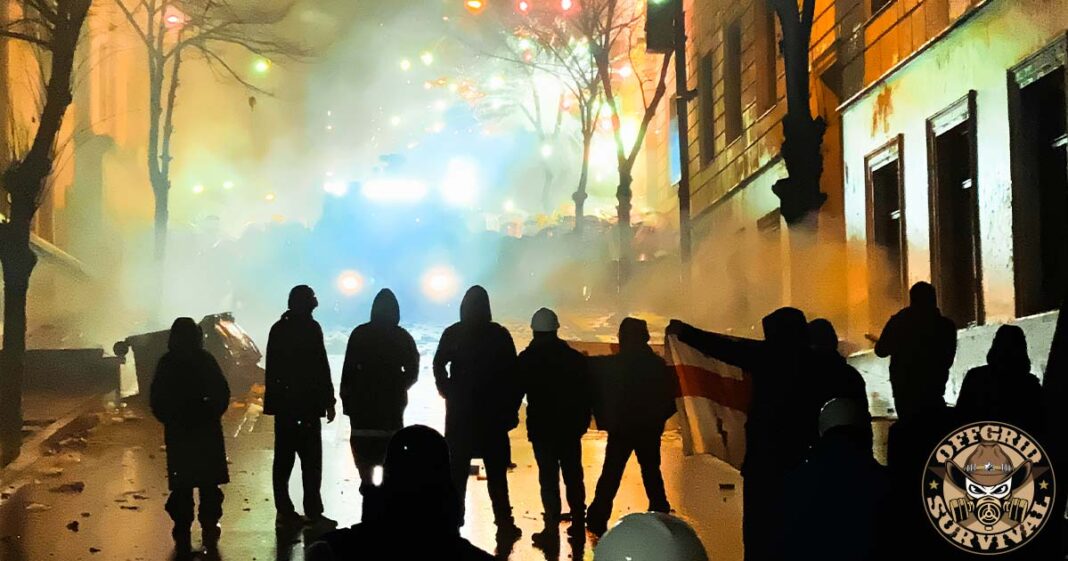
During unrest, the most dangerous place isn’t always inside the crowd. It can be the compressed space around it where police lines, protesters, vehicles, fences and escape routes start squeezing people into a smaller area.
Never willingly put yourself between a crowd and the direction it wants to move.
And don’t stand around watching.
A peaceful protest at 3:00 can look completely different at 3:45. You don’t know what rumor just hit the crowd, what happened two blocks away or whether police are about to move everyone out of an area.
You aren’t there to film it. You aren’t there to make a political point. You’re trying to get home.
Our full article on surviving riots gets deeper into what to do if you’re already trapped inside one. The better outcome is avoiding that position entirely.
Stop Dressing Like a Walking Survival Catalog
We’ve written about discreet survival backpacks for years because carrying a giant black tactical pack covered in MOLLE webbing through a city that’s coming apart is basically an advertisement.
At some point, though, the whole “gray man” idea became another product category.
Buy the gray-man jacket. Buy the gray-man backpack. Buy the gray-man pants.
Blending in is mostly behavior.
What gets attention is usually a combination of things. You’re walking faster than everybody else. Your head is constantly turning. Your clothing doesn’t make sense for the neighborhood. You keep touching something underneath your shirt. You’re staring at everyone like you’re expecting trouble.
Any one of those things may mean nothing. Put several together and now you’re memorable.
Context also changes block by block. Business clothes may disappear into the crowd downtown at five in the afternoon and stand out badly in a residential neighborhood at midnight.
Lose political gear too. Shirts, hats, flags, patches and stickers advertising which side you’re on are unnecessary baggage when people are angry and looking for enemies.
The same goes for your vehicle. Plenty of people dress discreetly and then drive around in a truck covered in gun-company stickers, political slogans and gear decals that might as well say, “There’s probably expensive stuff inside.”
Your Vehicle Is Great Until It Isn’t
A vehicle gives you speed, shelter and the ability to carry supplies. In the early stages of an emergency, that’s a huge advantage.
Then traffic stops.
Now you’re sitting inside two tons of metal that can’t turn around because cars are stacked behind you and can’t go forward because something is blocking the road.
This is why fuel discipline matters so much. I don’t like letting a vehicle fall below half a tank. During normal life that may feel overly cautious. During a regional power outage when fifty stations can’t pump fuel and the remaining three have lines stretching around the block, it suddenly looks pretty reasonable.
How you park matters too. Back into spaces or park facing outward whenever practical. It takes a few extra seconds now and makes leaving easier if things become chaotic.
When you’re driving, leave room between you and the vehicle ahead. In bad traffic, that gap is what gives you the option to turn, change lanes or move around a disabled vehicle instead of becoming boxed in.
And don’t knowingly drive toward crowds.
If you can see something happening two blocks ahead, turn before you reach it. The worst possible time to start figuring out what to do is when people are already surrounding your vehicle.
You should also know when you’re willing to abandon the car.
Where along your normal routes could you safely park and continue on foot? Do you have decent shoes, water and a small kit in the vehicle? Could you walk the remaining distance home?
If leaving the car means leaving every useful thing you have, you’re going to stay inside it far longer than you should.
Water, Heat and Toilets Will Probably Matter More Than Gunfights
This is the part of survival that doesn’t make good movies.
It also happens to be the part most likely to hurt you.
If you suspect a prolonged outage or water problem, start storing water before the taps stop working. Fill bathtubs, buckets, pitchers, pots and other clean containers while pressure still exists.
Your water heater may also hold thirty to fifty gallons depending on its size. Learn how to safely access that water before an emergency, including shutting off power or gas to the unit and isolating the house supply when necessary.
I want to stay on this a second, because there’s a woman I think about whenever this comes up. After Sandy, a resident at LaGuardia Houses on the Lower East Side was stranded on the 16th floor with no power and no elevator. No heat, no hot water. She told a reporter the only water she had was what was in her bathtub. Around 80,000 NYCHA residents across roughly 400 buildings lost power, heat, and hot water in that storm, and some of them waited two weeks to get it back. Volunteers going floor to floor in the Rockaways afterward found elderly people who’d been trapped in dark high-rises for days with no working plumbing.
Your water heater is holding thirty to fifty gallons right now and there’s a drain valve at the bottom of it. Kill the power or gas to it first. Then go find your home’s main shutoff, because closing it keeps contaminated municipal water out of your lines and keeps what you’ve got from draining back into the system.
Have a legitimate water filter and a way to boil water without relying entirely on your electric stove.
Temperature is another issue urban preppers tend to underestimate. A high-rise apartment without electricity, airflow or running water can turn brutally hot during a summer outage. In a place like Las Vegas or Phoenix, that can become dangerous long before anybody starts worrying about starvation.
The same principle works in reverse during winter. Instead of trying to heat an entire home, consolidate everybody into a smaller room, close off unused areas and retain as much heat as possible.
Then figure out sanitation before you’re forced to improvise.
A five-gallon bucket, heavy trash bags and absorbent material such as cat litter or sawdust can create a workable emergency toilet. It isn’t glamorous, but neither is having a nonfunctioning toilet full of human waste sitting inside your apartment.
High-rise residents also need to think about stairs. Once the elevators stop, anybody who cannot physically manage those stairs has a serious problem. That is not something you want to discover on day two of an outage.
When the Cell Network Is Useless
Assume voice calls are going to become difficult and data may become painfully slow.
Text messages often have a better chance of getting through congested networks because they require far less bandwidth. Keep them short and useful.
Something like: “At office. I’m okay. Taking south route home. Check again at 6.”
Families should also establish check-in times ahead of an emergency. Saying “call me when you can” sounds reasonable until nobody can call anybody.
Instead, agree that everyone tries to check in at specific intervals. That way nobody drains half a battery making repeated calls because they have no idea when the other person will try again.
An out-of-area contact is useful too. Local networks may be overwhelmed while long-distance communications still function, so one relative or friend outside the region can sometimes serve as a relay point.
Protect your phone battery from the beginning instead of waiting until it hits ten percent. Dim the screen, turn off unnecessary background activity and use airplane mode when you aren’t actively trying to communicate.
You should also have some way to receive information without relying entirely on a smartphone. A battery-powered AM/FM or NOAA weather radio is cheap insurance, and a scanner can provide useful information in many situations.
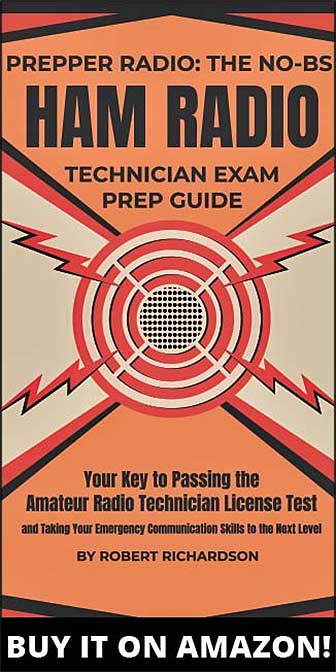
And yes, this is one of the reasons I’ve been pushing ham radio for years. When conventional networks start failing, amateur radio gives you an independent communications option. If you’ve been putting off getting licensed, I wrote a complete Technician exam prep book specifically to make getting your license easier.
Make Your Home Harder to Notice and Harder to Enter
If you’re staying put, you don’t want to be the most interesting house on the block.
During a neighborhood blackout, light pouring through every window tells everybody that you’ve got power. A generator roaring in an otherwise silent street tells people the same thing.
That doesn’t mean you sit in darkness while your generator collects dust. It means you think about light discipline, blackout curtains, where lights are positioned and when you’re running noisy equipment.
Security works the same way.
You don’t need to make your house look like a prison. In fact, I’d rather reinforce things in ways people outside never notice.
Residential doors frequently fail around the strike plate, so longer screws driven into the framing can make a meaningful difference. A basic door wedge adds another layer when you’re sleeping. Sliding doors can be reinforced without turning the place into a fortress.
What I wouldn’t do is stand outside advertising what you own.
Walking around your porch displaying weapons doesn’t automatically make everybody think you’re the guy to avoid. It may tell the wrong person exactly what is inside your house and who they need to watch.
There’s also one security advantage people completely overlook: decent neighbors.
Two families who know one another can watch different approaches, share information, help with water, notice unfamiliar people and sleep at different times. Twenty households who have never spoken to one another are just twenty isolated targets living close together.
You cannot build those relationships after the emergency starts.
What I Would Actually Carry
I’m not turning this into another ridiculous “ultimate survival kit” article. I’ve already written about why most ultimate survival kit lists were created by people who never used the gear.
For an urban get-home setup, I would keep it simple:
- Broken-in shoes you can actually walk in. If you wear dress shoes to work, keep walking shoes and good socks nearby.
- Water and a way to make more. Carry some water and keep a compact filter in the bag.
- Cash in small bills. Ones, fives and tens are far more useful than trying to break a hundred.
- Necessary medications. Don’t let yourself constantly get down to the final day or two.
- An N95 or better respirator. Smoke, dust and debris can become a major issue during fires, riots and infrastructure failures.
- A small flashlight. Something that stays with you instead of sitting in a drawer at home.
- A printed map. Mark your primary and alternate routes.
- Phone, charging cable and battery bank.
- Basic trauma equipment you know how to use. A tourniquet and pressure dressing are far more useful than a giant first-aid kit full of tiny Band-Aids.
- Weather protection. A layer, hat or whatever makes sense where you live.
Carry it in something ordinary.
Nobody should be able to look at your bag from across the street and immediately conclude that you’re the guy carrying several days of emergency gear.
The Urban Survival Mindset
If I had to boil everything above down, it would come back to three basic ideas: act early, don’t be too curious, and don’t stand out in the crowd.
Most urban disasters give you warning signs before conditions become truly dangerous. The problem is that people don’t want to react while reacting still feels unnecessary. They wait for somebody else to validate the threat, and by the time everybody agrees there’s a problem, they’re all trying to solve it simultaneously.
That’s how roads lock up, gas disappears and grocery stores get stripped.
Being low-profile matters for the same reason. The route that takes another twenty minutes is usually better than cutting toward a crowd just because it saves time. Clothes that blend in are better than advertising your politics. A short text is better than burning battery on a FaceTime call. And sometimes staying put is smarter than piling your family into the car because social media has everybody convinced the world is ending.
And curiosity gets people hurt.
You don’t need to see the riot. You don’t need footage for social media. You don’t need to walk closer to figure out what the cops are doing. You don’t need to stop on the side of the road and watch the fire.
Your job is to notice trouble early enough that you aren’t standing in the middle of it when everybody else finally realizes something is wrong.
Learn where the choke points are. Know how you’re getting home. Keep fuel in the vehicle. Store water. Have shoes you can walk in. Know your neighbors. Figure out which systems around you will disappear first and what you’re going to do when they do.
Do that work on a Saturday when nothing is happening, because when the lights finally go out and the rest of the city starts trying to figure things out at the same time, that is the worst possible moment to start making a plan.