

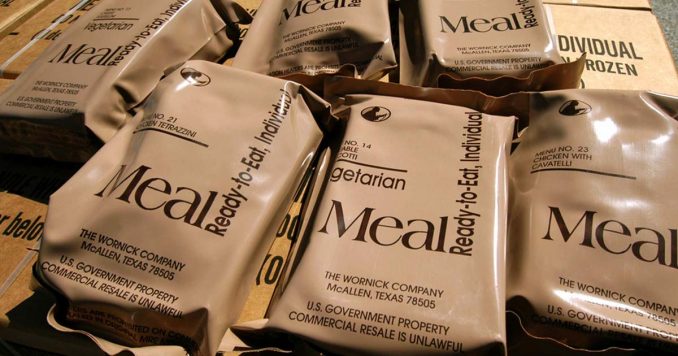
What is an MRE?
MRE stands for Meal, Ready-to-Eat. They are meant to be self-contained packages that can sustain a solider when food service facilities are not available. There are twenty-four different varieties of military MRE meals; they contain an entrée and a variety of other food items like spices, cheese spread, peanut butter, snacks, and in some cases food heaters.
Should preppers buy MRE Meals for there emergency food supplies?
Over the years, stockpiling military supplies has become a growing trend with preppers. While stocking up on MREs may seem like a quick and easy way to grow your emergency food supplies, there are a number of reasons that you may be better off buying civilian MREs instead of their U.S. military counterpart.
Why Civilian MREs are a better option:
- The commercial sale of Civilian MRE is not restricted like military MREs.
- You can buy from legitimate dealers, not eBay sellers who may be selling you old or fake MRE.
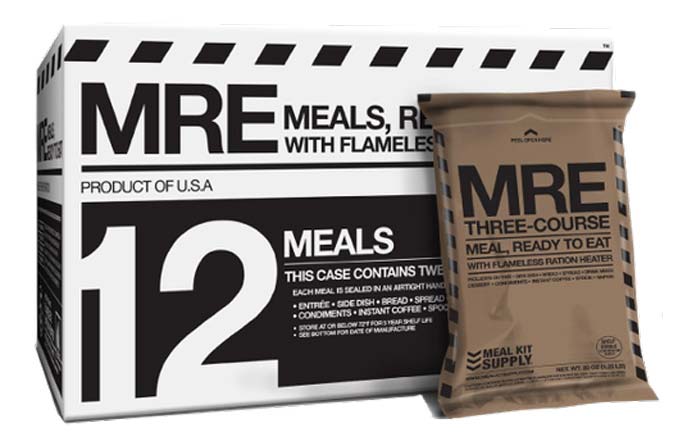
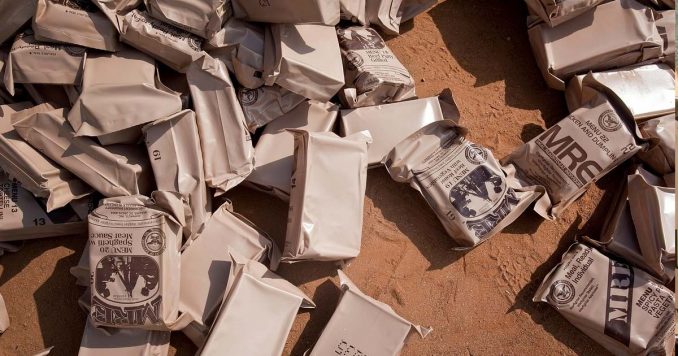
Knowing Exactly where your Ready to Eat Meals came from: We have heard of some military MRE that have sat in war zones for months or years before making their way on to eBay. Who wants to eat something that’s been lying around in the desert for the last year? Even the best MRE are going to be affected by the harsh heat of the desert.
The U.S. Army’s NATIC Research Laboratories have done numerous tests on the shelf life of MREs. They found that when exposed to heat over 100 degrees they lasted less than two years while MRE stored at around 70 degrees were good for at least 100 months.
Knowing what’s on them: A lot of crazy stuff happens in war zones, including the use of some pretty nasty chemicals that can stick to everything. I don’t know about you, but after seeing all the people come back from Iraq with mysterious illnesses during Desert Storm, I tend to think that eating something that’s been sitting over there may not be so safe.
Quality Issues: The quality of everything the military gets is usually dependent on how some special interest group who won a no-bid contract for that item. In fact, the quality of a lot of equipment and military gear has gotten so bad over the years that many service members have been forced to buy their own gear. The sad truth is the government treats the military like crap. I just don’t trust them enough to believe that the MRE are any better than the civilian version. Civilian MRE companies have to worry about lawsuits from unsafe products; the military doesn’t.
Counterfeit MRE: Much of what you find online is complete garbage, and many of the so-called military MRE that are sold online are actually bad counterfeits from China. Personally, I wouldn’t trust someone on eBay or some thrown together website with my emergency food supplies!
What’s in Military MRES?
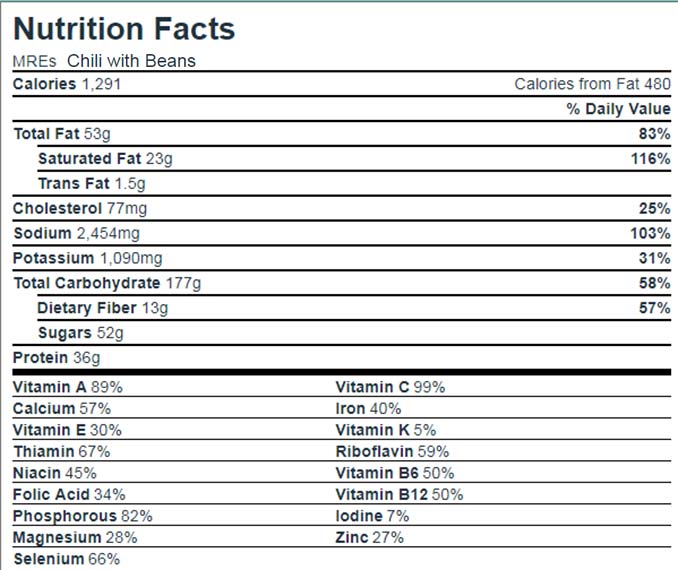
The average military MRE gives the soldier an average of 1,300 calories. For instance, a Chili with Beans MRE is about 1,291 calories (36 Grams of protein, 83 percent fat, and 177 Grams of carbohydrates) and about half of the Military Recommended Daily Allowance of vitamins and minerals.
What about real Military MREs: How long do they last?
If you’ve ever bought military MREs, you’ve probably noticed they don’t contain traditional expiration dates. This can make trying to figure out shelf life a little tricky. Most of the time you can determine the manufactured date by looking for a series of numbers on the package. The first looking at the first number represents the last number of the year it was packaged.
As long as your MRE supplies are not damaged in any way (swelling, punctured, ripped, etc…) then they should last for quite awhile.
The Army’s Natick Research Laboratories tests indicate that MRE from the early 80′s and 90′s stored below 60 degrees have a shelf life of about 130 months. The newer MRE now have a significantly shorter shelf life and will last for about 60 months at 60 degrees – this is what happens when cronyism takes the place of actually carrying about the quality of our military’s supplies. Any fluctuation in storage temperature can and will affect the shelf life of your MRE. For instance, the same MRE stored at 100 degrees has a shelf life of about 6 months.
Where to Buy the Top Civilian MRE products:
- Sure-Pak MRE’s – These are one of the Top MRE on the market and probably the closest to actual military MRE
- Mountain House #10 Can Freeze-Dried Food
- Wise Company Emergency Food Rations
- 2400 Calorie ER Bar – Emergency Food Ration (4 Pack)
- Mainstay Emergency Food Rations – Case of 10 Packs






Don’t take cross contamination so lightly.
I’m gluten intolerant. It’s an auto-immune disease. My body will attack anything with wheat, rye or barley products in it, including the lining of my gut and skin should I eat or apply them to my skin, and then I can’t absorb vitamins and minerals properly. For years I had no overt symptoms other than chronic fatigue, and seizures until last year when I developed edema, pellagra and a goiter all at the same time.
Guess what? Just about every MRE or packaged emergency food item will basically kill me – sometimes just from the labels and packaging where starch was used to size the paper. Starch, like that used on military uniforms, might be transfered from the packaging directly to the food or
to my hands and then to the food.
And NO !!!! I didn’t believe it either but the Doc has cut me off cold turkey. Can’t use any paper products because they might have been contaminated with starch at the plant. The whole idea is so wild, I was going to get a T-shirt that says: “TP is killing me!” or maybe “Guns don’t kill people. Books kill people!” but the Doc said I’d have to get my SO to wash it first.
I too am gluten sensitive. I am looking for MRE’s that are gluten sensitive for the public for emergency preparedness events, but also people who are gluten sensitive also have other food sensitiivies such as milk, soy, nuts etc. does anyone know of a company or does the Gov’t have sensitive free foods for our great warriors in the field? Alpha/Omega Storehouse. please e-mail me, as I am also getting this together for churches. We must be ready. Spiritually for the Lord and physically so that we can help others in need. God Bless, thank you for any info. Marie
Legacy makes gluten free foods
If you want gluten sensitive food for long term food storage or for hunting, camping, and hiking then look at the freeze-dried food IF YOU CAN GET IT, since some of those packets will be for gluten sensitive people. You need to ask the suppliers of these kinds of survival food storage items about which ones are for gluten sensitive people and which ones are not. God bless, Andrew
Back in the 80s I was eating
C & K rations from Vietnam. They’re still good. Sat in a warehouse for years. SO WHATS SO BAD WITH THOSE MRES ? NOT A THING.
People are spoiled nowadays. That’s what’s wrong, not the MREs.
Vietnam era MRE’s were pretty bad. I don’t blame anyone for not liking them.
The LRRPS out of the jungle at Dak To 68-69 would trade their freeze dried with us and we would trade just about anything for them because they were great. Just add water.
There were no MREs in Vietnam. We had canned rations. And they were very good food, if you did not have to live on the same ones every day.
Friend of mine was chemical enginee who was drafted and spent his time at Natik, MA, developing MRE’s. We met in grad school in 1971 after we both got out. They were not in production
Its for common man not for ny fifty ave tasters.
People are very spoiled and mothers of america run stupid liberals on this page have not used these mres in any place other than there kitchen. they also last alot longer than six months in 100+ degress, Shit afghan average temps are like 105-115.
If you’ve been to the sandbox either OIF or OIF, you know that 95% of the time you’re eating in a DEFAC (dining facility), even when you’re at a FOB (forward operating base) there’s usually hot chow. MREs are used on convoys or as a last resort. I don’t think you’ll see many MREs lying around in the desert. I’m just saying.
Your wrong. People who work on bases and not on the Real front line, as if there was one, eat in DEFACS. I am a sergeant in the infantry and I have been to iraq and afghanistan. While in afghanistan we ate almost only MRE’s for a year because we were fighting in the woods and on mountains and other remote places. This was in 2009 and 2010. So not everyone is a pogue. And no for you civilians, everyone does not fight, just the infantry and some other combat arms mos’s.
I agree with ecpaint. I think it’s a little presumptious of balbaca to assume that all of us spent our time playing spades and not fighting a war. Those who have gone in the recent years assume that war is sitting around and waiting. I was in Iraq in 05 and aside from my time in Fallujah, we weren’t even near a DFac. We ate MRE’s for 3 weeks straight then got 2 days off to shower, grab some things from the px, get laundry done, and eat real food. then it was back for 3 weeks. don’t talk about what EVERYBODY that has been to war does when you see it from behind a desk. ask a grunt next time before you make yourself look stupid again.
Many who served wanted to serve in other branches and had the absfab scores to do so. To say only you did the fighting is childish and explains why you were only a grunt. Just who do think provided all the communications, radar support, intelligence and the like? It wasn’t you.
Sergeant, i want to inform you that aviation (my branch of the army) specifically 615th CAB and 1st CAB also fight, especially when in kandahar and the infantry ore so busy dealing with indirect fire threats and front line business
So very arrogant. That is why the CAB was created, for all of those OTHER MOS’s that actually fight too. Even the band has a combat role. Maybe, Sergeant, you’ll live long enough to learn before opening your mouth.
You must of been a R.E.M.F. ?
When I was in Afghanistan in 2002 we only ate MRE’s. That was for 7 months. There were no Defacs set up, we also lived in tents. By the time we left contractors were pouring in and building barraks and defacs. In Iraq in 2003 we started with MRE’s and ended with a huge post with every modern “necessity” available.
I disagree. MRE’s civilian or military are the same, but the military package is better if but for one reason: It comes with the goddamn heater. and it’s sealed in the package so you can’t lose it. And as far as getting them second hand, I know a guy who knows a guy who get’s them from a guy in the army.
No, they actually are not the same. Military meets a standard, civilian do not and some are imported from China.
I have about 30 MRE’s that I saved up from the late 80’s & 90’s when I was in the Army. They have been stored in a cool closet around 60 degrees. Whats you opinion? Are they still good to eat?
How is the best way of getting MRE’s because i’m going for my OP-40 too become 11BANG BANG. Army in the 75th rgt, But i have a fast metabolism. So i need too get alittle bigger before i go through AIT?
There needs to be several things cleared up in this blog, number one, temp and humidity etc does factor into the shelf life of mres, number two, you DO NOT know where they come from when buying them off line, nor how they have been stored, number three, if they have been in the desert or high temps then the shelf life is reduced, there are charts on the internet to help you with this discussion, number four ive been there done that and I deal in military surplus as well as have eaten about every brand and menu out there in training and hunting purposes so use common sense, do you think food can sit in a sea container in high temps and not be affected? Ive ate older mres myself and they were still good, but ive also ate current production mres and they were spoiled and had to be thrown out, number five, as far as the chemical exposure, Im a haz mat tech and if they have been exposed to any chemical agents then you still could be exposed but its not likely because of all the handling etc, so it would be an extremely low exposure if any
robert, yes temperature does affect the life of an mre, yet for what it is worth, they theoretically never go bad, over the summer i had a chicken breast mre from 1991, it was still good, i didnt get botulism or anything like that, even tho the chicken breast is really beaks and feet lol, this was a pretty good post, yet if you do want safe military mres you should go to a military surplus store
My son was forced to eat MRE’s during basic training at Ft. Leonard Wood, MO in 1986. The MRE’s were spoiled – separated cheese in mac & cheese. He became extremely ill. The military refused to acknowledge responsibility and “retired” our 19 yr.old son. The VA docs gave him steroids to treat the symptoms of ulcerative colitis. The steroids masked over symptoms that ultimately were connected to liver cancer. He died in 1991 at age 23. This was a young man who had never been ill a day in his life before entering the US Army…. SHAME ON OUR MILITARY for feeding this kind of SLOP to our young soldiers!
i’m sorry for your loss, but if you believe that mre’s caused the death of your son you are foolish. first off any processed cheese will separate given a little bit of time. hell, natural peanut butter will separate if you let it sit in your closet a day or so. “retiring” your son was an acknowledgement though i don’t think they should have done as such. there are no cases of cancer EVER related to mre consumption. if there were they wouldn’t be issued. i understand your hurt and maybe even resentment but to blame the military and/or mre’s for your son’s liver cancer is ridiculous. you’re probably one of those mom’s that didn’t want your son yelled at in basic training too arent you?
I spent 13 months in Vietnam as a Marine and we ate c-rations some as old as 10 years. MRE’s are a gourmet’s delight compared to c-rats. I went to Vietnam weighing 160lbs and came back weighing 128lbs and never had the opportunity to call home once. You modern soldiers have it too good!!
I to ate c-rations in VietNam but some were dated in the early 1940’s so don’t believe all the crap about not being any good after so and so date.
Lucky Bastard….I would have eaten the can and all.
BT….1982
OCS…1983
JumpSchool…1983
IOBC…1983
Ranger..1984
That’s like walking into a Gold Mine.Unless you got caught, We would still be trying to find some or your DNA. We ate C-Rats that were from The Korean War and they were great.
Sua Sponte
Let’s not play the better than or I had it worse card. There was a day when man lived in caves and had to fight dinosaurs with sticks and stones.
Let’s man up and honor each other as brothers…
First of all cavemen didn’t have to fight dinosaurs for food mankind was separated by a minimum of 59 million years. I bet you used to watch the Flintstones and think it was a documentary film just like all those religious but jobs out their spouting that garbage.
MRE nutrition value goes down over time. You can still eat the food, but the vitamins, minerals etc found in fresh foods are not found in old MREs. They’re mostly gone. The same is true of canned meats and some vegetables.
I was a military food inspector for 23 yrs and had a lot of experience with C rats and MRE’s. If I had MRE’s 10 yrs old I would start to consume them and replace them with newer ones just to be one the safe side. Cooler storage temps are better for shelf life. Higher temps degrade the taste of the product inside the MRE package but they are edible but would you want to. My motto is better safe than sorry when it comes to food. You would’nt want to be out in the bush somewhere and get sick from the food.
My landlord found some mres from hurricane Katrina and I was wondering if they would be safe to eat
What happens it you leave a banana in your car for a month? It rots. But not in a jeep? Oh, Just Army jeeps.
FYI America’s Army is a game. LOL
I would watch the slander sir. As a soldier currently still serving i can attest that while all branches of military have flaws we dont tirelessly work day in day out to be i sulted my people with no knowledge of our sacrifice or by people who have an IQ lower than your shoe size. Careful words my friend maybe join the military then talk shit
C-Rat’s aren’t the same thing as mre’s. C-Rat’s are just like canned goods. They might not taste as fresh as new or they may loose some of their texture but they will last for ever if the seal is in tact.
As I was sitting in my formaldehyde filled trailer Uncle Sam provided, I was wonder the same
My question is this: how does something spoil that is dried completely then sealed?
It makes no sense to me. My grandfather grew up on canned vegetables from the garden and smoke cured meat.
No matter the food, it will not last forever – sealed or not. First of all, almost nothing is completely dried out. Second, if oxygen is present in the package, things will happen. Tasting OK or looking OK means nothing. You can seal up pancake mix in an air-tight container, open it up years later and eat an OK-tasting pancake: don’t be surprised when you are puking and have the trots within an hour. Nothing lasts forever, and there’s no reason to risk it. Also, anyone with any science training, which seems scarce in these posts, would listen to the numbers the government is posting on their own tests, and then cut them in half. They are always over-optimistic numbers based on averages and a few selective tests – frequently by the vendor/contractor rather than the military. I’ve known plenty of military folks that bought their own boots, knives, and food because of quality issues recently. My nephew was one of them, who was KIA in Afghanistan with the Airborne.
First and foremost, “meals ready to eat” are temporary sustanance food. They are handy because science and processed foods producers have not come up with thesci fi food “pill” yet( one day it might happen and a soldier or marine or civilian back packer might be able to carry a weeks,supply of “food” in an aspirin bottle). Remember eating C rats and K rats in training( USMC, ’78 to ’82); back then it was the min. To keep people in the field fed with calories to continue to move and fight, but was never a home cooked or gourmet meal! This generations MREs are actually quite good for their intended use, they last 3 to 5 yrs, taste decent( akin to frozen micro wave food), and provide calories and nutrition -for emergencies or combat they work. But again they do not replace having a home meal or mess hl food. Arguing about their pluses or minuses is a waste of time. Buy a case from a reputable dealer and use them for camping or as a emergency kit. If you are worried about your future food supply , start a back yard garden, raise chickens , and learn to smoke or can , or dry store certain items