
This is probably one of the most divisive topics that we write about, and every time we try to start a discussion about which firearms are the best it seems to generate some pretty strong feelings. So in the spirit of stirring shit up, we are going to look at what we consider to be one of the best defensive firearm options for defending your home.
If you are just starting to think about the defensive aspects of preparedness, then I advise finding a local expert that can walk you through proper firearms and self-defense tactics. The best firearm is only as good as the person wielding it, so if you don’t have experience you need to seek out someone who can help train you before stockpiling weapons that may do more harm than good.
The Home Defense Shotgun: Why a shotgun is one of the top choices for preppers
We are going to look at what we think is one of the best options for home defense, especially if you have limited experience with firearms. There are two main reasons that we recommend adding a shotgun to your defensive stockpile: Firepower and Ease of Use
Firepower
When I say firepower, I mainly mean the ability to pump an intruder with as much lead as possible, as quickly as possible. When it comes guns that can quickly fill an asshole with lead, there is no better option than a shotgun.
A 12-gauge shell loaded with 00 buckshot contains anywhere from 8 – 15 Pellets – with one good shot you are delivering the equivalent of four to five concurrent rounds of .45 ACP. Each pellet packs about the same power as a round of .380 ACP: Now are you starting to see why a shotgun ranks at the top of the list for home defense guns?
Ease of Use
My second reason for choosing a shotgun is that even a beginner has a pretty damn good chance of being effective with very little training. Unless you routinely train with a handgun, you are more likely to hit your target with a shotgun than you are with a handgun, especially during a high-stress situation like a home invasion.
When it comes to protecting your home, the good thing about a shotgun is that you don’t have to be as accurate as you do with any other type of firearm. A shotgun has a very forgiving blast pattern; chances are pretty high that you are going to hit almost anything in the general direction of where you are aiming.
A Closer Look at the “Forgiving Pattern” Claim
It’s worth being precise about this, because “shotguns spray everywhere” is one of the most overstated claims in firearms discussions, and it’s not accurate at typical home defense distances. At the ranges that actually matter inside a house — most interior hallway and room shots happen somewhere between 7 and 21 feet — a shotgun loaded with 00 buckshot patterns tight, often producing a spread of only a few inches across. The “wide spray” effect people picture from movies really only starts to show up at 15+ yards, which is well beyond the distance of nearly every home defense encounter that’s ever happened inside a house. The forgiveness of a shotgun comes less from a wide spread and more from the fact that you’re putting multiple projectiles on target with a single trigger pull, not from some magic ability to hit a target you’re not actually aiming at.
So Why is a Shotgun at the top of the list of preparedness weapons?
I’m not going to debate whether or not the sound of racking the slide of a shotgun is enough to scare off an attacker; there are a million and one different opinions on this, and there are some people who insist that the sound of racking a shotgun is enough to scare off an attacker. While racking a shotgun can be a scary sound, I sure as hell am not going to count on it to do the job. If sound was enough to scare an intruder effectively, I would keep a chainsaw in my bedroom – I don’t!
One thing I will add to the debate, something every side needs to consider is that unless you store your shotgun with a round chambered, your choices are either rack or face the intruder with an unloaded firearm.
When it comes to defending your castle, there’s simply nothing better than the accuracy and power of a shotgun. A SHOTGUN IS GOING TO END THE FIGHT!
Some things to consider when buying a Home Defense Shotgun
The first time you fire it should not be during a home invasion!
While I did say this was a great choice for people who lack firearms experience, I didn’t say it was for someone who has never fired a gun.
PLEASE, if you are buying a firearm to protect yourself and your family from criminals, you owe it to yourself and them to learn how to use it properly.
Consider buying either a Mossberg 500 or a Remington 870
If you are just getting into firearms, then chances are you don’t know what the hell to buy.
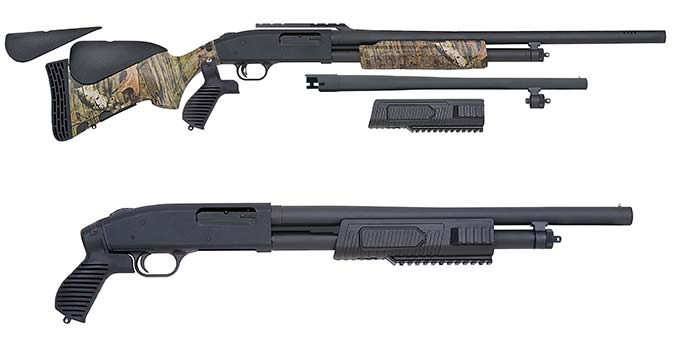
If you’re looking for a good beginner shotgun, you really can’t go wrong with either a Mossberg 500 or Remington 870. I personally like the Mossberg 500 Flex system, because it can literally be converted from a deer or bird hunter to a tactical home-defense gun in a matter of seconds. You can read more about it here.
What’s the best Shotgun load for home defense?
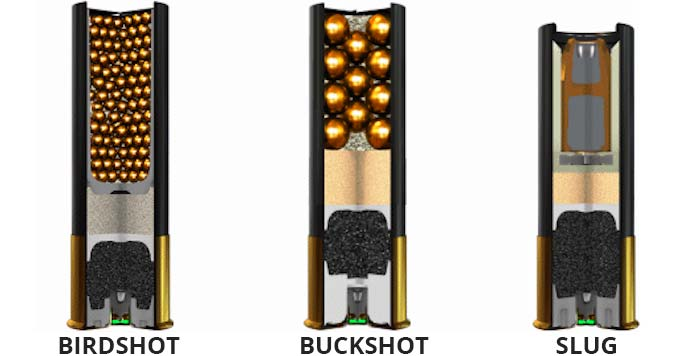
This is another one that is going to divide the hell out of people, but in my opinion there really is no wrong answer – but there are a variety of situations to think about. While some loads are going to have some positive and negatives, pretty much any shotgun shell you choose is going to stop an attacker.
Birdshot
One reason people choose birdshot is it does a lot of up-close damage without having to worry too much about penetrating household walls. That being said, if you are shooting from further out, you may want to consider 00 buckshot.
00 buckshot
When it comes to shotgun loads, defense is one of the primary uses for 00 buckshot.

00 Buck is one of the most effective choices for a home defense shotgun; in fact, it’s so useful that the military and numerous police departments throughout the country use simple 00 buckshot for their shotguns. The stopping power and penetration of 00 buck is better than any other size on the market.
A Deeper Look at Shot Sizes and Wall Penetration
Since the load debate is one of the biggest arguments in this whole topic, it’s worth actually laying out the numbers rather than just picking a side. Every shot size is a tradeoff between stopping power and overpenetration risk through interior walls — a real safety concern if anyone else is in the house, or lives on the other side of that wall.
| Load Type | Pellet Count (12ga, 2.75″) | Typical Use Case | Interior Wall Penetration Risk |
|---|---|---|---|
| Birdshot (#7.5–#8) | 350+ tiny pellets | Close-range defense, lower overpenetration risk | Low — pellets lose energy fast, often won’t punch through multiple interior walls |
| #4 Buckshot | ~27 pellets | A middle-ground compromise some trainers prefer | Moderate |
| 00 Buckshot | 8–15 pellets (.33 cal each) | The standard law enforcement/military defensive load | Higher — designed to penetrate deeply enough to stop a threat |
| Slug | 1 solid projectile | Maximum range and penetration, longer-distance defense | Highest — will go through multiple interior walls and likely exterior walls |
There’s no universally “correct” answer here, which is exactly why the original debate above is framed the way it is — your choice should depend on your home’s layout, who else lives there, and what’s on the other side of your walls. A second-story apartment with neighbors below deserves a different conversation than a stand-alone rural house with acreage around it. If you’re genuinely unsure, this is a question worth bringing to an actual qualified instructor who can look at your specific home, not just a general internet debate.
Avoid cheap blue poly tarps for primary use—they’re heavy and noisy. Just kidding — that’s a different article. But the same blunt, no-hedging principle applies here: don’t buy promotional “tactical” shells with flashy marketing copy and skip the actual pattern-testing step. Whatever load you settle on, pattern test it through your specific gun at your actual likely engagement distance before you trust your life to it. Two shotguns of the same model can pattern differently with the same ammo due to barrel and choke variance.
Look for the Tactical Version
While your hunting shotgun will do the same damage to the bad guy, a tactical shotgun is specifically made for defense and moving around in the tight quarters of a home.
The difference between a hunting shotgun and a tactical or combat shotgun really comes down to just a couple of things:
- A shorter barrel: Usually around 18 to 20 inches so it can be easily handled when used indoors.
- A good set of sights – we recommend investing in a ghost ring site; it will increase both your accuracy and target acquisition.
- Pump or Semi-Automatic Operation – When it comes to defensive shotguns there are really only two options semi-auto or pump action.
Pump vs. Semi-Auto: The Real Tradeoffs
Since the original list above raises the question without fully answering it, here’s the actual breakdown of why this matters and how to think about it.
Pump-action is mechanically simpler, cheaper, and famously reliable — there’s no gas system or recoil spring assembly to clean and maintain, and a pump shotgun will reliably cycle low-powered or mismatched shells that might cause a semi-auto to short-stroke. The tradeoff is speed: you have to manually cycle the action between every shot, and under stress, short-stroking a pump (failing to fully rack it back and forward) is one of the most common malfunctions new shooters experience.
Semi-automatic shotguns cycle automatically off recoil or gas pressure, letting you fire faster follow-up shots without manually working the action — a real advantage if a fight goes past the first shot. The tradeoffs are cost (semi-autos generally run more expensive than a comparable pump), more cleaning and maintenance requirements, and a real sensitivity to ammunition: some gas-operated semi-autos won’t reliably cycle low-recoil “reduced” defensive loads, which matters if you’ve chosen a lighter load specifically to manage recoil or overpenetration risk.
Our take, in the spirit of the original section above: for a first-time gun owner specifically prioritizing reliability and lower cost, the pump-action argument from this article’s earlier sections still holds up well. For an experienced shooter who trains regularly and wants faster follow-up capability, a quality semi-auto is a legitimate upgrade — but “legitimate upgrade” assumes you’re actually putting in the trigger time to handle the added complexity.
You Bought It — Now Train With It
Buying the right shotgun solves maybe a third of the problem. The other two-thirds is training and maintenance, and this is where most people’s home defense plan quietly falls apart.
Basic drills worth running, ideally under qualified instruction:
- Load, unload, and load again until it’s unconscious muscle memory — under stress, your fine motor skills degrade significantly, and fumbling a reload or a chamber check at 2 AM is exactly the scenario you’re trying to prepare for.
- Practice from realistic positions — most defensive shotgun training happens standing at a square range. Practice moving through doorways, around corners, and from a seated or kneeling position too, since that’s far closer to how an actual home invasion unfolds.
- Dry-fire practice (with the gun confirmed empty, multiple times, every time) on mounting the gun to your shoulder quickly and consistently — a shotgun that isn’t properly mounted will hurt you with recoil and throw your point of aim off.
- Pattern-test your actual defensive load at your actual likely engagement distance, not just at the range’s standard distance, so you know exactly what your specific gun and ammo combination does.
- Know your local laws on self-defense, use of force, and what’s considered “reasonable” in your jurisdiction — a topic entirely outside the scope of this article, but one you owe it to yourself and your family to actually research, ideally with a local attorney’s input, before you ever need it.
Maintenance: The Boring Part That Actually Matters
A home defense shotgun spends 99.9% of its life sitting in a safe, not on a range — which means the maintenance schedule looks different than a gun you shoot every weekend.
- Check it monthly, not just after you fire it. Cycle the action, confirm it functions smoothly, and visually inspect for any rust or corrosion, especially if you live somewhere humid.
- Keep it lightly oiled, not soaked. Excess oil attracts dust and grime and can actually gum up the action over time — a thin, even coat is all a defensive shotgun needs.
- Rotate your chambered round periodically if your gun sits loaded for extended periods. A shell that’s been chambered and unchambered repeatedly over months can develop a “set back” bullet or primer issue in rare cases — swap it into your range ammo rotation every few months rather than letting the same shell sit indefinitely.
- Know exactly where it is and how it’s stored, balancing accessibility against safe storage if you have kids or anyone else in the home who shouldn’t have unsupervised access.
The Top 5 Tactical Home Defense Shotguns
Mossberg 500 Tactical
For the price, this is probably one of the best choices on the market. It’s simple, but effective and a great option for those who are looking for their first shotgun.
- Price: $399
- Action: Pump-action
- Gauge: 12
- Barrel: 20″
- Capacity: 8
- Chamber: 3″
- Sight: Ghost Ring
- Weight: 7 lbs
Mossberg 590 Tactical
If you want to take it a step up from the 500, the 590 has been used for decades by both military and law enforcement and has a long history of reliability in combat situations. Additional features on the 590 include tri-railed forends for accessory lights and lasers, an adjustable stock for rapid adjustment of length of pull.
- Price: $559
- Action: Pump-action
- Gauge: 12
- Barrel: 20″
- Capacity: 9
- Chamber: 3″
- Sight: Ghost Ring
- Weight: 7 lbs
Remington 870 DM
Remington 870s are known to be damn fine weapons, and the 870DM takes that reliability and combines it with tactical features that make it one of the top shotguns on the market. What sets this apart is it features a detachable 6-round box magazine for quick and easy ammo loads.
- Price: $599
- Action: Pump-action
- Gauge: 12
- Barrel: 18.5″
- Capacity: 7
- Chamber: 3″
- Sight: Single Bead
- Weight: 7.5 lbs
Benelli M4 Tactical
Worth including here because it’s become a genuine benchmark in the semi-auto defensive shotgun world — it’s the platform the U.S. Military adopted for its own combat shotgun program, which says something about its reliability under real-world conditions. The tradeoff is price: this gun runs significantly more than the pump-actions above, and it’s a clear example of the pump-vs-semi-auto cost gap discussed earlier in this article.
- Price: ~$2,000+
- Action: Semi-automatic (gas/inertia hybrid)
- Gauge: 12
- Barrel: 18.5″
- Capacity: 5–7 (model dependent)
- Chamber: 3″
- Sight: Ghost Ring
- Weight: ~7.8 lbs
Mossberg Maverick 88
The budget option worth knowing about, and one several readers of this site have specifically mentioned starting with before working their way up to a 500 or Flex system. It’s made by Mossberg but sold under a separate brand at a lower price point, with fewer refinements but the same core reliability the 500 series is known for — a legitimate entry point if cost is the main barrier to getting a defensive shotgun in the house at all.
- Price: ~$200–$260
- Action: Pump-action
- Gauge: 12
- Barrel: 18.5″–20″
- Capacity: 5–6
- Chamber: 3″
- Sight: Bead or Ghost Ring (model dependent)
- Weight: ~7 lbs
Shotguns: The Ultimate Home Defense weapon for Preppers
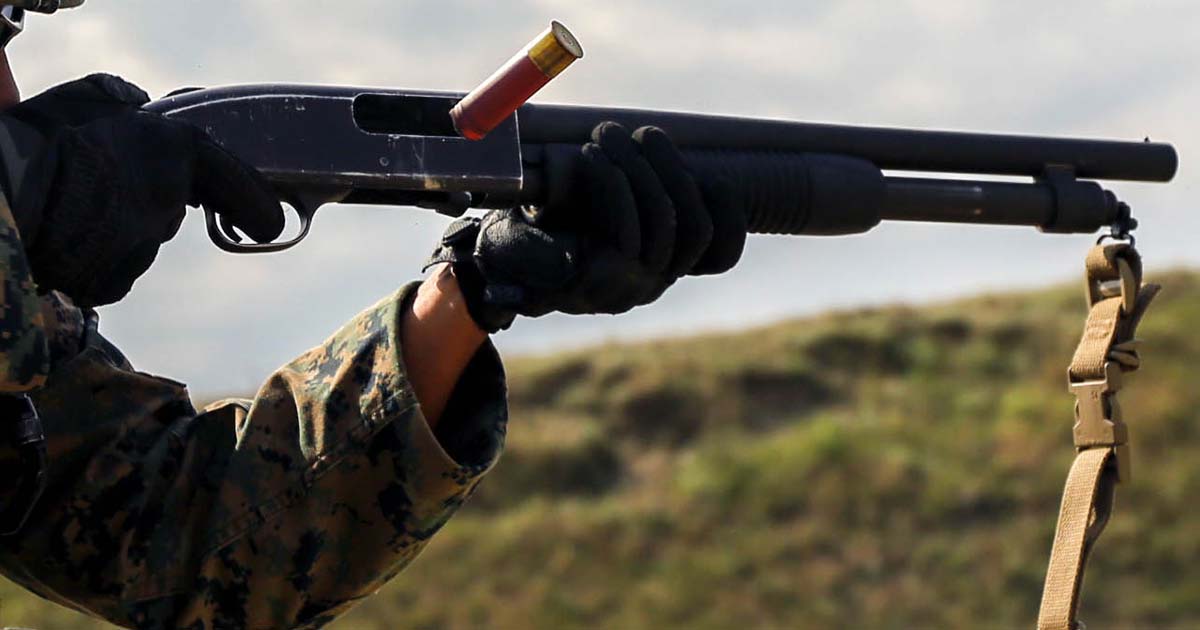
Remember, it’s all about firepower, accuracy, and ease of use.
The number one thing that swayed our thinking was a statistic on how many shots hit their mark during real-life gunfights where police fire a shot at a suspect.
Up to 75% of all handgun rounds fired by trained police officers miss their mark.
These are shots taken with a handgun by people who in all likelihood have more training, more range time, and more experience dealing with high-stress situations than the average Joe. Now take that average Joe and throw him into a home invasion situation and what do you think is going to happen? Do you think the hit rate is going to go up or down?
This one thing is the primary reason we think the shotgun as the ultimate home defense weapon.
In a home defense situation, nothing beats a good shotgun and training.
Selecting a home-defense firearm is not something that should be taken lightly, make sure you do the proper research. Do your homework. Go to your local gun shop or range and try out as many different firearms as you can before you buy.
Want to go deeper on the broader self-defense picture? Check out our breakdown of defending yourself from an attacker, and make sure your home isn’t accidentally signaling vulnerability with our piece on the warning signs that invite a home invasion in the first place — the best fight is the one that never starts.






I have a Mossberg 500, and I think it is an amazing firearm. I would have no problem using it for home defense… if it was all that was available.
I recently built an AR pistol in 300aac with a 7.5″ barrel, and I must say, that is my preferred home defense firearm now. It shorter length gives me far more maneuverability in close quarters than the Mossberg 500, and the 300aac round gives me more punch without the over-penetration that 5.56 has. In addition, the AR pistol in 300aac has far less recoil then my 12 gauge Mossberg making followup shots far easier, and with a 30 round magazine I can get a lot more follow up shots.
I will never give up my Mossberg 500 12 gauge, but if I hear a window break in the middle of the night, I will be grabbing my AR pistol in 300 aac
Shotguns are fine weapons… Training is essential. You soon learn that keeping them topped up with ammo is critical to win the fight !
The outdoor channel series “Gun Stories” has an excellent show on the “Combat Shotgun. It shows you the history and evolution of the shotgun.