
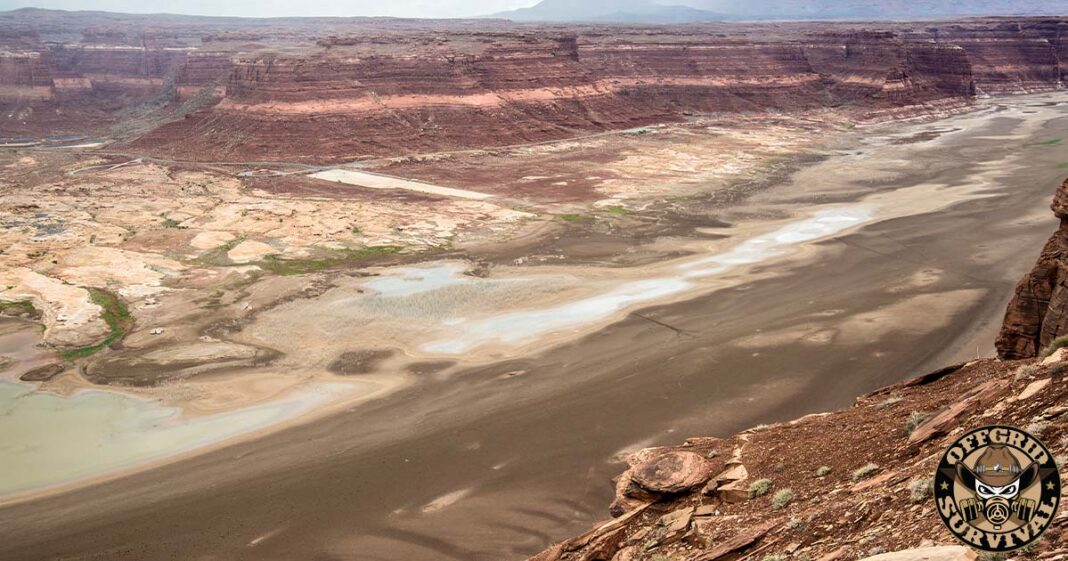
The Washington Post ran a story this morning about a desert town that came within weeks of dry taps, with a warning that others are lined up behind it. The town is Kearny, Arizona. Two thousand people in Pinal County, about an hour and a half southeast of Phoenix, built in the 1950s to house the crews working the Ray Mine.
I want to spend some time on it because of one detail that most of the coverage treats as background: the Gila River was running the whole time. Water in the channel, water in the wells, and the town legally could not touch any of it. Mayor Curtis Stacy said as much back in April, that come Day Zero the river would probably be flowing close to bank to bank while Kearny had nothing.
If you read the first piece in this series, you already know the Colorado is governed by a hundred-year-old allocation that promised more water than the river carries. The Gila is a Colorado tributary, and it’s running on the same kind of arrangement, just older and smaller and therefore capable of breaking on a timeline you can actually watch. Kearny is what the failure looks like when it finishes.
How a town of 2,000 ends up with 77 acre-feet
Kearny takes all of its municipal water from the Gila, which runs down out of the New Mexico mountains and pools behind Coolidge Dam in San Carlos Lake. Two things went wrong this year and they compounded.
The snow didn’t come. Snowpack in the Gila basin peaked around 25 percent of normal, and USDA maps had parts of the contributing high country between zero and 10 percent of average snow water. San Carlos Lake is built to hold up to 900,000 acre-feet. This spring it was holding about 19,700, call it two percent of capacity. By June the Arizona Game and Fish surveys were reporting the lake’s fish population essentially wiped out, oxygen having collapsed along with the water level. The San Carlos Apache told a federal court back in 2003 that pulling the reservoir below 75,000 acre-feet would do exactly that. Nobody stopped it.
The second thing is Globe Equity No. 59, a decree entered by a federal district court in 1935 that quantifies every water right on the Gila from above Virden, New Mexico all the way down to the Salt. It runs on prior appropriation, which is the rule across most of the West: whoever put the water to use first is the last one cut when there isn’t enough. Kearny was incorporated in the 1950s on a river where the senior claims date to the 1800s, which puts it close to the back of the line, and the line is what decides everything once the water goes short.
So the commissioner did the math and Kearny’s allotment for 2026 came out at 77 acre-feet against a normal year of roughly 600. An 85 percent cut. The town’s average annual use is about 280 acre-feet, so the arithmetic there isn’t complicated, and Stacy laid it out for residents in an April 8 letter that said the town would run out on or about July 15 and that when it did there would be no water available for any purpose until the Gila River Water Commissioner issued a new allotment. Not reduced pressure or odd-even days. Nothing, until a court-appointed official signed off on more.
What they did
The council passed the hardest restrictions it had authority to pass. No washing vehicles or sidewalks, no landscape irrigation, no filling pools, and a catch-all prohibiting any use of water not tied to sanitation or supporting life. Stacy then went past what an ordinance can cover and started asking residents directly, in writing, to wear clothes two or three times before washing them, to shower at work if they had the option, and, in the line that got him picked up nationally, to consider that there had never been a better time to shower with a spouse.
People actually did it, which surprised me a little. Municipal consumption came down roughly 30 percent inside of a few weeks. Households cut to flushing once or twice a day. A couple named Bill and Becky Dunn started hauling water in from their place in Kelvin in barrels to keep the trees alive along the commercial district, and the town put it in a newsletter as an example. Day Zero slid from July 15 to August 1, then out toward September.
Underneath the conservation the staff was working two other tracks. They’ve been bringing backup wells back into service, and since last August they’ve been negotiating with the other users on the river for water Kearny could legally take. That group includes the Gila River Indian Community, the San Carlos Irrigation Project, and two mining companies, ASARCO and Resolution Copper. Stacy has said the willingness seems to be there but that any permanent arrangement needs cooperation, money, and a judge’s approval. There was also a chance the 77 acre-foot figure would get revised upward in July, and there was the monsoon.
Between the conservation, the wells, the neighbors and the rain, we’re reading a story about a town that almost ran out instead of one about a town that did. The people there earned that. But I’d point out that not one item on that list is a plan. That’s four months of improvisation by a small staff working the phones, and it worked, and if any two of the four had gone differently it wouldn’t have.
The thing I keep coming back to is that Kearny did everything you’d want a town to do. Emergency declared in January, restrictions in April, consumption down a third, wells rehabbed, lawyers engaged, national press on their side, the mayor checking reservoir gauges every morning before coffee. And the town still ended up leaning on monsoon rain and the goodwill of senior rights holders, because there is no quantity of shorter showers that beats a priority date. That’s not a knock on Stacy, who by every account has been about as good as a small-town mayor gets in a bad situation. It’s the point. Local competence has a ceiling, and the ceiling is written into a 1935 court document nobody in Kearny had any part in.
Why this matters to the other 40 million of us in the Southwest
The Colorado mainstem runs on the same seniority principle as the Gila. Seven states, thirty tribal nations, Mexico, forty million people, all of it sorted by who got there first.
Arizona sits junior in the Lower Basin. The Central Arizona Project, the 336-mile canal that lifts river water uphill to Phoenix and Tucson, holds some of the most junior rights on the entire system, which means Arizona takes the first cut and the deepest one, the same way Kearny did on the Gila. Federal proposals have floated Lower Basin reductions of up to 3 million acre-feet a year, and the harshest scenarios that have shown up in the reporting put Arizona’s exposure as high as 77 percent of its share.
The reservoirs are in no shape to absorb an argument. As of mid-July, Powell was around 3,524 feet and roughly 23.5 percent full, its lowest summer elevation on record and about 34 feet above the point where Glen Canyon’s turbines have to shut down. Mead was near 1,040 feet, about a third full, scraping its all-time low. I went through what happens to the plumbing below those marks in the Glen Canyon piece, and the short version is that the bypass system Reclamation would have to run showed wear the one time it got used hard.
And the rulebook expires in five months. The 2007 Interim Guidelines and the 2019 drought contingency plans that govern how Powell and Mead get operated run out at the end of December. Interior wants post-2026 rules locked by October 1. Last week Secretary Burgum pulled the seven basin-state governors into a room and they came out without an agreement, which is now the third time, after the November 2025 and February 2026 deadlines both came and went. Arizona, California and Nevada gave up on the seven-state process back in May and filed their own Lower Basin proposal with the detailed numbers due in August. Meanwhile Arizona’s water bank just approved a policy to make cities whole during Colorado River cutbacks, and that policy runs for one year, which tells you how far ahead anybody actually feels able to commit.
Put it together and you have a legal framework older than most of the towns it governs, a river that physically delivers around 12 million acre-feet against 16 to 18 promised on paper, two reservoirs at or near record lows, and no successor agreement with the deadline inside of six months. That is Kearny’s situation with more zeros on it. Kearny got there first because a town with one source, one decree and no political weight fails fast, and Phoenix fails slow, but the mechanism doesn’t change on the way up.
Stacy put it better than I’m going to. Just because we’re the first don’t mean we’ll be the last.
The questions worth answering about your own water…
Most people can’t say where the water they drank this morning came from, how far it traveled, or who gets cut ahead of them when it goes short. That’s the actual exposure, more than any reservoir elevation. If your system has one source and a junior claim, you’re Kearny with better luck so far, and it’s worth knowing that now rather than in April of some year when the snow doesn’t show up.
The practical side hasn’t changed from what I’ve written before. Store water, and store more of it than FEMA’s one gallon per person per day, which does not survive contact with a 115-degree Arizona August. A gallon and a half per person per day is a better floor, two weeks minimum, a month if you’ve got the space, food-grade containers, rotated every six to twelve months. Your water heater is another 40 or 50 gallons sitting there if you know how to drain it. There’s a full walkthrough in Long-Term Water Storage.
Own filtration, because rationing tends to show up alongside pressure drops, boil notices, and utilities pulling from sources they’d normally leave alone. Gravity filter at the house, portable one in the bag.
Figure out how you’d haul and hold non-potable water, because that’s what actually kept things alive in Kearny. Barrels, a transfer pump, somewhere to put it.

And don’t skip the power side of this. On the Colorado, hydropower goes before the drinking water does, and losing Glen Canyon or Hoover generation in the middle of a Southwest summer means a strained grid stacked on top of a strained water system. Cheap Off-Grid Power: Real Solar Setups Under $1,000 is a reasonable place to start.