
Emergency water storage is a topic most survivalists think they’ve got covered. Ask around, though, and you’ll find the same thing every time: a case or two of bottled water in the garage, maybe a filter in a bug out bag, and no actual plan. Considering that you’re dead in about three days without water, it always surprises me how many otherwise serious preppers treat this like an afterthought.
Food storage gets all the attention. Water is what actually kills people.
Anyone prepping for a long-term survival situation needs a real emergency water storage solution — one that lets you store serious amounts of water AND capture and filter water from multiple sources once your stored supply runs dry. Because it will run dry. Every stored supply does. The question is what you do on that day.
We Watch This Happen. Over and Over and Over.
If you think a modern American city can’t lose its water, you haven’t been paying attention.
February 2021, Winter Storm Uri. The Texas grid failed, and when the power went, the water went with it. Treatment plants couldn’t run. Pipes froze and burst by the thousands — Fort Worth alone logged over 500 confirmed water main breaks, Dallas nearly 800. At the peak, roughly 14.9 million Texans — about half the state — had disrupted water service. More than 1,100 boil water notices. People were melting snow on their stoves just to flush their toilets. A single distribution site in Fort Worth burned through nearly 50,000 water bottles in one day, and cars were lining up five hours before the trucks even arrived. Ten days after the storm hit, over 200,000 Texans still had nothing coming out of the tap.
That was a cold snap. It lasted about a week.
September 2024, Hurricane Helene. Asheville, North Carolina took it worse. Flooding annihilated the transmission lines coming out of the North Fork Reservoir — the source of 80% of the city’s water — and filled the reservoir itself with so much sediment the treatment plant couldn’t process it. Somewhere around 110,000 customers had no water at all in the early days. Not dirty water. No water. Non-potable water came back to most of the system by mid-October. Safe drinking water took 53 days. Almost two months of hauling, boiling, and standing in line, in an American city, in 2024.
Here’s the number that should stick with you: FEMA and the Red Cross recommend a three-day water supply. Asheville needed fifty-three. The people who did fine were the ones who had storage measured in weeks and a way to treat creek water when that ran out. Everyone else spent their autumn in a bottled water line.
Your three cases of Costco water are not a plan. They’re a head start of about two days.
How Much Water Should You Store?
Even in the aftermath of a short-term disaster, finding clean, drinkable water can become very difficult. Hurricanes, flooding, and earthquakes can cut off or contaminate your local water supply — and as Texas proved, so can a stretch of cold weather hitting a grid that wasn’t built for it.
The baseline: one gallon per person, per day
At minimum, store one gallon of water per person per day, covering both drinking and sanitation. For a short-term disaster that means at least seven days’ worth — so a family of four is looking at 28 gallons just to clear the one-week mark.
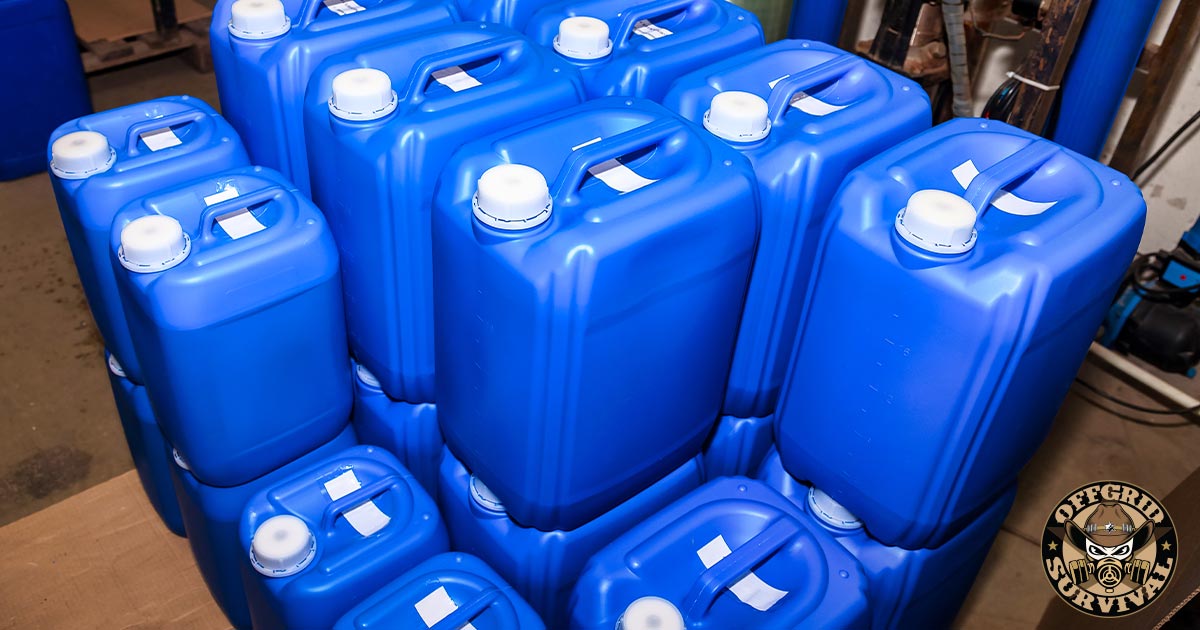
Do the math on that for a second. 28 gallons is more than five of those big blue office water cooler jugs. It’s over 200 standard 16.9 oz bottles. Most households don’t have a tenth of it.
And frankly, after watching the last few years, I think seven days is the floor, not the target. Two weeks per person is where I’d tell anyone to start, and if you’d been sitting in Asheville with two weeks of water, you still would’ve been scrambling for the other five and a half.
Things that push your number higher:
- Hot, dry climates. If you live in the desert southwest, multiply everything by at least 1.5 — and understand that a gallon a day in Phoenix in July is a survival ration, not comfort. You can sweat out a gallon before lunch.
- Medical conditions in the household. Anyone on medications that require water, anyone managing kidney issues, diabetes, anything of that nature — store extra, well above the recommended requirements.
- Children, nursing mothers, and the chronically ill all need more than the baseline. A nursing mother can need close to a gallon a day for drinking alone.
- Pets and livestock. A big dog drinks close to a gallon a day in hot weather. Nobody counts the dog. Count the dog.
The gallon-a-day figure also assumes you’re mostly drinking it. It does not account for cooking rice and beans (which soak up a shocking amount of water), washing wounds, cleaning dishes, or basic hygiene — and hygiene is exactly what keeps people from getting sick when the sewers and hospitals are struggling too. During Uri, hospitals in Texas were hauling water in buckets to flush toilets. Sanitation fails fast, and when it fails, disease follows.
If you’re planning for a long-term disaster — anything past 14 days — you’re going to have to develop a plan that goes far beyond stocking up on ordinary bottled water. Bottled water is a bridge. It was never meant to be the destination.
How long can you store water?
Theoretically, water doesn’t have an expiration date. It’s not milk. Properly stored water will not spoil and can be safely consumed at any point in the future — the “best by” dates on bottled water exist because of container regulations and taste, not safety.
That said, improperly stored water absolutely can become biologically or chemically contaminated, which is why your containers and storage conditions matter more than almost anything else in this article. Water doesn’t go bad. Storage goes bad.
A few realities on that front:
Stored water often tastes flat after months in a container. That’s just lost oxygen, not contamination. Pour it back and forth between two clean containers a few times and it tastes normal again. Don’t dump good water because it tastes stale.
Light is your enemy. Sunlight hitting a translucent container will grow algae eventually, even in treated water. Cool and dark, always.
And the bleach question, since it comes up every single time: some so-called experts will tell you all stored water must be treated with bleach first. If you’re filling containers with municipal tap water, it’s already treated with chlorine — adding more bleach is unnecessary. Fill clean containers from the tap, seal them, store them dark and cool, done. Where treatment matters is water from a well, rain catchment, or any untreated source, or water you’re pulling BACK OUT of long-term storage and aren’t sure about. For that, the standard guidance is plain unscented household bleach — regular sodium hypochlorite, no splashless, no scents, no additives — at roughly 8 drops per gallon, let it sit 30 minutes, and you should catch a faint chlorine smell. If you don’t, repeat once. Also worth knowing: liquid bleach itself degrades on the shelf. After a year or so it starts losing strength, so rotate your bleach like you rotate everything else, or keep calcium hypochlorite (pool shock, the plain 68-73% kind with no algaecides) on hand — it stores for years and a one-pound bag can disinfect thousands of gallons. Handle it carefully and store it away from anything it can react with, because it’s not a gentle chemical.

I rotate my stored tap water about once a year. Not because it’s unsafe at 13 months — because rotation forces me to inspect every container, and containers fail quietly. A slow leak in a 55-gallon barrel in your basement is a problem you want to find on your schedule, not the disaster’s.
How to Store Emergency Water
The type of storage container you choose is really up to you, and honestly it’ll mostly be decided by how much room you can dedicate to water. Water is brutal on space and weight — it’s 8.3 pounds per gallon and it doesn’t compress. A filled 55-gallon barrel weighs over 450 pounds. You’re not moving it. Plan accordingly.
The universal rules, whatever containers you land on:
- Pick cool, dark storage areas out of direct sunlight. UV degrades plastic and feeds algae.
- Never store water containers directly on concrete for years on end — chemicals can leach through plastic over long periods, and concrete holds temperature swings. A couple of 2x4s or a pallet underneath solves it.
- Keep water away from gasoline, pesticides, solvents — anything with strong vapors. Plastic breathes more than you’d think, and water stored next to a gas can will eventually taste like the gas can.
- Stock multiple ways to filter and purify, because storage without treatment capability is half a plan.
- Check your containers and supplies periodically for degradation, leaks, cloudiness, or anything growing where it shouldn’t be.
Reusing Commercial Water Bottles
One of the cheapest and easiest ways to start is store-bought bottled water. Nothing wrong with it. It’s sealed, it’s portable, it’s already packaged in serving sizes, and cases stack neatly. If you’re really looking to save money, wash and refill your old plastic bottles when you’ve finished with them — they were designed to hold water, so they can reliably kick off a preparedness stockpile.
Some hard-won specifics on the bottle route:
- Most commercial water bottles can be reused at least once; beyond that you start worrying about leaching from the thin plastic, and the bottles themselves get flimsy. These are single-use containers being asked to do a second tour. Don’t ask for a fifth.
- I advise against ordinary milk jugs, full stop. The plastic is designed to biodegrade, they’ll start weeping and splitting within months, and you cannot fully clean milk residue out of them no matter how hard you try. Milk proteins hide in the seams and feed bacteria. A milk jug of “clean” water sitting in a warm garage is a bacteria farm with a handle on it.
- 2-liter soda bottles, on the other hand, are genuinely good. PET plastic, built to hold pressurized liquid for months, easy to clean, easy to tuck away, and light enough to throw in a backpack when staying put isn’t an option. Wash them thoroughly with hot soapy water, rinse, then sanitize with a splash of bleach solution swished around inside, rinse again, fill, cap tight. Sugar residue is what you’re killing — get it all.
- Fill any empty space in your freezer with spare water bottles (leave a couple inches of headspace so they don’t split when they freeze). You get extra water, your freezer runs more efficiently when full, and if the power dies, that ice buys your frozen food an extra day or two before it thaws. One prep, three payoffs.
Bottles are a starting point. If your entire water plan fits in a kitchen cabinet, you don’t have a water plan yet — you have a rough weekend covered.
Water Barrels
55-gallon water barrels are the workhorse of survival water storage, and they should be easy to find at almost any outdoor sporting goods store or farm supply. They’re usually blue — that’s a deliberate safety convention marking food-safe drinking water, not decoration — and made from heavy-duty, food-grade HDPE plastic that’ll outlast most of the other gear in your garage.
One barrel = 55 days of water for one person at the baseline ration, or about two weeks for a family of four. Two barrels in a garage corner takes up roughly the footprint of a washing machine and puts a month of family water in the bank. For the money, nothing else touches that ratio.
A few things nobody tells you before your first barrel:
- Buy the accessories WITH the barrel. You need a bung wrench to open it and a hand pump or siphon to get water out, because you are not tipping 450 pounds to pour. Barrels get sold every day to people who realize six months later they own a sealed monolith they can’t open.
- Buy new, food-grade only, or used barrels ONLY if you know exactly what was in them. Food-grade barrels that previously held soda syrup or juice concentrate can be cleaned and are cheap. A barrel that held industrial chemicals is never a water barrel again, no matter how many times you rinse it. If the seller can’t tell you what was in it, walk.
- Fill it where it’s going to live. Refer back to the 450 pounds.
- Pretreat any untreated water going in. City tap water is fine as-is since it’s already chlorinated — top it off, seal it, mark the date on the barrel with a paint pen, and rotate annually.
They’re a great option if you have room in a garage or basement. If you have the space and you’re serious about this, barrels are where your drinking water reserve should live.
Tanks, Cisterns & Rain Catchment Systems
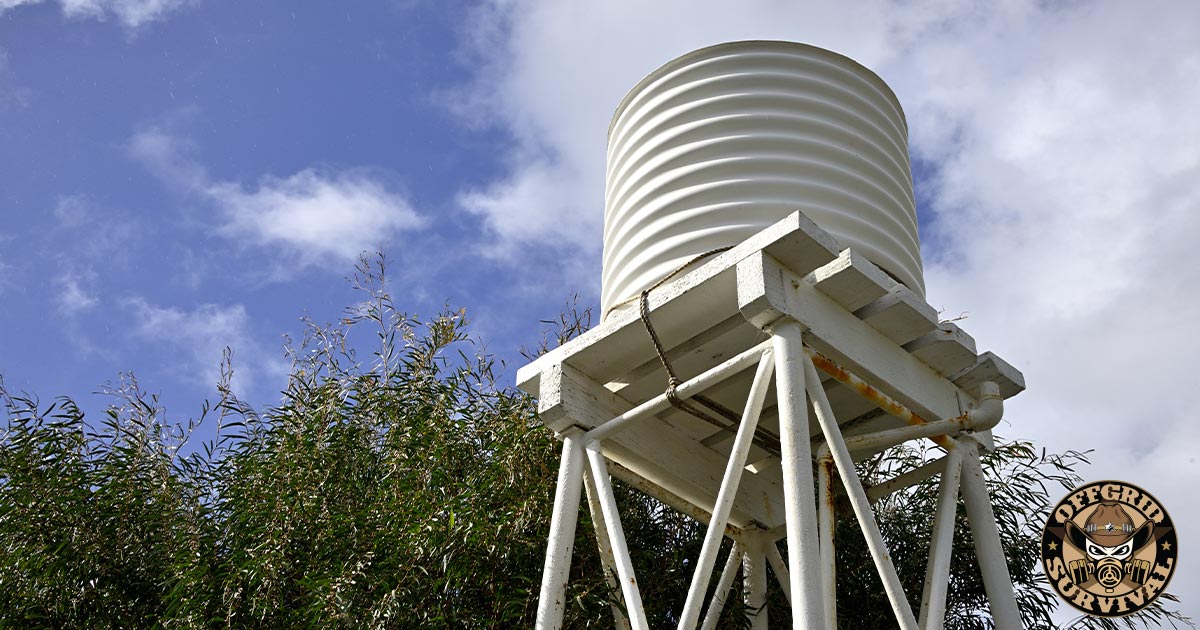
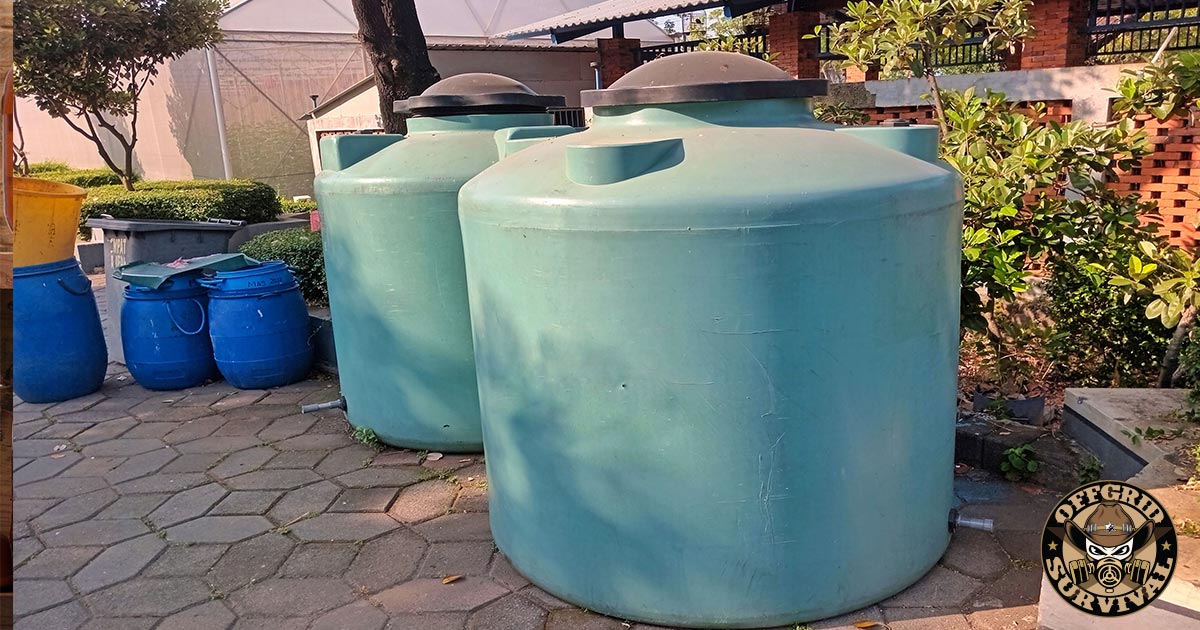
The next step up is a freestanding tank or cistern — anywhere from a few hundred gallons to several thousand. These are standard equipment in rural parts of the country without public water utilities, but they can be used pretty much anywhere rainwater runoff can be collected.
And rainwater collection is the part that changes the whole equation. Every storage method above this point is a countdown clock: you have X gallons, and every day subtracts from X. Hook a tank to your rooftop gutter system and you have a supply that refills itself. The math is better than most people expect — one inch of rain on a 1,000 square foot roof yields around 600 gallons. Even a modest climate refills a serious tank a few storms at a time.
They’re too big and too expensive for some situations, no argument. But if you can afford to install a roof catchment system, this is an excellent option for long-term survival retreats and rural homes, and it can go a long way toward solving your water problem more or less permanently.
If you go this route:
- Put a first-flush diverter on the system. The first water off your roof after a dry spell carries the bird droppings, dust, and pollen — the diverter dumps that first bit so it never enters your tank. Cheap component, huge difference in water quality.
- Screen every opening. Mosquitoes will find a way into an unscreened tank inside a week, and then you’ve got a larvae nursery instead of a reservoir.
- Treat all rain catchment as non-potable until it’s been filtered or boiled. Rainwater is fairly clean falling out of the sky; your roof is not clean. Asphalt shingles shed grit and compounds, and everything a bird has ever done up there washes down with the rain.
- Check your local regulations. Most states are fine with residential rain harvesting and some actively encourage it, but a handful still have restrictions on the books. Know before you build.
One more thing Asheville taught everybody: even non-potable stored water is enormously valuable. Flushing toilets, washing, cleaning — a big tank of “don’t drink this” water frees up every drop of your clean supply for drinking. The city got non-potable water flowing weeks before the drinkable stuff came back, and it mattered.
Emergency Water Storage for Apartment Preppers
Having a large water supply is genuinely difficult in an apartment, and I’m not going to pretend a 55-gallon barrel is happening in a third-floor walkup — even if it fit, a landlord seeing 450 pounds parked on a joist has a point. But apartment dwellers were hit as hard as anyone in Texas and North Carolina, and there’s real capacity hiding in a small space if you go looking for it.
2-liter bottles: The apartment prepper’s best friend. Easy to tuck away where larger storage isn’t possible — and there’s more room than you think. Fill as many as you can and slide them into closets, under beds, behind books on the bottom shelf, in the dead space under the bathroom sink, in the back of the coat closet floor. Twenty bottles scattered around a one-bedroom apartment is ten gallons nobody can see, in containers light enough to grab and go.
Your water heater: Already sitting in your unit holding 30-50 gallons of clean water, and most renters never think about it. Learn where the drain valve is at the bottom NOW, and keep a short garden hose that fits it. In an emergency, shut off the power or gas to the unit, close the cold water inlet, open a hot tap somewhere to break the vacuum, and drain from the bottom valve. First water out may carry sediment — let it run a moment. That tank is a free 40-gallon reserve you already paid for.
Knowing where to find water during an emergency: Make sure you check out our article on urban water sources. In a dense city, knowing where water is beats any amount you can physically store in 700 square feet. It’s always a good idea to know exactly where you can obtain water before you’re competing with everyone else in the building for it.
Storing water in your bathtub: This is the apartment ace in the hole. There are two things worth knowing here. First, the old-school move — plug the tub and fill it when trouble’s coming — works but has real problems: tub drains seep, the water sits open collecting dust and soap residue, and you can’t drink it without treating it. Second, somebody solved all of that:
- The WaterBOB – We came across the WaterBOB years ago and it remains one of the best pieces of emergency water gear per dollar that exists. It’s a heavy-duty, food-grade plastic bladder that lays in your bathtub; you fill it from the faucet in about 20 minutes and it holds up to 100 gallons, sealed, clean, and drinkable, with a little siphon pump to dispense. The WaterBOB turns any bathtub into a 100-gallon sealed tank for about the price of a pizza. It’s a last-minute item — the catch is you need warning and working taps to fill it, which makes it perfect for hurricanes and named storms and useless for the earthquake nobody saw coming. Buy it now, store it flat in a closet, and fill it the moment things look ugly. The people who owned one before Helene made landfall started that 53-day outage with 100 gallons in the bank. The ones who ordered one during the outage got a delivery estimate.
Long Term Emergency Water – Adding Filtration Is the Key!
Storing water is great, but here’s the truth every stored supply eventually forces on you: it ends. Fifty gallons, five hundred, doesn’t matter — a long enough disaster outlasts any tank. When that day comes you need a way to find water and a way to make it safe, and the finding part starts now, while the internet works and the roads are open.
Finding local water sources before you need them:
- Map every water source you can find before a disaster hits. Jump on Google Earth and mark every pond, creek, lake, and reservoir within walking distance of your home, then within driving distance. Print the map. Your phone’s battery is not part of a survival plan.
- Then actually go look at them. That blue shape on the satellite view might be a seasonal pond that’s a mud flat in August, or fenced, or a golf course pond — and golf course ponds catch every chemical they pour on those greens, so cross those off entirely. Ten minutes of ground truth per source, done on a Saturday, is intel you cannot buy later.
- Have a way to transport water home. Water is 8.3 pounds a gallon, and a five-gallon container coming back from a pond a mile away weighs over 40 pounds. Buy a couple of dedicated water containers now, and if that walk is in your plan, a cheap garden cart or even a kid’s wagon stops being a joke real fast.
- Knowing where these natural sources are will be your lifeline if things go really bad. Don’t neglect this part of the plan. It costs nothing and it’s the part most people skip.
Water Storage Treatment: How to Filter Your Survival Water Supply
A good water filter is one of the most important pieces of gear you can own. Without water you’re pretty much screwed, and without a filter, every pond on that map you just made is a gamble with pathogens that will put you on the floor — and dehydration-by-diarrhea in a disaster, when the hospitals are dark, kills people. It’s one of the biggest killers in every major disaster zone on earth, and there’s nothing about an American zip code that makes you exempt.
There are plenty of quality filters on the market. Two are worth considering first, and they solve different problems:
Berkey Water Filter – The Berkey Water Purification System is the standard in the survivalist community for home-base filtration, and it earned that. It’s a gravity-fed stainless steel unit that sits on your counter — no power, no pressure, no moving parts. Pour dirty water in the top, clean water comes out the bottom. It removes viruses, pathogenic bacteria, cysts, and even filters out chemicals, and a pair of the black filter elements is rated for thousands of gallons before replacement. During a long outage, this is the machine that turns your rain barrel and your pond runs into drinking water for the whole household, day after day, with zero fuel cost.
Hiking Filters – For the portable side, the best I’ve found is the Katadyn Pocket Water Microfilter. It’s one of the more expensive hiking filters on the market, and I’d buy it again tomorrow. Swiss-made, mostly metal where the competition is plastic, backed by a 20-year warranty, and rated to handle over 13,000 gallons — that’s not a typo, most competing filters tap out somewhere around 1,000 — while stripping out all microorganisms larger than 0.2 microns. That’s your bacteria and your protozoa, including Giardia and Cryptosporidium, the two that most commonly ruin lives out of North American surface water. Its small size makes it a natural fit for any bug out bag or survival kit, and unlike the cheap squeeze filters, it won’t die quietly from one hard freeze in your trunk. Buy once, cry once.
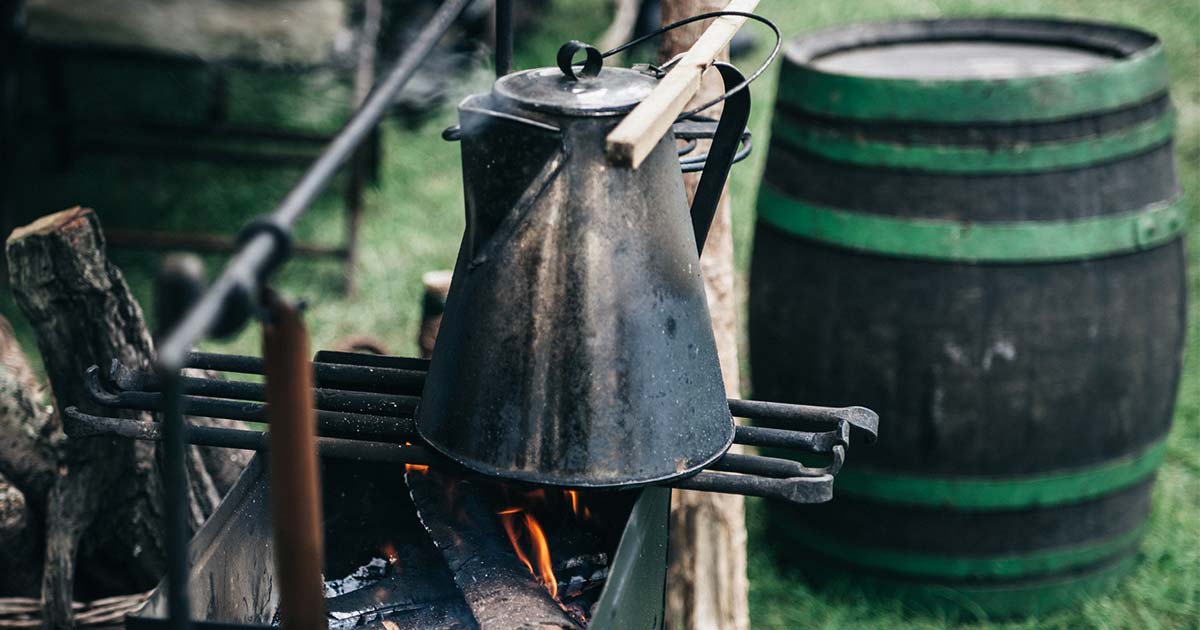
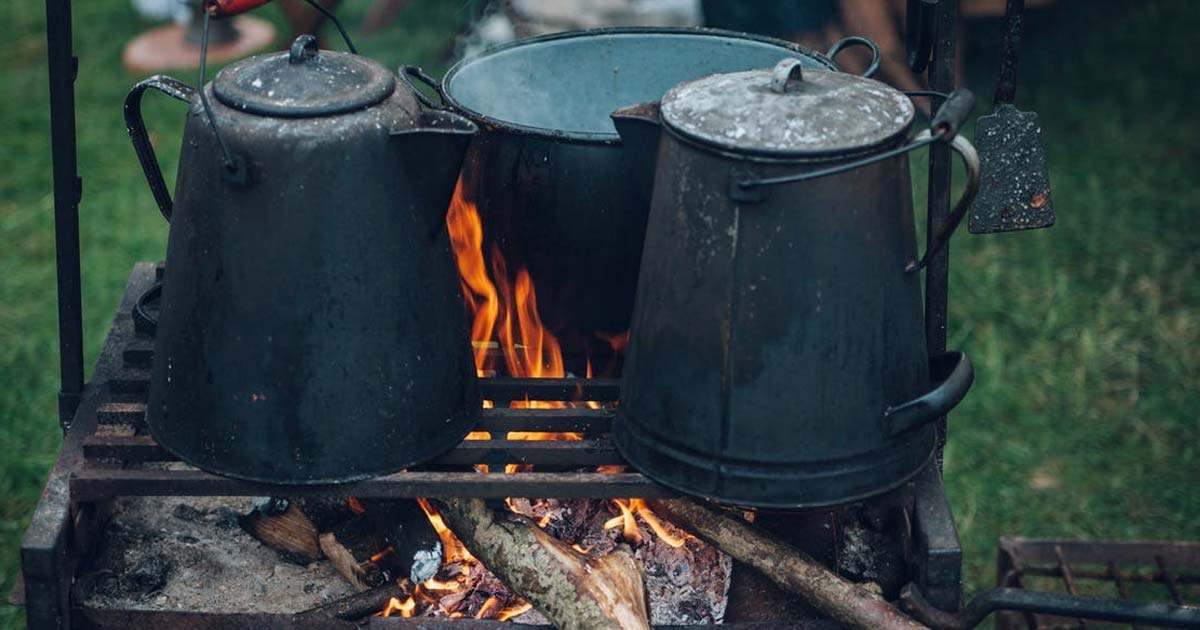
Good Quality Pots – And don’t skip the least glamorous item on the list: a couple of good stainless steel pots for boiling. Boiling won’t remove chemicals, but it is probably the single most reliable way of killing viruses and pathogens ever devised — a rolling boil for one minute (three at high altitude) and the biological threats are dead, every time, no filter cartridge to clog, nothing to expire. It’s also the backup that makes every other method honest. Filters clog. Chemical treatments run out. A steel pot over a fire works until the pot wears through, which is roughly never. Pair it with a way to make fire off-grid and a boil water notice becomes an inconvenience instead of a crisis — remember, most of those 14.9 million Texans didn’t need exotic gear, they needed to boil water in houses that had no power to boil it with.
Redundancy is the whole game here. Filter, chemical treatment, boiling — pick at least two, and know how to use both before the day you’re using them for real.
Fifty-three days. That’s how long a mid-sized American city went without drinkable tap water, eighteen months ago, and the country has mostly already forgotten. The people who lived it haven’t. Somewhere right now there’s a guy in Asheville topping off a water barrel in his garage, and he’s not doing it because a blog told him to.
Don’t wait for your own 53 days to become that guy. The barrel costs less than one hotel night, and the tap works today.






in case of emergency can i use something like a brita water filter or a zero water filter to filter out my emergency water? how long can i store my tap water and it still be safe to drink without refiltering it. thank you before hand to anyone who has any insight to these questions that i ask.
How long you can store your tap water and it still be safe to drink will depend on how and where you store it… the better sealed, better (higher grade/quality) of storage container, the longer your water will stay “fresh.” Also keeping it in a cool dark space that maintains a pretty consistent temperature will help it maintain longer. You absolutely want to avoid the single use bottles as a storage method, and any water you keep in your car you want to change out regularly as it will be subject to high heats and extremely varying temperatures. I imagine that your home filter will be fine for properly stored water, but I would check the stats of your specific system before using it beyond that. That being said, there are many great portable water filters out there, I personally like the Sawyer Mini due to it’s excellent filtration ability, compact size, ease of use, compatibility (it can be screwed onto many basic readily available bottles and even connected to Camelbak and other hydration bladders) durability, and it’s inexpensive usually found between $20-$30.
I once read a comment that really made sense to me and that was to take a protractor and with a map of your area draw a 5 mile circle around your place, then map out each body of water where you can get water from, a lake, pond, golf course pond etc. Something to think about
thanks kloathis for the info. i’m just getting started on my survival storage and water is one of my biggest concerns.
also wondering, does rain water need to be filtered or treated in any way?…..things that i am just now learning about….so much i don’t know :)
Just be safe rain water is ussually ok but if u let it sit for to long it becomes stagnant and can start gtowing bacteria just make sure to aggitate the water one you store it shake the container every few days i learned the hard way had 20 gallons saved up and then had a water advisory and there was a thin layer of a gooey substance floating on the tops of all my water ive been doing this since and so far i havent had any problems
In general rain water is pretty safe as long as what you are using to collect it is clean, your brita pitcher would filter any of the particles that the moisture in the clouds uses to coelesce into rain (well as long as there isn’t any airborne toxic or biologic contaminants in the area) One idea for portable water storage that I would like to throw out there is Home Depot and Lowes (or any other big hardware store) has the 5 gallon jugs for the “Culligan” style water dispensers and they are relatively cheap, store very well, and can be re-used.
You can then use your empties to purify new sources of water in a similar fashion that is used in 3rd world countries.
1. Paint the back half of the bottle/jug black.
2. Take a coffee filter to strain the sediment and particulates out of the new water source and fill the plastic or glass bottle/jug
3. Put the bottle out in the sun for about 24 hours (painted side away from the sun so it can shine thru the jug, if the jug is large let it sit longer)
UV light kills bacteria, think the SteriPen they sell for water purification. When you add to this the black side of the bottle helping to raise the temp of the water you get a nearly free process of water purification. They have been using this method in 3rd world countries with much success.
This thread reminds me that one should make it a top priority to include a reliable and portable means to boil water as part of any disaster prep kit. There are many effective and affordable options to do so. A time proven Coleman type camp stove that runs on the disposable 16 oz. propane canisters is a good option for most folks. The propane fuel has an indefinite shelf life, it is simple and clean to use, and can be used indoors as well as outside–so long as it is only used for relatively short durations and placed near a slightly open window to allow fresh air in.
Just a little tip: But if you do go the “Plastic bottle” route make sure you do not fill the bottles completely up. If you fill it completely up and throw it in your “BOB” it will puncture more easily. Leave a little “Crinkling” (as I call it) room for it.
Oh yea. and if you get a water filter, Depending on the size of your filtering unit, you can use coffee filters to take some of the work away from your expensive replacement filter.
(Just to clarify, use the coffee filter WITH your filtration units specific filter. The coffee filter just helps prolong the “life” of it)
Just one comment about finding water in the area. NEVER use golf coarse water sources. They use TONS of chemicals to keep the lawn that green. And most of it runs off into those ponds. I’d rather be a little thirsty and find somewhere else than be embalmed from the inside out.
how about a backyard pool if you dont have to move. a 21 foot round pool has about 11,000 gallons of water.
I disagree. Balanced pool water is as safe as the water from any city water supply. I have a 30k gal pool; water from a very good well, the chemicals are CaCl for softening, and chlorine. That is it. I use sodium hydroxide and Hcl for ph balance. I am thrilled to have this water for emergencies. A lot of people could be helped with this supply. Remember, you can sterize 17k gallons of water with one pound of calcium hypoclhorite-three bucks at wal mart.
I have to agree with off the grid on this one. A pool is an open body of water and is no way a safe or clean as a closed water system in a community. Consider diesel fumes, car exhaust, tire wear, brake dust. All these things end up in pool water. The pool filter is hardly adequate to clean these hazards.
Those impurities and chemicals will way heavy on your kidneys for long term negative health effects.
You could use a Seychelle Water Bottle filter to filter a 100 gallons to 99.9999% for real safe water for your kids to drink.
Sorry, I strongly disagree with the statement that pool water has less chlorinating compounds than city tap water. Pool water has much a chlorine total count of 4.0-6.0, average for city water should be around 1.0-1.5. Please check out the American water works association for details. I’ve spent ten years in the water utility industry, I think I know what I’m talking about.
You guys are talking collecting rainwater, getting water from ponds etc, and are arguing against a pool as a water source? If you have a means of purifying the water (no electricity/no pump/no circulation)it is a large quantity of water in your back yard (walking distance)
I work as a water treatment and distribution operator. I would just like to mention that often the supply of water entering the treatment facility is ten times worse than anything you will see in a swimming pool. That is to say, with the proper treatment techniques, almost any water can become potable.
If properly sanitized, your pool water should be fine, except that you will have to use a pre-filtration product/ first stage filter to make sure that you get all of the dirt and leaves etc. and possible mosquito larva out from this water. If you have a salt water pool, you will need to use alternative methods to make this suitable for drinking.I actually use my pool water to wash/bathe and flush toilets. It is a good It is a good water source when you don’t need basically sterile water/sterilized water, but if you filter it properly before adding bleach or chemical water sterilization tabs it would be fine. I personally would not use it for drinking unless there was absolutely no other way of getting drinking water. It would all depend on what you use as sterilization/chlorination/bromination for the pool on a routine basis.
ok so this might sound a little weird, but i’m being serious: we’ve all seen bear grills drink his own pee when he had to. if it comes down to it and there really isnt anything to drink, how safe would it be and is there anything to do to make it safer to drink such as filtering, distiling, or boiling?
This may seem a bit off topic for this thread but I am wondering if there is a simple way to treat pee so that you could water your plants with it so you wouldn’t have to use your fresh water supply to keep your fresh vegies watered.
As long as you are eating good foods, your pee does not need to be treated to water your plants. – And if you live way out in the country, you men, especially, can just go out & pee on the plants. – Or do as I read one family does – collect the pee in jars (easier for men) – seal the jar & use as needed – And mark the jars, please. -Search online, you’ll discover lots.
Misty, there really isn’t a diagram on the internet. I had to do a college research paper on preventing illness in 3rd world countries and the biggest preventable killer of children is diahrea (causing dehydration) associated with waterborne bacteria and viruses. I discovered numerous ways that people were using with significant success to purify their water with almost no supplies. The easiest of course was letting the water sit out in a clear plastic container in the sun. Using a coffee filter is primarily to pull out the large particles. The easiest way to do this is to put the filter in a funnel and pour away. I only brought this up to add to a little bit of knowledge for if the SHTF and there are limited supplies or you find yourself without anything. Best to spend the $80 and get a decent hand pump filter system and add it to the bug-out-bag.
Try to find non-bleached (brown) paper coffee filters, too. These have fewer contaminants/carcinogens/etc. in them to transfer to your filtered water.
I have assembled several 5 gallon food-grade buckets with O-Ring seals in their lids, in which pickles were delivered to local restaurants.
I washed these out with a bleach solution to get rid of the pickle remnants and want to use these for water and food storage containers. My storage area is sunlight-free.
Should I add bleach to the water to prevent the growth of bacteria? and how much should be added to a 5 gallon container? Also, if kept out of sunlight, how long will this treated water last in storage and still be safe to use for drinking and cooking?
Another point to consider: Boiling water is not necessary to purify from pathogens. Getting the temp of the water to 150 F is generally sufficient, as the time to get there and back to room temperature will kill the little buggers. This is why the “paint on the bottle” trick works so well…it’s the time spent at hotter temps that does it. Boiling is so often recommended because it’s a VISUAL indicator that a hot enough temp has been reached. I note this since saving fuel might be important in a survival situation.
Water filtering and purification are two different things. Filter to remove larger particles and so forth. Purification neutralizes the bacteria and other nasties that can make life miserable.
I have a Pur Hiker filter. Pur is now owned by Katadyn. I use it for backpacking but I always know where it is at home. It’s small, works well, new filters are about $35-40 and last a long time. It has a long inlet hose with an acorn shaped prefilter at the end. This keeps the larger debris from clogging your filter. I keep some large coffee filters to wrap around the acorn and secure it with a rubber band. I carry a cut-down gallon milk jug on the trail to use as a collection/settling container. Pour the water in, drop the acorn in and pump away. Letting sediment settle will help the filter last longer. At home, where weight is less an issue, I use a clean 5-gallon bucket from a hardware store. Remember to keep the inlet and outlet hoses separate at all times and mark them clearly. Running clean water through a dirty line makes, ummm, dirty water.
Bleach works for purification but remember it has a shelf life. Buying the giant jugs at the big-box store seems like a good idea until the point where the bleach becomes less effective. From a quick Google search, I believe the effective shelf life is about a year. Camping stores have some good purification tablets that are good for about a year after the expiration date.
One caution – some people write about using the ‘pool shock’ powdered chlorine, but there are some definite rules for storing it to prevent chlorine gas buildup and other serious dangers.
If you will be using house fixtures, like outdoor spigots, buy a hose rated for drinking water. These are labeled as safe and are usually white. Keep it separate and don’t use it to wash the car or dog. The typical garden hoses available today have significant amounts of lead and other toxic chemicals that leach into the water.
Remember, you don’t have to purify water that you will using to water plants, wash clothes or flush toilets. Think about ways to get multiple uses from your water rather than just dumping down a drain.
Peace.
Another option for water purification that I haven’t seen yet is iodine. During a 22 day hiking/canoe trip in and around the thousands of lakes of Minnesota, my group used iodine to purify all water. We took water from almost any source we could find, including rivers, lakes, incredibly small streams and the like, with no filtration what so ever. In filling up a nalgene sized bottle with water (aprox. 1000ml) a few drops of iodine would kill all bacteria and pathogens. We drank this way for the entirety of the trip and no one got sick from any water source. A small bottle of iodine (aprox. 50-60ml) lasted about 15 or so days for 8 people filling two 1000ml water bottles every couple of hours.
Now I can’t speak to the shelf of iodine, but if kept in a dark bottle and away from sunlight when not in use, it should last quite a while. I would approximate more than a year, but again, I don’t know for sure.
Any more opinions or comments about iodine are welcome but in a discussion about water purification I felt it was necessary to say. Iodine is very helpful in situations where mass water storage is not really an option or your group is on the move and able to find new water sources.
We boiled tap water, but ours does not use cnrloihe in the filtering process. I’ve since stopped boiling and use Brita filtered tap water.When we went to the US to visit, we used nursery water from Babies R Us. My husband was adamant that we not introduce the chlorinated tap water.
nursery water has added flouride
The problem with filling those big blue containers with water you intend to drink is you can’t see inside them. If using tap water depending on your area the water is going to develop a film and/or mineral deposits eventually. If you was to put maybe 1/4 cup of bleach per the 55 gallons the water might be safely drinkable for a year but it really depends on the quality of your tap water.
3 tablespoons of bleach per 55 gallons of water is what I’ve read elsewhere.
Great ideas. Just FYI, bleach only lasts 3-6 mos. in storage before losing its ability to disinfect. So you must rotate your stock. Also it is unregulated so it contains mercury, arsenic and other impurities.
A better idea is the iodine water tabs which will store for 4 years if unopened.
My sister is a biochemist. She once told me that Clorox brand better than the rest. She work at a lab and used reagent grade bleach for some of her test. If she was out of the reagent, she would use Clorox and only Clorox, it has less reaction by products that other brands.
I am a physician, and worked as a biochemist prior to Med school. Bleach is bleach. Sodium hypochlorite. As long as the chemical percentage is the same, volume per volume, even “dollar store “ / any generic brand will do. I store my water each year in 5 gallon water jugs. I put city water in it then cover with a blue nitrile glove, rubber banded to the neck of the bottle. Since I live in a hurricane-prone area, I fill my bottles in June and label with the date. I leave it there through hurricane season (end of November), but keep it that way until the next June. This way if a boil water order is issued due to broken water mains, I use this water, but may or my not add a few drops of bleach. When June comes around again, water bottles are emptied, sanitized and the process is now begun again.
…and an even better idea is calcium hypochlorite, as it has pretty much an indefinite shelf life and works just as well.
I think the 3 to 6 month estimate is a bit on the overly cautious side to be honest. Household bleach, if stored in a fairly mild temperature environment, and protected from direct sunlight, should last a year before it begins to lose its disinfecting properties. Secondly, after this one year, the bleach will not suddenly lose ALL of its disinfectant capability, but rather simply BEGIN to lose its ability. So bleach over a year old can still kill germs, it might just require larger amounts to do so than when it was fresh.
You would have to live on 1 gallon a day per person(drinking only) You would have to build a make sift shower that runs off 5-10 gallons that everyone used.(recycled water)boiling filtering then cooling the water each time it was used.Special soaps or shampoos would have to be used.As long as nobody is peeing in the water this would work.remember-it’s the end of the world as we know it.So suck it up!
does water really go “bad”? I know it goes stagnant grows mold,mosses,bugs etc. but couldn’t this be filtered and sterilized for use?
I live on the confluence of 3 rivers…the Mississippi river,the Black river and the LaCrosse river so I will have a constant water supply…To make it drinkable I will start with a 55 gallon barrel with holes and catch screen in the bottom I will fill the barrel with multiple layers of sand and activated charcoal..filtering the water 5 gallons or so at a time it should drip through the bottom through a cloth or coffey type filter into another 5 gallon bucket…from there it will be distilled at an outdoor (in my yard)distiller…from there it will be transfered to 1 of 4 500 gallon storage units in my basement…upon being dispenced from one of these it will be filtered once again before being consumed…this should insure a safe water supply for my family and me…1 question…what can I do to prevent algae buildup or scum invading the basement storage tanks?
Any tips, suggestions or comments would be greatly appreciated
Thanks from Scott in La Crosse