
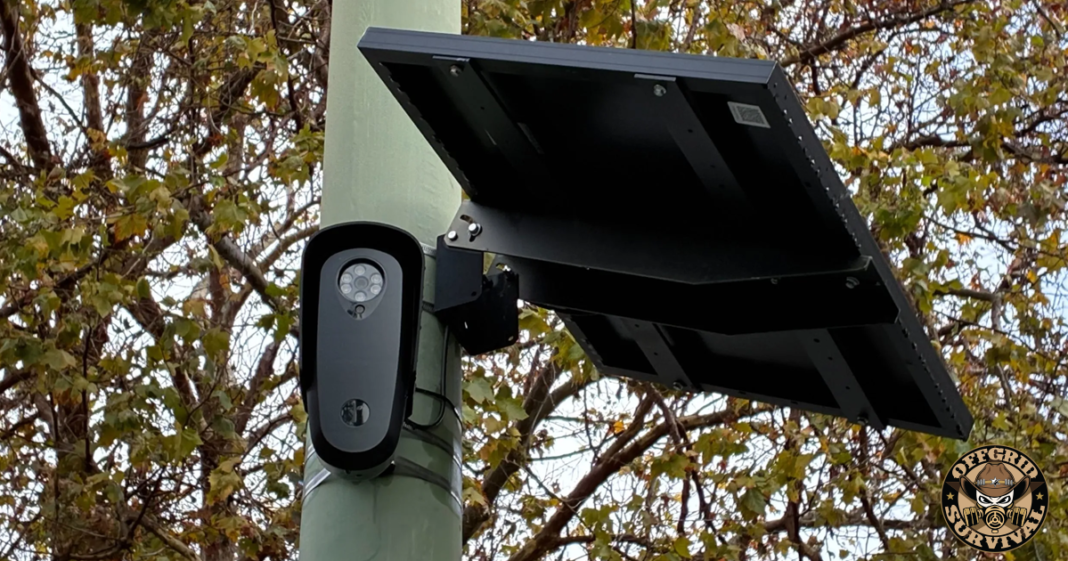
As of July 17, 2026, the crowdsourced DeFlock map had located 95,923 Flock Safety cameras in the United States. That’s about 83% of every automated license plate reader volunteers have managed to find.
Volunteers. That’s who’s counting. There’s no honest national inventory, plenty of departments won’t say where their cameras are, and the ones bolted to shopping centers and apartment complexes are harder to spot than the ones on utility poles.
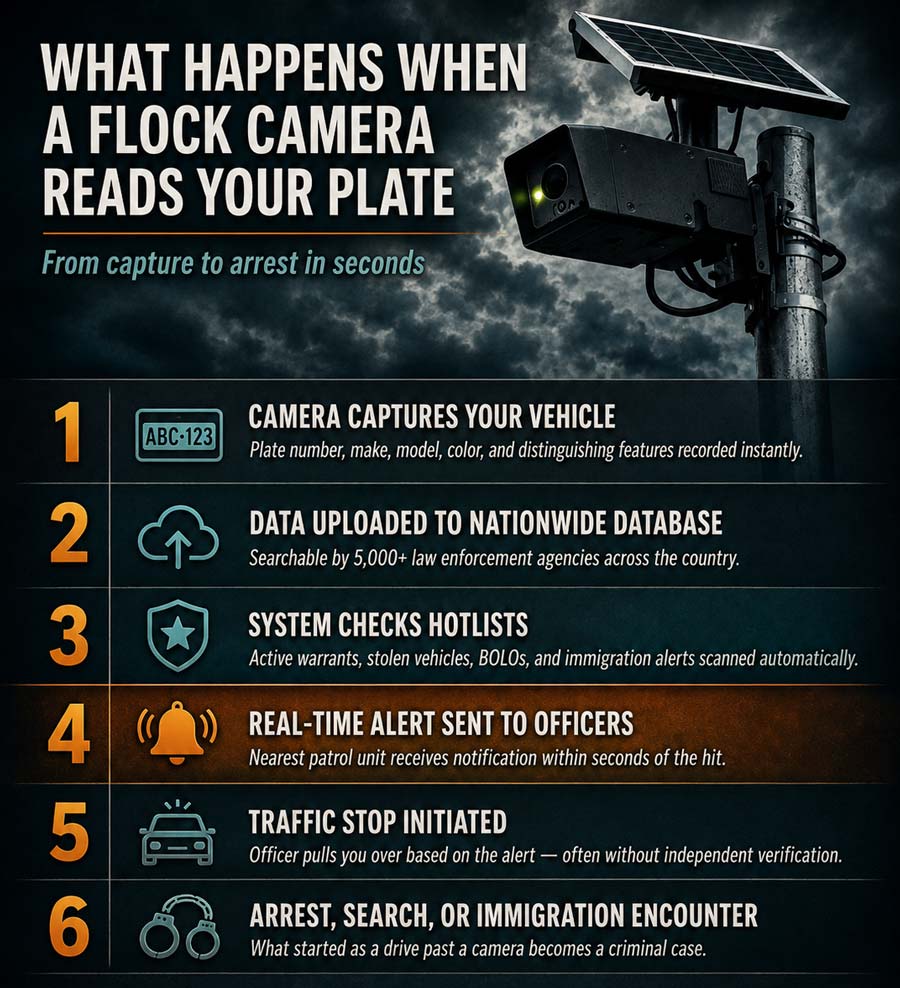
Flock’s own number is more than 20 billion vehicle scans a month across more than 5,000 communities. Not 20 billion scans of wanted felons. Twenty billion scans of whoever drove past.
Your commute. The doctor. Your kid’s school. Church. The gun shop. The rally. The motel you stopped at on a road trip. Your buddy’s house after work.
Photographed, timestamped, geotagged, dumped in a database somebody can search.
Now find me the election where Americans voted for that.
There wasn’t one. There was never going to be one. Nobody amended anything, nobody campaigned on it, nobody held a referendum. The whole thing went up through purchase orders, consent agendas, federal grants, HOA boards and city council meetings attended by nine retired people and a property manager.
The surveillance state didn’t kick the door in. It showed up on a solar-powered pole.
Sold with a missing kid, used for a loud muffler
Flock started in Atlanta in 2017. Nine years later it’s worth around $8 billion and its cameras are in nearly every state.
The pitch never changes: stolen cars, carjackings, missing children, wandering seniors. It works because no councilman wants to be the guy who voted against finding a missing kid.
That’s how every expansion of police power has ever worked. Lead with the most sympathetic emergency available, get the tool, then quietly widen the use once the room empties out. Wiretaps weren’t sold as a way to listen to everybody. The PATRIOT Act wasn’t sold as permanent bulk collection. Civil asset forfeiture wasn’t sold as a way for departments to take cash off people who were never charged.
We know what happens next, because the audit logs are public now.
The Electronic Frontier Foundation went through millions of Flock searches. In Buford, Georgia, a district of about 6,000 students, school police ran more than 375 searches between January 2025 and March 2026 with the reason listed as school residency verification. For part of 2026 that was three-quarters of all their searches. Some of those queries reached across 5,800 camera networks.
They were checking whether kids lived in the right zip code by pulling their parents’ movements from thousands of camera networks nationwide.
EFF also found 26 agencies running the national network on noise complaints, some reaching 6,500 networks over loud music and exhaust pipes. Others ran employment background checks. One department in Missouri searched 2,853 networks for that. A police chief in North Carolina, asked about an “Employment Background” search, told EFF it was a poor choice of words.
No judge signed off on any of it. Somebody with a login typed a plate into a box.
The “local control” story is dead
Every city that bought these was told it controlled its own data. Then people started pulling the logs.
Dayton, Ohio found roughly 7,100 searches of its cameras citing immigration purposes, which its own policy banned. The city couldn’t figure out how to get out of the contract fast, so workers went up ladders and pulled black garbage bags over 72 cameras.
Mountain View, California found that 250-plus agencies it had never signed anything with ran about 600,000 searches of its data over a year. The ATF was in there. The Air Force. The GSA Inspector General. Council killed the contract unanimously.
Oxnard set its system to California only. A vendor-side problem quietly turned nationwide queries back on, and outside agencies were searching Oxnard’s data without the police chief knowing. All 19 readers got shut off.
Ventura County’s sheriff found 364,000 unauthorized accesses in two months. San Francisco is facing a class action alleging ICE, CBP, the FBI and ATF queried its cameras 1.6 million times in seven months.
Illinois audited after Texas cops used Illinois data to track a woman who’d gotten abortion care there. The audit found Flock had let Customs and Border Protection into Illinois cameras through a pilot program nobody disclosed. Flock’s answer was that its own leadership didn’t know. Forty-seven agencies got stripped of access.

Then it got stupid. Evanston canceled and ordered the cameras gone. Flock reinstalled some of them anyway, without permission. The city had to send a cease-and-desist. The last ones didn’t come down until months later.
Local control is bullshit. The cities didn’t control who searched, didn’t control which settings were live, and in Evanston didn’t even control whether hardware they’d rejected stayed bolted to their own poles.
A Texas deputy searched 83,000 cameras looking for a woman
Johnson County, Texas. A deputy ran a nationwide lookup across more than 83,000 cameras trying to find a woman connected to a self-managed abortion. He typed the reason in himself. The search reached states where abortion is legally protected.
Flock and the sheriff first called it a welfare check on a missing person. Records EFF later obtained showed deputies had opened a death investigation over a non-viable fetus, gathered abortion-related evidence, gone through her messages and talked to prosecutors about charges.
Flock’s fix was a word filter blocking certain abortion and immigration search terms.
The architecture didn’t change. One deputy in Texas can still reach 83,000 cameras. All that changed is which words he’s allowed to type in the box. State lines, shield laws and local policy turned out to be settings inside a private company’s software.
The people with the logins are people
Flock points to audit logs like the log prevents anything. A log tells you who got stalked, after.
In Orange City, Florida, an officer ran his ex-girlfriend’s plate at least 69 times, her mother’s at least 24, her father’s at least 15. A colleague saw him doing it and told him to knock it off. Kansas: a police chief ran his ex 164 times and her new boyfriend 64. Milwaukee: 179 personal searches before the officer resigned and got charged.
The Institute for Justice has counted at least 18 officers caught using plate readers to stalk somebody they were involved with. In Georgia alone, Atlanta News First identified 19 cases in a single year. Those are just the ones egregious enough to end in a firing or an arrest.
In almost every case the victim noticed before the oversight system did.
And sometimes the camera is just wrong
Even with honest cops, the machine misreads.
Morristown, Tennessee: a Flock camera read JC and Carolyn Herron’s plate, LOVEY with a letter O, as a stolen truck’s L0VEY with a zero. Guns drawn, grandparents in handcuffs, their three-year-old granddaughter crying alone in the back seat. Cleared after somebody finally checked the VIN.
Toledo, Ohio: a camera read the 7 on Brandon Upchurch’s Dodge Ram as a 2. Officers stopped him at gunpoint, put a K9 on him, and jailed him. Charges dismissed. He was hospitalized, lost work and housing, settled for $35,000.
Sherwood, Arkansas, this February: a single-character misread put a couple on the ground at gunpoint in a parking lot while their six-week-old sat alone in the car. One of the officers, uncuffing them: he wouldn’t say the cameras are perfect, because that’s modern technology.
The Institute for Justice has documented 27 of these since 2018, 19 of them traced to Flock, with officers drawing guns in roughly two-thirds. One driver in Colorado spent 13 days in jail. Another spent nearly a month.
Flock calls the alert an investigative tool. Cops treat it as evidence. By the time the officer walks up to your window he’s already been told your car is stolen, and his hand is on his weapon.
Now think about who else can get in
Here’s the part that should worry anyone who’s read our stuff on Mythos and the cyber threat to infrastructure.
Security researchers have turned up at least 35 sets of stolen Flock customer credentials, some offered on a Russian-language cybercrime forum. More than 60 camera feeds sitting on the open internet with no password. Fifteen published CVE vulnerabilities including hardcoded passwords and disabled secure boot.
That’s a national movement database, holding 20 billion scans a month, running on hardware with hardcoded passwords, at a moment when AI labs are publicly warning that machines can now find and chain exploits faster than humans can patch them.
Nobody has to break into this thing. Ventura County, Mountain View and San Francisco prove that authorized users going where they shouldn’t already accounts for millions of improper searches. The front door works fine.
And the plate is only the entry point. Flock builds a Vehicle Fingerprint from make, model, color, body style, roof racks and damage, so it can find your car without ever reading the plate. Leaked slides and meeting audio obtained by 404 Media described Nova, a product built to let police jump from a plate to a person to that person’s relatives and associates, wired into commercial data brokers, with employees raising concerns about data pulled from breaches.
Meanwhile Leonardo is selling SignalTrace, which bolts onto plate readers and harvests Bluetooth, Wi-Fi and RFID from everything riding in your car. Phone, watch, earbuds, key fob, your dog’s microchip. It bundles the signals that always travel together into an electronic fingerprint and ties the bundle to your vehicle. Leonardo says it works in rail stations, malls and venues too, with or without a plate reader.
The phone identifies the car. The car identifies the route. The route identifies you. The other devices in the car identify who you were with.
The Fourth Amendment doesn’t have a technology exception
Two Norfolk residents, a retired Navy sailor and a home health aide, sued over their city’s 176 cameras. Over four months in 2025 the system logged one of them 475 times and the other 325. A federal judge ruled for the city in January, reasoning that a rolling 21-day window doesn’t capture the whole of a person’s movements. It’s on appeal at the Fourth Circuit.
Then on June 29 the Supreme Court decided Chatrie v. United States, 6-3. Kagan wrote that pulling stored phone location data through a geofence warrant is a Fourth Amendment search. The government’s argument, that you surrendered your privacy interest by letting a company hold the records, lost.
That reasoning doesn’t sit well next to a citywide camera grid.
The standard defense is that you have no expectation of privacy on a public road because a cop could have seen you drive by. Sure. One cop, one intersection, once. He doesn’t have perfect recall wired to 5,000 agencies and 96,000 cameras. He can’t pull up everywhere your truck went last month in four seconds.
The Fourth Amendment exists because British agents used general warrants to search broadly and figure out what mattered afterward. Collect everybody, sort it later. We fought a war partly over that.
Stop treating this as a left-right thing
The coalition against these cameras is the strangest one in American politics right now. The ACLU is running a campaign. EFF is publishing the audit logs. The libertarian Institute for Justice is litigating. Cato filed a brief. Cambridge, Massachusetts and small Texas towns have canceled for identical reasons.
Tim Burchett filed the Protection Against Mass Surveillance Act on July 21. Thomas Massie announced on July 25 he’ll sponsor a bill withholding federal money from cities running these systems, and posted a Gadsden flag with a rattlesnake wrapped around a camera pole.
Whether either goes anywhere is another matter. Politicians rediscover the Fourth Amendment when the other side holds the machinery and misplace it when their own guys take over.
Which is exactly why this can’t be partisan. Republicans shouldn’t back a national tracking system because they think it’ll be pointed at illegals. Democrats shouldn’t back one because they think it’ll be pointed at right-wing militias.
Every database built for your enemy eventually gets handed to your enemy. Sooner or later somebody you can’t stand gets the password.
Flock’s CEO Garrett Langley called DeFlock, a volunteer group that maps publicly visible cameras, a “terroristic organization” whose motivation is chaos. He apologized this month, after Tucker Carlson spent a segment on it and the backlash got loud enough to matter.
That apology arrived on a schedule. Take it for what it’s worth.
Killing Flock isn’t the same as fixing this
Cancel Flock and buy the same capability from Axon or Motorola. Some places already are. Swapping the logo on the pole doesn’t restore anything.
The problem isn’t a brand. It’s the idea that government should collect everybody’s movements first because the data might be handy later.
What actually works
Don’t wreck the cameras. Beyond the felony, it hands every official in your town an easy way to call all critics lunatics.
Use the boring stuff instead, because the boring stuff is what’s been landing.
Pull up DeFlock and see what’s already mapped near your house and your normal routes. Then file a records request for the contract, the audit logs, the full list of agencies with access, the retention policy, and any searches tied to immigration, protests, abortion, firearms or noncriminal matters. Don’t accept a link to Flock’s own transparency portal. A dashboard the vendor built and formatted isn’t oversight. Ask for the raw logs.
Then ask your chief and your council, on the record: does a historical search require a warrant, who reads the audit logs and how often, can federal or out-of-state agencies query us, has the sharing configuration ever changed without a council vote, and when does the contract renew.
That last one matters most. Contract renewal is the only moment your council actually has leverage. Make them vote in public and put their names on it.
Every scandal in this article started the same way. Somebody finally read the logs nobody had bothered to read.
Dayton read theirs, found 7,000 searches that violated its own policy, and then discovered it couldn’t just switch the system off. So the city sent guys up ladders with garbage bags.
That’s what fixing this looks like after you’ve signed. A ladder and a lawyer.
Better to show up before the vote.