
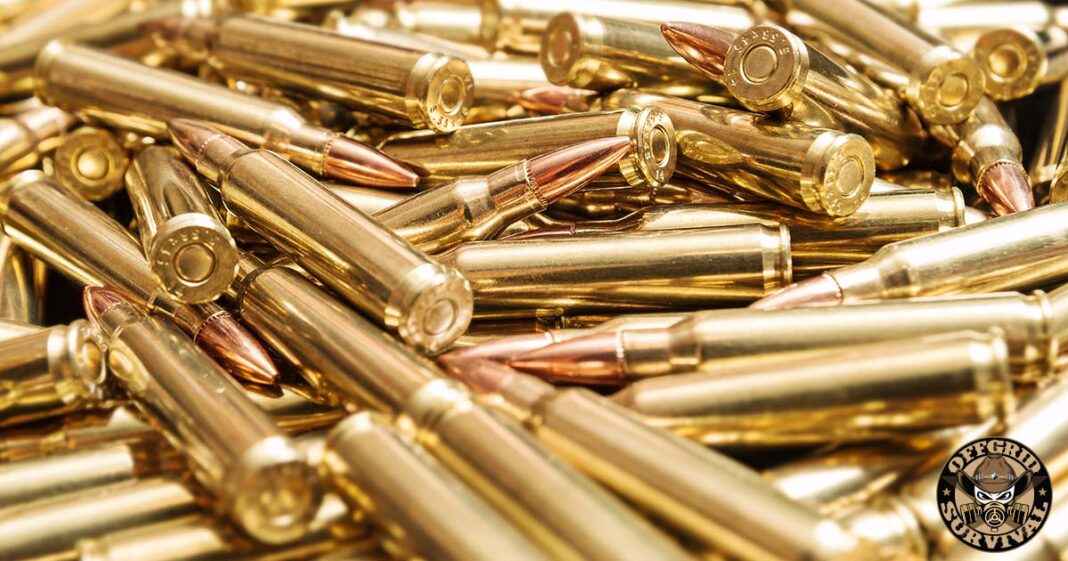
Rifle, Handgun & Shotgun Ammunition
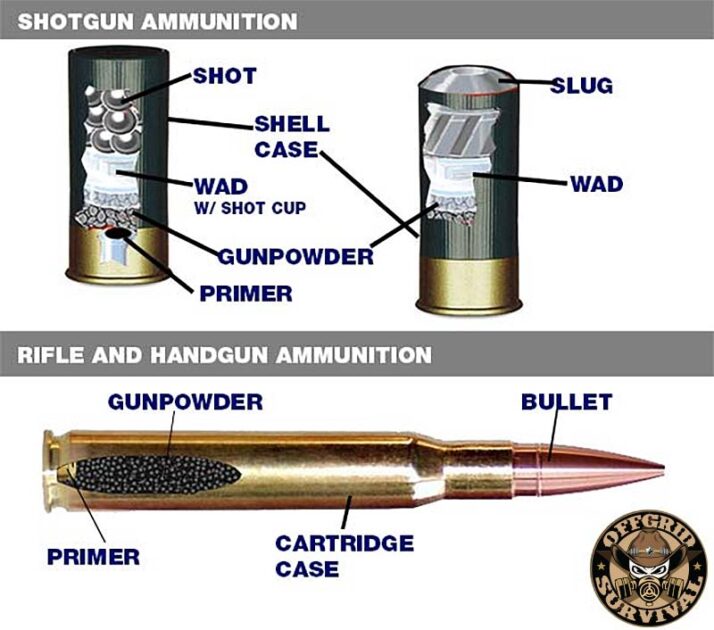
There are basically two types of ammunition, the cartridge and the shotshell. Rifles and handguns use a cartridge containing a projectile (bullet). Shotguns use a shotshell which contains either a number of small projectiles (known as shot) or a single projectile (known as a slug).
The components of both types of ammo are pretty similar; they both have the same basic components which include the case, the primer, gunpowder, and a projectile.
How does the ammo fire?
Ammunition is fired when a gun’s firing pin hits the ammo’s primer. This causes a spark from the primer to ignite the gunpowder. Gas is then converted from the burning powder which forces the projectile out of the case and down the barrel of the gun.
The whole sequence happens in roughly one to two milliseconds, start to finish — faster than you can consciously perceive. Modern smokeless powder doesn’t actually “explode” in the dramatic sense most people picture; it burns extremely fast in a controlled, progressive way, generating expanding gas that builds pressure behind the bullet. That pressure, not an explosion, is what pushes the bullet down the barrel.
Reading a Cartridge: What the Numbers Actually Mean
If you’ve ever looked at a box of ammo and wondered what “.223 Remington,” “9mm Luger,” or “.308 Winchester” actually tells you, here’s the breakdown most FAQs skip:
- The first number is typically the bullet diameter, in either inches (.223, .308, .45) or millimeters (9mm, 5.56mm). A “.308” bullet is roughly 0.308 inches across.
- The name after the number usually tells you who designed the cartridge or which company standardized it (Remington, Winchester, Luger), which matters because two cartridges with the same diameter aren’t always interchangeable — a .223 Remington and a 5.56 NATO are nearly the same bullet diameter but differ in chamber pressure and case dimensions, and shouldn’t be treated as identical despite looking nearly the same on a shelf.
- Grain weight (often printed as “115gr,” “147gr,” etc.) refers to the weight of the bullet itself, with one grain equal to 1/7,000th of a pound. Heavier grain bullets of the same caliber generally move slower but carry more momentum; lighter ones move faster but lose energy to drag sooner. Neither is universally “better” — it depends entirely on what you’re using it for.
- “+P” or “+P+” on a box means the ammunition is loaded to a higher pressure than standard for that caliber, producing more velocity and energy — but also more recoil and wear on your firearm. Always confirm your specific gun is rated for +P ammunition before using it; not all are.
What Is the Best Self-Defense Round?
This is one of the most argued-about questions in the entire firearms world, and honestly, much of the internet argument is built on incomplete or outdated information. Here’s where the actual data stands today.
Shot placement matters more than caliber. This part of the old conventional wisdom holds up: a center-mass hit from a smaller caliber will generally outperform a poorly placed hit from a larger one. No cartridge reliably guarantees an instant stop regardless of where it lands.
But “any caliber works the same” oversimplifies it. The idea that a .22LR performs identically to a 9mm or .45 ACP in a defensive situation doesn’t hold up against more rigorous, modern testing standards — which brings us to the actual industry benchmark worth knowing about.
The FBI Ballistic Protocol
In 1986, eight FBI agents engaged two heavily armed suspects in what’s now known as the Miami shootout. Standard-issue 9mm and .38 Special ammunition failed to stop the suspects effectively even with multiple hits on target, which exposed a serious gap in law enforcement ammunition performance. Two agents were killed and five others were wounded in the incident.
In response, the FBI spent the following years developing a standardized testing protocol, and by 1989 it had become what most shooters now consider the gold standard for evaluating handgun ammunition. Here’s how it actually works:
Bullets are fired into bare ballistic gelatin, then through a series of barrier tests — four layers of heavy winter clothing, half-inch wallboard, two pieces of 20-gauge sheet steel, three-quarter-inch plywood, and automobile windshield glass — into gelatin behind each barrier, fired from a range of ten feet. Thirty total shots are fired, five for each portion of the test, and the results feed into a scoring formula.
The penetration standard that came out of this testing is genuinely useful information for anyone serious about defensive ammunition:
The FBI requires a minimum penetration of 12 inches and a maximum of 18 inches in ballistic gelatin, a range intended to ensure the bullet reaches vital organs even after first passing through an extremity or an obstacle like clothing or glass. Penetration under 12 inches is heavily penalized as a real risk of failing to incapacitate a threat, while penetration beyond 18 inches is also penalized due to overpenetration risk; 14 to 16 inches is generally considered the ideal range.
Worth noting: this protocol was never designed to measure “stopping power” in the dramatic, one-shot-drop sense often discussed online — it measures whether a round will reliably reach vital organs under realistic, imperfect real-world conditions. That’s a more useful, more honest framing than the “magic bullet” debates that dominate online forums.
What this means practically: modern, quality hollow-point defensive ammunition in mainstream calibers (9mm, .40 S&W, .45 ACP, .380 ACP from a reputable manufacturer) that’s designed and tested to meet FBI protocol standards will perform far more predictably than older anecdote-driven comparisons suggest. The “9mm vs .45” debate that dominated forums for decades has cooled considerably in serious ballistics circles precisely because modern bullet construction closed most of the practical gap between calibers — assuming you’re using established, protocol-tested defensive ammunition rather than cheap practice-grade FMJ rounds, which don’t expand and behave very differently on impact.
A Note on Rimfire (.22LR) for Defense
The honest answer here: a .22LR is dramatically better than no firearm at all, and shot placement with any working firearm beats no firearm in a true worst-case scenario. But rimfire ammunition has real, well-documented limitations for defensive use — lower reliability of ignition (a dud rate that’s measurably higher than quality centerfire ammunition), less consistent penetration depth, and less reliable functioning in some semi-auto platforms under stress. If you’re building out a dedicated defensive battery and have the means to do so, a centerfire handgun in a mainstream defensive caliber is the better-supported choice based on current ballistic data — but a .22LR you’re actually trained and comfortable with will always beat an unfamiliar or unavailable larger caliber.
Is Old Ammunition Safe to Shoot?
It really depends on how the ammo was stored. Improperly stored ammo can be damaged by environmental conditions, especially humidity. Primers can lose their sensitivity, charges can deteriorate, and cartridges can become brittle and even rupture when fired. You also have to watch out for corrosion problems that can actually change the size or characteristics of the ammunition.
If you’re buying old or surplus ammunition, here’s a quick visual inspection checklist before you ever load it:
- Case corrosion or discoloration — green or white powdery residue on brass is a red flag, especially around the primer pocket
- Loose or “cocked” primers — a primer that looks tilted or sits proud of the case head can indicate prior firing pin contact or improper seating
- Case cracks or splits, especially near the case mouth — brittle, season-cracked brass
- Bulged or dented cases — can indicate the round was already chambered and extracted improperly, or stored under pressure or impact
- Discolored or crusty powder visible through the case mouth (on disassembled or damaged rounds) — a sign of significant propellant breakdown
When in doubt, don’t fire it — set it aside, or have it inspected by someone experienced in reloading or ammunition disposal.
How Should You Store Your Ammo?
With ammunition supply and pricing swinging wildly with the news cycle, more and more people are thinking seriously about long-term storage. The short version: humidity is the real enemy, rotation matters, and the cardboard boxes ammo ships in are fine for the short term but not for serious long-term storage.
We go into significantly more depth — including the actual chemistry of why heat and humidity degrade primers, powder, and brass, real target humidity and temperature numbers, and the truth about whether desiccant belongs inside a sealed ammo can — in our dedicated guide: How to Properly Store Ammo for Long-Term Survival.

One thing worth flagging here specifically: there’s a genuine, ongoing debate among experienced operators about whether desiccant packets belong inside a sealed ammo can at all. Some military veterans with decades of hands-on munitions storage experience argue that smokeless powder needs to retain a small amount of inherent moisture to burn at its intended, predictable rate — and that aggressive desiccant use inside a fully sealed can may pull that moisture out of the powder itself over long periods, not just out of the surrounding air. This isn’t settled with the kind of hard public data that would make it a slam-dunk either way, but it’s a real enough concern among people with serious storage experience that it’s worth knowing both sides exist rather than treating “more desiccant is always better” as gospel. The safer middle ground most serious long-term storage guides land on: use a reasonable amount of desiccant, recharge or replace it periodically rather than letting it sit indefinitely, and prioritize a stable, low-humidity room over trying to bone-dry the inside of every individual can.
The Lowdown on Firearm Ammunition
Ammunition isn’t complicated once you understand what each component is actually doing — primer ignites, powder burns and generates gas, gas pushes the bullet. Where people get into trouble is skipping the “why” behind the rules: why penetration depth matters more than muzzle energy bragging rights, why a cracked case is more dangerous than an old one, why humidity is the real enemy of a stockpile rather than time itself.
Building out your home defense plan? Check out our breakdown of why a shotgun belongs in your home defense arsenal, and make sure your stockpile is actually protected long-term with our full guide to ammo storage.







1.st timer…
Thank You! you really are helping people
GOD BLESS AMERICA!
I have a Model 10, Ruger, .22lr. My woman has a Glock, 9mm I bought her for Valentine’s Day. I am happy with both and so is she. We will show our guns to anyone who wants to see them. Anyone who tries to get froggy will get to hear them. Briefly.
Ooh, tough guy.
22 is good if you mean .223 trying killing a deer with 22 or a large motivated( drugs) individual stopping power has proven itself time and time again. Things are different in real life ill take 8 .45 or the extra weight of a real rifle. You wont have time to take abreath and aim for the smallest but most vulnerable part. you pick the biggest part and put as many bullets in it as the .23 seconds of a physical engagement can last. No hungry mass or rioting looters will be deterred by a 22 . Now a round that will go through 2 or three people before stopping is scary
I am not underscoring the supreme advantage to having a .22 rifle with a thousand rounds that weigh the same as 250 .223. I understand most small game have been taken since its inception with a .22. The 22 is in valuable just for survival out in the nowhere but in crazy town bigger always = badder. It’s called force multiplyer
I doubt many rioters have been heard to say “He’s only got a .22, let’s get him!” Maybe, “He’s only got a .22, YOU get him!”
If you are suggesting that a .45 is superior well i won’t argue. It is the Ford Chevy fight. However, if you don’t think a .22 LR or a 9mm will effectively work against a riot memeber, well stand out in a field and let me shoot you. If they wont effectively work against a riot member then they wont hurt you.
@Rob, Nice article for the basics, though I have a difference of thoughts on a few things. Rotation is right on and if you want to vacuum seal it, that’s fine but I’m not sure if it or even the inspection schedule is necessary. If the ammo is stored in “real” ammo cans with good seals, it should be good for years if stored out of the elements (not buried) and doesn’t reach VERY extreme HIGH temps. Also silica gel or other dehumidifiers should not be used inside the ammo cans. Ammo must have the “inherent” humidity of the powder kept intact to remain viable at acceptable and usable velocities and if desiccant is in the cans, when it removes all the humidity in the can it will then remove the humidity in the powder. In the military we store our munitions in the earthen “mounds” often seen on military installations. These are called igloos and they are anything but dry on the inside. Ammo is stored in the ammo cans, sans desiccants, but it will last for years. I have shot military ammo that was 40 years old or more with no problems other than corrosive primers (military safety officer, had to inspect the igloos, as well as use the ammo!). Now having said that, military ammo is sealed. Both the primer and the bullet itself are sealed with a lacquer. I do the same with my reloads for storage by using clear nail polish over the primers and the bullet to case interface. This one thing (and you can do it to commercial ammo as well)will do more to keep your ammo in good long-term shape than anything else, that and use good quality ammo cans. As far as direct burial, I don’t have any scientific, research based material on that but I would have to say that it would have to be buried with care and the fact that it is buried removes any reasonable inspection ability. A hidden bunker hole and storage without immersion in water (stored as mentioned above) and without ground contact would be the best way to store it out of sight rather than direct burial, though in this instance the vacuum sealing would prolly be useful and functional. Drafted in 72, retired in 10 JMHO. Be well.
Your A Good Man Trip… Thank You, For You!!
THE BEST SELF DEFENSE ROUND…I appreciate the intent, but this article is borderline dangerous. I have seen men die from a 22 caliber round, but it usually much later(infection, etc). The author requires a one-shot-stop to be a head/torso shot, yet those I’ve seen go down after a 45 ACP struck them in the hand, or a 357 magnum hit them in the elbow (effectively removing the limb). A bullet can AND DOES kill in minutes if a femoral artery is severed. As a PhD, this article wouldn’t make most journals because the author defines in a way that omits relevant data and presents bias into the study. I was hit in the leg by a 22 caliber round. It hurt & GOD intervened, but had the round been something like a 45 ACP or 357 Sig, the short term and long term consequences would probably have been much different. I’m sure the author is a good teacher and police officer, he is not a researcher. Do not trust this data.
I think the main point is that the rusty .22 you HAVE is better than the tricked-out AR15 you WANTED. I’ll take a single shot 12 guage over a ball bat any day. Don’t let the perfect be the enemy of the good.
I am pretty sure that bringing GOD into the equation when discussing research acumen completely destroys your credibility. Just saying.
I’m thinking more along the lines of having to be on the move. I don’t think bunking down anywhere is gonna be a long term option for most people should things really get bad. I think having to move around will probably be more relevant for most. In that case I’d rather carry a few thousand rounds of .22 as opposed to larger heavier ammo.
I can survive with a rifle, and fishing gear.
If I had to pack up and go those two things would be of most value to me.
I agree with the large clip idea. I’ll shoot until they stop moving or scatter. I keep a 9mm loaded with a 16 round clip and an extra clip loaded as well. If your shot can’t be quality, at least it can be quantity!
It’s a MAGAZINE(!) not a clip
what is your ip address just in case?
Here is some food for thought. Although the author is correct in what he says, the 22 requires a perfect shot. There is a reason that the Special Forces community is reviving the 45 ACP. It is the same reason that I carry a 45. When loaded with a hollow point it removes body parts. During the Philipine Insurection the military adopted the 45 because the 38 (the 38 and 9 MM are very similar) would not stop the enemy who were high and would wrap themselves with hemp rope. The Army had already adopted the 1911, however there were not enough in the inventory yet. The Army then went to the manufacturers and asked what they could get now that could shoot the 45 ACP. They got a revolver that with moon clips could shoot the 45.
Simply put the 45 will remove body parts. That will stop the attacker and you do not need that perfect shot. That is what this caliber is designed for. We use the 9 MM because of our allies.
I’d like to learn more about the types and sizes of certain ammunition what the grain sizes indicate and more detail if you have the time. Thank you.
Cheers!
They’ll get back to you next week.
Nice information. Thanks for sharing!
My boyfriend has a rifle round that he can’t identify I am hoping that you may be able to help him. The markings on the bottom part is CA B44
Thank you very much