
Knowing the parts of a firearm is not useless trivia reserved for gunsmiths and people who spend too much time arguing online. It is the basic language you need to safely operate a gun, maintain it, buy the right ammunition and explain what went wrong when something stops working.
Walk into a gun shop and tell the guy behind the counter that your gun “jammed.” He is going to ask whether it failed to feed, failed to extract, failed to eject or went out of battery. Those are four different problems involving four different parts. Saying it jammed is like telling a mechanic your truck made a noise. It does not give him much to work with.
The same gap shows up when you are reading an owner’s manual, ordering replacement parts, cleaning a gun for the first time or trying to figure out why a rifle that used to shoot tight groups is suddenly throwing rounds all over the target.
The basic layout is not as complicated as it looks. Almost every firearm breaks down into three groups: the action, the barrel and the stock or frame. What lives inside those groups changes depending on whether you are holding a bolt-action rifle, a pump shotgun, a revolver or a semi-automatic pistol. The job of each group does not change at all.
The Three Main Parts of a Firearm
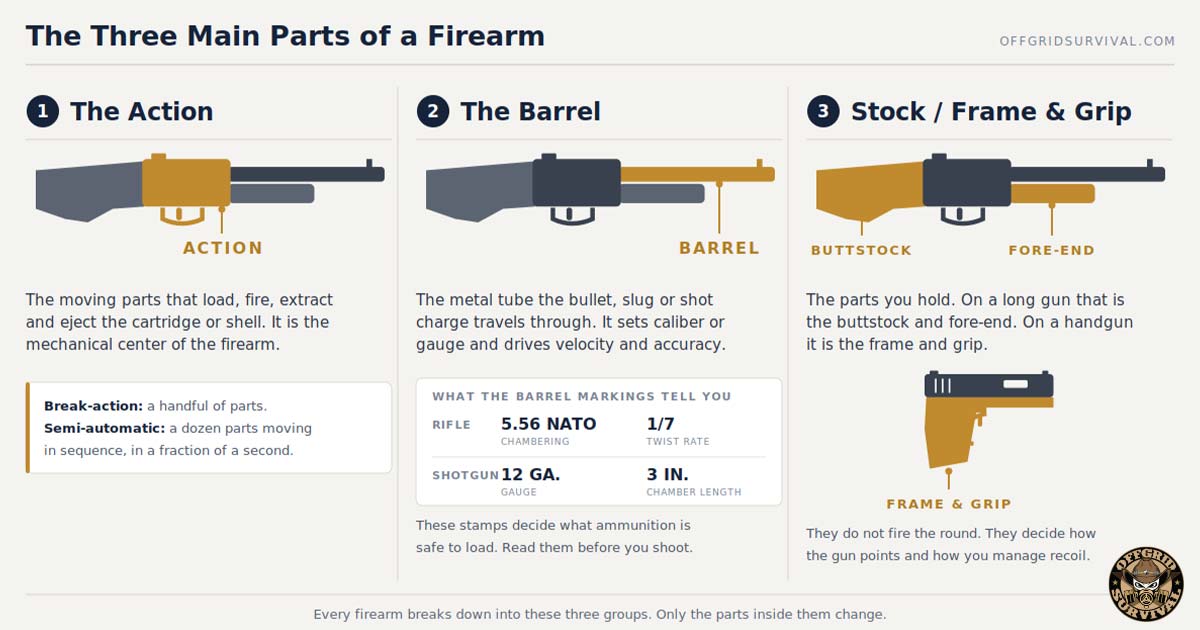
The action contains the parts responsible for loading, firing, extracting and ejecting the cartridge or shell. It is the mechanical center of the firearm. On a break-action shotgun the action is a handful of pieces. On a modern semi-automatic, a dozen parts have to move in the right order, under spring pressure, in a fraction of a second.
The barrel is the metal tube the bullet, slug or shot charge travels through. It determines the caliber or gauge the firearm is chambered for and drives velocity, accuracy and effective range. The barrel also carries the most important markings on the entire firearm: caliber, chambering and, on shotguns, chamber length. Those stamps decide what ammunition is safe to put in the gun.
The stock is the portion of a long gun that contacts your shoulder and gives you a place to hold and control the firearm. On a handgun, the equivalent parts are the frame and grip. These parts do not ignite the cartridge, but they determine how naturally the gun points, how well you manage recoil and whether your eye lands behind the sights the same way every time.
The Barrel: More Than a Metal Tube
The hollow interior of the barrel is called the bore, and bore diameter is where caliber comes from. The exact way manufacturers measure and name calibers is not always as straightforward as the number printed on the ammunition box, which is why the barrel stamp matters more than the label.
Inside most rifle and handgun barrels is a series of spiral cuts called rifling. The raised portions are the lands and the recessed portions are the grooves. As the bullet travels down the barrel, the rifling forces it to spin, and that rotation stabilizes it in flight so it does not tumble after it leaves the muzzle.
The rate of that spin is the twist rate, written as a ratio such as 1:7, 1:9 or 1:12. A 1:7 twist means the rifling makes one complete rotation every seven inches of barrel.
Bullets of different lengths and weights need different amounts of spin to stay stable. A fast 1:7 twist is commonly used with heavier .223 and 5.56 bullets in the 62- to 77-grain range. A 1:9 barrel is better suited to lighter and midweight bullets up to roughly 69 grains. Early AR-15 and M16 barrels often used slower 1:12 rifling because they were built around 55-grain ammunition. Most .308 rifles run 1:10 or 1:12, and .22 LR is almost always 1:16.
This is one reason a rifle may shoot well with one load and poorly with another. Shooters usually blame trigger control, a loose scope or cheap ammunition. Sometimes the barrel simply will not stabilize that bullet, and in the worst cases an unstable projectile leaves an elongated or oval hole in the paper instead of a clean round one. Check the twist rate before you buy another box of match ammo trying to fix a problem that is not yours.
Chamber and Throat
The enlarged section at the rear of the barrel that holds the cartridge is the chamber. It is machined for a specific cartridge, and the markings on the barrel need to match the ammunition you are feeding it.
Immediately in front of the chamber is the throat, sometimes called the leade. This is the short unrifled transition the bullet crosses before the rifling grabs it. Throat length affects pressure, reliability and accuracy, which is why two cartridges that look identical on the outside are not automatically interchangeable.
The common example is .223 Remington and 5.56 NATO. They are dimensionally near identical and they sit next to each other on the shelf, but a 5.56 NATO chamber has a noticeably longer throat. Fire 5.56 ammunition in a barrel marked only .223 Remington and the bullet engages the rifling sooner than the chamber was designed for, which drives pressure up. SAAMI specifically warns against it. The reverse is fine: .223 Remington in a 5.56 chamber is safe.
Do not guess based on appearance. Read the barrel markings and the owner’s manual. The stamp on the barrel matters more than something you heard from a guy at the range.
Muzzle and Crown
The front opening of the barrel is the muzzle. The machined edge around that opening is the crown, and it does more work than it looks like it does.
As the bullet exits, high-pressure gas escapes around its base. If the crown is dinged or worn unevenly, that gas escapes harder on one side and pushes the bullet off axis on its way out. A rifle that suddenly starts throwing unexplained fliers may have a damaged crown, especially if it has spent years standing muzzle-down in a truck bed or a corner.
Many modern barrels are threaded near the muzzle for flash hiders, muzzle brakes or suppressors. Common patterns are 1/2×28 on .223 and 9mm firearms and 5/8×24 on most .30-caliber rifles, but there are plenty of exceptions. Verify the thread pattern before forcing an accessory onto the barrel.
Shotgun Barrels Work Differently
Most shotgun barrels are smoothbore, meaning no rifling. A shotgun is throwing a group of pellets rather than a single projectile, and spinning that column would fling the pattern apart rather than tighten it.
Shotgun bore size is measured in gauge rather than caliber. The measurement is based on the number of round lead balls, each the diameter of the bore, that would together weigh one pound. Twelve balls matching a 12-gauge bore weigh a pound, putting that bore at roughly .729 inches. Twenty balls matching a 20-gauge bore weigh a pound, putting it at roughly .615 inches.
That is why the numbers seem backward. Bigger gauge number, smaller hole. The .410 is the oddball because it is not a gauge measurement at all. It refers to a bore diameter of approximately .410 inches.

Chokes
The choke is a constriction near the muzzle that controls how quickly the shot pattern spreads. An open choke lets the pellets spread sooner. A tighter choke holds the pattern together over a longer distance.
Choke is measured in thousandths of an inch of constriction. In a 12 gauge, the common ladder runs roughly Cylinder at .000, Skeet at .005, Improved Cylinder at .010, Modified at .020, Improved Modified at .025 and Full at .035. Tighter choke means a tighter pattern and more effective range, and it also means less margin for error on a moving target.
Many modern shotguns use removable choke tubes, so one barrel covers close-range defensive work, clay targets, upland birds and waterfowl. Know which tube is installed and whether it suits the ammunition. Some slug, buckshot and specialty loads carry manufacturer restrictions on choke selection, and firing a rifled slug through an extra-full turkey choke is a good way to ruin a barrel.
Chamber Length
Shotgun barrels are also marked with a chamber length, commonly 2¾ inches, 3 inches or 3½ inches. Use only shells that do not exceed the length marked on your barrel.
A 3-inch shell will physically fit into a 2¾-inch chamber before it is fired. The problem comes when the crimp opens. If there is not enough room for the shell to unfold, pressure climbs to levels the barrel was never proofed for.
Read the barrel. Do not assume every 12-gauge shell belongs in every 12-gauge shotgun.
How the Action Cycles Ammunition
Every repeating firearm performs the same basic jobs, whether you supply the energy or the last shot does. The operating cycle runs in eight steps:
- Feeding: A cartridge moves out of the magazine and into position.
- Chambering: The cartridge is pushed into the chamber.
- Locking: The breech closes and locks behind the cartridge.
- Firing: The firing pin or striker hits the primer.
- Unlocking: The action releases after the shot.
- Extracting: The fired case is pulled from the chamber.
- Ejecting: The case is thrown clear of the firearm.
- Cocking: The hammer or striker is reset for the next shot.
Learn this cycle and troubleshooting stops being guesswork. When a gun fails to pick up a cartridge from the magazine, the problem happened at feeding, and you are looking at damaged magazine feed lips, a weak magazine spring, a dirty action or a magazine that was never fully seated.
When the empty case stays stuck in the chamber, the firearm failed to extract, and now the extractor, extractor spring, chamber condition or the ammunition itself is the suspect. When the case gets pulled from the chamber but ends up trapped upright in the ejection port, commonly called a stovepipe, the failure happened at ejection.
Instead of saying the gun jammed, you can name the step where the cycle stopped. That gives you and your gunsmith somewhere useful to start.
Common Types of Firearm Actions
Break Action
A break-action firearm opens on a hinge, exposing the chamber or chambers for manual loading. It is common on single-shot rifles, single-shot shotguns and double-barrel shotguns. Break actions are mechanically simple and easy to inspect, and when the action is open it is usually obvious whether the gun is loaded. The tradeoff is limited capacity and slower reloading than any repeating design.
Bolt Action
A bolt-action rifle uses a manually operated bolt to load, lock, fire, extract and eject. The bolt has locking lugs that rotate into matching recesses in the receiver or barrel extension. To cycle it, you lift the bolt handle, pull it rearward, push it forward and rotate it back down. The rigid lockup and small number of moving parts are why bolt actions have a reputation for accuracy and reliability, and why they have stayed in the hands of hunters, precision shooters and military marksmen for more than a century.
Lever Action
A lever-action firearm uses a lever beneath the receiver and grip. Moving it down and forward opens the action, extracts and ejects the fired case and usually cocks the hammer. Returning the lever chambers a fresh cartridge.
Many traditional lever guns feed from a tubular magazine under the barrel, and that design puts a real restriction on your ammunition. Cartridges sit nose to primer inside the tube, so a pointed bullet resting against the primer ahead of it can set that round off under recoil. Use flat-nose or round-nose ammunition in a tube magazine, or the polymer-tipped loads built specifically for it. Do not load pointed spitzer bullets into a tube gun.
Pump Action
A pump-action firearm, also called a slide action, is worked by moving the fore-end rearward and forward. Pulling it back unlocks the action, extracts the fired shell and ejects it. Pushing it forward feeds and chambers the next one.
Pump actions are most associated with shotguns, though pump rifles exist. Because you supply the energy that cycles the action, a pump shotgun will run light loads that would not generate enough force to cycle a semi-auto.
The most common source of trouble is the operator. Failing to run the fore-end all the way rearward or all the way forward causes a malfunction called short-stroking, and under stress it happens to people who have owned the gun for years.
Semi-Automatic
A semi-automatic uses energy from the fired cartridge to cycle the action. It fires one round per trigger press, then extracts, ejects, cocks and loads the next round on its own.
Blowback designs rely on the mass of the slide or bolt plus recoil spring resistance to hold the action closed long enough for pressure to drop. This is common in .22 LR firearms, pistol-caliber carbines and smaller handguns.
Gas-operated designs tap a portion of the expanding gas through a port in the barrel. That gas travels through a gas block and tube or drives a piston, supplying the energy to cycle the bolt. AR-pattern and AK-pattern rifles are the familiar examples, and their gas systems work differently from each other.
Recoil-operated designs use the rearward movement of the barrel and slide together to unlock and cycle. Most modern centerfire semi-automatic pistols use some version of a locked-breech recoil-operated system.
Revolver
A revolver holds cartridges in a rotating cylinder, with each chamber rotating into alignment with the barrel as the gun is cocked or the trigger is pressed.
In a single-action revolver, the hammer is cocked manually before each shot. Cocking rotates the cylinder and places the next chamber behind the barrel, and the trigger only releases the hammer. That is why single-action trigger pulls are short and light, usually somewhere around 3 to 4 pounds.
In a double-action revolver, one press of the trigger rotates the cylinder, cocks the hammer and releases it in a single continuous motion. That pull is long and heavy, commonly 10 to 12 pounds, and on most double-action revolvers it is the entire safety mechanism. That is why they generally have no manual safety lever at all. Most can also be fired single-action by cocking the hammer first.
Internal Firearm Parts You Should Know
Most beginner diagrams label the sights, trigger, grip and barrel and ignore the parts that actually make the gun run. Those are the ones you need when you are cleaning it, troubleshooting it or talking to a gunsmith.
Firing Pin and Striker
The firing pin hits the primer and starts the firing process. In hammer-fired guns, the hammer strikes a separate firing pin that runs forward into the primer.
A striker-fired design combines those jobs into one spring-loaded assembly that moves directly forward when released. Not every striker system works the same way. Some are partially tensioned by the movement of the slide and finished during the trigger press. Others are placed under full spring tension when the slide cycles.
Sear
The sear holds the hammer or striker back against spring pressure until the trigger releases it. The geometry and condition of the sear surfaces are where trigger feel comes from. When shooters talk about creep, they are describing the sear surfaces sliding against each other before release, and a crisp break is the sear letting go with almost no movement first.
The sear is not a part for an inexperienced person to attack with a file, a rotary tool or polishing compound. Altering engagement surfaces without understanding the design produces a gun that fires when you did not ask it to, slips off the sear under recoil or discharges when the action closes.
Disconnector
The disconnector is what makes a semi-automatic fire once per deliberate trigger press. As the action cycles, it catches or controls the hammer until you release the trigger and let it reset.
A worn, damaged or improperly installed disconnector can cause doubling or uncontrolled firing. That is not a quirk to shoot around and see whether it gets worse. Unload the gun and get it to a qualified gunsmith, because an unintentional machine gun is a federal felony regardless of how it got that way.
Extractor
The extractor is a claw-shaped part that hooks the rim or extractor groove of the case. As the bolt or slide moves rearward, it drags the fired case out of the chamber.
Extractors are small parts living with heat, carbon buildup and repeated impact, which makes them one of the most common breakage points on any semi-auto. A damaged extractor, a weak extractor spring, a filthy chamber or a deformed case all show up as failures to extract.
Ejector
The ejector throws the case clear of the gun after the extractor has pulled it from the chamber. Depending on the design it is either a fixed projection or a spring-loaded plunger.
The extractor grabs the case. The ejector kicks it out. Keeping those two straight makes every malfunction description easier to follow.
Feed Ramp
The feed ramp is the angled surface guiding a cartridge from the magazine up into the chamber. A damaged, dirty or badly shaped ramp causes feeding problems, and wide-mouth hollow-points are more sensitive to ramp geometry than round-nose ammunition. The answer is not to start grinding on it. Test the ammunition the manufacturer recommends, keep the ramp clean and have persistent problems inspected by someone who knows what he is doing.
Recoil Spring and Buffer
The recoil spring absorbs part of the energy generated as the slide or bolt travels rearward, then pushes the action forward, strips a fresh cartridge from the magazine and returns the gun to battery. On AR-pattern rifles the same job is handled by a buffer and buffer spring inside the receiver extension, and buffer weight and spring strength both change how the rifle cycles.
Recoil springs are wear items and they are cheap. As one weakens, the gun starts cycling harder than it should, ejecting brass inconsistently or failing to return fully into battery. Replacement intervals vary by design, so follow the manual rather than a round count you read on a forum. Many pistol manufacturers put it somewhere in the 3,000- to 5,000-round range.
Firing Pin Block and Transfer Bar
A firing pin block physically stops the firing pin or striker from moving forward unless the trigger is pressed through the required portion of its travel. It is standard in modern pistols.
Revolvers use one of two similar systems. A transfer bar sits between the hammer and firing pin only when the trigger is held to the rear, so a blow to the hammer with the trigger forward transmits nothing. A hammer block does the reverse, physically blocking the hammer until the trigger is pressed. Either way the result is the same.
These systems are why many modern firearms can be carried safely with a round in the chamber, in the correct holster, per the manufacturer’s instructions. Older designs may not have them at all. Traditional single-action revolvers were carried with the hammer down on an empty chamber for exactly this reason, and that advice still applies to any gun built on the old pattern.
Stock, Grip and Firearm Fit
The rear portion of a rifle or shotgun is the buttstock. The surface that meets your shoulder carries a hard butt plate or a softer recoil pad.
The top edge where your cheek rests is the comb. The top rear corner is the heel and the bottom rear corner is the toe. The narrower section behind the trigger is the wrist or grip. The forward portion your support hand holds is the fore-end or handguard.
These are not just vocabulary words. Stock dimensions decide whether the gun fits you, and a gun that does not fit is harder to mount, harder to control and worse under recoil.
Length of Pull
Length of pull is the distance from the face of the trigger to the center of the buttstock. Factory long guns almost all ship between 13.5 and 14.25 inches, with about 13.75 to 14 inches as the default. That default was built around an average adult male, which is why a shotgun off the rack is too long for a lot of women, teenagers and plenty of grown men.
When the stock is too long you cannot mount the gun cleanly, your head cranes forward and the recoil pad catches your bicep instead of the pocket of your shoulder. Heavy winter clothing and body armor make it worse, since both effectively add length. One rough check: put the buttstock in the bend of your elbow with your forearm folded up and see whether your trigger finger reaches the trigger naturally. That will not replace a real fitting, but it exposes a stock that is badly wrong.
Drop at Comb and Sight Height
Drop at comb is how far the comb sits below the line of sight, and it decides where your eye lands when your cheek is down on the stock.
Adding an optic changes the cheek height you need. A rifle that felt natural with iron sights can suddenly require you to lift your head off the stock after a scope goes on, and a cheek riser or adjustable stock is what fixes it.
Sight height also moves your point of impact up close. On an AR-pattern rifle the sights or optic sit roughly 2½ inches above the bore. At very close range the bullet strikes low, because it has not yet risen to intersect the line of sight. That is not a malfunction and it is not bad shooting. It is the geometry of the gun, and you have to hold for it before you rely on that rifle at across-the-room distance.
Parts of a Semi-Automatic Pistol
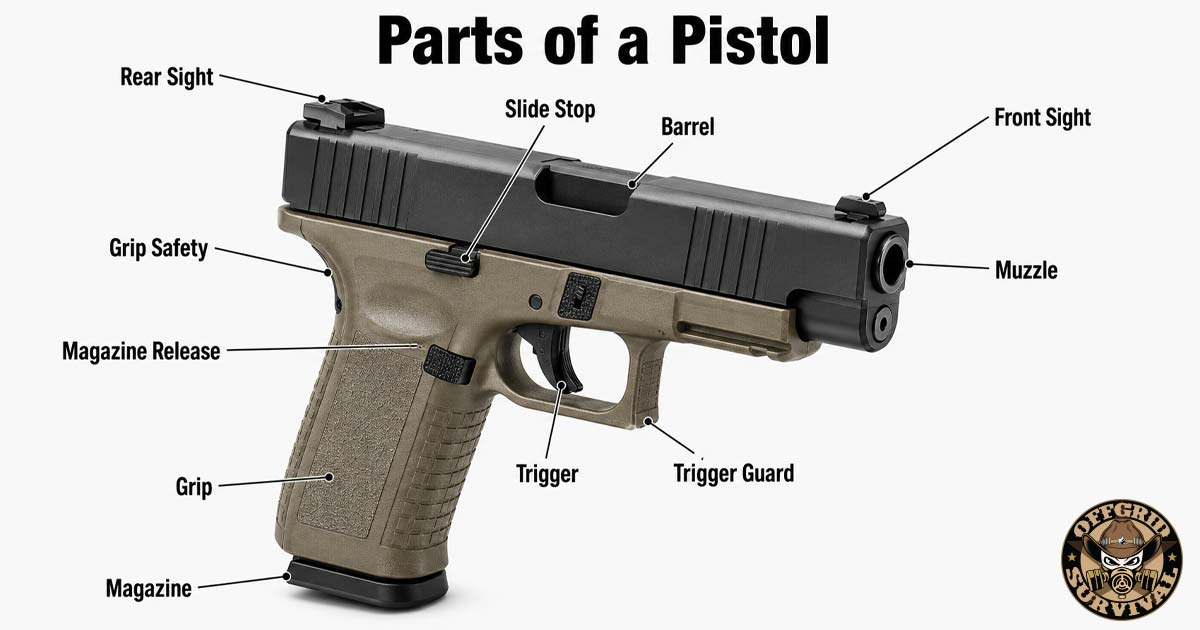
The frame is the lower portion of the pistol, holding the trigger mechanism, grip, magazine well and controls. On most pistols the frame is also the serialized component, though some designs serialize an internal fire control unit instead.
The slide is the upper assembly that travels rearward and forward during firing. It normally carries the firing pin or striker, the extractor and the rear sight. The barrel and recoil spring assembly sit beneath and inside it.
The magazine well is the opening in the grip where the magazine inserts. The magazine release lets the magazine drop free or be pulled out. The slide stop, sometimes loosely called a slide release, holds the slide open after the last round is fired.
Pistol safety systems vary widely. Some use a manual thumb safety. Some use a grip safety that must be depressed by your firing hand. Traditional double-action pistols may have a decocker that lowers the hammer without firing. Many striker-fired pistols use a trigger-mounted safety lever plus internal firing pin and drop safeties.
Do not assume a control does a particular thing because it looks like the control on another gun. The same lever is a safety on one pistol and a decocker on another, and confusing the two has put rounds through floors. Read the manual before you manipulate an unfamiliar handgun.
Parts of a Revolver
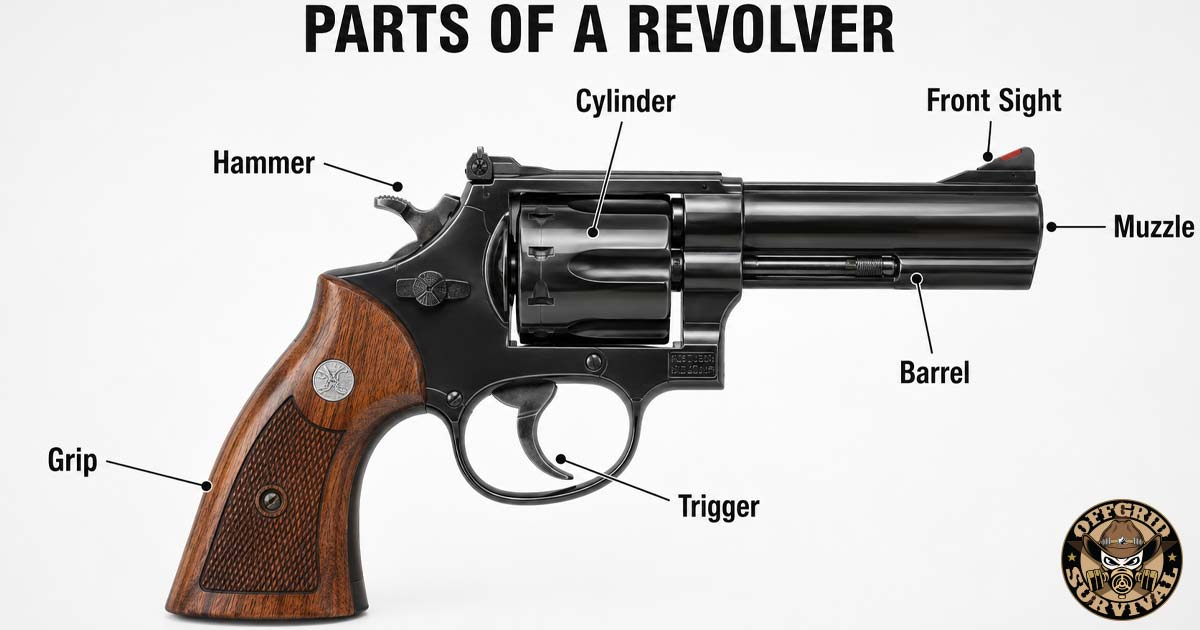
The cylinder holds cartridges in separate chambers and rotates to line each one up with the barrel. On most modern double-action revolvers, the cylinder swings out of the frame to load and unload.
The arm supporting the open cylinder is the crane or yoke. The ejector rod runs through the center of the cylinder and pushes the empty cases out when pressed.
The cylinder release unlocks it, and manufacturers do not agree on how it should move. Smith & Wesson thumb pieces are pushed forward. Ruger releases are pressed inward. Many Colt releases are pulled rearward. Learn the one on your gun rather than assuming.
The bridge of metal running over the top of the cylinder is the topstrap. At the rear of the barrel is the forcing cone, the funnel-shaped opening that catches the bullet and guides it out of the cylinder and into the bore.
The space between the front of the cylinder and the forcing cone is the cylinder gap, and on a healthy revolver it measures somewhere between .002 and .006 inches. High-pressure gas and shaved lead escape through that gap on every shot. Never put a finger, thumb or any other body part alongside it. People have lost pieces of a thumb learning that lesson.
Rifle-Specific Parts
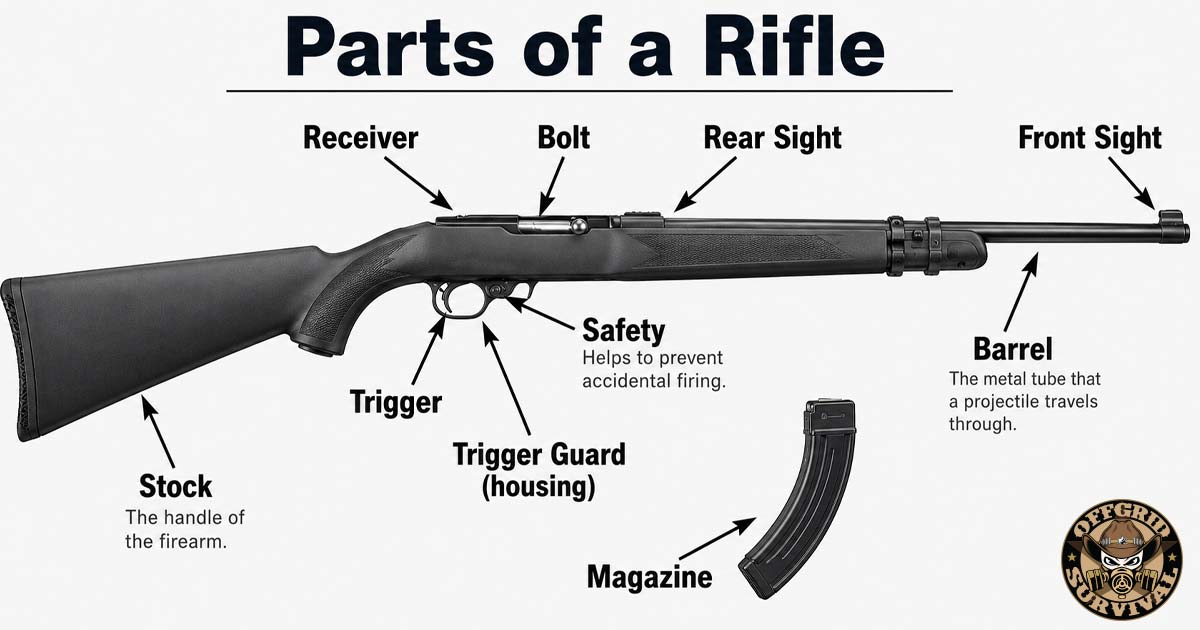
The receiver is the central housing that supports the action and provides attachment points for the other major components. On many traditional rifles it is one assembly. On an AR-pattern rifle it is split in two.
The upper receiver carries the barrel, bolt carrier group, charging handle and handguard. The lower receiver holds the trigger group, safety selector, magazine well, grip and stock attachment.
The bolt carrier group on a typical direct-impingement AR includes the bolt, carrier, firing pin, cam pin and gas key. Piston-operated models use a different arrangement.
The charging handle lets you cycle the action by hand: pull it rearward to open the action, release it and the spring drives the bolt carrier forward. The magazine catch is the assembly that holds the magazine in place, and the release button you press is part of that same assembly rather than a separate part. The bolt catch holds the bolt open on an empty magazine and can also be used to release it.
Pump-Shotgun Parts
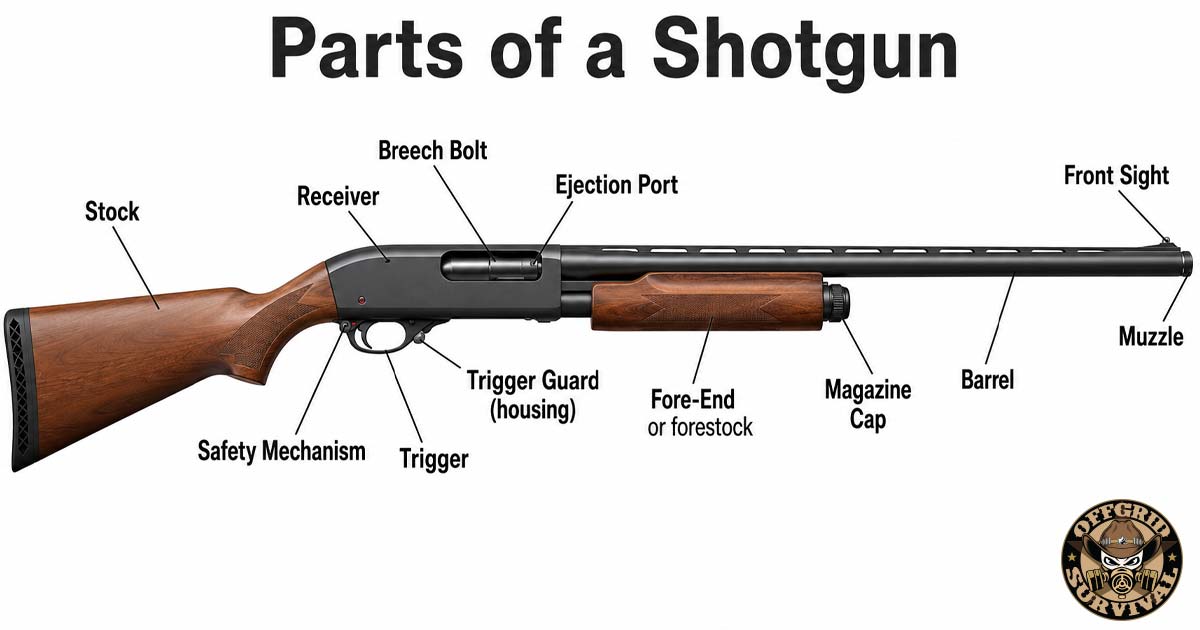
A pump shotgun has a sliding fore-end connected to the action through one or more action bars. Moving the fore-end rearward opens the action, extracts and ejects the fired shell and cocks the firing mechanism.
The magazine tube sits under the barrel on most pump guns. Shells go in through the loading port on the bottom of the receiver, past the shell latch, and a spring and follower inside the tube push them toward the action. The carrier, also called the lifter, raises a shell out of the tube and into line with the chamber, and the bolt drives it forward as you close the fore-end.
Many sporting barrels have a raised rib along the top that provides a sighting plane, usually ending in a front bead. Defensive models often use rifle sights, ghost-ring sights or an optic instead.
A Magazine Is Not the Same Thing as a Clip
Clip and magazine get used interchangeably, but they are different devices.
A magazine is a spring-loaded container that stores cartridges and feeds them into the firearm. It has a body, spring, follower and feed lips. It can be detachable, like a pistol or AR magazine, or fixed, like the tube under a shotgun barrel.
A clip holds cartridges together so they can be loaded into a magazine faster. A stripper clip holds them in a row so you can thumb them down into a magazine in one motion. An en bloc clip is loaded into the gun along with the ammunition and stays there until the rounds are fired or the clip is removed. The M1 Garand is the famous example, and the metallic ping of that clip ejecting is the most recognizable sound in American rifle history. A moon clip holds rimless handgun cartridges in a ring so certain revolvers can load and eject them all at once.
Yes, calling a magazine a clip is technically wrong. It is also not worth acting like an insufferable jackass every time a new gun owner uses the wrong word. Correct the terminology, explain the difference and move on.
The Serialized Frame or Receiver
Under federal law, the frame or receiver is the component legally treated as the firearm. It carries the serial number and manufacturer markings and transfers through a federally licensed dealer when required.
Other parts, including barrels, slides, stocks, grips and many trigger components, can generally be bought without being treated as complete firearms under federal law. That does not make every part unrestricted in every situation, and state law, local law and the final configuration of the gun can all add restrictions on top.
Federal definitions covering frames, receivers, unfinished components and parts kits have been through major rule changes and years of court fights, most recently in Bondi v. VanDerStok, where the Supreme Court rejected a facial challenge to the federal rule in March 2025. Related litigation and rulemaking are still in motion. Anyone buying, finishing or transferring receiver-related components should verify current federal regulations and the laws of his own state first, because a legal mistake there carries consequences a lot worse than ordering the wrong handguard.
Federal law also sets minimum lengths. A conventional rifle generally requires a barrel of at least 16 inches, a conventional shotgun a barrel of at least 18 inches, and both are subject to a 26-inch overall length minimum. Anything shorter may fall under the National Firearms Act. Several states are more restrictive than the federal floor, so never assume that what is legal in one state is legal in the next.
Mechanical Safeties Can Fail
A firearm safety is a mechanical device. Depending on the design it blocks the trigger, sear, hammer, striker or firing pin. It is metal and springs, and it can wear, break, collect debris or be reassembled wrong.
That is why safe gun handling cannot rest on a lever marked “safe.” The mechanical safety is the backup. Your handling is the primary safety system, and it is the only one that does not have parts in it.
The four rules of Firearm Safety
- Treat every firearm as loaded until you personally verify its condition.
- Never let the muzzle point at anything you are not willing to destroy.
- Keep your finger outside the trigger guard until you are ready to fire.
- Know your target and what is behind it.
To verify a magazine-fed gun is unloaded, remove the magazine first. Then lock the action open, look into the chamber and physically check it with a finger when the design allows.
The order matters more than almost anything else in this article. Open the action while a loaded magazine is still seated and the gun ejects the chambered round and immediately feeds another one. Pull the magazine after that, and you are now holding a gun that looks unloaded and is not. That reversed sequence is behind a large share of negligent discharges, most of them committed by people who had handled guns for years. Familiarity builds complacency, and complacency around a firearm kills people just as efficiently as ignorance does.
Learn the Parts Before Something Goes Wrong
You cannot maintain a firearm when you do not know what you are looking at. You cannot describe a malfunction when every failure gets called a jam. You cannot pick the right ammunition when caliber, chambering, gauge and chamber length all blur into the same idea. None of that requires becoming a gunsmith. It requires knowing the components of every gun you own, understanding the operating cycle and recognizing the point where a problem is past your skill level.
Unload the firearm, clear all live ammunition out of the work area and open the owner’s manual. Find the barrel, chamber, muzzle, action, receiver, bolt or slide, extractor, ejector, recoil spring, magazine release and safety system, and put a name on each one. Learn the manufacturer’s field strip and reassembly procedure and run it until you do not need the book. Do that before you are standing at a range with a gun that will not run, before you are describing a broken part over the phone, and long before you are depending on that firearm during an emergency.







This information is really helpful ,espacially for a beginner
please send me the gun and the parts of the gun to 717 juniper st hemet calif 92562
I came to this page for some information on firearm safety before I take a course. Could you please explain the “Is it because I am black?” shirts you have advertised that are worn by two caucasian people. I am not sure what the intent is or how it is related to firearm safety. I do get that it is trying to be funny or piss of liberals as per the company slogan, but what is it that the shirt is asking exactly? Is it funny because the models are white? Does the joke on the shirt work if other ethnicities wear it? Very curious. Take care.