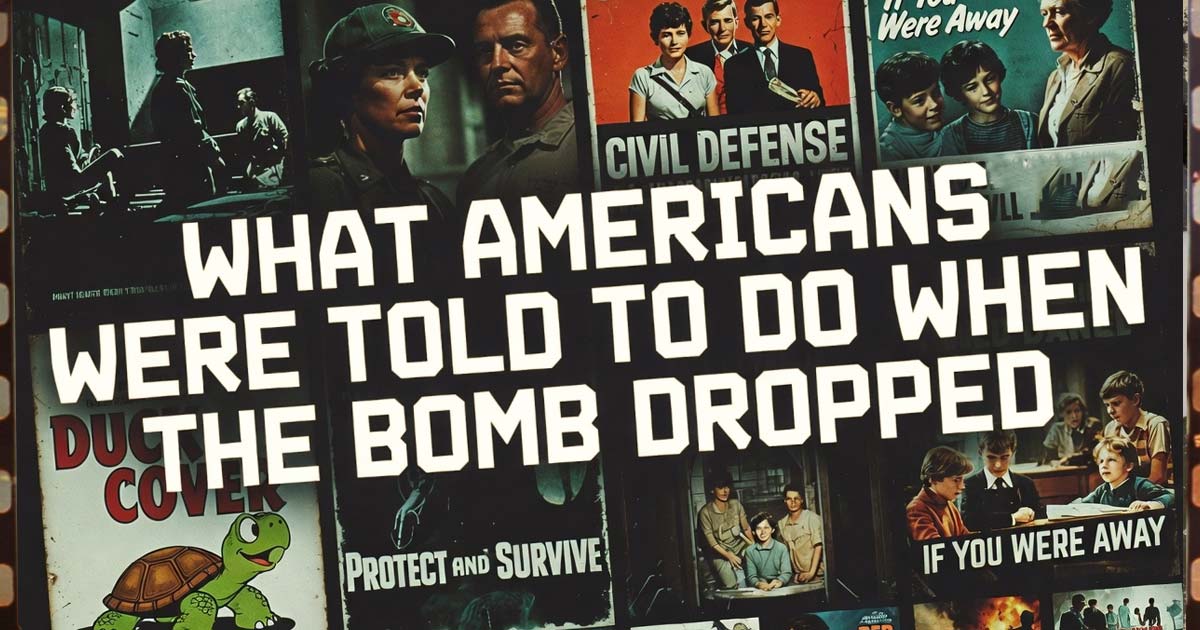
Long before YouTube and emergency alert apps, Americans were taught how to survive nuclear war through government-produced films. (Yes, many view them today as propaganda—blending education with reassurance to maintain public morale amid escalating Cold War fears.)
These weren’t fringe materials. They were shown in classrooms, community centers, factories, and living rooms. Millions of people—adults and children alike—were trained to respond to the unthinkable using calm voices, authoritative narration, and carefully controlled messaging.
What makes these films worth revisiting today isn’t nostalgia. It’s perspective.
They show how the threat of nuclear war was explained to the public, what information was emphasized, and just as importantly, what was left out. They also reveal how civil defense messaging balanced survival guidance against morale, productivity, and social order during the Cold War.
Below are three historically significant civil defense films, presented in full and without edits, so you can see exactly what Americans were told to do if an atomic bomb dropped:
- Survival Under Atomic Attack (1951) – An early guide emphasizing calm, sheltering in place, and quick return to normal duties amid blast and radiation threats.
- Atomic Alert (Elementary Version, 1951) – This 1951 public-domain civil defense film, produced by Encyclopaedia Britannica Films, was made specifically for elementary school children.
- Self-Preservation in an Atomic Bomb Attack – 1950s film from Cascade Pictures, sponsored by the Armed Forces Special Weapons Project, was one of a series produced for general information on atomic weapons defense.
- Radiological Defense (1961) – A detailed explanation of radioactive fallout dangers, monitoring, decontamination, and why it was portrayed as survivable with proper preparation.
- Duck and Cover (1952) – The iconic animated film featuring Bert the Turtle, widely screened in schools to teach children immediate response to a nuclear blast.
- Protect and Survive: What to do in the event of a nuclear attack (1978) – A collection of videos from the UK Governments Protect and Survive campaign in the late 1970s and early 1980s.
Survival Under Atomic Attack (1951)
Released in 1951 by the U.S. Office of Civil Defense, Survival Under Atomic Attack was one of the earliest attempts to explain nuclear weapons to the general public.
The film focuses on blast effects and radiation exposure while repeatedly urging Americans to remain calm and stay where they are. Homes, offices, and factories are described as “posts of duty,” reinforcing the idea that continuity mattered as much as personal safety.
What stands out today is the confidence behind the advice. Viewers are shown people sheltering under furniture, behind walls, or in street gutters as if nuclear detonation were a survivable inconvenience rather than a civilization-altering event.
The film is a snapshot of early Cold War thinking—when nuclear weapons were terrifying, but their long-term consequences were still poorly understood by the public.
Atomic Alert (Elementary Version, 1951)
This 1951 public-domain civil defense film, produced by Encyclopaedia Britannica Films, was made specifically for elementary school children.
It teaches kids what to do during an atomic bomb alert or surprise attack—at school, home, or outside. Instructions are simple: take cover, protect your head and neck, and obey teachers or adults.
The film even gives a basic explanation of nuclear weapons (including a simplified nod to fusion) so children can “understand” the threat without panicking.
Serious, calm, and straightforward, it treats nuclear attack drills like everyday safety procedures.
Self-Preservation in an Atomic Bomb Attack (1950)
This 1950 public-domain film from Cascade Pictures, sponsored by the Armed Forces Special Weapons Project, was one of a series produced for general information on atomic weapons defense.
A sergeant eases three recruits’ atomic fears with straightforward advice: hit the ground at the flash, use any cover against blast and heat, avoid looking at the fireball, and shelter indoors or in ditches until the danger passes.
Radiological Defense (1961)
By the early 1960s, the government’s message had shifted.
The blast was no longer the primary focus. Nuclear Fallout was.
Radiological Defense explains how radioactive fallout could spread across cities, farmland, highways, and entire regions of the United States. Viewers are shown animated contamination maps, Geiger counters, evacuation scenes, fallout shelters, and radiation monitoring efforts.
The tone is more serious and more technical than earlier films, but the underlying message remains the same: fallout is dangerous, but manageable—if people follow instructions and trust the system.
What’s unsettling in hindsight is how orderly fallout is portrayed. Radiation becomes something that can be measured, mapped, and controlled, even as the film quietly acknowledges that vast areas could be affected for extended periods.
Duck and Cover (1952)
Perhaps the most disturbing films from he cold war era, Duck and Cover was created specifically for children.
Using animation and live-action footage, the film introduces Bert the Turtle, a cartoon character who survives danger by retreating into his shell. Children are taught that when they see the flash of an atomic bomb, they should immediately duck down and cover themselves—under desks, against walls, or wherever they happen to be.
The goal was repetition and automatic response.
What makes Duck and Cover disturbing today isn’t the cartoon—it’s the audience. Children were being trained to respond calmly to an existential threat without being given context, scale, or honest discussion of fallout, radiation sickness, or long-term survival.
In 2004, the film was selected for preservation in the National Film Registry for its cultural and historical significance.
Protect and Survive: What to do in the event of a nuclear attack (1978)
Produced by the British Home Office in the late 1970s and early 1980s, the “Protect and Survive” films and pamphlets were the UK’s official response to the growing threat of all-out nuclear war.
Meant for broadcast only when attack was imminent, these short, calmly narrated films cover building an inner refuge at home (using doors, books, and mattresses), stocking supplies, surviving fallout, sanitation without services, handling bodies, and maintaining public order afterward.
The tone is deliberately flat and procedural—almost bureaucratic—describing horrific scenarios with minimal emotion, which made the series infamous when leaked to the public.
From Nuclear Reassurance to Reality: What’s Changed Since These Films
These old films really show how governments tried to talk about nuclear bombs and fallout risks back then—packaging terrifying stuff into calm, simple messages to keep everyone from panicking. Watching them now, knowing what we actually know about radiation, fallout, and what happens when the grid goes down for good, you can’t help but notice how big the gap was between what they said and what would really happen.
If you want straightforward, no-BS info on modern nuclear preparedness—real fallout risks, effective sheltering, dealing with long-term power loss, keeping food and water safe, and surviving well past the first week—check out our full guide here: