
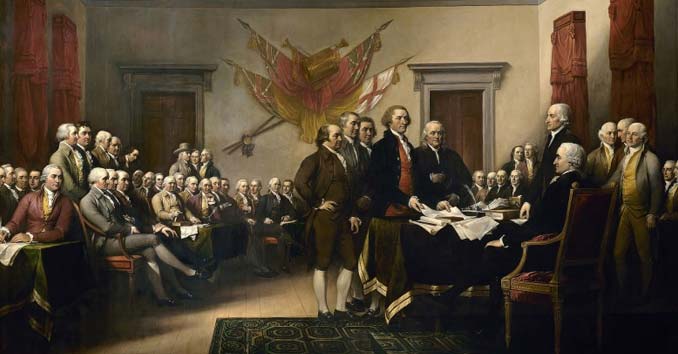
Today when we talk about Patriotism, a lot of people fail to understand what that actually means. But on this day in 1776, 56 brave men put their lives on the line when they signed their names to an enlarged copy of the Declaration of Independence.
Those Fifty-six congressional delegates put their lives, their fortunes, and their families on the line that day – all for the cause of liberty and freedom.
Of the 56 men who signed the Declaration:
- 12 fought in battles as members of state militias
- 5 were captured and imprisoned during the Revolutionary War
- 17 lost property as a result of British raids
- 5 lost their fortunes in helping fund the Continental Army and state militias fight the British.
Here are just a few examples of the sacrifices these men made:
Abraham Clark, delegate for New Jersey to the Continental Congress, saw two of his sons captured by the British. They were captured, tortured, beaten and incarcerated on the prison ship Jersey. John Witherspoon, delegate from New Jersey to the Second Continental Congress, lost a son during the Battle of Germantown in 1777.
Five signers of the Declaration of Independence were captured and imprisoned by the British during the Revolutionary War.
- George Walton was captured after being shot while commanding militia at the Battle of Savannah in December 1778.
- Thomas Heyward, Jr., Arthur Middleton, and Edward Rutledge served in defense of Charleston. They were taken prisoner at the Siege of Charleston in May in 1780. During the imprisonment, Heyward’s wife died at home, and his estate and property were heavily damaged. Rutledge’s family sold much of their belongings to reunite with him after his release.
- On November 30, 1776, Richard Stockton was dragged from his bed in the middle of the night, stripped of his property, and marched to Perth Amboy where he was put in irons, and brutally tortured by the British. He was then moved to Provost Prison in New York, where he was starved and forced to live in freezing conditions until Gen. Washington helped secure his parole.
Many of the Signers either lost their homes or had their property stolen and vandalized by the British:
- Francis Lewis lost his Whitestone, New York home to the British who raided and destroyed the home. His wife was also arrested and denied a change of clothing or adequate food for weeks while in captivity. Her hardships in captivity ruined her health and led to her death in 1779.
- John Hart was forced from his home and lived for some time on the run from the British.
- Lewis Morris lost his home and much of his wealth during the revolution. His property was looted and burned by the British when they occupied New York.
- Philip Livingston lost several properties to the British during their occupation of New York.
- In 1781, Thomas Nelson’s home was taken over by Cornwallis, who used the home as his headquarters. According to legend, Nelson had General Washington fire on his own home to take out Cornwallis.
- Carter Braxton invested much of his wealth in the American Revolution and lost much of it in the process. Braxton loaned a great deal of his own money to the cause, and funded shipping and privateering (and lost about half of the 14 ships in which he held interests). According to his family, Henrico County Sheriff Samuel Mosby was at Braxton’s door attempting to collect debts when he died on October 10, 1797.
- Lyman Hall was accused of High Treason by the British. His property in Savannah was burned to the ground, and he had to flee to Connecticut.
After the Revolution, there dedication to the country didn’t get wavier.
- 13 signers went on to become governors.
- 18 served in their state legislatures.
- 16 became state and federal judges.
- 7 became members of the U.S. House of Representatives.
- 6 became U.S. senators.
- James Wilson and Samuel Chase became Supreme Court justices.
- Jefferson, Adams, and Elbridge Gerry each became vice president.
- Adams and Jefferson went on to become president. Adams and Jefferson both died on July 4, 1826, the 50th anniversary of the Declaration of Independence.
The 56 Patriots who put it all on the line for FREEDOM
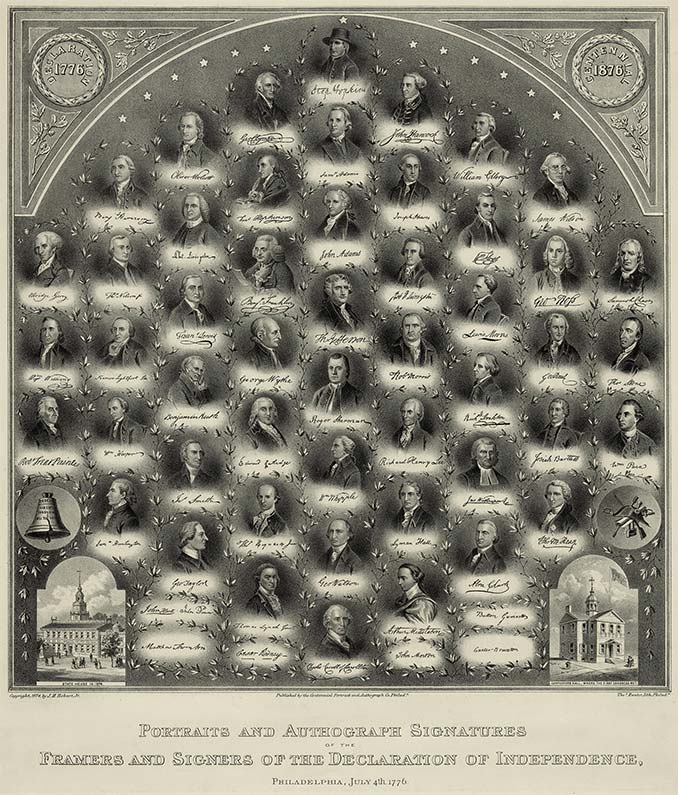
Delaware:
George Read | Caesar Rodney | Thomas McKean
Pennsylvania:
George Clymer | Benjamin Franklin | Robert Morris | John Morton | Benjamin Rush | George Ross | James Smith | James Wilson | George Taylor
Massachusetts:
John Adams | Samuel Adams | John Hancock | Robert Treat Paine | Elbridge Gerry
New Hampshire:
Josiah Bartlett | William Whipple | Matthew Thornton
Rhode Island:
Stephen Hopkins | William Ellery
New York:
Lewis Morris | Philip Livingston | Francis Lewis | William Floyd
Georgia:
Button Gwinnett | Lyman Hall | George Walton

Virginia:
Richard Henry Lee | Francis Lightfoot Lee | Carter Braxton | Benjamin Harrison | Thomas Jefferson | George Wythe | Thomas Nelson, Jr.
North Carolina:
William Hooper | John Penn | Joseph Hewes
South Carolina:
Edward Rutledge | Arthur Middleton | Thomas Lynch, Jr. | Thomas Heyward, Jr.
New Jersey:
Abraham Clark | John Hart | Francis Hopkinson | Richard Stockton | John Witherspoon
Connecticut:
Samuel Huntington | Roger Sherman | William Williams | Oliver Wolcott
Maryland:
Charles Carroll | Samuel Chase | Thomas Stone | William Paca





This is the best article I have ever read.
Thank you.
Excellent summary. Excellent. I’d like to add a quote from a great book, Rebels and Redcoats (1957) that is, as the cover says, “an eyewitness account of the American Revolution taken directly from letters, diaries, journals, and battlefield reports.”
This account is from the battlefield journal of a young Irish colonel, John Fitzgerald, written on December 25 and 26, 1776, as General Washington readied his men to cross the Delaware and attack the Hessian troops in Trenton, NJ.
“Christmas, 6 P.M.–The regiments have had their evening parade, but instead of returning to their quarters are marching toward the ferry. It is fearfully cold and raw and a snowstorm is setting in. The wind is in the northeast and beats in the faces of the men. It will be a terrible night for the soldiers who have no shoes. Some of them have tied old rags around their feet; others are barefoot, but I have not heard a man complain. They are ready to suffer any hardship and die rather than give up their liberty. . . .
Dec. 26, 3 A.M.–I am writing in the ferry house. The troops are all over, and the boats have gone back for the artillery. We are three hours behind the set time. Glover’s men have had a hard time to force the boats through the floating ice with the snow drifting in their faces. I have never seen Washington so determined as he is now. He stands on the bank of the river, wrapped in his cloak, superintending the landing of his troops. He is calm and collected, but very determined. The storm is changing to sleet and cuts like a knife. The last cannon is landed, and we are ready to mount our horses.
Dec. 26, noon–It was nearly four o’clock when we started. The two divisions divided at Bear Tavern. At Birmingham, three and a half miles to the south of the tavern, a man came with a message from General Sullivan that the storm was wetting the muskets and rendering them unfit for service.
‘Tell General Sullivan,’ said Washington, ‘to use the bayonet. I am resolved to take Trenton.'”
This was Washington’s first victory after the signing of the Declaration, and it proved to the world that citizen soldiers could win against trained fighting men.
So here’s a thought: Are we in the 21st century ready to suffer any hardship for our freedom? Would we march into battle barefoot through a snowstorm rather than give up our liberty? Would we?
Yes we would. Our liberty is our principal motivation for survival.
Yes we would die for our liberty it is our principal motivation for fighting for survival
Yes we would die for our Freedom and Liberty as Sovereign beings under God.