
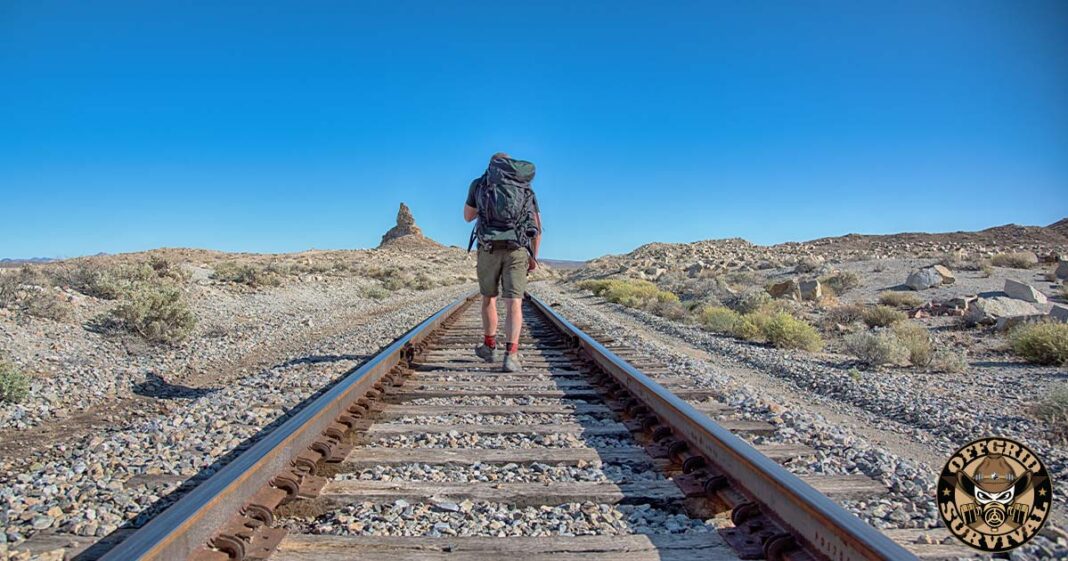
Everybody talks about bugging out. Almost nobody has actually tested whether they can.
That reality is the most dangerous part of the entire bug-out fantasy. People picture themselves slipping into the tree line with a 50-lb pack, living off the land, melting into the wilderness like some kind of trained operator — and they’ve never once carried that pack more than the distance from the truck to the trailhead.
It’s one thing to talk about bugging out. It’s another thing entirely to carry a loaded pack 10-15 miles a day, in bad weather, on no sleep, while scared. That’s the test almost nobody runs before they need to pass the exam!
The Fantasy vs. the Reality
Go read the comment section on any bug-out article on a prepper site and you’ll see the same split every time. Half the people are confident they’ll “head for the hills” the second things go bad. The other half — usually the ones who’ve actually spent real time in the woods — are trying to talk them down.
One reader summed it up about as bluntly as it gets: most of the bug-out-to-the-hills crowd will not make it 30 days. Not because the gear failed. Because living in the woods is hard, even for people with real woodsman skills, and the fantasy of disappearing into the wilderness alone rarely survives contact with the actual wilderness.
That’s not pessimism. It’s the same warning we give in our own bug out planning resource guide: planning to live off the land without ever having done it before is not going to work. Don’t be one of those people who thinks he’s going to be some wilderness nomad wandering the countryside— bugging out without a place to go isn’t a plan, it’s just being a refugee with a backpack.
The Numbers Nobody Plans For
Here’s a useful exercise: figure out how far you can actually walk in a day, carrying everything you own, on unfamiliar terrain, with no support vehicle. Most people who’ve never tried this guess high. The real number, for most out-of-shape adults carrying a 30-40 lb pack, is a lot closer to 8-10 miles a day than the 20+ they picture in their head — and that’s before you factor in injury, bad weather, exhaustion, or having kids or elderly family members with you.
That distance problem alone is why we built an entire breakdown on how far you can realistically walk in a day when bugging out into our main planning guide — because the gap between the number in your head and the number your body can actually deliver is exactly where bug-out plans fall apart.
Backpacking Is the Closest Thing to a Real Test You’ll Get
You can never fully simulate a real bug-out situation. But backpacking — actual, multi-day, pack-on-your-back backpacking — is the closest thing most people will ever do to a dress rehearsal, and it tells you things no amount of gear shopping ever will.
It tells you how your body actually responds to carrying weight over real distance and real terrain — not how you imagine it will respond. It tells you how much ground you can realistically cover in a day, which is almost always less than you think. And it exposes every weak point in your plan before your life depends on it being right.
Having an evacuation plan is great. Have you ever actually walked it?
If the answer is no, you don’t have a bug-out plan. You have a bug-out idea. Those are not the same thing, and the difference only becomes obvious at the worst possible time.
Hit the Trail. Take Notes. Treat It Like Homework.
- Walk the actual route you plan to take, not a route that looks similar on a map.
- Figure out — for real, with a loaded pack — how far you can comfortably cover in a day.
- Note every natural resource along the way: water sources, treeline cover, places you could shelter.
- Identify chokepoints, hazards, and anywhere you’d be exposed or vulnerable.
- Mark watering holes and possible emergency shelter spots on a physical map, not just your phone.
This is also where a real bug-out location matters. Walking toward “somewhere in the woods” isn’t a plan — walking toward a specific, scouted, known destination is. Our guide on finding the right bug out location goes deeper into what separates an actual destination from wishful thinking.
Test Your Gear Now, While Your Life Isn’t on the Line
The single worst time to discover that a piece of gear doesn’t work is during the emergency it was bought for.
Every weekend you spend in the field is a chance to find out which parts of your kit are dead weight. Ask yourself, honestly, after every trip:
- How easy was this to actually use, under real conditions — not in your living room?
- Did you use it at all, or did it just ride in the bag the whole trip?
- Was there something you needed and didn’t have?
A lot of bug-out bags are built off checklists copied from the internet, never field tested, and packed with gear the owner has never once used outside the box. That’s not preparedness. That’s an expensive guess. If you want a real starting point, our Budget Bug Out Bag gear list and our full Bug Out Bag resource guide cover what’s actually worth carrying versus what just adds weight.
The Part Nobody Wants to Talk About: Your Mind Breaks Before Your Legs Do
Gear gets all the attention. It’s also not what fails first.
Adrenaline narrows your focus and wrecks your judgment. Kids cry, spouses argue over priorities, someone in the group shuts down entirely — and panic spreads through a group faster than exhaustion ever will. Bugging out means losing your home, your routine, and your sense of safety all at once, and that hits people harder than a sore back ever could.
This is the piece that gets skipped in almost every bug-out conversation, and it’s arguably the most important one. We go into this in detail in our mental and psychological preparedness section of the main bug-out planning guide — covering decision-making under stress, keeping a family or group functional when everyone’s scared, and what disaster-related stress actually does to people who weren’t prepared for it mentally, even when they were prepared for it physically.
So Are You Actually Prepared?
If your bug-out plan exists entirely on paper — or worse, entirely in your head — the honest answer is no. Not yet.
A real plan has been walked. The gear has been used, not just bought. The distances have been tested with a loaded pack on real terrain, not estimated from a couch. And somebody in your group has thought seriously about what happens to morale and decision-making when things go sideways, because that’s usually what breaks first, not the supply line.
None of that requires a doomsday mindset. It requires a few weekends. Start with a short trip on your actual planned route, log what goes wrong, fix it, and go again. For the rest of the planning — bug-out bags, vehicles, locations, self-defense considerations, and a full breakdown of the disaster scenarios that actually trigger evacuations — our complete Bug Out resource hub has the rest of what you need to turn the idea into an actual plan.

Have you run a real bug-out drill? What broke first — your gear, your legs, or your plan? Drop it in the comments.





12 miles once a month all your stuff. Tells the truth of things related.
Vic
I use my gear on a weekly bases…In wooded terrain i can cover 3-4 miles a day at best at the age of 46 I’m slower then when i was young but still a slow pace is better… my hunting gear and pack is heavy at 65 lbs. setting camp every night the kit has been culled of the unnecessary gear..it’s down to the basic water,shelter,fire and food the gear is sufficient for survival the rest comes from knowledge of your surroundings…and your right.. believe me it ant easy but I’m not the urban couch potato i been using my gear for 30 years in the heat and cold….
I like to do flash packing drills…timing just how long it takes me pack and haul ass…I have a bug out spot that I love, but need to make an alternate just in case.
Do you have a BOB R2G? Or do you just have the gear and see how quick you can get it all together?
Ha! Us Old Schoolers knew about this 25 years ago…I even have my Alpenlite Backpack and all the gear….years of testing too!!
Why do so many focus on “bugging out” to wilderness areas? If I were to bug out, as it were, despite being one to enjoy outdoor pursuits the “woods” aren’t where I’d go. Even Charles Ingalls took a wagon, oxen, and period construction equipment.
Granted, some live in extremely large urban environments so large in scale that you cannot even drive through in an hour, but I’d bet most reading this blog are not in that subset.
How about a hotel for a while or a family or friend’s house in another area? If I had to leave my home, for a short scale retreat, I’d merely drive 40 minutes (across a rural area) to the family home. If that weren’t far enough I suspect I’d just go hit up the first clean hotel I found. Alas, I guess many will lament that an EMP, urban mobs, injury, or some other misfortune will be the counter to this more reasonable approach.
My bug out/EDC vehicle bag contents have a fundamental supply of wilderness-oriented goods, but I’ve got probably the only bag I’ve seen that includes the complete array of hygiene items and urban necessities (compact power strip/surge protector for instance).
Hey Brian,
I can not speak for everybody, but the reason I am prepared to go out into the wilderness is my attempt at being prepared for the worse case scenario. I have no idea what kind of emergency will force me to flee my home, but I know when people are desperate for food and water they will do anything. By getting away from people you can mitigate the risk of people stealing what you have.
I honestly feel that most of the bug out to the hills crowd will perish within 30 days. Not all, but most. Living in the woods is hard at best, especially people with no real woodsmen skills. It makes for a nice dream, but not much else.
You really need to be preparred for the woods, as you will not be alone once it really starts. At minimum, there will be hundreds of thousands if not millions of people trying to join you and even bambi will get out of dodge so to speak.
in my opinion if you truly want to survive you will not stay in any one place for any length of time doing so only makes you a target yes it would be nice to have everything you need in one place but realistically its not possible being nomadic and scavenging what you can and i dont mean stealing from others is realistic even thou we are the top of the food chain look at nature they move to survive no matter how well fortified your structure it can be breached or even better you could easily be trapped inside if they cant get in to get what they want do you think they will just leave i think not people are vengeful and greedy thats alot of why we are in this mess right now it will be a dog eat dog world and i for one do not plan on sitting in one place waiting to be picked apart just look to the past at all of our ancestors before so called civilization in one way or another they all moved with the food supply and changing of the seasons for one i think if they cant loot what you have they will burn you out or trap you inside and unless you can live in a hole indefiniely which in my opinnion is no way to live at all i would rather be moving and i mean on my own two legs i for one will be one of those crazies running to the woods i grew up hunting fishing and camping with only my knife and a pole in the mountains and have no fear of being able to survive in this way i see everyone here talking about what you need to survive growing up not having so much has made me realize its not what you have to survive its your will to survive and your knowledge god has given us everything we need to survive but we made the tools
Take it easy on the abbreviations. What does MBOs stand for?
Why do people handicap the English language?
I agree. Use abbreviations when it helps communicate with everyone you are trying to communicate with but if it hinders that attempt you are missing the mark with your words.
MBO? mini bug out?
Mock Bug Out
I hike, backpack, and exercise as often as I can to prepare for my bugging out. Unfortunately, I’m still in high school so ‘as often as I can’ is a backpacking trip once or twice a month, survival experiments in the summer, and serious exercise on the weekends. I’m worried that the dollar may collapse and force me to bug out before I can accumulate top-quality survival gear. Anyway, the economy is gonna collapse soon in the US, which will have detrimental effects on other economies as well. Even if our time for training is limited, we should make sure we train as often as possible :0 We don’t want to get left behind in a few years when ‘SHTF’.
I would go to the woods but most people could not survive and that is fine by me I know what plants I can and can’t eat I know what mushrooms I can and can’t eat I have been a hunter for most my life and fishin most my life a huge portion of the food I eat comes from the woods whether it be from huntin fishin or foraging I will keep myself and family fed