
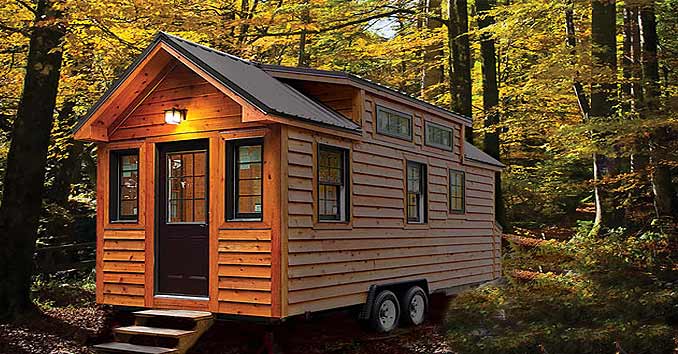
I first wrote about this back in 2012, after seeing a story about a family who rebuilt their life after losing their home and business in the recession by building a tiny home. The tiny home movement has changed a lot since then — the legal landscape, the costs, and honestly the whole conversation around what these things are actually good for. So this is a full update, not just a touch-up.
Tiny homes have been growing in popularity for well over a decade now, as more people decide to downsize their lifestyle to stay ahead financially or simply own something outright instead of carrying a 30-year mortgage. By avoiding high rental costs, excessive mortgage payments, and soaring energy bills, tiny home owners save real money and have redefined what it means to live frugally.
What counts as a “tiny home” now
Back when I first wrote this, “tiny home” mostly meant whatever a particular builder decided to call their project — there was no formal definition, and that lack of clarity is part of why so many tiny home owners ran into trouble with their counties. That’s changed. In 2018, the International Residential Code, the model building code adopted in some form by 49 states, added Appendix Q specifically to address tiny homes: a dwelling of 400 square feet or less (not counting lofts), with relaxed requirements around things like compact stairs, ladders instead of stairs to a sleeping loft, reduced ceiling heights in lofts, and emergency escape openings.
That might sound like a minor bureaucratic detail, but it’s actually the single biggest legal development in the tiny home world since the movement started. Before Appendix Q existed, a tiny home builder had no clear path to code compliance — they were trying to fit a dwelling into a code written entirely around conventional-sized houses, with stair and ceiling height requirements that simply don’t work in 150 square feet. Appendix Q gives jurisdictions a ready-made, ICC-approved framework to adopt if they choose to allow tiny homes as legal dwellings.
The catch — and it’s a real one — is that appendices aren’t automatically part of the code just because a state uses the IRC. Each state, county, or city has to specifically adopt Appendix Q on top of the base code for it to apply locally. Some states have adopted it statewide. Many others leave it up to individual counties, which means your neighbor two counties over might be fully legal building exactly what would get you a stop-work order. This patchwork is exactly what tripped up several people in the comments on the original version of this article — permits denied, code enforcement showing up mid-build, six-figure compliance demands for a 188-square-foot cabin. None of that was paranoia or bad luck; it was the predictable result of trying to build something the local code had no category for.
There’s also a second, separate legal track worth understanding: tiny homes on wheels versus tiny homes on a foundation. A tiny home on a foundation is real property, subject to building codes (including Appendix Q where adopted) and local zoning. A tiny home on wheels is generally classified as personal property, similar to an RV, and often falls under RV or “park model” standards (ANSI 119.5) rather than residential building code at all. That distinction matters enormously for financing, insurance, taxation, and whether you’re even allowed to live in it full-time on a given piece of land. Some jurisdictions are starting to bridge the two — San Diego County, for example, issued a determination in 2025 confirming that wheeled tiny homes meeting park model standards can qualify as legal dwellings under its zoning code — but that kind of clarity is still the exception, not the rule, across most of the country.
What it actually costs in 2026
The economics have shifted since 2012 too, and not entirely in the direction you’d expect. A fully built tiny home today typically runs $30,000 to $70,000 for a standard build, with bare-bones DIY shells starting lower and fully custom, professionally built units with off-grid solar and high-end finishes climbing past $150,000.
Here’s the part that surprises people: tiny homes usually cost more per square foot than a conventional house, not less — typically somewhere in the $200 to $400 per square foot range, against roughly $150 to $200 per square foot for a standard new home. The reason is straightforward once you think about it. A tiny home still needs a full kitchen, a bathroom, an electrical panel, plumbing, and some kind of heating and cooling system — the same expensive systems a 2,500-square-foot house needs — just packed into a fraction of the space. Those fixed costs don’t shrink proportionally with the square footage, so the per-square-foot price goes up even though the total price goes down.
That’s the real value proposition of a tiny home: not a lower cost per square foot, but a dramatically lower total cost, because you’re simply buying so much less of it. A $50,000 tiny home is still a small fraction of the median price of a conventional American home, which is well north of $400,000 as of early 2026.
If you’re building it yourself, expect real labor, not a weekend project — most realistic DIY timelines run 500 to 1,000 hours of work over six months to a year, depending on your skill level and how much time you can put in each week. Hiring it out professionally compresses that to two to four months, at a meaningful cost premium.
Is a tiny home actually a good bug out vehicle?
This was the original framing of this article back in 2012, and it’s worth being more careful about it now than I was then. A tiny home on wheels is not the same thing as a “mobile” bug out vehicle in the sense most preppers mean that term. You can’t just hitch up and drive off in an emergency the way you could with an RV or a truck camper. A tiny home on a trailer is heavy — often 10,000 to 16,000 pounds fully built out — requires a properly rated tow vehicle, takes real time to break down and secure for travel, and isn’t designed for frequent road trips the way an RV is. Several people in the comments on the original version of this article made exactly this point, and they were right to.
Where a tiny home does make sense in a preparedness context is as a low-cost, semi-permanent retreat structure — something you can park on a piece of rural land you own, fully off-grid if you choose, without the cost or permitting burden of a full-size home. Think of it less as “the vehicle you escape in” and more as “the affordable shelter waiting for you at the place you’d go.” That’s a meaningfully different use case, and it’s the one tiny homes are actually good at.
- Low operating cost. A small, well-insulated structure is cheap to heat and cool, and pairs naturally with a modest solar setup since the total power draw is so much lower than a conventional home.
- Lower barrier to entry. $30,000 to $70,000 cash is a realistic savings goal for a lot of people in a way that a $400,000+ conventional home purchase simply isn’t.
- Can be sited on land that wouldn’t support a full build. Smaller footprint, lighter foundation requirements (where on a foundation at all), and lower utility demand all make tiny homes a fit for marginal or remote parcels that would be expensive or difficult to develop conventionally.
The real limitations are also worth being honest about:
- Storage is the recurring complaint, and it’s a fair one. Several long-time commenters on the original article made this point and they’re right: a serious preparedness setup involves food storage, tools, fuel, and gear that simply doesn’t fit in 200 square feet. A tiny home works much better as one structure in a small cluster — paired with a shed, a root cellar, or a storage container — than as the sole structure on a property meant to support long-term self-reliance.
- Financing and insurance are still genuinely difficult. Most conventional mortgage lenders won’t finance a structure this small, and tiny homes on wheels in particular often don’t qualify for standard homeowners insurance, since insurers tend to treat them more like RVs. Expect to pay cash, use a personal loan, or work with one of the smaller number of lenders who specialize in tiny home financing.
- Zoning is still the single biggest obstacle, even with Appendix Q’s progress. Plenty of counties still have minimum dwelling size requirements well above 400 square feet, and a tiny home — especially one on wheels — can run straight into those rules regardless of how well-built it is. This is exactly what happened to several people in the comments below: permits denied, structures red-tagged, thousands of dollars in compliance demands for systems (full septic, grid electrical hookup) that defeated the entire purpose of building small and self-sufficient in the first place.
Climate matters more than people expect
One thing the original article never addressed at all, and that the comments kept circling back to without an answer, is how much your climate should shape the build itself. A commenter on the original piece pointed out that most travel trailers aren’t built for cold weather, and that’s exactly right — there’s a real difference between an RV-style shell and a properly insulated tiny home, and conflating the two is a common and expensive mistake.
Cold climates need real wall, floor, and roof insulation rated for the local climate zone, not the thin RV-grade insulation that comes standard on a lot of trailer-style builds. Pay particular attention to the floor, since it’s the part most often skimped on and the part most exposed to cold air underneath a wheeled structure. A skirting system around the base, even a simple one, makes a meaningful difference in keeping pipes from freezing and cutting heating costs. Plan your water lines so they can be insulated and, ideally, drained easily if you’ll be away during hard freezes.
Hot, humid climates flip the priority toward ventilation and moisture control. A small, tightly sealed structure can trap humidity fast, which becomes a mold problem in a hurry given how little air volume there is to begin with. A dedicated ventilation fan, ideally with a humidity sensor, is worth the cost. Light-colored or reflective roofing cuts cooling load significantly, which matters even more in a tiny home since a mini-split or window unit is doing all the work with no buffer from a large interior air volume.
Anywhere with real seasonal swings benefits from sizing the loft and window placement around passive solar gain, the same basic principle behind a well-designed earthship: south-facing glass to catch winter sun, properly placed overhangs to block high summer sun. It’s a much smaller-scale version of the same idea, but it works the same way and meaningfully reduces how hard your heating and cooling system has to work.
Financing and insurance, in more detail
This deserves more than a passing mention, because it trips up more would-be tiny home owners than almost anything else on this list.
Conventional mortgages are built around minimum loan amounts, often $50,000 to $100,000, and many lenders simply won’t underwrite a structure this small or this unconventional, regardless of how well it’s built. A small but growing number of credit unions and specialty lenders now offer tiny-home-specific loans, but expect a higher interest rate than a conventional mortgage and a shorter loan term, similar to financing for a manufactured home or a large RV. Personal loans, a HELOC against an existing property, or straightforward cash savings remain the most common ways people actually fund these builds.
Insurance follows a similar pattern. A tiny home on a permanent foundation, built to residential code, can often be insured under a standard or near-standard homeowners policy. A tiny home on wheels usually can’t — insurers tend to treat it like an RV or travel trailer, which means a different kind of policy, different coverage limits, and sometimes different requirements about how many days a year you can occupy it before it’s considered a primary residence rather than a recreational vehicle. If full-time living is the plan, say so explicitly when shopping for a policy; getting this wrong is the kind of mistake that only becomes obvious after a claim gets denied.
What about resale?
Worth a quick, honest note here too: tiny homes generally don’t appreciate the way conventional real estate does, and resale can be slow simply because the buyer pool is smaller. A tiny home on wheels depreciates more like an RV than a house. A tiny home on a foundation, on owned land, holds value better, closer to how a small conventional home would, since the land itself can appreciate even if the structure doesn’t. If resale value and long-term equity building are a priority for you, factor that into the decision now rather than after you’ve built — it shouldn’t be the deciding factor, but it shouldn’t be a surprise either.
Before you build: what to actually check first
If you’re seriously considering this, the order of operations matters more than almost anything else:

- Call your county planning and zoning office before you buy land or materials. Ask specifically whether they’ve adopted Appendix Q, what their minimum dwelling size is, and whether they distinguish between a tiny home on a foundation versus one on wheels. Get this in writing if you can.
- Confirm what classification you’re building under. A tiny home on wheels built to RV/park model standards is a completely different legal and insurance category than one built to residential code on a foundation. Decide which one you’re actually doing before you start, not after.
- Budget for the systems, not just the shell. A weathertight shell is often the cheapest part of the build. Off-grid solar, water catchment and filtration, and wastewater systems (especially anything beyond a simple composting toilet) can rival or exceed the cost of the structure itself.
- Plan for where it’s going to sit long-term, not just where you’ll build it. Land you can legally and practically place a tiny home on, with the access, utilities, or off-grid systems you’ll actually need, is a separate problem from the build itself — and often the harder one to solve.
In my opinion, tiny homes are still a solid option for both off-gridders and preppers — just not for the reasons the “mobile bug out location” framing originally suggested. They’re a genuinely affordable way to own a self-sufficient structure outright, free of a 30-year mortgage. Just go in with a realistic plan for storage, a clear-eyed read on your local zoning, and the understanding that “tiny” and “easy to relocate on short notice” are not the same thing.




Hats off to that young man for already being financially and environmentally responsible, I can see he will go far. His can-do attitude makes me want to start getting on with building my tiny-home.
I have to second that!! He shows real initiative. The idea of a tiny home, to me, is a GREAT idea. It has the advantages of mobility and the costs are affordable.
I love these little tiny homes. Back 50 years ago the average house had about half the square footage of today’s homes and people did just fine. I could totally see living in one of these out in the middle of the forest somewhere.
And Bravo to the 16 year old in the video. It’s good to see that not all kids are complete morons.
Next you know the lame Obama admin, will call them 5150 and they will find a way to kick and or ban these tiny homes. I wouldnt mind living in one because i been feeling like a gypsy for the last three years traveling up and down communist california
Wow they really pack a lot into a small place. just goes to show how little we actually need and how bad peoples spending habits have become. Bet these people have far less stress.
I like the idea of tiny homes can be built for a lit less than 10k. I have plans for a 12×16 “barn style” shed (with a loft area). I just talked with Home Depot, and to frame/roof/floor, etc will cost approx $2,500. then, if ur smart, check out Craigslist for the rest: windows, sink, drywall, etc. Scavenge batteries and solar AND wind/water turbines. Sure, you could spend 10k or more, but in a survival situation, that oak floor at $2.45 sq ft will just look stupid. If your broke like me, give yourself a 5 year plan. You can still buy land in Northern California for $5,000 an acre. No kidding. I just did it, and it was not considered unusual… just rare, and you GOTTA LOOK. Consider forclosures and auctions and property away from towns (which u would want anyway). I just purchased A FORCLOSURE for $6,700. One acre of land, backs to a year round creek. YUP.
My Mom bought 5 acres of woodland. We built a house and everything on it. We started out with no electric or running water. 6 weeks without electric and 2 years without running water. There is nothing like living in the woods and smelling the fresh air in the morning and watching the deer cross the driveway as you sip coffee and think about what you will be doing that day. I miss it so much! I ended up getting married and I live in Georgia. Way too close to town and I am itching for the woods and solitude. I used to live in a 16 x 16 cabin in the Missouri woods and behind my mothers house. Sometimes I really miss that place. Even though it was unfinished and had no insulation/ heating or cooling. There was something about the quiet and the alone that made me feel peaceful and calm. Living in a small house is the way to go. I was never happier then when I lived in that tiny cabin all to myself. You do find peace and it is very soothing.
Tiny homes are a great way to have a bugout location ready to go. I’m sure everyone would like to have a full size house at their location, but cost can certainly get in the way. Having a place to stay that only cost a few thousand sounds like a solid plan!
This is a heck better than homelessness! These sort of mini-cabins would be great for students. Give them some land with a plumbing and electrical hook-up and they’re all set.
I manage a trailer park with electrical, water and sewage hookups. I rented to someone with a tiny home built onto a running truck. Worked fine for him.
What I like about this website is that it bring all people together liberals and conservatives. I think taking back our right to build sustainable homes and living off grid is a common ground we all can agree on. I think what was done to those people out in the L.A. desert was appalling!
I for one do not think it is wise to depend too much on our cities utilities for too much of anything. I think if we can do for ourselves we should be given more support from our city leaders. Some cities/counties support living off the grid others don’t we have got to make it a must. We are saving resources and tax dollars it just makes sense.
But ok enough of that! What I wanted to let you guys know about if you don’t already is shipping container homes check them out they cost 1000.00 raw can sustain 50,000 pound of pressure each. They are rust resistant nearly impenetrable by hurricane, fire etc. They are cheaper when you buy more they can be put together like legos stacked! Let the imaginations run wild..
Tricked out ready made for delivery for your foundation all the bells and whistles counter tops etc. 10,000 dollars. In addition foundation cost can be cut in half cause they only need the simplest form of anchoring small sunken concrete pylons.
“Tiny houses” for survival or self-sufficient living are a delusion.
No room to store supplies. No room to store tools. No room to prepare food or do other necessary work.
And the prices being asked for these “tiny houses” are simply absurd. If you really want to “live simply” buy a $2000 shed from Home Depot and spend a weekend or two assembling it and adding insulation. Or just move to a small town in the Midwest where there are 2 or 3 bedroom homes selling for $20,000 that would provide the room to store cheaply-purchased bulk foods and with kitchens large enough to prepare food from a garden for storage.
I tend to agree with you simply because of the space limitations. I like to can and I have food storage that simply would NOT fit into a tiny house. I have two kids who wouldn’t know what to do with themselves if I forced them into this lifesytle. I would consider it for myself, but I definitely like your idea of moving to a small town in the midwest and buying an inexpensive home. I also like the idea that my home would be “attached” to the ground!
I’ve been living relatively independent of the system in a RV for 15 years, no real difference between that and a tiny home, and I love the idea of being minimalist and also the idea of tiny homes.
BUT
Living like that is very close to the “bugging out and going solo” SHTF option, you cannot really store much in the way of supplies. Sure we had a large RV and stored about 3 months of food, water etc, OK for local disasters etc but not much for a real national/global event.
We still live in the RV but it’s parked on our land (25 acres) and I’m converting two 20′ containers into living quarters, a third holds tools, and we may get a 4th for food. Plus I’m building a shed for blacksmithing and general metal work.
The next task will be look into growing food.
We still have the option of bugging out in the RV or the 4×4, but both would be a trouble magnet in times of strife. Really I’d rather stay put with facilities to live long term out of sight and out of mind.
So, bottom line I don’t think a TH is all that appropriate for SHTF unless it’s parked on some decent land with other sheds/buildings that can be used for storage of the 1000 things you need. In that case sure, it’s a comfortable place for 1-2 people to live. But bugging out with a stick built “trailer” that weighs 2 tons or whatever and that is really not designed for frequent travel is not on IMO. If you want to do that get an RV or something that’s designed to travel.
Just don’t try and live in one in Florida over 60 counties here will not approve and will take legal action if you house is not built to their code and a minimum of 640 sq. ft. even for one person. They also make it mandatory for certain “approved” windows, ac, appliances and more. Florida is a communist state like Cali. and you will comply or else. But this would be great as an “office or accessory structure” to park you camper next to it. You supposedly own the land but have to beg for permits and a CO to live on your land.
BHideaway in Alaska…$80,000.00, A perfect place for long summers (excellent growing season) and easy to live off the land year long.
25 Acres plus 8-12 acres of reclaimable/survey-able river flood plain acreage (river changed direction since 1917 U.S.G.S. survey) , half bluff and half river frontage,with 1/2 mile of Susitna River frontage, bluff views of Mt. Denali (McKinley and Mt. Susitna), accessible by road up to about 1/2 mile from property line and of course river access. About 100 miles from Anchorage, Alaska.[61*49’43.97″N – 150*08’03.27″W] All species of wild salmon, Bald Eagles, fox, moose, black and brown bears, with large spruce and cottonwood trees. This is an exceptional spot for a charter sport fishing lodge and/or an eco-turism kayaking, boating, hiking, camping spot. A real hideaway for anyone to disappear for a few months or have a summer high income business. Owner finance possible with 1/2 down,and with payments for (2) two years …..firm.
The price of this lot may raise by spring because of delvelopements in the area that are happening quite fast.
Contact: Bud Nelson (510) 224-1131 in California and Brenda Anacleto (907) 745-5573 in Alaska.uild a tiny cabin on this property with the million board ft. of natural trees on lot.
Well, I live in nevada county ca. and looked into the tiny house on wheels about 3 years ago after i got red tagged…the county was very hard on me to start permitting starting with purk and mantel…just to shut them up i paid 300.00 dollars for the permit…never used it because i don’t have $10,000.00 to put in a septic…i live off the grid and have been for 20+ years moving often..finally i got a loan when i was on ssi and feeling guilty from moving often not giving my son a stable foundation i pulled the loan and told him to fine property he wanted..my son found off grid property..6 acres ..this story is too long but i have it now and after being red tag i can’t believe how many rules this county has…it is not legal in this county to build a yurt..the tinny house like you show here,a trailer that is not wheel chair accessible…this is my first time buying bare land and had no idea all the rules this county has….looking for a grant… now that i know i just can’t do what i want to on my property ..i have about 20day left to come into compliance and i have looked at all angles..i am 64 on SS have only 79,000.00 left to pay on bank loan and as long as no disaster happens i am making it on $550.00 per month..i am disable and a senior…can they kick me off my land???take my land from me???or fine me if i don’t come into compliance???the tinny house or a yurt will not work in this county..have any good suggestions on how to beat the county’s rules..need help …can’t sleep at night with worry.
I’ve always thought that a cheap travel trailer would be the ultimate bug out shelter. I think this is still true as long as you live in a fairly warm climate. But since most of these trailers are not built for cold climates they have their limitations. A tiny home can be insulated for cold climates and that is a definite advantage.