
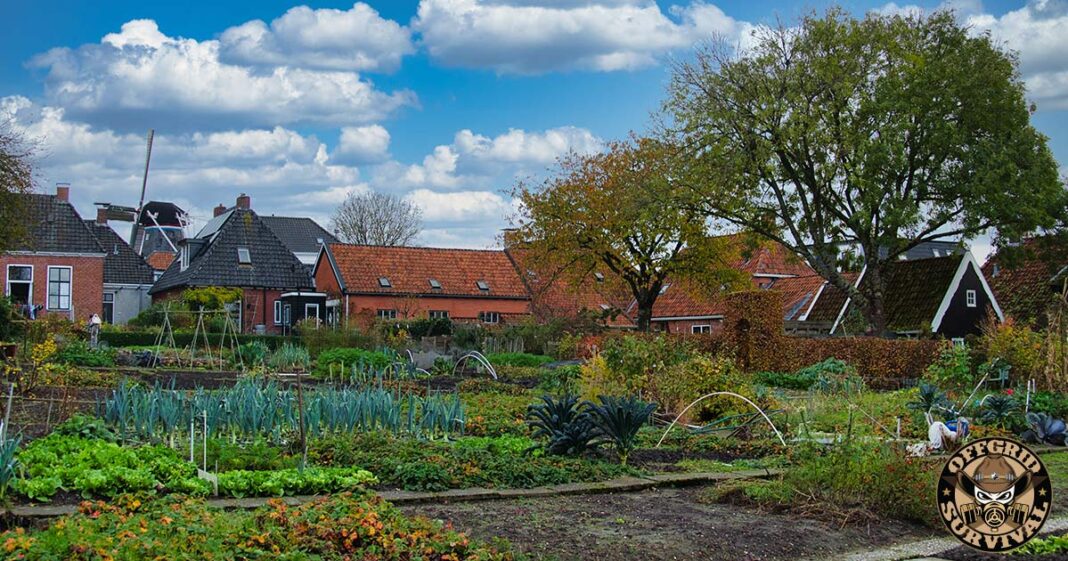
You don’t need acres to feed yourself. The Dervaes family proved that on a tenth of an acre in the middle of Pasadena, California, pulling roughly 3 tons of organic produce a year off a suburban lot smaller than most backyards. Jules Dervaes started the project in the 1980s after downsizing from a 10-acre farm in rural Florida, and after his death in 2016, his three adult children — Justin, Anais, and Jordanne — kept it running. Today the Urban Homestead still supplies salad mix, herbs, and specialty crops to restaurants and a CSA across the LA area, all grown on land that, if you subtracted the house itself, comes out to about a tenth of an acre.
If they can pull that off on a city lot a mile from downtown skyscrapers, you can grow something meaningful on whatever patch of dirt you’ve got — a backyard, a front yard, a balcony, or a few raised beds along a fence line. This guide walks through how to actually start, what the real yield numbers look like, what’s legal where, and the systems that let small urban plots outperform what most people assume is possible.
What “urban homesteading” actually means
The term gets used loosely, but at its core it means producing as much of your own food, water, and energy as your property allows, without moving anywhere. That’s different from a backyard garden in degree, not in kind — it’s the same basic activity, taken further and tied together as a system. A full urban homestead might include intensive vegetable beds, a small flock of laying hens, a couple of fruit trees, a rain catchment setup, a compost system that turns kitchen and yard waste back into soil, and maybe a few bee hives. You don’t need all of it to get real value. Most people start with one piece — usually the garden — and build outward as they get comfortable.
It’s also worth knowing the term itself has a tangled legal history. The Dervaes family trademarked “Urban Homestead” and “Urban Homesteading” in the late 2000s and spent several years sending cease-and-desist notices to other gardeners, bloggers, and even cities using the phrase. The backlash was significant enough that the Electronic Frontier Foundation and a competing homesteading group sued to cancel the trademarks, and a federal court did exactly that in 2015. The terms are public again, free for anyone to use — which is part of why you’ll see “urban homesteading” all over gardening blogs, city programs, and homesteading books today without anyone needing permission.
Start with square footage, not acreage
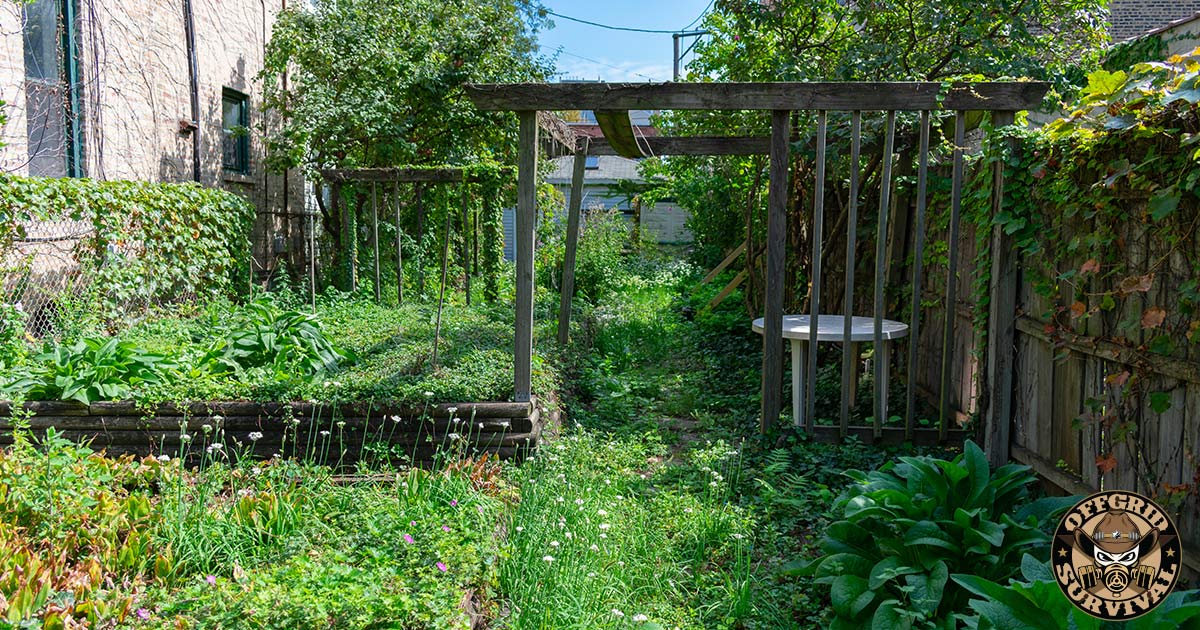
The single biggest mental shift required here is thinking in square feet instead of acres. Most backyard gardens waste enormous amounts of space on walking rows between widely spaced plants, a layout inherited from commercial row-cropping where machinery needs to fit between rows. None of that applies to a hand-tended urban plot.
Square foot gardening, a method popularized by Mel Bartholomew, divides raised beds into a grid of one-foot squares and plants each square at a density appropriate to that crop — anywhere from one plant per square (peppers, broccoli) to sixteen (carrots, radishes), with beets, lettuce, and bush beans landing somewhere in between. A single 4-by-4-foot raised bed gives you 16 of these squares, and because the soil in a raised bed is built specifically for the purpose rather than inherited from whatever was there before, it can support that density without exhausting itself in a season.
This is the same basic principle behind what the Dervaes family does at scale: their growing space runs right up to the walls of the house, using unglazed clay pots called ollas buried in the soil for sub-surface irrigation. Conventional wisdom keeps gardens away from a home’s foundation because surface watering causes runoff that can damage it over time. Ollas solve that by releasing water slowly underground exactly where roots need it, which is also far more water-efficient than spraying a hose over the top of a bed.
Vertical growing is the other lever. Trellises, cages, and wall-mounted planters let pole beans, cucumbers, squash, and even some melons grow up instead of out, which can roughly double the usable growing area of a small plot. A south-facing fence line that’s doing nothing but holding up a yard is, in homesteading terms, wasted square footage.
Containers fill in the gaps — porches, driveways, anywhere with full sun and no soil underneath it. A five-gallon bucket with drainage holes drilled in the bottom will grow a respectable tomato plant. Container gardening also solves a problem a lot of renters and apartment dwellers have: you don’t need to own the dirt to grow in it.
Build the soil before you plant anything
Here’s the part that determines whether any of the above actually works: soil quality is the real limiting factor on small-plot yield, not space. A tenth of an acre of rich, well-built soil will outproduce a full acre of compacted, depleted dirt every time, and this is the actual secret behind operations like the Urban Homestead pulling multiple tons of food from a residential lot — decades of continuous soil building, not some unusual growing technique.
Composting is the foundation. A simple setup — concrete blocks stacked with gaps between them for airflow, or a basic wood-and-wire bin — turns kitchen scraps, yard trimmings, and chicken bedding into the organic matter that feeds soil biology. Layer “greens” (food scraps, fresh grass clippings, coffee grounds) with “browns” (dry leaves, cardboard, straw) roughly in a 1:2 to 1:3 ratio of greens to browns, keep it as damp as a wrung-out sponge, and turn it every couple of weeks. In a few months you’ll have finished compost ready to dig into beds.
Get a soil test before you do anything else, especially in an established urban or formerly industrial lot. Most state extension offices run inexpensive soil tests that check pH, nutrient levels, and — critically in cities — lead and other heavy metal contamination from old paint, leaded gasoline residue, or prior industrial use. This step gets skipped constantly and shouldn’t be. If lead shows up, raised beds with imported soil, rather than digging directly into native ground, are the safer route, especially for anything you’ll feed to kids.
Mulch heavily. A few inches of straw, wood chips, or shredded leaves on top of beds suppresses weeds, holds moisture, and breaks down slowly to keep feeding the soil. This single habit cuts watering needs dramatically, which matters a lot if you’re gardening somewhere hot or under water restrictions.
What you can realistically expect to grow
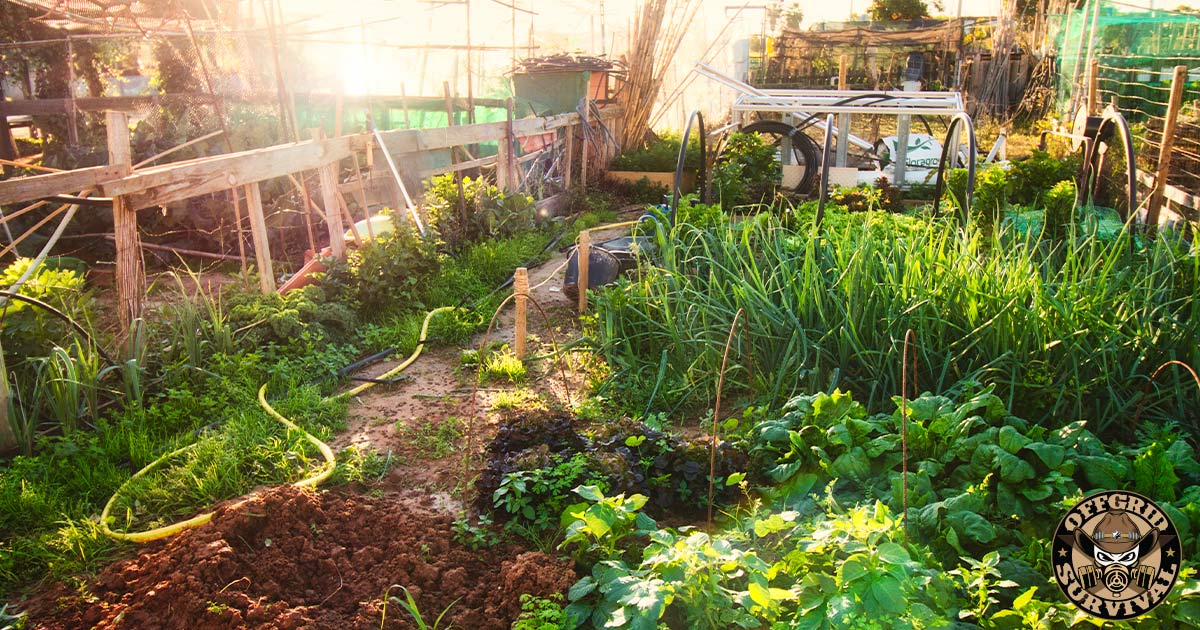
It’s worth being honest about yield numbers instead of just citing the headline “3 tons” figure, because that number represents decades of soil building and a level of intensity most people won’t match in year one — and that’s fine. Here’s a more grounded sense of what intensive small-space gardening produces, drawn from extension and intensive-gardening yield data:
- Leafy greens (lettuce, chard, kale): roughly 0.5 to 1 pound per square foot per harvest, and most leafy greens regrow for multiple cuttings in a season.
- Bush beans: around half a pound per square foot.
- Tomatoes: one well-supported plant per square foot of bed space can produce 10 to 20 pounds over a season.
- Potatoes: roughly 1 to 1.5 pounds per square foot.
- Root vegetables (carrots, radishes, beets): lower weight per plant, but planted 9 to 16 per square foot, the total weight per square foot stacks up fast.
None of this requires anything exotic — it requires consistent soil building, succession planting (replacing a spent spring crop with a new summer one in the same bed instead of leaving it empty), and picking crops that regrow rather than ones you harvest once and pull. A modest 200-square-foot garden, intensively planted and succession-cropped through a full growing season, can realistically produce several hundred pounds of food a year for a household — not 3 tons, but a meaningful dent in a grocery bill, and a genuine education in how food actually grows.
Adding small livestock — what’s actually legal
This is where urban homesteading runs into city government, and it’s worth understanding before you build a coop. Backyard chicken laws are set almost entirely at the city or county level in the US, not the state level, so the honest answer to “can I keep chickens” is “you have to check your specific city.”
That said, some patterns hold up across most of the country:
Hens are usually fine in some number; roosters usually aren’t. The most common limit nationally is somewhere between 3 and 6 hens for a standard residential lot, though some cities allow more — Fayetteville, Arkansas allows up to 20 birds per property, for instance, while plenty of older suburban ordinances cap it at 3 or ban poultry outright. Roosters are banned in the overwhelming majority of urban and suburban ordinances because of crowing complaints, and you don’t need one anyway — hens lay eggs perfectly well without a rooster around; you only need one for breeding fertile eggs.
Setbacks matter. Most ordinances that allow chickens require the coop to sit a minimum distance from property lines and neighboring homes, commonly somewhere in the 10-to-25-foot range, sometimes more. This is usually paired with a requirement that the coop stay out of front yards.
Slaughter is usually restricted or banned outright within city limits, which is part of why so many urban homesteaders, including the Dervaes family, keep poultry mainly for eggs rather than meat.
HOAs are a separate problem from city law. Even where your city allows chickens, a homeowners association covenant written decades ago, before backyard chickens were a mainstream idea, may still ban “livestock” or “farm animals” on the property. These covenants are sometimes ambiguous enough to be worth pushing back on — a few legal disputes have turned on whether a handful of pet hens actually qualify as “livestock” under an old HOA’s specific wording — but that’s a fight you want to know you’re walking into, not one to discover after you’ve already built a coop.
Bees are commonly allowed in cities with far fewer restrictions than poultry, often just a hive-count cap and a setback requirement, since a properly kept hive isn’t loud and rarely creates the kind of neighbor complaints chickens can. Honey production is also one of the lowest-maintenance additions to an urban homestead relative to the food and pollination value it provides.

Before building anything, call your city’s planning or zoning office directly and ask what’s allowed on your specific lot. Don’t rely on what a neighbor told you or what a gardening forum says some other city allows — ordinances vary block to block in ways that surprise people constantly.
Closing the water loop
Water efficiency is where urban homesteading earns a lot of its sustainability credentials, and it’s also one of the more legally complicated pieces to get right, because greywater and rainwater rules vary enormously by state.
Rain barrels are the simplest entry point and are legal nearly everywhere in the US without a permit, as long as you’re just catching roof runoff in a barrel for outdoor watering. A few states have history here worth knowing — Colorado actually banned residential rainwater collection outright until 2009, treating rain as belonging to downstream water rights holders, which surprises a lot of people who assume catching rain in a barrel is universally uncontroversial.
Greywater (water from showers, bathroom sinks, and washing machines — not toilets, and not kitchen sinks in most jurisdictions, which count as more contaminated “blackwater” because of food waste and grease) is legal in most states for outdoor irrigation, but the permitting requirements range from “none at all” to “licensed contractor and inspection required.” A few useful data points: Arizona and New Mexico both allow simple residential greywater systems under about 400 and 250 gallons a day, respectively, with no permit needed at all, as long as the water stays on your property and isn’t used to irrigate food crops that touch the soil directly. California allows a basic laundry-to-landscape system without a construction permit if it meets specific guidelines, though more complex systems connected to multiple fixtures do require one. Texas allows greywater reuse but generally requires a permit for anything beyond the simplest setup. A handful of states, including Florida, ban outdoor greywater use entirely but allow it for toilet flushing instead.
The practical takeaway: simple, single-fixture systems (laundry-to-landscape being the classic starter project) are frequently exempt from permitting almost everywhere, while anything that involves cutting into your home’s drain plumbing to capture shower or sink water usually requires at least a basic permit. Check your state’s plumbing code or your local building department before you start cutting pipe.
What this buys you, beyond the legal compliance: the Dervaes household has reported using around 6.5 kilowatt-hours of electricity a day total, a fraction of a typical American household, and built much of that efficiency around exactly this kind of resource-stacking — using water, then reusing it, then composting what’s left.
Solar and other small power upgrades
You don’t need to go fully off-grid to benefit from urban homesteading’s energy principles. Small solar setups — a handful of panels feeding a battery for essential loads, or a solar oven for summer cooking that doesn’t heat up the kitchen — are common additions that don’t require touching your home’s main electrical panel or local utility hookup at all. A solar dehydrator or solar oven is a particularly good starter project: it’s cheap to build, has an immediate and visible payoff (dried fruit, jerky, slow-cooked meals on a sunny day), and doesn’t trigger any permitting at all in most places, since it’s not connected to anything.
A realistic first-year plan
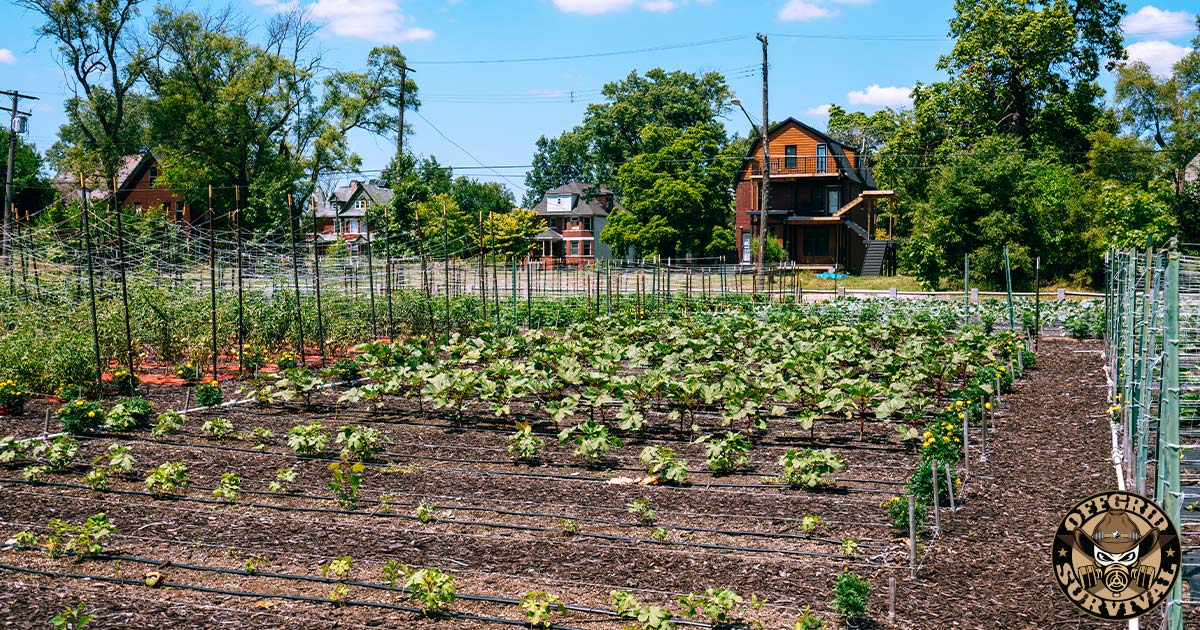
If all of this feels like a lot at once, here’s a sequencing that keeps the workload manageable:
Months 1–2: Get a soil test. Build one or two raised beds, or convert a section of lawn into in-ground beds if your soil tests clean. Start a compost bin. Plant a small, manageable first round of easy, high-yield crops — leafy greens, bush beans, herbs, tomatoes.
Months 3–6: Learn your beds. Track what grew well, what didn’t, how much sun each spot actually gets through the season (this is almost always different from what you assumed in spring). Add a rain barrel. If your city allows it and you’re ready for the daily commitment, this is a reasonable point to add 3 or 4 laying hens.
Year two: Expand bed space based on what you actually use and eat, not what looked exciting in a seed catalog. Consider a simple laundry-to-landscape greywater system if your state allows it without a permit. Add fruit trees or berry bushes, which take a few years to produce but ask for very little in the meantime.
Year three and beyond: This is roughly the point where yields start compounding, because the soil itself has improved. If you’ve got the appetite for it, this is when bees, a second compost system, or selling surplus through a small CSA box or farm stand starts to make sense — the Dervaes family didn’t start selling produce to restaurants until their soil and systems had matured over years, not months.
Planning what actually goes in the ground
Once the beds are built and the soil is decent, the next mistake people make is planting whatever looks appealing in a seed catalog instead of planning around what their household will actually eat and how much space each crop earns back.
Rank crops by return on space, not by excitement. Corn is a classic example of a crop that looks great in a homesteading fantasy and performs poorly in a small-space reality — it needs a lot of square footage, takes most of a season, and yields relatively little per square foot compared to something like leafy greens or bush beans planted in the same space. Squash and melons have a similar problem: their sprawling vines can eat ten times the bed space of a trellised cucumber for a comparable harvest. None of this means skip them entirely — corn and squash have real value and some gardeners grow them specifically because they store well over winter — but in a genuinely space-constrained yard, they should be a deliberate choice, not a default.
High-return crops for small urban plots generally share three traits: they regrow after cutting (loose-leaf lettuce, kale, chard, many herbs), they produce continuously over a season rather than once (bush beans, cherry tomatoes, summer squash if you do have room), or they pack densely without losing yield (carrots, radishes, beets, most alliums). Stack a bed with a mix of these and you get a rolling harvest from spring through fall instead of one big dump of food in August that outpaces what any household can eat fresh.
Succession planting is the technique that turns a single bed into multiple harvests. As soon as a spring crop like radishes or lettuce finishes, that square goes straight back into production with something suited to the next stretch of the season — bush beans or a second lettuce planting in early summer, then a fall crop of greens or root vegetables as the weather cools again. A bed that produces one crop a year is leaving most of its potential on the table. A bed that’s replanted three or four times across a season is doing the real work that makes small-plot yields competitive with much larger conventional gardens.
Companion planting helps too, though it’s easy to overstate. Some pairings have a real, documented basis — tall plants like tomatoes providing afternoon shade for shade-tolerant greens, deep-rooted plants growing alongside shallow-rooted ones without competing for the same soil layer, aromatic herbs like basil or marigold disrupting some pest patterns. Treat it as a useful organizing principle for using vertical and horizontal space efficiently, not as a guarantee against pests or disease.
Match crops to your actual sun exposure, not the sun exposure you assumed your yard had before you tracked it for a season. Most fruiting vegetables — tomatoes, peppers, squash, cucumbers — want six to eight hours of direct sun. Leafy greens and many herbs tolerate partial shade and are the right call for the side of a yard that only gets a few hours of morning light. Putting a sun-hungry crop in a shady corner is one of the most common and most avoidable reasons a new garden underperforms.
Other urban homesteads worth knowing about
The Dervaes family gets the most attention because they were early, well-documented, and media-friendly, but they’re far from the only example worth studying. Looking at a few different approaches makes clear there’s no single right way to do this — climate, lot size, city rules, and household priorities all shape what an urban homestead ends up looking like.
Plenty of smaller-scale urban homesteaders operate with just a few hundred square feet of beds, a handful of hens, and no aspirations toward selling anything — purely growing for household use, treating it as a hobby that happens to cut the grocery bill and produce better-tasting vegetables than anything available at a typical supermarket. This is, realistically, where most people who try this end up, and there’s nothing lesser about it. A family covering even 15 to 20 percent of their produce needs from their own yard, consistently, year after year, is doing real and meaningful work — it doesn’t need to scale to tons of annual output to be worth the effort.
Community and city-supported programs have also pushed urban food production well beyond individual backyards. A number of mid-sized cities have passed dedicated urban agriculture ordinances in the past decade specifically to make small-scale farming and livestock-keeping easier on residential lots, recognizing that the old zoning codes written for a car-centric, single-use-residential mindset never anticipated — or particularly wanted — food production happening in people’s yards. Where those ordinances pass, they tend to raise chicken limits, legalize a small number of goats or other small livestock on appropriately sized lots, and explicitly permit homeowners to sell what they grow directly from the property, which is often technically illegal under older zoning that treats any on-site sales as a “commercial use” not allowed in a residential district.
The throughline across all of these approaches, big and small, is the same: building soil, using space efficiently, closing resource loops where possible, and treating food production as a normal, expected use of residential land rather than something that only happens out in the country. None of it requires the scale, media attention, or decades of work that built the Urban Homestead in Pasadena. It requires starting.
What it actually takes, beyond the gardening
A few honest notes that don’t always make it into the inspirational version of this story:
It’s real, regular labor. The Dervaes operation runs on multiple adults working it as close to full-time as a job. A smaller homestead scaled to a single household’s needs is far less demanding, but daily watering, regular harvesting, coop cleaning, and compost turning are recurring chores, not a one-time setup.
Selling surplus is harder than growing it. If part of your plan involves a CSA box or selling to restaurants, that’s a small business with its own logistics, food safety considerations, and time commitment layered on top of the growing itself.
Climate sets your ceiling. Pasadena’s near-year-round growing season is a major reason the Urban Homestead can produce what it does. The same techniques applied in a place with a short growing season and hard winters will yield less per square foot, though cold frames, row covers, and a greenhouse-style structure can meaningfully extend the season almost anywhere.
Start smaller than you want to. The single most common reason people abandon a new garden is starting too big, getting overwhelmed by weeding and watering by July, and writing off the whole effort. A well-tended 100 square feet beats a neglected 1,000.
None of this requires moving to the country, buying acreage, or waiting for some future off-grid homestead that may never happen. It requires soil, sun, water, and a willingness to start with a few beds and expand only as fast as you can actually keep up with them. Watch the videos below to see what a fully built-out version of this looks like after decades of work — then start with something much smaller.
Additional Resources
- Mini Farming: Self-Sufficiency on 1/4 Acre
- Backyard Barnyard: Bring the Farm to your backyard. Learn to raise goats, chickens, rabbits and more as part of a sustainable way of life.
- The Backyard Homestead Seasonal Planner: What to Do & When to Do It in the Garden, Orchard, Barn, Pasture & Equipment Shed
- The Self-Sufficient Backyard







While they have goats, chickens, rabbits and such they made no mention of eating any meat. I don’t know if this was due to the focus of the story being on the gardening or a choice on the families part. Still very impressive effort. The living on $30k was a bit short sighted though considering the value of four adults working the gardens/animals full time needs to be considered at some level.
I liked his compost pile also….cement bricks with gaps for air and for the enriched soil to spill through.
Although we have several acres available for farming, we use maybe 1000 square feet for gardening. The rest is pasture for the milk goats, chickens, etc.
An excellent video illustrating the potential of self-reliance with minimal resources in the suburbs. Enlightening.
Mike-
Come on join us!
I have been an urban homesteader for about 25 years now. While my family still hold an outside jobs, we grow a lot of our own food. We have a garden, dwarf fruit trees, grapes, and berry bushes. We also raise chickens for eggs and meat, and have even raised our own meat rabbits. It is a very wonderful thing to put a meal on your table that came in it’s entirety from your own labor on your land.
Our homestead is located in a large city as well. Just like the video shows a homestead can be beautiful and productive as well.
I started my website to help others interested in learning how to homestead. Homesteading is much more than growing your own food – it is a mindset, a way of life. It doesn’t matter whether you live in the wild woods, on a farm, a suburban lot or in a city apartment… you too can be a homesteader!
“Stop Dreaming About the Good Life and Start Living IT!”
Excellent video! I’m a little late in finding it, but this family should inspire all of us.
Interesting. Humbling.
$30,000 a year, It must be expensive to live there! I live on 20K/year and buy everything…
The fact that they can earn $30,000 from selling salads makes me drool!
I grew up in the city of St. Louis. My mother was a sharecropper’s granddaughter so she knew a thing or two about growing veggies. We also grew things in our garden in the city. We grew corn, cucumber, tomatoes, cabbage and greens. We routinely grew so many tomatoes we had to give them away to neighbors. It is most certainly possible. However, my father never left his job to do though! I’m definitely inspired!
I don’t need a lot of land to survive I need it to keep the rest of the world at bay!
Neal, they are vegetarians and have the animals for milk and eggs. Slaughter is usually not allowed in city limits and I notice many homesteaders are vegetarian or nearly so due to the cost and effort involved in raising most meat animals and distaste for slaughtering.
I just started urban homesteading and it great to see the popularity on the rise :)
Excellent video, on a 5th of an acre what they have achieved is mighty impressive. inspiring stuff.
I love this! I’m definitely going to share this video far and wide. It’s just so wholesome.
I was wondering about the social aspect of the kids too and I really like how the Dad sees to it. What a guy!
I’m a couple years late on this one, but it is amazing! Thanks for posting. So cool, and really quite inspiring to see what someone can do with so little by organizing so precisely.
This is an outstanding video on how to live the way that used to be common knowledge a few decades ago. The hard part for many of us who would love to live this way is finding a way to get your own property. I would have started living this way years ago if I could afford to quit renting and was able to get a home loan. :o(
For those who have a home of their own, this is a wonderful and revealing piece of media showing how to become even more independent of a government that insists on making their citizens dependent upon them. Bravo!
only comment i have is this is excellant,and more familys should try this.great vidio
My husband and I have traveled and lived off the grid on about $12,000 per year for three years now practicing a loose Vanabode lifestyle. It is totally doable.
For those liking or concerned with a diet containg meat protein may consider insects. If we look at frugality and alternative lifestyles insects are easy to raise in large numbers in small areas, quite nutritious, and can be easily prepared in flavorful meals.
very interesting. if they can do it on .2 acres i am game to try it on my 1.73 acres. and by the way, nathan, there is plenty of protein in veggies, i’ve been a vegetarian sense 1966 and never been healthier, you can have my share of insects.
I love that all there plants are edible the one thing I think would make it even better would be yucca plant because its completely edible and the root can be used as soap