How the hell are people still pretending everything is okay?
Remember when MAGA promised no new wars, an end to inflation, and a stop to the destruction of our economy? Well, buckle up, folks, because today we’re even closer to barreling over the edge of the financial abyss.
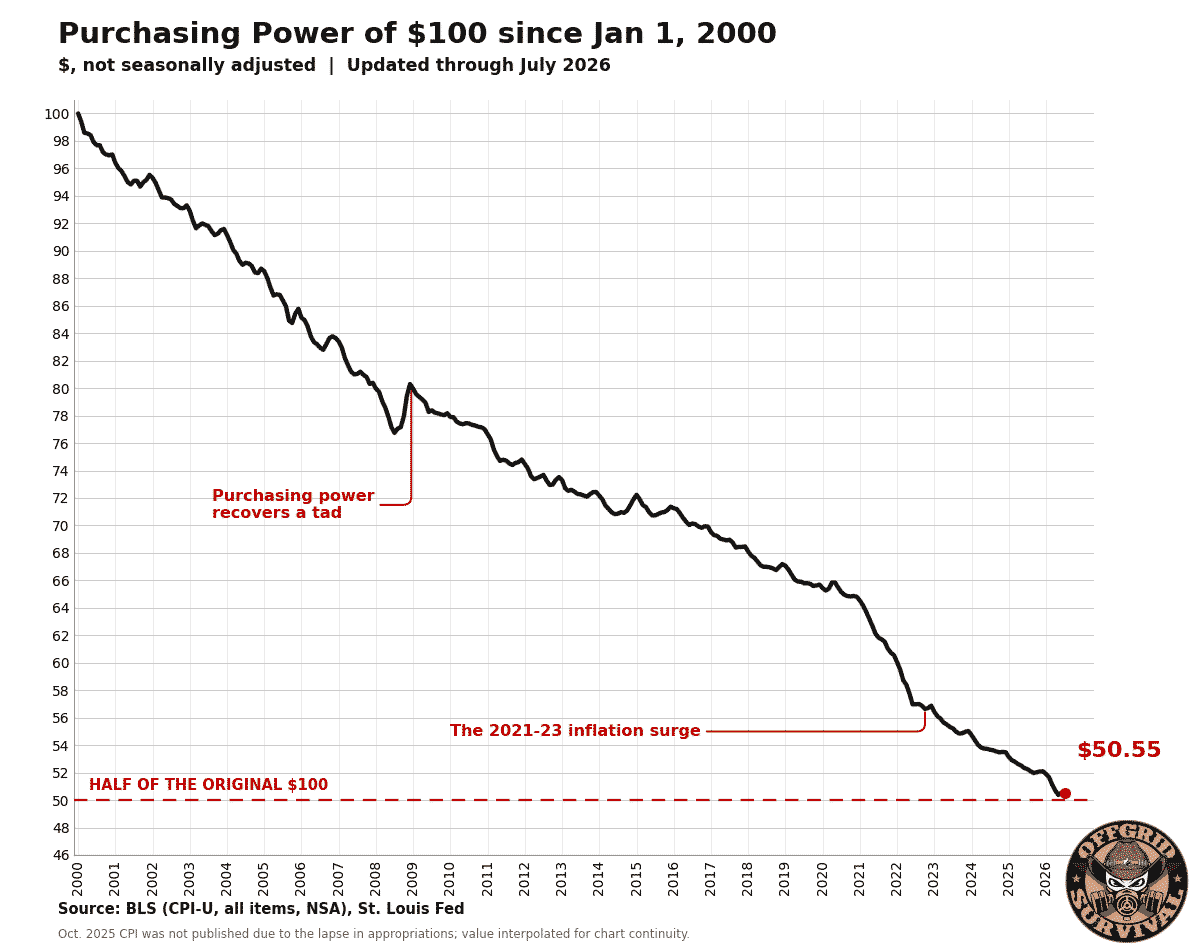
There is a chart that should probably be hanging next to every American family’s monthly budget. It tracks what $100 from January 2000 is actually worth today using the government’s own Consumer Price Index numbers. There is nothing complicated about it. No prediction, no conspiracy theory, no Wall Street model telling you what might happen five years from now. It simply shows what has already happened to your money.
And as of July 2026, that $100 is worth about $50.55 in January 2000 purchasing power.
The CPI-U stood at 168.8 in January 2000. In July 2026 it was 333.918. Run those numbers against each other and almost half the purchasing power of that original $100 is gone. The latest CPI report also says prices are still rising at a 3.4 percent annual rate, so if anything close to that pace continues, we could cross the 50 percent line before the end of the year.
And while we’re talking about numbers that would have sounded insane 25 years ago, here’s another one.
Today, August 19, 2026, the United States officially crossed $40 TRILLION in national debt.
Treasury data put total public debt outstanding at roughly $40.047 trillion. We crossed $39 trillion only about five months ago. Whatever political team you root for, there is no honest way to look at that trajectory and pretend Washington has the country’s finances under control. The debt has been piled up by Republicans and Democrats alike, through wars, bailouts, entitlement spending, emergency spending, stimulus packages, tax and spending decisions, and a federal government that simply cannot seem to live within anything resembling a budget.
That doesn’t mean the dollar collapses tomorrow because somebody rang the $40 trillion bell. It doesn’t work that way. But when you put the debt chart next to the purchasing-power chart, you start to see the problem that we’ve been warning about for years: while Washington keeps borrowing, spending and rolling over mountains of debt, the money sitting in your bank account keeps buying less.
This Isn’t a Crash. That’s What Makes It So Dangerous.
People are conditioned to prepare for dramatic events. A bank closes. The stock market drops 30 percent. Gas stations run dry. The power goes out. Something happens that gets everybody’s attention at the same time and suddenly people realize they might have a problem.
Currency depreciation doesn’t usually get the same attention.
Look at the purchasing-power chart and there isn’t one giant cliff. The line just keeps grinding downward. Some years are worse than others, and the inflation explosion after 2020 made the damage impossible to ignore, but most of the time it happens slowly enough that people adapt without realizing how much ground they’ve lost.
Your grocery bill goes up, so you stop buying a few things. The restaurant gets too expensive, so you don’t go as often. The pickup you thought would cost $45,000 suddenly costs $60,000, so you stretch the old one another three years. Home prices and mortgage payments get ridiculous, so the kid who should have bought his first house at 28 is still renting at 35.
Then Washington comes out and tells everyone inflation is cooling.
Inflation falling from 9 percent to 3.4 percent does not mean prices went back down. It means prices, on average, are still going up, just more slowly than they were during the worst part of the surge. The purchasing power that disappeared doesn’t magically come back because the rate of inflation dropped. July’s CPI was still 3.4 percent higher than it was a year earlier.
That’s the game most Americans never seem to understand until they’re looking at 20 or 30 years of numbers at once.
And Now Diesel Is Pouring Gasoline on the Fire
Here’s another part of this economic mess that isn’t getting nearly enough attention: diesel is back above $5 a gallon.
The national average for on-highway diesel hit $5.454 a gallon on August 17, up from $5.257 the week before and roughly $1.74 a gallon higher than a year ago.
That matters a hell of a lot more than what it costs to fill up a diesel pickup.
Diesel runs the trucks hauling food to grocery stores. It runs farm equipment, construction machinery, delivery fleets and much of the equipment responsible for moving raw materials and finished goods around this country. When diesel stays expensive, those costs don’t just disappear. They eventually work their way through the supply chain and land on the consumer.
And now we have the war with Iran that MAGA voters were repeatedly told they weren’t signing up for.
The conflict has dragged on for months, shipping through the Strait of Hormuz remains disrupted, and oil markets are once again reacting to fears that the situation could get worse. On August 19, Brent crude climbed to $91.62 a barrel and U.S. crude reached $85.83 as the Middle East crisis escalated and tanker traffic through Hormuz remained below normal levels.

U.S. refiners are already running hard, global distillate supplies are tight, and American diesel exports have surged as buyers elsewhere scramble for fuel.
So while politicians tell you inflation is under control, they’re simultaneously presiding over another Middle Eastern war that is putting pressure on one of the most important inputs in the entire economy.
You don’t need an economics degree to figure out what happens if diesel stays above $5, oil pushes back toward $100, and the war keeps dragging on. Trucking gets more expensive. Farming gets more expensive. Construction gets more expensive. Shipping gets more expensive. Eventually, the things those industries produce and transport get more expensive too.
That’s how another inflationary wave gets started.
And Now We’re Sitting on $40 Trillion of Debt – Rising by $90K per second
The $40 trillion number matters because this isn’t some temporary COVID hangover that Washington is working down. The debt is still growing. In fact, Data from the U.S. Congress Joint Economic Committee shows that the debt grew at an astonishing rate of $90,000 per second over the past year.
According to the Treasury figures released today, about $32.3 trillion of the total is debt held by the public, with another roughly $7.8 trillion in intragovernmental holdings. Interest costs have become an enormous part of the federal budget, which means more and more government money has to go toward servicing yesterday’s spending before politicians even start arguing about tomorrow’s spending.
There are really only so many ways a government deals with a debt problem over the long haul. It can cut spending. It can raise taxes. It can grow the economy fast enough that the debt becomes easier to carry. It can default or restructure obligations. Or it can continue allowing inflation to reduce the real value of money and long-term debt over time.
If you’ve watched Washington for any length of time, you can decide for yourself which options politicians seem most willing to tolerate.
Again, I’m not telling you $40 trillion means hyperinflation is coming next Tuesday. Anyone giving you an exact collapse date is selling something. What I am telling you is that a country adding trillions in debt while its currency steadily loses purchasing power is not a situation I would build my family’s long-term security around and simply assume everything will work itself out.
About That “Official” Inflation Number
This is where people usually go off the rails in one of two directions. One side acts like the CPI is holy scripture and perfectly describes what every American household is experiencing. The other claims the government simply invents the number.
Neither is particularly useful.
The CPI is a real statistical measurement produced by the Bureau of Labor Statistics. But it is also an average designed to measure prices across an enormous economy. It is not your personal cost-of-living statement.
You’ll sometimes hear people say CPI assumes that when steak gets expensive, the government simply replaces it with chicken and pretends prices didn’t rise. That’s not quite how the regular CPI-U works. BLS uses a geometric-mean formula in many categories that allows for some substitution among similar products within a category, but the regular CPI-U does not simply swap entire categories like steak for chicken whenever one gets expensive. The chained CPI goes further in accounting for changing consumer behavior.
BLS also makes quality adjustments when products change. If the newer version of something has additional features or measurable improvements, part of the price difference can be treated as a quality improvement rather than pure inflation. There is a legitimate economic argument for doing that, but there is also a practical reality for the guy standing at the dealership: the truck still costs more money, whether the government thinks the new electronics, airbags and cameras make part of that increase a quality improvement or not.
Housing creates another disconnect. Owner-occupied homes themselves are treated as capital goods rather than consumer goods in CPI. For homeowners, BLS relies heavily on something called owners’ equivalent rent, which is intended to measure the rental value of the housing service a homeowner receives rather than the purchase price of the house, mortgage interest, property taxes and many other costs associated with owning it. That’s legitimate methodology for what CPI is designed to measure, but it also helps explain why someone actually trying to buy a house can look at the official inflation numbers and wonder what planet the statisticians are living on.
Then there is the biggest problem of all: you don’t live inside a national average.
If you live in a rural area, drive 20,000 miles a year, heat with propane, buy lumber and hardware, maintain older equipment, pay your own health insurance and feed a family, your expenses can look radically different from somebody living in a downtown apartment without a vehicle.
That’s why I don’t need to claim CPI is fake to tell you the official number may seriously understate what inflation feels like in your house. Your bank account already knows the answer.
Inflation Hits Prepared People Differently
For people interested in preparedness and self-reliance, this matters for reasons that go well beyond whether eggs cost another dollar.
The first problem is cash. You absolutely need it. I still believe in keeping emergency funds, accessible savings and physical cash available for situations where banks, credit-card systems or electronic payments aren’t working. Going into an emergency without liquid money because somebody on the internet told you “cash is trash” is just another form of stupidity.
But you also have to understand what cash is doing while it sits there.
Money that you intend to spend next month is money. Money you intend to leave untouched for 20 years is something else entirely. If the past 26 years tell us anything, it is that simply stuffing dollars somewhere and expecting them to preserve the same purchasing power forever is not a plan.
The second problem is that nearly everything on a prepper’s wish list gets more expensive while he procrastinates. Generators, solar equipment, well pumps, chainsaws, fencing, tools, replacement parts, firearms, ammunition, boots, building materials, food and fuel don’t care that you’re “waiting until next year.”
I’m not suggesting you run out tomorrow and max out a credit card buying survival gear. That’s how you turn inflation into bankruptcy. But if something has a long useful life, you know you’re going to need it, and you can afford it without screwing up the rest of your finances, waiting indefinitely for everything to get cheaper hasn’t exactly been a winning strategy.
What This Means for Preparedness
For anyone serious about self-reliance, inflation isn’t some abstract economic story. It directly affects how much preparedness you can afford.
Cash is still important. You need emergency savings and I still believe in keeping physical cash available for banking outages, grid-down situations and other disruptions. But leaving a huge pile of money sitting untouched for decades while assuming it will maintain its buying power isn’t much of a strategy when we’ve just watched the dollar lose almost half its purchasing power since 2000.
The same thing applies to equipment. Generators, well pumps, chainsaws, fencing, tools, replacement parts, ammunition, boots, building materials, food and fuel don’t care that you’re waiting for a better time to buy.
I’m not telling anyone to max out credit cards buying survival gear. That’s how you turn inflation into bankruptcy. But if you know you’re going to need something, it has a long useful life, and you can afford it, sitting around for another five years hoping everything suddenly becomes cheap again hasn’t exactly worked out very well.
Stop Thinking Only in Dollars. Start Thinking in Capability.
This is where preparedness gives you an advantage that most people don’t have.
A normal consumer looks at rising prices and asks, “How much more money am I going to need?”
A prepared person should also be asking, “What can I buy, build, learn or produce today that reduces how much I need to buy tomorrow?”
That might mean building a deeper pantry around food you already eat instead of buying some ridiculous 25-year survival-food package your family will never touch. It might mean putting in a garden, improving your water storage, installing solar, buying the tools to repair your own equipment, stocking common replacement parts or finally learning how to maintain the things you already own.
There’s a big difference between hoarding stuff and building capability.
A garage full of junk doesn’t make you independent. Knowing how to repair a small engine does. Owning $5,000 worth of freeze-dried food that nobody rotates isn’t nearly as useful as having six months of food your family actually eats and a system for replacing it. Buying the newest piece of tactical gear every six months isn’t as useful as becoming physically fit, knowing first aid, understanding communications and having people around you who can actually solve problems.
Production is even better than storage when you can pull it off. A garden doesn’t make you immune to the grocery store, but every pound of food you produce is something you aren’t buying at tomorrow’s price. The same goes for chickens, a productive piece of land, a well, solar power, firewood, repair capability or anything else that turns you from a pure consumer into someone capable of producing part of what your family needs.
- 30+ Self-Reliant Resources: Preparedness Skills that Everyone Should Know
- Emergency Preparedness Training: 27 Essential Preparedness Tips, Skills and Resources
- Basic Hunting Skills – Preparing for the Hunt
- Prepper Communities: Building a Survival Network in Troubled Times
Buy the Boring Stuff Before You Need It
Preparedness gets marketed as exciting gear because exciting gear is easier to sell. Unfortunately, some of the smartest inflation preps are incredibly boring. It’s why I have been telling you for over 20 years that this shit isn’t getting any cheaper, stockpile what you need now!
Buy the hardware you know you’ll use. Keep spare parts for equipment that matters. Have filters for your water system instead of discovering during the next shortage that your particular model has been discontinued. Keep oil, belts, spark plugs, fasteners, batteries, extension cords, plumbing fittings, repair materials and the other stupid little things that can turn a minor problem into an expensive emergency when you don’t have them.
Build your pantry slowly and rotate it. Don’t buy things because some prepper checklist told you to. Buy what your household actually consumes, get ahead of your normal usage and replace it as you use it.
And invest heavily in skills. Carpentry, welding, electrical work, radio communications, gardening, canning, food preservation, basic mechanical repair and first aid don’t become obsolete because the CPI went up another four percent. In a bad economy, the person who knows how to keep old equipment running becomes more useful, not less.
Forty Trillion Dollars Should Get Your Attention
Today the national debt crossed $40 trillion. At almost the exact same time, a dollar from the beginning of 2000 is approaching the point where it has lost half its purchasing power.
Diesel is above $5 a gallon. The Iran war is still dragging on. Oil is climbing again. Washington is still borrowing and spending, and ordinary Americans are once again being told that inflation is under control.
Maybe everything settles down. Maybe oil drops, the war ends, inflation cools and Washington suddenly discovers fiscal responsibility.
I wouldn’t build my preparedness plan around that assumption.
If you haven’t seriously looked at your economic preparedness plan, start with our complete guide to preparing for an economic collapse. We cover the warning signs, financial steps, survival supplies, self-reliance skills and preparations that can help protect your family during a prolonged economic crisis.
You should also read:
- Surviving the Financial Storm: Essential Tips for Economic Hard Times
- Economic Storm? Deficits, Bankruptcies, and the AI Revolution That Could Change Everything
- America Is About to Hit $40 Trillion in Debt: Prepare for the Economic Squeeze Before It Gets Worse
- The Next Financial Crisis May Already Be Taking Shape