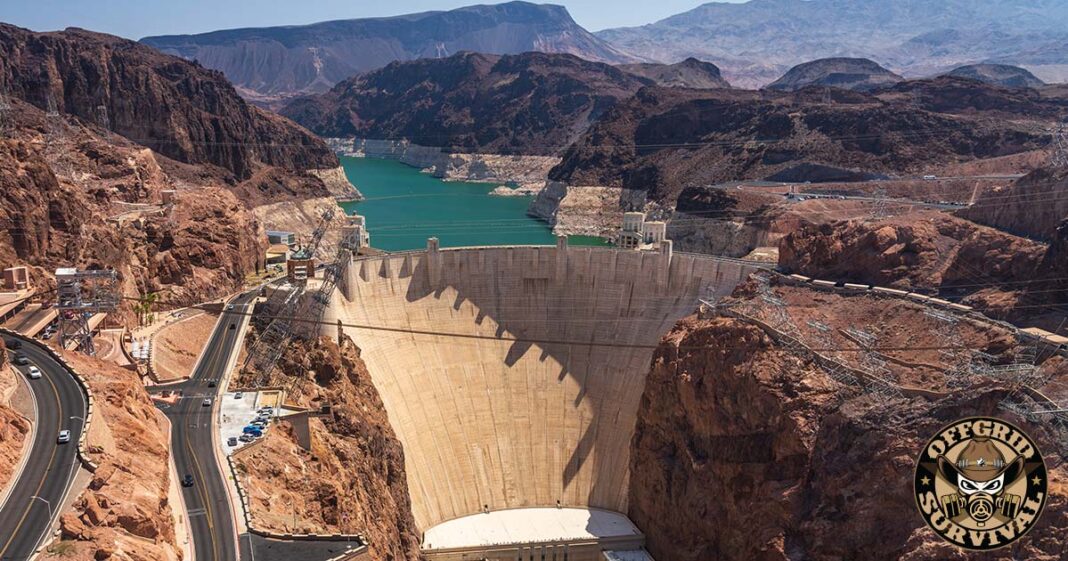
For years, officials, water managers, and politicians have watched Lake Mead slide lower and lower while pretending there was still plenty of time to figure it out. Now that game is ending. The country’s biggest reservoir just dropped to a new record low, Hoover Dam is getting dangerously close to the point where it loses most of its generating capacity, and the people who are going to feel it first are the same people who had the least say in any of it.
Popular Mechanics recently called Hoover Dam’s decline the “slowest-moving train wreck in history.” The problem with that line is that a train wreck sounds like an accident. This wasn’t an accident. Nobody got blindsided here. These people had decades of warning, years of deadlines, endless studies, and more than enough data to know exactly where this was going. They saw it coming and kept kicking the can anyway.
Lake Mead hit a record low, but the bigger problem is what comes next
On August 7, Lake Mead dropped to about 1,040.5 feet above sea level, the lowest point since the reservoir was filled. That made headlines, but the record itself is not the real issue. The number that matters now is 1,035 feet.
That is the line where twelve of Hoover Dam’s seventeen turbines shut down because the older units were never built to operate at water levels this low. Once Mead falls below that mark, only five newer turbines can keep running. Reclamation’s own projections show the lake crossing that line within the next year, and some forecasts suggest it could happen even sooner. From there, the lake is expected to keep sliding, with projections putting it around 1,015 feet by next summer and near 1,012 feet by spring 2028.
That is not a temporary dip. That is a long, ugly decline with no quick fix.
Hoover Dam is about to take a massive hit
Hoover Dam was built with a maximum capacity of 2,074 megawatts. Because of falling water levels, that has already dropped to around 1,302 megawatts. If Lake Mead falls below 1,035 feet, capacity plunges again to just 382 megawatts.
That is a 70 percent cut from current output and more than an 80 percent cut from what the dam was originally built to produce.
This is where the press likes to talk in abstract numbers, but people do not pay their electric bills in megawatts and acre-feet. They pay them in dollars, and those dollars are about to go up. Hoover power has historically been cheap. Utilities that relied on it could build stable rates around it. When that power disappears, they have to replace it with market power, and market power costs a hell of a lot more.
That difference is the story.
Rural Nevada is going to get hit first
Nevada gets a little under a quarter of Hoover’s output, but not every part of the state feels that loss the same way. For the big utilities, Hoover is one source among many. For smaller rural districts, it has been the backbone of the whole system.
Lincoln County Power District serves more than 5,000 customers in places like Panaca, Caliente, and Pioche. About 70 percent of its electricity comes from Hoover Dam. If current projections hold, that share falls to 30 percent by 2027. That is not some minor adjustment. That is the kind of loss that blows apart a small utility’s entire cost structure.
And they have already had a preview of what is coming. When Lake Mead hit its 2022 low, Lincoln County Power had to raise rates two years in a row because it got pushed into buying more expensive power on the open market. They are now trying to pre-buy as much replacement electricity as they can before things get worse, but there is only so much a small rural district can do.
Overton Power District, which serves around 19,000 customers in Mesquite, Bunkerville, Logandale, and Overton, has also been taking cuts. Last year, a 15 percent reduction in Hoover deliveries more than doubled the district’s power costs. Read that again. A 15 percent cut more than doubled costs. The next cut coming down the pipe is far bigger.
And the people stuck paying for this are not rich suburban homeowners with backup systems and money to burn. These are regular families in remote Nevada towns where summer heat is brutal and air conditioning is not optional.
The federal government is making the problem worse
Here is the part a lot of coverage dances around. Lake Mead is not just falling because of drought. It is also falling faster because the federal government is holding water back upstream to protect Lake Powell and Glen Canyon Dam.
Glen Canyon’s ability to generate power starts breaking down when Powell gets too low, so Reclamation has been cutting releases from Powell and keeping extra water there. That means less water flowing down into Mead. Reclamation has admitted the tradeoff could push Mead down faster and knock even more generating capacity off Hoover.
So yes, part of this is a drought story. It is also a policy story. The government is deliberately protecting one failing reservoir by squeezing another one even harder, even though Lake Mead supplies 90 percent of Southern Nevada’s drinking water and supports the region’s power system. Maybe there is an engineering case for it. Fine. But let’s stop pretending this is some natural mystery nobody understands. These are choices, and those choices come with a bill.
The people paying that bill were never asked.
The basin states had years to deal with this and still blew it
The 2007 Interim Guidelines were always set to expire at the end of this year. The 2019 Drought Contingency Plans expire too. Everyone knew the deadlines. Everyone had the calendar. And still, the seven basin states missed one deadline after another.
So now the federal government is stepping in with its own framework, and once again the burden falls hardest on the Lower Basin states: Arizona, Nevada, and California. Those are the states already carrying much of the pain, already dealing with the toughest restrictions, and already supporting the largest populations tied to this system. Meanwhile, the Upper Basin states keep getting treated with softer language and “voluntary” expectations.
That is not a solution. That is a political dodge.
Storage in Powell and Mead combined is now at levels not seen since the 1950s, back before the modern river management system even fully existed. That should tell you everything you need to know about how badly this has been handled.

And while all this is happening, they approve a data center next to the dam
Now for the part that really ought to make people furious.
While Hoover Dam is on the edge of losing most of its power and Lake Mead is collapsing, the federal government approved a data center project on public land inside Boulder City’s jurisdiction. Boulder City, of all places. The town tied directly to Hoover Dam. The town sitting right next to the infrastructure that is already under pressure.
Residents objected. City officials said they were not meaningfully consulted. The city council moved to appeal. People raised obvious concerns about water use, electrical demand, and the complete insanity of pushing a power-hungry, water-hungry project in a desert already running short on both.
And why did this thing move so fast? Money. The lease would reportedly pay Boulder City about $1.46 million a year, more than double what a solar-and-battery project would bring in.
That is the kind of decision-making that defines this entire mess. They will tell you development is development and progress is progress, but that is garbage. A solar project generates power and uses very little water once built. A data center does the opposite. It consumes power around the clock, uses water for cooling, adds more strain to the grid, and locks in that demand for years.
Those are not the same thing, and anybody pretending otherwise is either lying or too stupid to be making decisions.
The “fix” is tiny compared to the problem
Congress did free up $52 million for three new wide-head turbines that can operate at lower water levels. That part is real. Those turbines matter. But let’s not oversell it.
Those three turbines do not save Hoover Dam. They do not restore anything close to normal operation. What they do is reduce the projected capacity loss from 70 percent to 58 percent. That is better than nothing, but it is still a disaster. Hoover also needs around $200 million in maintenance over the next decade just to keep the aging structure functioning.
So no, this is not a rescue. It is triage.
Meanwhile, Lincoln County Power is building a small two-megawatt solar project of its own. Good move. Smart move. But two megawatts does not fill a 920-megawatt hole. Local utilities are trying to patch together whatever they can while the people higher up the chain keep acting like there is still time to negotiate their way out of physics.
There isn’t.
This is what it comes down to
Hoover Dam has spent decades helping keep power cheap in the desert Southwest. That era is ending. When Lake Mead crosses 1,035 feet, a huge chunk of that low-cost power goes away in one shot, and replacement electricity is going to cost more. A lot more.
The first people to feel it will not be the ones making the decisions. It will be people in places like Pioche, Caliente, Overton, and Mesquite. Small towns. Rural families. Retirees. Working people already dealing with inflation, high food prices, housing costs, and everything else hitting the middle of the country right now.
They did not overpromise the river. They did not mismanage the basin. They did not approve a data center in the wrong place at the worst possible time. But they are going to pay for all of it anyway.
That is the real story here. Not drought. Not a “slow-moving train wreck.” Not some vague climate talking point that lets everybody responsible off the hook.
This is what government failure looks like when it finally lands on regular people.
What OffGrid readers should take from this
If you live anywhere in the Southwest, stop assuming the grid is just going to hold together because it always has. Cheap hydro power is disappearing, replacement power is more expensive, and the people running this system have already proven they will let things slide until the crisis is sitting on the doorstep.
That means now is the time to think seriously about backup power, water storage, heat planning, and how exposed your household really is to rate hikes and supply disruptions. If you have been putting off a generator, battery backup, solar setup, extra water storage, or even basic emergency planning for summer outages, this is your warning.
Because once the bills start climbing and the shortages get worse, nobody in Washington or at Reclamation is going to show up and make your house easier to cool.