The water cuts everyone spent three years arguing about got signed today. The Lower Basin loses about 21 percent of its river water, and the cuts could nearly double after 2028.
Interior Secretary Doug Burgum signed the final Colorado River water plan Friday. After three deadlines blew by and seven states that could not agree on anything, the federal government stopped waiting and imposed its own terms.
Here is what it actually says.
Starting in 2027, Arizona, California, and Nevada — the Lower Basin — take a mandatory cut of 1.25 million acre-feet per year. That runs through 2028. It works out to roughly a 21 percent reduction in what those three states pull off the river.
Split out by state:
- Arizona: 760,000 acre-feet per year — by far the biggest hit, landing hardest on the Phoenix and Tucson metros
- California: 440,000 acre-feet per year
- Nevada: 50,000 acre-feet per year
On top of the mandatory cuts, the three states volunteered to conserve at least 700,000 acre-feet more across the two years. Add it all up and you get about 3.2 million acre-feet left in Lake Mead over the two-year period. Officials are calling it one of the largest conservation efforts in the river’s history, which is true, and also tells you exactly how bad things have gotten.
The Upper Basin — Colorado, Utah, New Mexico, and Wyoming — takes zero mandatory cuts. They agreed to coordinate operations at three additional reservoirs to help prop up Glen Canyon Dam. That’s it. If you want to understand why that split makes Arizona furious, I laid out the whole Upper Basin versus Lower Basin fight in 40 Million People, One Dying River. Short version: the river was divided up in 1922 based on flow numbers that never existed, and everything since has been arguing over water that isn’t there.
The part that hasn’t happened yet
The 1.25 million acre-feet number could be just the beggining.
The 10-year framework Reclamation put out in July gave the feds authority to cut the Lower Basin by as much as 3 million acre-feet per year — up to 40 percent. Today’s plan didn’t pull that trigger. It went with roughly what the three states had already proposed themselves, which is why you’re seeing Arizona officials describe this as “avoiding” the deep cuts rather than celebrating.
But that authority is still sitting in the framework. After the first two-year operating period ends, if the reservoirs keep dropping, the mandatory cuts can nearly double to 3.0 million acre-feet a year.
Arizona and Nevada have both said cuts that deep would wreck their economies. Arizona has already threatened to sue the federal government if it goes there. So the most likely outcome is that 2029 arrives with lawyers instead of a plan — which means years more uncertainty while the reservoirs keep falling.
J.B. Hamby, California’s Colorado River Commissioner, put it about as honestly as anyone in this fight ever does: this is a bridge, not a permanent solution.
Why this is happening now
The plan didn’t come out of nowhere. The water is physically running out.
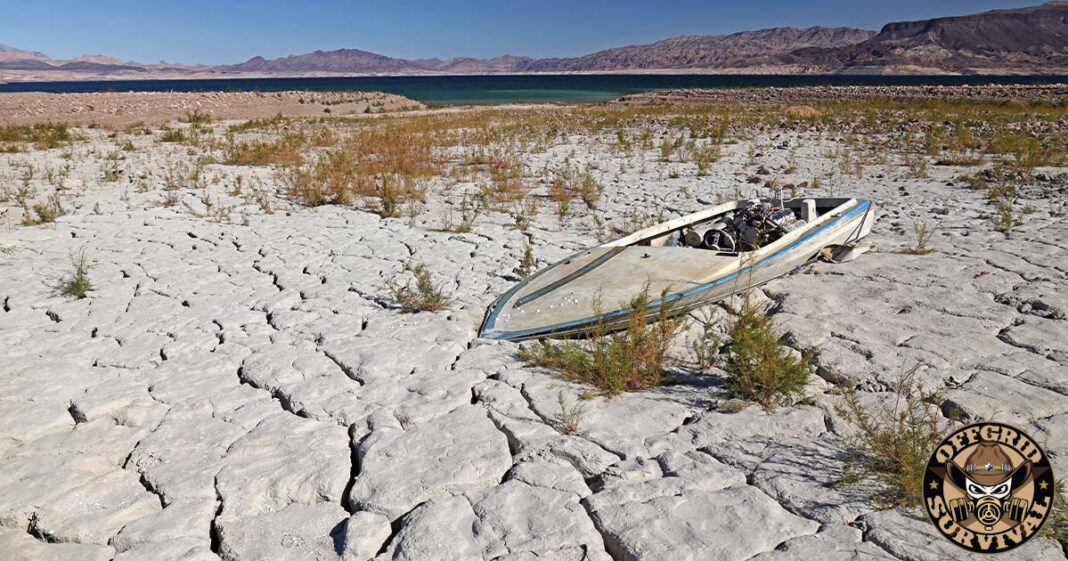
Lake Mead hit the lowest level ever recorded this month — lower than 2022, lower than any point since Hoover Dam filled it in the 1930s. I covered that when it happened in Lake Mead Just Hit a Record Low While Nevada Residents Are Told to Use Less Water.
Lake Powell is worse in the way that matters most. Reclamation’s own July projections show it potentially reaching minimum power pool by spring 2027 — the elevation where Glen Canyon Dam stops generating electricity entirely. Below that, you’re relying on river outlet works that were built for occasional short jobs and showed real wear the one time they got used hard. I went through that failure mode in detail in Colorado River Apocalypse: Inside Glen Canyon Dam’s Dead Pool Problem.
Driving all of it: the winter of 2025–26 delivered the lowest snowpack ever observed in the basin. Roughly 80 percent of the Colorado’s water is Rocky Mountain snowmelt. No snow, no river.
What this actually means for the Southwest and the rest of the U.S.
The river supplies water to one in ten Americans, irrigates farmland producing 15 percent of U.S. food output, and generates power for six million people. So “water cuts in the Southwest” is not a regional story.
If you live in the Southwest: Your rates are going up. Cities in central Arizona are absorbing the largest share of Arizona’s 760,000 acre-feet, and utilities don’t eat costs, they pass them along. Municipal restrictions get tighter from here, not looser. Nevada residents are already being told to cut back while the reservoir that supplies them sets record lows.
If you live anywhere: Roughly 70 to 80 percent of Colorado River water goes to agriculture, and about 90 percent of America’s winter vegetables are grown with it in the Imperial and Coachella valleys and around Yuma. Cutting 1.25 million acre-feet doesn’t mean shorter showers in Scottsdale. It means fallowed fields, and it shows up in your grocery bill in January.
On power: Hoover Dam’s generating capacity falls with Lake Mead’s elevation, and it has already lost a serious chunk of it. Cheap hydro coming off the system gets replaced with something more expensive. I broke that down in Lake Mead Running Out of Water and Hoover Dam Is About to Lose 70% of Its Power.
And it’s not theoretical. An Arizona town came within days of running dry earlier this summer — the story is in Southwest Water Crisis: An Arizona Town Nearly Ran Out of Water This Month. Small systems fail first, and they fail quietly.
What to do about it
The point of paying attention to this stuff is so that a bad month is an inconvenience instead of an emergency.

Store water now, not later. Two weeks minimum per person, a month if you have the space. Municipal supply interruptions during a shortage aren’t dramatic, they’re mundane — a main break, a pressure loss, a boil notice — and everybody hits the store at the same time. Our guide to emergency water sources and storage walks through what to store it in and how to keep it drinkable.
Have a way to treat water you didn’t store. Filtration plus a chemical backup. Two independent methods, because the one you own is the one that breaks.
Get off the single point of failure for power. If you’re in the desert and your summer cooling depends entirely on a grid that’s losing its cheapest generation, that’s a real exposure. Battery backup, a generator, or a solar setup — whatever fits your budget and your living situation.
If you have land, look at catchment. Rules vary a lot by state, and they’ve loosened in places that used to ban it outright — Colorado being the famous example, which we covered when rainwater collection stopped being a crime there.
Here’s the honest read on today’s news: the federal government just imposed the mildest version of the cuts it has the authority to impose, on a system that is still shrinking, using a framework that expires in ten years and gets renegotiated under threat of litigation the whole time. The reservoirs did not stop falling because a document got signed.