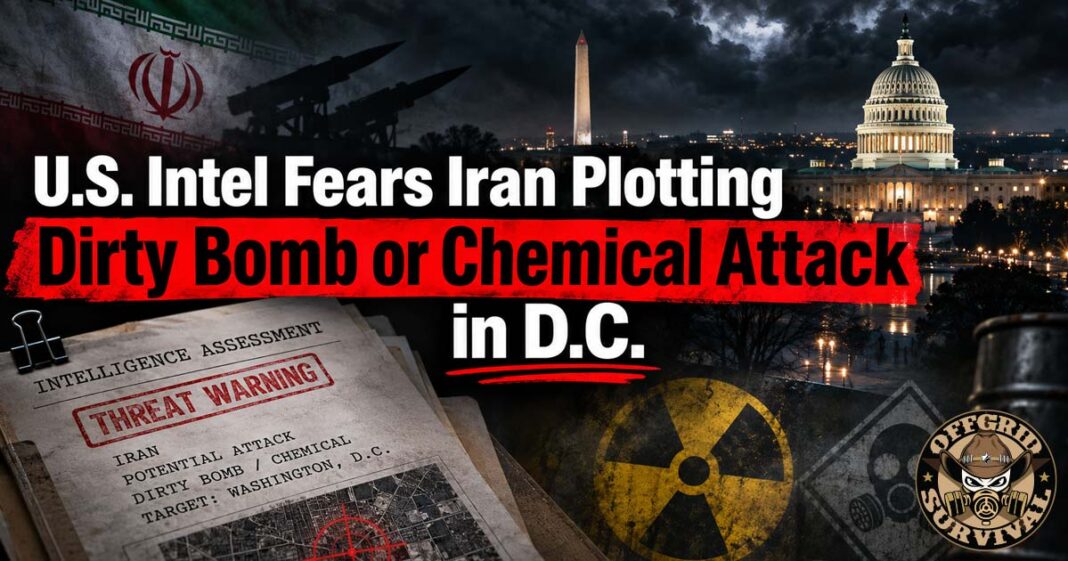
U.S. intelligence officials are warning that Iran may be preparing to unleash a radiological dirty bomb or chemical weapon in Washington, DC, targeting senior members of the Trump administration. Even more disturbing, intercepted Iranian communications reportedly suggest that materials needed for an attack may already be hidden inside the United States.
According to an explosive CNN report published Monday, November 16, seven U.S. officials say newly gathered intelligence indicates Iran is developing plans to attack senior Trump administration officials in the nation’s capital. The possible attacks involve either a radioactive dirty bomb or a chemical weapon, with intelligence reportedly identifying specific targets and locations.
The claims have triggered contingency planning and high-level security meetings in Washington. According to the report, Treasury Secretary Scott Bessent was moved into military housing last week because of Iranian threats.
But perhaps the most alarming revelation is that U.S. intelligence has reportedly intercepted Iranian communications claiming materials necessary for an attack have already been smuggled into the country.
American intelligence officials are divided over whether those claims are credible, whether Iran has the operatives necessary to carry out an attack, and whether Tehran would actually give the order. The White House maintains there are currently no credible threats to the homeland.
Nevertheless, the fact that officials are examining possible dirty bomb and chemical weapon attacks against targets in Washington marks another dangerous development in the escalating conflict between the United States and Iran.
And it comes just weeks after we reported on Tucker Carlson’s warning that a U.S. nuclear strike against Iran could be days away and the subsequent decision by Iranian state media to broadcast instructions teaching its citizens how to survive a nuclear blast.
Now American officials are confronting intelligence suggesting the next major escalation could take place on U.S. soil.
Intelligence Suggests Iran May Already Have Weapons Materials Inside the United States
Among the most troubling details in CNN’s reporting are claims that Iran may have already positioned dangerous materials inside America, potentially allowing an attack to be launched without having to smuggle those materials across the border at the last minute.
According to the report, U.S. intelligence intercepted Iranian communications claiming bomb-making materials have been stored somewhere inside the country. Officials have not publicly confirmed the existence of any such stockpile, and some intelligence sources remain skeptical of the claims.
Others reportedly believe Iran could have positioned radioactive materials or chemical agents in the United States years ago.
One source suggested that the possibility of such materials being hidden in America for years, or even decades, has long been considered by some officials.
That distinction matters. There is no publicly verified evidence that Iran has an operational dirty bomb or chemical weapon inside the United States. But the intelligence raises the possibility that American security officials must prepare for an attack involving materials that would not necessarily need to cross the border during the current conflict.
The report also revealed several additional details:
- Specific targets have reportedly been identified. Two sources said the intelligence includes particular locations and individuals, prompting contingency planning by American security officials.
- Iran may be preparing options for retaliation. Intelligence sources described the planning as a way for Tehran to preserve possible responses rather than proof that an attack is imminent.
- Officials are questioning Iran’s operational capabilities. Some doubt whether the country has personnel already positioned inside America who could carry out such an operation.
- The motivation to attack may be increasing. One source said Iran’s capabilities have not necessarily changed, but its incentives may have shifted as the military conflict intensifies.
- Security officials are preparing countermeasures. Multiple meetings have reportedly taken place as authorities evaluate the intelligence and potential responses.
There is a significant difference between a country discussing a potential attack and actually having the means, personnel and authorization to carry it out. That uncertainty remains central to the intelligence assessment.
The White House Says There Is No Credible Threat, but Security Officials Are Taking Precautions
White House spokesperson Lauren Bis told CNN that the administration continues to monitor potential threats but said there are currently “no credible threats to the homeland.”
Iran’s mission to the United Nations also rejected allegations that the country was considering chemical weapons, describing those claims as fabricated and maintaining that Iran considers the use of chemical weapons illegitimate.
The Iranian statement reportedly did not specifically address the dirty bomb allegations.
Meanwhile, CNN reported that Treasury Secretary Scott Bessent was relocated to military housing following Iranian threats, an extraordinary precaution involving one of the most senior officials in the administration.
The reported intelligence also comes during an increasingly dangerous military confrontation between Washington and Tehran.
The United States has been conducting military operations against Iran, while economic pressure and the struggle over the Strait of Hormuz have further destabilized the region. President Trump suggested last week that the conflict could end relatively soon, but the possibility of further escalation remains.
American officials are reportedly concerned that Iranian leaders could calculate that unconventional retaliation is worth the risk if they believe their government is facing an existential threat.

There are also concerns about hardliners or elements operating outside the normal chain of command attempting to provoke an even larger conflict.
Iranian threats against American officials are nothing new. Federal authorities have previously investigated assassination plots linked to Iran, including a 2024 murder-for-hire plot targeting Donald Trump.
What makes the latest intelligence especially concerning is the reported consideration of weapons capable of contaminating civilian areas in the nation’s capital.
What Would Happen if a Dirty Bomb Detonated in Washington?
A dirty bomb is not the same thing as a nuclear weapon, although the distinction would offer little comfort to anyone caught near the explosion.
Unlike a nuclear bomb, which produces an enormous release of energy through nuclear reactions, a dirty bomb uses conventional explosives to scatter radioactive material into the surrounding environment.
The immediate blast would likely cause the greatest number of serious injuries. Depending on the radioactive material involved, the explosion could also spread contamination across nearby streets, buildings, vehicles and public spaces.
A dirty bomb could force authorities to evacuate or restrict access to parts of a major city, potentially shutting down government buildings, public transportation and businesses while specialists determine the extent of contamination.
Radioactive particles could also create health risks if inhaled or ingested, particularly for individuals close to the explosion.
The CDC emphasizes that most dirty bombs would not produce enough radiation to cause immediate radiation sickness in people outside the immediate blast area. However, the contamination, disruption and fear generated by such an attack could last far longer than the explosion itself.
In a city like Washington, DC, even a relatively limited attack could generate enormous consequences if it occurred near government facilities or heavily populated areas.
And while most Americans understandably associate radioactive attacks with nuclear war, the threat posed by a dirty bomb is fundamentally different. You do not need to survive a nuclear fireball to be affected by radioactive contamination.
You need to know how to avoid exposure, protect your family and follow the correct sheltering procedures.
How to Survive a Dirty Bomb Attack
The federal government’s basic advice for a radiation emergency is straightforward: get inside, stay inside and monitor official instructions.
If a dirty bomb detonates near you, your immediate actions could significantly reduce your exposure.
- Get inside immediately. Find the nearest sturdy building, preferably one constructed from brick or concrete. Stay away from windows and exterior doors. A basement or interior room generally provides better protection against radioactive material outside.
- Keep contaminated air out. Close windows and exterior doors. Shut down ventilation systems that bring outside air into the building.
- Remove contaminated clothing. If you were outdoors near the explosion, carefully remove your outer layer of clothing and place it in a plastic bag away from other people. According to the CDC, removing outer clothing can eliminate up to 90% of radioactive contamination.
- Wash exposed skin and hair. Shower with soap and lukewarm water if possible. Avoid scrubbing aggressively, and do not use hair conditioner because it can make radioactive particles harder to remove.
- Remain sheltered until authorities provide instructions. Federal guidance commonly recommends sheltering for at least 24 hours during a radiation emergency, although the appropriate response to a particular dirty bomb incident will depend on where you are and the contamination involved.
- Monitor emergency broadcasts. Keep a battery-powered or hand-crank radio available. Cellular networks and internet connections could become overwhelmed during a major incident.
Do not assume that potassium iodide tablets are a universal radiation treatment. They only provide limited protection against radioactive iodine and should be taken when public health officials recommend them.
For additional information, see our guide on how to prepare for a nuclear attack and radioactive fallout.
A Chemical Weapons Attack Would Require a Different Response
A chemical attack presents different dangers, and some of the actions that protect you during a radiological emergency could be inappropriate during a chemical release.
While a basement can provide protection from radioactive fallout, it may be a dangerous place to shelter during certain chemical emergencies because some hazardous gases accumulate in low-lying areas.
If a chemical weapon is released, your first priority is to avoid exposure and determine whether evacuation or sheltering in place is safer.
- Move away from the source. If you are outdoors near a chemical release, move away from the affected area and stay upwind when possible.
- If authorities order sheltering in place, choose an upper-floor room. Select an interior room with few windows that can be isolated from outside air.
- Shut down outside ventilation. Close windows and doors and turn off systems that draw outside air into the building. Plastic sheeting and duct tape can help seal a designated shelter room when appropriate.
- Remove chemical contamination quickly. If a chemical gets onto your clothing or skin, remove contaminated clothing carefully and wash exposed skin with plenty of water and mild soap.
- Watch for signs of exposure. Difficulty breathing, burning eyes, excessive tearing, nausea, confusion or unusual muscle movements can indicate a serious problem requiring immediate medical attention.
One especially important warning: ordinary N95 masks do not protect against chemical gases or vapors. Do not rely on one to enter or escape through a contaminated chemical environment.
Follow emergency responders’ instructions, which may require evacuating rather than sheltering. The CDC recommends getting away from the source, removing contamination and seeking medical assistance when exposed.
What Americans Should Have Ready Before an Attack
You do not need to live in Washington, DC, to understand why emergency preparedness matters. A radiological attack, chemical release, industrial accident or major infrastructure failure could all leave people confined to their homes or unable to access essential services.
There are several basic supplies every household should consider keeping available:
- Emergency food and water: Enough for at least two weeks if possible, including a minimum of one gallon of water per person per day as a basic planning target.
- Emergency radio: A battery-powered or hand-crank radio capable of receiving local emergency broadcasts.
- Plastic sheeting and duct tape: Useful for preparing a temporary shelter room during certain chemical emergencies.
- First aid supplies and medications: Include necessary prescriptions and other essential medical supplies.
- Extra clothing, gloves and heavy-duty plastic bags: Useful if contamination requires you to remove and isolate clothing.
- Flashlights, batteries and portable power banks: Essential when electrical or communications systems fail.
- Appropriate respiratory protection: Particulate respirators may reduce exposure to some airborne particles but do not protect against chemical warfare gases.
- A radiation detector or dosimeter: An optional tool for people seeking additional preparedness, provided they understand its capabilities and limitations.
- A family emergency plan: Establish where everyone will shelter, how you will communicate and what to do if family members are separated.
Knowing when to evacuate and when to remain indoors is just as important as having supplies. A family that has prepared a shelter room, stocked emergency water and developed a communication plan will be in a far better position to respond to a major emergency.
Washington Is Preparing for the Possibility of an Attack. What About the Rest of America?
The White House insists there is currently no credible threat to the homeland. Intelligence officials themselves reportedly disagree over Iran’s ability or willingness to carry out the plans described in the latest reporting.
Those are important facts. Intelligence suggesting that a foreign government has considered an attack is not proof that an attack is imminent.
But consider what is being reported.
American intelligence officials are examining potential dirty bomb and chemical weapon attacks in Washington. The reported planning includes specific targets and locations. Intercepted communications allegedly suggest that dangerous materials may already be inside the United States. Senior officials are taking additional security precautions, and government agencies are developing contingency plans.
Whether Iran ever attempts to act on those plans remains unknown.
What is no longer theoretical is the possibility of unconventional weapons being considered as part of an escalating conflict that is already threatening to spread beyond the Middle East.
For years, Americans have been told that major emergencies are unlikely, that critical systems will remain operational and that authorities will be there when something goes wrong. Yet recent events have repeatedly demonstrated how quickly ordinary life can be disrupted.
You cannot control what happens between Washington and Tehran. You cannot control whether intelligence agencies uncover every potential threat or whether emergency services can reach everyone immediately after an attack.
What you can control is whether your household has the food, water, supplies and knowledge necessary to make it through the first hours and days of a serious emergency.
If the federal government is preparing for scenarios involving dirty bombs and chemical weapons on American soil, Americans have every reason to understand those threats and prepare accordingly.
The time to figure out where your family will shelter is before an emergency warning reaches your phone.