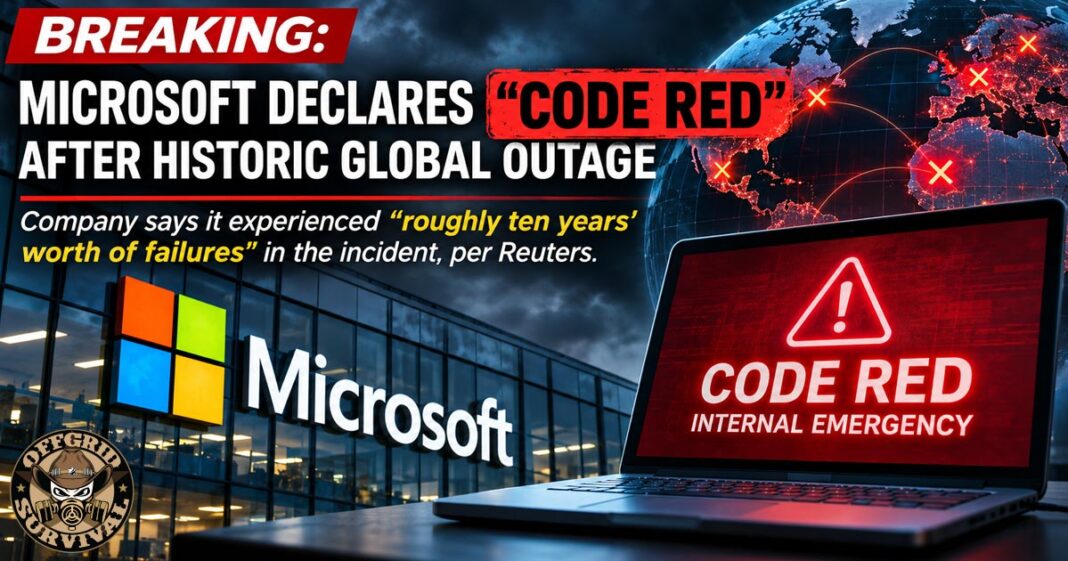
Microsoft has declared an internal “Code Red” following the historic 24-hour global outage that crippled communications across businesses, government agencies and critical services earlier this month. Internal company memos obtained by Reuters reveal just how badly things went wrong and how unprepared one of the world’s largest technology companies was to deal with the collapse of its own systems.
Microsoft executive Charles Lamanna reportedly told an internal review that the affected system had experienced “roughly ten years’ worth of acceptable failures.” The November 12–13 outage knocked out Microsoft Outlook, Exchange Online, Teams and other services that hundreds of millions of people rely on to conduct their daily business.
According to Reuters, the company has now made preventing and responding to these failures its highest internal priority.
Microsoft Engineers Struggled to Make Sense of the Collapse
Internal communications paint a disturbing picture of what was happening behind the scenes. Engineers exchanged more than 11,000 messages across 11 separate Teams chats as they struggled to understand what was failing. Microsoft executive Amanda Silver described the situation as a “fog of war.”
Microsoft claims the outage was caused by a previously undetected software defect introduced in July that triggered a cascading series of failures. The company maintains that neither hackers nor AI agents were responsible for the incident.
In many ways, that explanation should be just as concerning. If a software defect sitting unnoticed for months can cripple communications around the world for an entire day, imagine what a coordinated attack against these systems could accomplish.
Microsoft is now aiming to bring future worldwide outages under control within an hour. Ironically, part of its plan involves using more artificial intelligence to help engineers diagnose system failures.
Another Warning That Our Digital Infrastructure Is in Trouble
For the last several weeks, we have been documenting an alarming series of failures involving some of the most important computer networks in the world. In less than two weeks, we have seen nationwide flight disruptions, widespread banking outages, problems with National Weather Service systems, an outage involving the NSA’s classified communications network, and multiple cyberattacks targeting major corporations.
Just two days ago, we reported that America’s intelligence chief is warning the public to prepare for more disruptions, while dozens of government, technology and cybersecurity leaders are warning that increasingly disruptive cyberattacks could become a constant threat over the next 18 months.
Now, Microsoft is essentially admitting that years of work to protect its systems were insufficient to prevent a catastrophic failure.
While there is no confirmed evidence that these outages are connected, the sheer number of failures in such a short period of time should have people questioning the wisdom of putting virtually every aspect of modern society online.
Related coverage:
- Internet Meltdown: NSA’s Classified Network Goes Down as Hackers Target Visa and JPMorgan Chase
- Internet Meltdown Gets Worse: Gmail, Apple Pay, iCloud and Marriott Hit as Trump Shrugs Off Nationwide Outages
- United Airlines Hit by New Outage Reports as America’s Digital Infrastructure Failures Keep Piling Up
What Happens When the Next Outage Lasts a Week?
For years, Americans have been sold on the convenience of a cashless, paperless, internet-connected society. We have watched companies eliminate physical backups, banks close branches, businesses abandon traditional communication systems, and governments move essential public services online.
We are now seeing the consequences of those decisions. Even the companies responsible for building and maintaining these systems are struggling to keep them operational.
How many Americans could function for a week without access to online banking, electronic payments, email, cloud storage or internet-based communications? How many businesses could continue operating? How many families have enough food, emergency cash and basic supplies to get through a prolonged disruption without relying on these systems?
Stop treating these outages as minor inconveniences and start looking at them as opportunities to test your own preparedness. Keep cash on hand, maintain physical copies of important documents, stock emergency supplies, learn how to communicate without the internet, and make sure you have access to information that doesn’t depend on a functioning computer network.
The last couple of weeks should have been a wake-up call for anyone who still believes our modern infrastructure is too advanced or too big to fail.
Start preparing now, while you still have the luxury of doing it on your own terms.