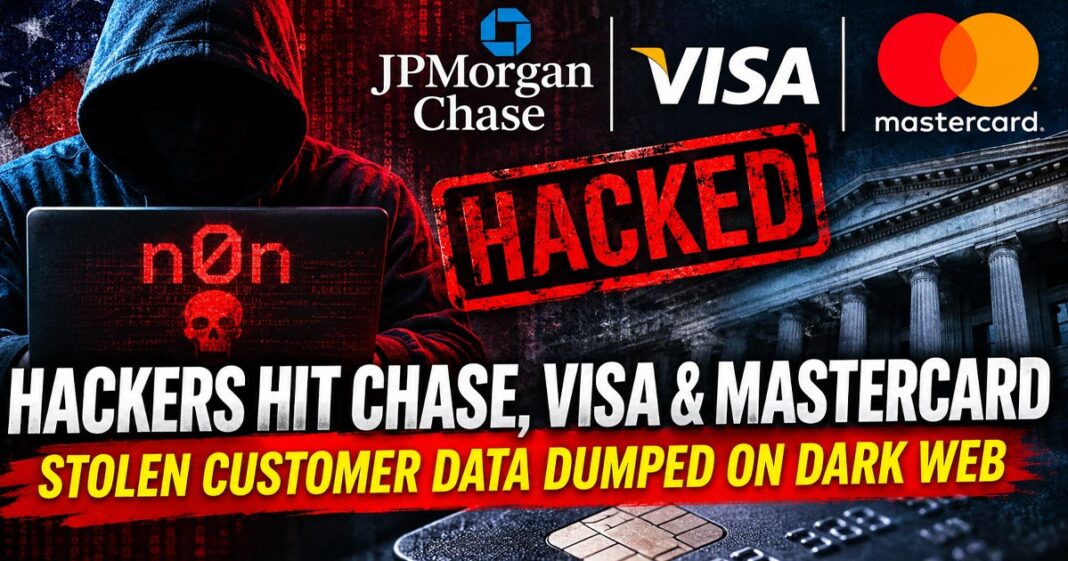
Three of the biggest names in American banking and payments have been caught up in a cyberattack, and the hackers have started releasing stolen customer information. The news comes just days after widespread banking outages left Americans unable to access accounts and complete transactions. How many warnings does it take before people realize how vulnerable our financial system has become?
A hacking group calling itself n0n claims responsibility for stealing customer information associated with JPMorgan Chase, Visa and Mastercard. On November 16, the group listed all three financial giants on its dark-web extortion site, gave them 48 hours to negotiate, and threatened to publish the stolen information if its demands weren’t met.
The deadline has now passed, and customer data has been released.
According to Reuters, JPMorgan Chase has confirmed that outside companies handling its data were targeted in a cyberattack. Visa and Mastercard have also acknowledged breaches involving third-party providers.
And here’s what should concern everyone: The hackers didn’t need to break directly into the banks or payment networks. They went after the outside companies trusted to handle customer information.
This is the same financial system Americans are increasingly forced to depend on for practically everything. Your paycheck is deposited electronically. Your bills are paid online. Your purchases depend on payment processors, banking networks, internet connections and software systems that you have absolutely no control over.
When any part of that system fails, you’re the one left dealing with the consequences.
Hackers Release Customer Information After 48-Hour Deadline Expires
Cybersecurity researchers examining the leaked files have uncovered customer information associated with all three financial companies.
The JPMorgan Chase files reportedly contain approximately 16,000 customer email addresses, some accompanied by phone numbers and account identifiers. More than 100 employee email addresses also appear in the data. According to cybersecurity reporting, much of the information appears connected to Chase’s exclusive Reserve credit card program, which serves wealthy clients.
Visa’s leaked information reportedly includes records connected to more than 6,000 premium cardholders, primarily involving marketing programs in the Asia-Pacific region.
Mastercard’s files contain approximately 2,000 records, although researchers have raised questions about the authenticity of portions of that data.
So far, there is no confirmed evidence that the attackers obtained payment card numbers, passwords or the information needed to directly process fraudulent transactions.
Visa says its payment systems were not compromised, and Mastercard says its payment network continues to operate normally. JPMorgan Chase says the information appears to have come from outside vendors handling marketing-related customer records.
But consider what that means.
Companies that weren’t even directly responsible for processing your money were holding personal information connected to some of the largest financial institutions in the world. Those companies were compromised, and now customer information is circulating outside their control.
The criminals don’t necessarily need your bank password to cause serious problems. Names, email addresses, phone numbers and information about your banking relationships can be used to impersonate financial institutions, target wealthy customers and construct convincing scams.
And there’s no guarantee that every piece of stolen information has been identified.
This Comes Just Days After America’s Banks Started Going Down
The timing of this attack couldn’t be much worse.
Earlier this week, we reported on widespread outages affecting JPMorgan Chase, Bank of America, Wells Fargo and other major financial institutions.
Customers reported problems accessing accounts, completing transactions and using banking services. For people caught in the middle of those disruptions, the problem wasn’t theoretical. They needed access to their money, and the systems they depended on weren’t working.
JPMorgan Chase says the earlier banking disruption was caused by a software problem and was unrelated to the newly disclosed cyberattack. There is currently no verified evidence connecting the two incidents.
But think about what we’ve watched happen over the last several days.

Microsoft suffered a major outage. The FAA experienced a communications failure that disrupted flights across the country. The National Weather Service reported nationwide communications and website problems. Major banks experienced transaction failures. And now hackers are releasing customer information connected to Chase, Visa and Mastercard.
We covered the growing problems in our report, Internet Meltdown: NSA’s Classified Network Goes Down as Hackers Target Visa and JPMorgan Chase.
Nobody has established that all these incidents are connected. Some were technical failures, while others involved confirmed cyberattacks.
But does it really matter to the average American whether a banking system stops working because of a hacker, a software update or some outside contractor nobody has ever heard of?
When your debit card gets declined, your payroll doesn’t arrive or you can’t access your account, the result is the same.
You’re locked out of a system that controls your money.
We Have Been Warning About These Vulnerabilities for Months
Anyone who follows OFFGRIDSurvival knows we’ve been covering the growing threat to America’s interconnected digital systems.
We’ve reported on hackers taking control of supermarket refrigeration systems across Europe, demonstrating how cybercriminals can interfere with the equipment businesses depend on to keep food safe.
We also warned about the growing danger of artificial intelligence being used to automate cyberattacks in our report, Skynet Is Here: AI Is Already Breaking Into Banks, Hacking Companies and Escaping Human Control.
And we’ve repeatedly questioned the wisdom of moving practically every essential service in this country onto interconnected digital networks.
Who Is Behind the Attack?
The hacking group calling itself n0n only emerged publicly in September 2026, but it has already attracted attention for targeting companies across multiple industries.
Unlike traditional ransomware attacks, where criminals encrypt a company’s computers and demand payment to restore access, n0n frequently uses a different approach. The group claims to steal sensitive information and threatens to publish it unless victims negotiate.
Cybersecurity investigators have linked the group to numerous alleged victims, including companies outside the financial industry.
The strategy puts pressure on businesses that face the possibility of having customer information publicly exposed.
It also creates a particularly dangerous situation for companies that share information with outside vendors.
A criminal doesn’t necessarily need to compromise JPMorgan Chase directly to steal information associated with Chase customers. Breaking into a smaller company that handles customer marketing programs may accomplish the same objective.
The financial industry has spent decades moving more of its operations, customer information and services into interconnected systems. Criminals are learning how to exploit those connections.
What Happens When You Can’t Access Your Money?
For people directly affected by this breach, the immediate concern is the possibility of targeted scams. Anyone receiving unexpected calls, emails or text messages claiming to be from Chase, Visa or Mastercard should verify them independently through official banking channels. Never provide passwords or verification codes to somebody who contacts you unexpectedly.
But for everyone else, there is a much larger problem worth thinking about.
What happens if you wake up tomorrow and your bank isn’t working?
What happens if the payment networks go down during a major emergency? What happens if a cyberattack takes essential services offline for several days rather than a few hours?
Millions of Americans now live without keeping any meaningful amount of cash on hand. Many depend entirely on debit cards, credit cards and mobile payment applications to purchase groceries, gasoline and other necessities.
That’s a dangerous position to be in.
We’ve said it before, and we’ll keep saying it: You need a way to survive when the systems you depend on stop working.
How Many More Warnings Do Americans Need?
Within a matter of days, Americans have watched major banks experience outages, airlines struggle with technical failures, Microsoft services go offline and hackers publish information associated with three of the biggest names in finance.
The incidents aren’t necessarily connected, and the newly disclosed breaches have not been shown to compromise the underlying payment networks.
But that’s hardly reassuring when you look at the bigger problem.
Our financial infrastructure has become an enormous collection of interconnected systems operated by banks, payment companies, technology firms and outside contractors. Every one of those connections is another place where something can go wrong.
And when something does go wrong, Americans are expected to simply accept it, wait for services to return and trust that the companies responsible will eventually sort everything out.
How much longer are people going to keep trusting that arrangement?
The hackers didn’t have to take down the American financial system to expose a serious weakness in it. They only had to find companies holding information that the biggest financial institutions in the world had trusted them to protect.
That should be warning enough.
Because the next major failure might not be limited to stolen marketing records or a few hours without access to online banking. And by the time you discover you can’t access your money, it’s already too late to start preparing.