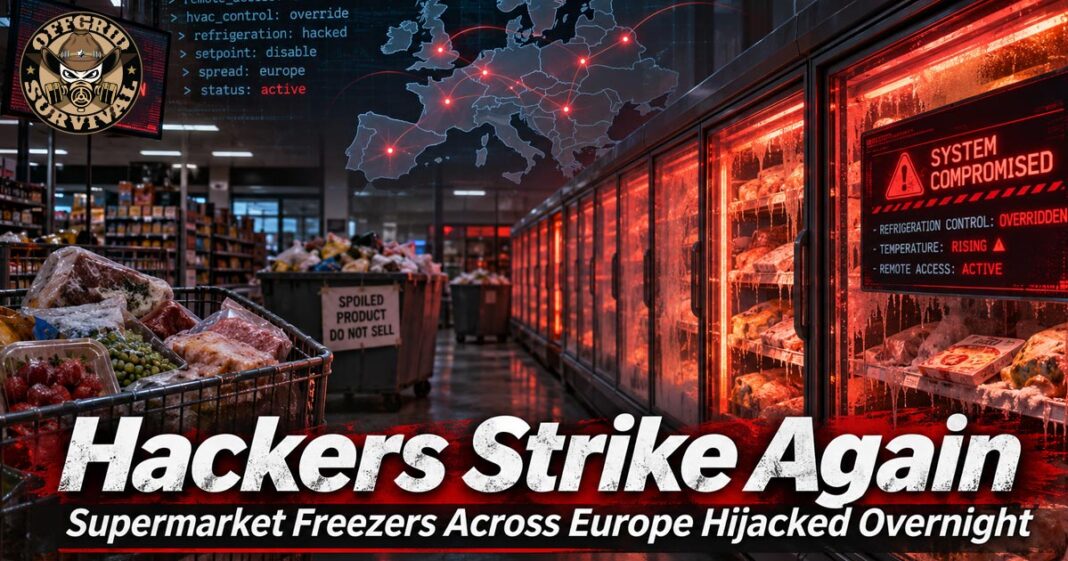
Hackers have once again targeted Europe’s food supply, remotely manipulating supermarket refrigeration systems and destroying thousands of dollars worth of food. The latest attacks hit stores and food businesses across multiple countries just weeks after hundreds of French supermarkets suffered similar damage.
Less than three weeks after hackers took control of refrigeration systems at hundreds of supermarkets in France, another wave of attacks has hit grocery stores across Europe. This time, the damage stretches across Sweden, Belgium, Luxembourg, Ireland, Estonia, and the Netherlands, with additional incidents reported in Finland.
The attacks happened overnight Sunday into Monday, November 2, with hackers reportedly manipulating refrigeration controls and pushing temperature settings as high as 50°C (122°F). By the time employees arrived for work, some stores had already lost their entire inventory of refrigerated and frozen products.
At an ICA supermarket in Stockholm, employees discovered the problem around 5:30 a.m., more than three hours after the reported attack began. Store workers were left clearing spoiled food from freezers while technicians attempted to get the systems back under control.
This should sound familiar to OFFGRID readers. Just last month, we reported on hackers taking control of hundreds of French supermarkets and destroying food by manipulating their refrigeration systems. That attack was bad enough, but the latest incidents show how easily the same type of sabotage can spread across borders.
Supermarkets Across Europe Hit in Overnight Attacks
The damage was reported across several major European grocery chains, with some stores losing significant amounts of food and others managing to contain the problem before their inventory was destroyed.
In Sweden, supermarket chains ICA and Coop reported refrigeration problems. At an ICA store in Sjöbo, employees said their refrigeration systems had been hacked and set to 50°C. Coop confirmed six affected stores, while ICA reported problems at a limited number of its locations.
Belgium was among the hardest-hit countries. Delhaize reported problems at several dozen stores in Belgium and Luxembourg, while Carrefour confirmed 15 affected Belgian locations. Five franchise Spar stores were also hit, and even an IKEA location in Mons reportedly had to remove food from sale.
One Belgian butcher estimated that approximately €15,000 worth of meat had been ruined overnight. Other retailers faced the additional expense of cleaning out their refrigeration units, replacing spoiled inventory, and losing business while repairs were made.
In Ireland, Musgrave confirmed that refrigeration systems at 13 SuperValu stores had been affected, forcing employees to remove chilled and frozen products as a precaution. Dutch refrigeration supplier Danfoss reported incidents involving 17 businesses, including butcher shops and smaller food retailers.
Estonia also reported an attack in which hackers accessed a computer controlling a refrigeration system and raised its temperature setting to 50°C. Technicians reportedly intervened within minutes, preventing significant losses.
The full extent of the damage is still being assessed, and investigators have not established whether all the incidents were carried out by the same attackers. So far, no group has publicly claimed responsibility.
Hackers Are Exploiting the Systems That Keep Food Cold
What makes these attacks especially disturbing is how little physical access is required to cause serious damage.
Modern supermarkets rely on internet-connected refrigeration controllers that allow maintenance companies to monitor equipment and adjust settings remotely. These systems are supposed to help technicians identify problems before a store loses thousands of dollars in inventory. Unfortunately, that same remote access can become a serious vulnerability when equipment is poorly secured or running outdated software.
According to the head of Belgian refrigeration company Sabcobel, which maintains systems for Delhaize and other retailers, attackers switched refrigeration equipment into defrost mode. Instead of keeping food cold, the equipment began warming up, potentially ruining entire cases of meat, dairy products, and frozen food.
That closely resembles what happened in France in October, when hackers reportedly compromised internet-accessible refrigeration controllers and manipulated temperature settings and defrost cycles. French authorities identified hundreds of affected businesses, with some incidents resulting in fires as well as substantial food losses.
Equipment from manufacturers including Danfoss has been linked to the incidents, and security researchers have warned about vulnerabilities in older refrigeration controllers that remain exposed to the internet.
Consider what that means for the food supply. An attacker doesn’t have to break into a supermarket, contaminate food, or physically destroy a warehouse. Depending on the equipment and its security, gaining access to a remote management system could be enough to ruin thousands of dollars worth of inventory while employees are home sleeping.
And the problem extends well beyond supermarkets. Similar control systems are used in food warehouses, commercial kitchens, butcher shops, distribution centers, and other facilities that depend on constant refrigeration.
Pentagon Investigating Similar Refrigeration Failures at U.S. Military Bases
There is also growing concern that similar sabotage may have already occurred in the United States.
According to Reuters reporting cited in coverage of the European attacks, Pentagon investigators are examining suspicious refrigeration failures at more than half a dozen U.S. military commissaries in August. The affected installations reportedly include Fort Irwin in California, Holloman Air Force Base in New Mexico, Naval Station Newport in Rhode Island, Little Rock Air Force Base in Arkansas, F.E. Warren Air Force Base in Wyoming, Robins Air Force Base in Georgia, and Fort Huachuca in Arizona.

Military investigators are reportedly working with French authorities to determine whether those failures involved cyberattacks and whether they could be related to the European incidents.
There is currently no public confirmation that hackers caused the military commissary failures. However, the fact that investigators are examining that possibility should concern anyone who understands how dependent modern military operations and civilian food distribution have become on connected technology.
The refrigeration systems used throughout Europe are not unique to that continent. American supermarkets, food distributors, and commercial cold-storage facilities rely on many of the same manufacturers and technologies.
There is no reason to assume American food suppliers are immune to the vulnerabilities being exploited overseas.
Governments Are Warning People to Prepare for Major Disruptions
These attacks are happening at a time when governments around the world are increasingly warning citizens to prepare for disruptions involving food, electricity, communications, and other essential services.
We’ve recently covered the Pentagon’s preparations for a potential prolonged conflict and Britain’s renewed warnings to households to stockpile food, water, and cash. We’ve also reported on emergency preparedness warnings and planning in Japan and Finland.
There is no evidence that these government preparedness campaigns were prompted by the supermarket attacks. However, the incidents illustrate one of the many reasons we have repeatedly warned people against relying entirely on systems they cannot control.
A cyberattack doesn’t have to shut down an entire country’s electrical grid to create serious problems. Disrupting regional food distribution, destroying refrigerated inventory, or interfering with grocery store operations can cause significant damage without a single shot being fired.
Sweden and Finland, two countries affected by or reporting incidents during the latest wave, have long encouraged households to maintain emergency food and water supplies. Their preparedness guidance reflects the reality that modern infrastructure can be disrupted by everything from severe weather and power failures to sabotage and armed conflict.
The growing dependence on internet-connected equipment has simply created another way for those disruptions to happen.
Another Warning About Our Increasingly Vulnerable Infrastructure
For years, cybersecurity warnings focused primarily on stolen passwords, compromised credit cards, and personal information. Those threats haven’t disappeared, but attackers are increasingly targeting the equipment and infrastructure that keep everyday life functioning.
We’ve already reported on billions of dollars being stolen through cryptocurrency hacks, the growing use of AI in cyberattacks against businesses and financial institutions, and the serious vulnerabilities being discovered in widely used internet infrastructure.
Now we’re watching attackers manipulate the temperatures inside commercial refrigeration systems and destroy food without ever entering the buildings.
The immediate damage from the latest European incidents appears concentrated in individual stores and businesses. Some retailers have already resumed normal operations, and there is no indication that Europe’s overall food supply has been crippled.
But the vulnerability itself is much bigger than the current damage. If attackers can compromise dozens of refrigeration systems across multiple countries in a single night, the potential consequences of a more coordinated attack against major warehouses or distribution centers deserve serious attention.
A supermarket can replace a few cases of ruined meat relatively quickly. Replacing the inventory of a major regional cold-storage facility, especially if multiple facilities were hit simultaneously, would be an entirely different problem.
What You Should Be Doing to Protect Your Own Food Supply
The biggest mistake people make when preparing for emergencies is assuming that because food is always available at their local grocery store, it will continue to be available whenever they need it.
Most grocery stores depend on frequent deliveries and maintain relatively limited backroom inventory. Even a temporary disruption to deliveries, refrigeration, or payment processing can create shortages, particularly when customers begin buying more than usual.
That’s why we have always recommended maintaining an emergency food supply that does not depend on refrigeration. Our survival food guide covers the basics, but the most important thing is to start storing food your family actually eats and gradually build a reserve that can get you through an extended disruption.
For most households, having at least two weeks of shelf-stable food is a reasonable starting point, with a longer-term goal of several months if storage space and finances allow. Canned meats, vegetables, pasta, rice, oats, and properly stored dry goods can provide a substantial food reserve without depending on a working refrigerator or freezer.
Freezers are useful for storing large quantities of meat and other perishables, but they should not be your only source of emergency food. A full freezer generally keeps food at a safe temperature for about 48 hours during a power outage if the door stays closed, while a half-full freezer may only provide about 24 hours. Refrigerators typically maintain safe temperatures for approximately four hours without power.
A backup generator or properly sized solar battery system can help protect that food during an outage, but learning to preserve food through pressure canning, dehydration, and other established methods gives you additional options. Always follow tested food-preservation procedures rather than assuming smoking, salting, or drying alone will make meat safe for long-term storage.
It’s also worth remembering that the supermarket is only one part of the food supply chain. Developing relationships with local farmers, maintaining a productive garden, and purchasing shelf-stable foods in bulk can reduce your dependence on a single store or distribution system.
We’ve warned for years that dependence on centralized systems creates vulnerabilities most people don’t consider until something fails. The latest attacks in Europe are another example of how quickly those failures can happen.
The supermarkets affected this week will eventually replace their spoiled inventory, repair their systems, and reopen their refrigerated departments. What remains unresolved is who is responsible, how many other systems are vulnerable, and whether the next attack will target something far more consequential than a few dozen grocery stores.
For anyone who still thinks emergency food storage is unnecessary, watching hackers destroy supermarket inventories from thousands of miles away should provide plenty of reason to reconsider.