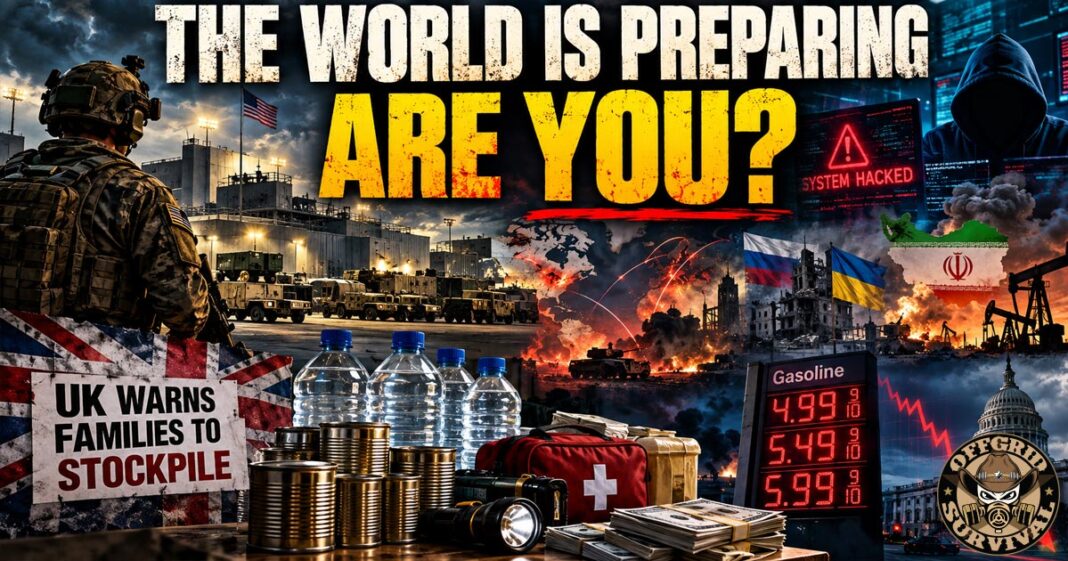
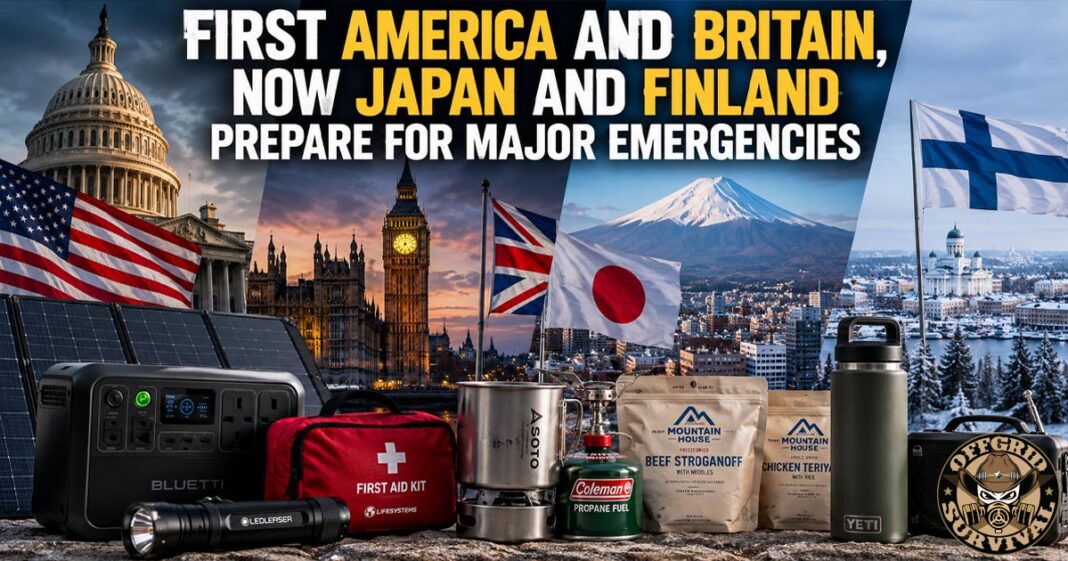
Four countries. Four different threats. One message: don’t count on help arriving right away.
Yesterday, we asked what the Pentagon and Britain know after the U.S. military began preparing bases to run for 90 days without outside support and Britain told families to stock food, water and cash.
Less than 24 hours later, two more governments joined the list.
Japan’s disaster management minister says he will formally ask every household in the country to keep at least three days of food, water and toilet supplies on hand, and ideally a full week. On the same day, Finland’s National Emergency Supply Agency published a new report on how a society keeps functioning during a military crisis that lasts not days or weeks, but years.
Different countries. Different threats. But the same growing realization: when a major emergency hits, ordinary families are going to be on their own for a while.
Japan Will Issue a Nationwide “Emergency Request” to Stockpile Supplies
Japan’s Minister of State for Disaster Management, Goshi Hosono, said he plans to issue what Japanese media are calling an “emergency request” to the entire country on November 2. The date coincides with the official launch of Japan’s new Disaster Management Agency, a stand-alone government body built to coordinate disaster preparedness and response across the national government.
Speaking on a Fuji TV online news program, Hosono asked households to be able to manage on their own, without public assistance, for “at a minimum, three days, but ideally a week.”
The recommendations include:
- Water: about three liters per person, per day, for drinking and cooking (roughly three-quarters of a gallon)
- Non-perishable food for every member of the household
- Emergency toilets and sanitation supplies
- Portable gas stoves for cooking when power and gas are out
- Essential medications
Japan’s government is also encouraging what preppers have called a rolling stockpile for years: instead of buying emergency rations that sit in a closet until they expire, buy a little more of the food your family already eats and rotate through it. That keeps supplies fresh, reduces waste and helps prevent the kind of panic buying that empties store shelves the moment a disaster is announced.
What Japan Is Actually Preparing For
Unlike Britain, which has pointed to cyberattacks, sabotage and hostile foreign governments, Japan’s stated reasons are natural disasters, and they are serious ones.
Hosono specifically pointed to the risk of a Nankai Trough megaquake off Japan’s Pacific coast, a major earthquake striking directly beneath Tokyo, large trench earthquakes, and a possible eruption of Mount Fuji. Any one of those could cut roads, rail lines, power, water and communications across a huge part of the country.
Japan has learned this lesson the hard way. After major earthquakes, emergency food deliveries have repeatedly fallen short of the number of people in evacuation shelters for the first several days. That gap is exactly what the three-day minimum is meant to cover.
To be clear: the request is not based on any new warning of an imminent disaster. Japanese officials and fact-checkers have pointed out that a three-day to one-week household stockpile has long been the government’s standing recommendation. What is odd, is how many governments started taking prepping serious. Japan is turning a quiet guideline into a national appeal, timed to the launch of a brand-new agency.
That hasn’t stopped speculation online that the timing is linked to fears of a wider war or AI-driven cyberattacks. There is no evidence of that. But the coincidence of timing with Britain’s Be Ready campaign and the Pentagon’s 90-day plans has people asking the same question we asked yesterday.
Finland Is Planning for a Crisis That Lasts Years
If Japan’s message is about the first few days after a disaster, Finland’s is about what happens if the disaster never really ends.
On October 27, Finland’s National Emergency Supply Agency (NESA), the government body responsible for keeping the country supplied during a crisis, released a report called Lessons from Ukraine for Finland’s Security of Supply.
NESA has followed Russia’s war against Ukraine for four and a half years and sent officials and executives from key Finnish companies on study visits to Ukraine. The report is built on what they found.
Its central conclusion should get every prepper’s attention: in a prolonged crisis, stockpiles and backup systems alone are not enough. Ukraine has shown that a society may have to function when disruptions last for years, and that the ability to adapt, repair damage and keep going under changed conditions matters as much as anything sitting in a warehouse.
The report highlights six lessons:
- People are the system. Nothing runs without workers who are available and able to do their jobs.
- Decentralize. Losing a small unit hurts far less than losing one large, centralized facility.
- Manage your dependencies. Everything ultimately depends on energy, telecommunications and logistics.
- Fix things fast. Damage from attacks has to be repaired quickly so everyday life can continue.
- Share information. In Ukraine, mobile apps help people know when to take shelter.
- Public and private sectors must work together, because businesses provide many essential services.
NESA’s Director General, Janne Känkänen, said the threats should be taken seriously but that there is no reason to give in to fear, arguing that determined preparation is what allows everyday life to continue in difficult conditions.
Notably, the public version of the report was deliberately written at a general level so it would not reveal Finland’s own vulnerabilities. The detailed version is not public.
Finland Is Also Mailing Paper Survival Guides to Every Household
The report is only the latest step. Earlier this month, Finland’s Interior Ministry announced it will print and distribute roughly 3.5 million emergency preparedness guides to households and businesses across the country, at a cost of about €2 million.

The reason? Officials concluded that keeping preparedness advice only online was not good enough. If the power or internet goes down, a website does nobody any good. The new guide will also address the threat posed by drones.
Finland already recommends that every household be able to cope on its own for at least 72 hours. It has a network of roughly 50,500 civil defense shelters, enough for most of its population. And just last month, NESA ran an exercise called TIETO26, testing whether companies and authorities could keep food flowing to the public during an escalating conflict.
This is a country that takes preparedness more seriously than almost anyone. And it’s still stepping up its efforts.
Four Countries, Four Timelines
Put the latest announcements side by side and a pattern starts to show.
| Country | Who’s preparing | Threat cited | Time frame |
|---|---|---|---|
| United States | Pentagon, for military bases | Global war, grid failure, supply chain collapse | 90 days |
| United Kingdom | Households, via the Be Ready campaign | Cyberattacks, sabotage, terrorism, hostile states | 3 days |
| Japan | Households, via a nationwide request | Megaquakes, Mount Fuji eruption | 3 days minimum, 1 week preferred |
| Finland | Society as a whole, plus households | Prolonged military crisis, hybrid threats | 72 hours for homes, years for the nation |
The threats are different. Japan is worried about the ground shaking. Britain and Finland are worried about Russia, cyberattacks and sabotage. The Pentagon is worried about all of it at once.
But look at the time frames. Governments are planning for months or even years of disruption for themselves, and asking ordinary families to handle three days to a week.
This isn’t a coordinated global panic, and none of these announcements prove that something specific is about to happen. What they do show is that governments around the world have reached the same uncomfortable conclusion: in the first days of a major emergency, they cannot reach everyone. Families who prepared will be fine. Families who didn’t will be waiting in line.
What Preppers Can Learn From Japan and Finland
There is useful, practical advice buried in both announcements that goes beyond “buy more canned food.”
Don’t forget sanitation. Japan put emergency toilets on the same list as food and water, and for good reason. When water and sewer systems fail after an earthquake, sanitation becomes a health crisis fast. Keep heavy-duty trash bags, a bucket toilet setup, absorbent material, disinfectant and hygiene supplies in your kit. Most people never think about this until it’s too late.
Store what you eat, and eat what you store. Japan’s rolling stockpile approach is the easiest way to build a deep pantry without wasting money. Buy one or two extra of the staples you already use, put the new ones in the back and use the oldest first. If you want to go further, our guide to long-term food storage covers what actually lasts. And don’t forget to learn how to cook everything from scratch!
Plan for water first. Three liters per person per day is a bare minimum for drinking and cooking. A family of four needs about three gallons a day, or more than 20 gallons for a week, before you account for hygiene, pets or hot weather. Learn what happens to your water when the power goes out.
Have a way to cook without the grid. A camp stove and extra fuel turn a pantry full of rice and beans into actual meals.
Keep your information offline. Finland is printing paper guides because websites go dark when the power does. Print your emergency plans, contact lists, maps and key how-to information. Keep a battery-powered or hand-crank radio, and consider getting your ham radio license.
Don’t forget a way to power everything if the grid goes down!
- OFFGRID Living: How Many Solar Panels and Batteries Do You Actually Need to Run Your Home?
- OFF-Grid Lithium-Ion Batteries: Which Batteries are the best for off-grid power!
- Cheap Off-Grid Power: Real Solar Setups Under $1,000
Think like Finland: redundancy and repair. Finland’s lessons from Ukraine apply at home. Don’t depend on a single source for power, heat, water or cooking. And build the skills and tools to fix things yourself, because in a long emergency, the repair crew may not be coming.
Build beyond the minimum. Three days is where governments start. It shouldn’t be where you stop. As we said yesterday, aim for 30 days of self-sufficiency, with 60 to 90 days as a longer-term goal.
The Warnings are Getting Harder to Ignore
A week ago, telling people to stockpile food and water was something governments did quietly, in pamphlets nobody read.
Now the Pentagon is building bases that can survive three months on their own. Britain’s Defence Secretary is on national television telling families to keep cash and a wind-up radio. Japan is launching a new national agency with a nationwide appeal to stock up. And Finland, one of the best-prepared countries on Earth, is studying how Ukraine has kept the lights on through years of war.
None of these governments are telling their citizens to panic. But all of them are telling their citizens the same thing: be ready to take care of yourself.
Maybe it’s time we listened.
Related: The Pentagon Is Preparing for 90 Days of War. Britain Is Telling Families to Stockpile Food. What Do They Know? · Pentagon Preparing U.S. Military Bases to Survive 90 Days · Britain Tells Families to Stock Food, Water and Cash