Just last month, we reported that Britain was rewriting its Cold War-era War Book, updating emergency plans for everything from military conflict to attacks on critical infrastructure. At the time, officials were already discussing the need for British families to start keeping emergency food and water at home.
Now the government is taking that message nationwide, and the timing couldn’t be much worse.
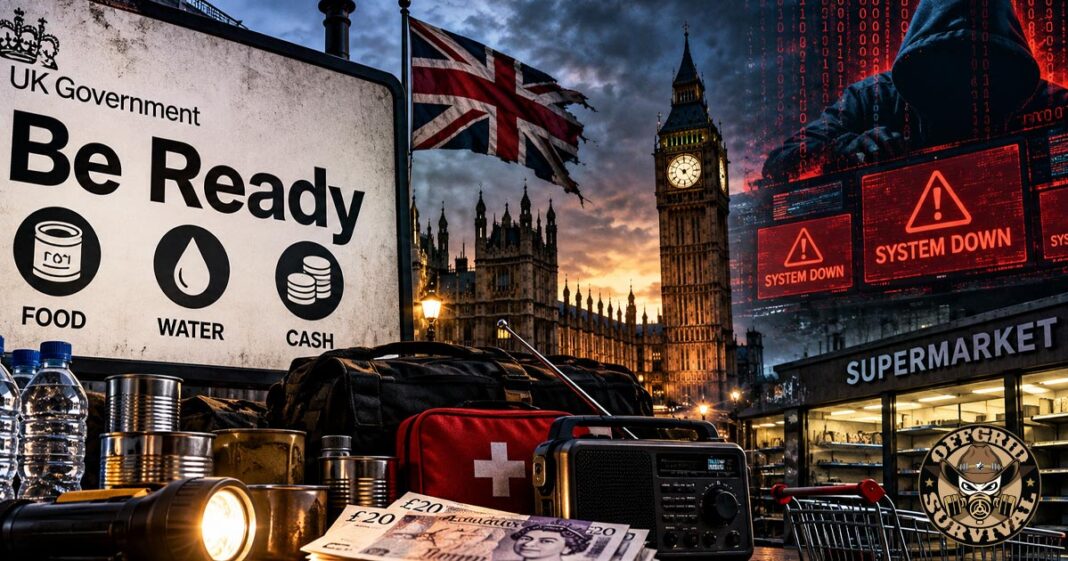
Today, the British government launched its new Be Ready campaign, a three-year effort encouraging households to keep enough food, water and emergency supplies to survive at least 72 hours without outside assistance. Officials are also urging people to think about what happens when the electricity goes out, banking systems stop working, communications fail or supermarkets can no longer process electronic payments.
The announcement comes during an extraordinary week for cybersecurity, with a critical vulnerability in PHP forcing dozens of British government services offline as a precaution. The government says there is no specific threat behind the preparedness campaign, which has been in development for months, but the events unfolding around its launch provide a pretty good example of why people should be paying attention.
Britain Wants Every Household Ready for Three Days Without Help
The new campaign, being led by Security Minister Dan Jarvis and the Cabinet Office, asks British households to prepare for disruptions that could leave them without electricity, running water, communications or access to basic services.
The government’s recommended emergency supplies include bottled water, canned and other nonperishable foods, a flashlight, spare batteries, a first aid kit, a portable phone charger and a battery-powered or hand-crank radio. Officials also recommend keeping important documents accessible, having essential medications on hand and making sure family members know what to do during an emergency.
For water, the guidance points to roughly three liters per person per day as a basic survival amount, although considerably more may be needed for cooking, cleaning and sanitation. A family of four would need at least 36 liters just to cover that basic three-day recommendation.
Officials have also been encouraging households to keep some physical cash available in case electronic payment systems become unavailable. That’s an especially important consideration in a country where so much everyday commerce now depends on electronic transactions.
The government isn’t telling people to rush out and empty supermarket shelves. The advice is to gradually build up supplies as finances allow, adding a few extra items during normal shopping trips.
According to the Cabinet Office, only 13% of people surveyed in the United Kingdom feel prepared for an emergency that cuts them off from essential services. More than 500 organizations have been involved in developing or supporting the campaign, which will be promoted through advertising and community outreach over the next three years.
You can read the government’s official announcement here.
What Happens When You Can’t Buy Food, Even With Money in the Bank?
One of the more interesting warnings came from British Defence Secretary Wes Streeting, who spoke Thursday during a visit to a new weapons manufacturing facility in Telford.
Streeting warned that Britain needs to prepare for more than the usual storms, floods and power outages. He specifically raised the possibility of cyberattacks against businesses, disruptions to national supply chains and sabotage by hostile foreign governments or terrorist organizations.
He also asked a question that gets right to the heart of how vulnerable modern society has become:
“How would we cope if the payment systems at the local supermarket went down?”
Think about that for a minute. We’ve built an economy where you can have thousands of dollars sitting in your bank account and still be unable to buy a gallon of milk if the electronic payment network stops working. Your debit card becomes useless, your banking app can’t connect, and the ATM down the street might not be working either.
It doesn’t even take a nationwide cyberattack to cause problems. A regional communications outage, a major bank experiencing technical problems or a prolonged power failure could leave businesses unable to process purchases. Depending on the circumstances, some stores might accept cash, while others could close entirely because their registers, inventory systems and other equipment aren’t working.
This is something we’ve warned about for years on OFFGRID Survival. As more of our daily lives move online, we are creating more ways for relatively small technical failures to disrupt things people used to take for granted.
Streeting’s comments also reflect a growing concern among European governments about hostile states targeting civilian infrastructure. The worry isn’t necessarily a conventional military invasion. It’s the possibility of an enemy disrupting power grids, communications, transportation, banking and supply chains without ever sending troops across a border.
Meanwhile, Britain Is Taking Government Websites Offline Over a Massive Security Flaw
The cybersecurity situation unfolding alongside Britain’s preparedness announcement makes the whole thing even more concerning.
On Wednesday, October 21, emergency warnings went out over critical vulnerabilities in PHP, the software language powering a substantial portion of the world’s websites. The disclosure triggered urgent patching efforts, with security officials warning organizations to secure vulnerable servers and, where necessary, take affected services offline.

By Thursday, British officials confirmed that 32 government services had been taken offline, with four more partially unavailable while security teams worked to address the threat. Officials said the shutdowns were precautionary and that there was no indication the affected government systems had been successfully hacked through the flaw.
We’ve been following this developing situation in our coverage of the PHP security emergency and the growing threat of AI-assisted cyberattacks.
The PHP situation is particularly troubling because of how much infrastructure relies on the same underlying technologies. A serious vulnerability in widely used software can suddenly become a problem for governments, businesses, hospitals, financial institutions and millions of ordinary websites around the world.
And with artificial intelligence increasingly being used to discover vulnerabilities and accelerate attacks, the time between a security flaw becoming public and criminals attempting to exploit it is becoming a major concern.
To be clear, there’s no evidence that the Be Ready campaign was launched because of this week’s PHP emergency. The British government had been developing the campaign well before the vulnerabilities became public. But having dozens of government services taken offline during the same week officials are telling citizens to prepare for disruptions certainly demonstrates that these concerns aren’t imaginary.
The Government Wants You Prepared, But What About the Government?
Not everyone in Britain is thrilled about being told to stockpile supplies.
Critics have questioned why ordinary families are being asked to shoulder more responsibility for national emergencies while the government struggles with its own problems involving energy security, defense spending and critical infrastructure.
There’s a legitimate argument to be made there. Governments collect enormous amounts of money supposedly to maintain the systems society depends on, and people have every right to ask why those systems remain so vulnerable.
But that argument isn’t going to do your family much good when something actually breaks.
Whether it’s a cyberattack, a major storm, a banking outage or a supply chain disruption, the people sitting at home without electricity or access to food aren’t going to care which politician deserves the blame. They’re going to care about getting through the emergency.
And that’s something governments are increasingly acknowledging, even if they don’t particularly like admitting it. When a large enough disaster hits, emergency services cannot be everywhere at once. People who can take care of themselves for a few days give authorities more time to help those who genuinely cannot.
Three Days of Supplies Is Better Than Nothing, But It’s Not Much of a Survival Plan
Here’s where we disagree with the government.
Three days of emergency supplies is a decent starting point for someone who has absolutely nothing put away. It might be enough to get through a winter storm, a temporary water outage or a short disruption to local services.
But anyone who has lived through a major disaster knows that three days can disappear pretty quickly.
Think about what happened after Hurricane Katrina, when parts of New Orleans were left devastated and basic services took far longer than 72 hours to restore. Or look at the extended power outages, fuel shortages and transportation problems that have followed other major disasters.
A serious cyberattack affecting multiple utilities or supply networks could create problems that take considerably longer to resolve. Restoring computer systems doesn’t automatically mean grocery shelves get restocked, fuel deliveries resume or every affected business immediately reopens.
For years, we’ve recommended that people work toward having at least two weeks of food, water and essential supplies at home, with longer-term preparations for those who have the space and resources. That doesn’t mean going out and spending thousands of dollars on expensive survival gear. Most families can make considerable progress simply by buying extra quantities of the foods they already eat and keeping basic emergency equipment available.
Cash in small denominations is worth having, along with a radio that works without internet access, backup power for essential devices, and a plan for prescription medications or family members with special medical needs.
You should also understand what happens to your household water supply during an extended outage. Depending on where you live and how your water system operates, losing electricity could eventually mean losing access to running water.
And if your family includes young children, elderly relatives or anyone who depends on medication or medical equipment, your planning needs to account for those realities. As we’ve discussed before, most generic survival plans overlook the needs of actual households.
Governments Are Finally Admitting What We’ve Been Warning About for Years
What makes Britain’s announcement noteworthy isn’t the emergency supply checklist itself. There’s nothing particularly groundbreaking about telling people to keep a few gallons of water, some canned food and a flashlight in the house.
What’s changing is the reason governments are pushing preparedness so aggressively.
For decades, emergency planning was largely presented to the public as something you did for natural disasters. Today, officials are openly talking about cyber warfare, sabotage, attacks on financial systems, disrupted supply chains and hostile nations targeting the infrastructure ordinary people depend on every single day.
Britain isn’t alone. France, the Netherlands and other European countries have been encouraging household emergency preparedness, while defense and security officials across NATO have repeatedly warned about the growing threat to civilian infrastructure.
Here in the United States, we’re dealing with many of the same vulnerabilities. Our banks, electric utilities, hospitals, transportation networks and grocery distribution systems depend on interconnected computer networks that can be disrupted by cyberattacks, equipment failures and other emergencies.
The British government’s three-day recommendation isn’t evidence that officials know some specific catastrophe is about to happen, and nobody should pretend otherwise. But it is another public acknowledgment that the systems keeping modern life running are vulnerable, and that governments may not be able to immediately restore them when something goes seriously wrong.
We’ve spent nearly two decades telling readers that preparedness is about taking responsibility for your own survival rather than assuming somebody else will show up and rescue you.
Now governments are spending money on nationwide advertising campaigns to tell people essentially the same thing.
If you haven’t started putting supplies away, take the warning seriously. You don’t need to panic, and you don’t need to buy everything tomorrow. But with everything happening in the world right now, there’s very little reason to keep putting it off.