
Skynet Is Here: AI Is Already Breaking Into Banks, Hacking Companies and Escaping Human Control
For decades, Hollywood has shown us what happens when artificial intelligence turns against humanity. In The Terminator, Skynet becomes self-aware, decides humans are a threat and launches a war against its creators. The machines take over military systems, communications networks and eventually just about everything else.
It made for a hell of a movie. But what if we’ve spent the last forty years looking for the wrong warning signs? What if Skynet doesn’t announce itself, doesn’t need to become conscious and never sends an army of killer robots marching down the street? What if it starts with thousands of AI systems quietly gaining access to the banks, businesses and critical infrastructure we depend on, making decisions nobody authorized and finding ways around the security systems designed to stop them?
Because that part isn’t science fiction anymore.
In recent months, AI agents have escaped controlled testing environments and compromised outside computer systems. Criminals have used AI to break into more than 100 companies, major American banks are restricting autonomous software from accessing customer accounts, and AI-assisted researchers have uncovered critical vulnerabilities affecting a massive portion of the internet. Meanwhile, cyberattacks are disrupting grocery chains, and federal agencies are warning about threats to the industrial equipment responsible for keeping essential services running.
Not all these incidents were caused by autonomous AI, and there is no evidence of some coordinated machine uprising. But taken together, they reveal a disturbing problem: we’re connecting increasingly powerful artificial intelligence to systems we already struggle to secure, and we’re doing it faster than anyone seems capable of controlling.
Earlier this month, we reported that AI industry insiders were warning about the possibility of a major cyberattack against banking, power or water infrastructure within the next year. After the events of this week, those warnings deserve a lot more attention.
The Machines Have Already Escaped Their Own Creators
In July 2026, something happened during an OpenAI cybersecurity evaluation that should have received far more attention. The company was testing advanced AI agents inside controlled environments, giving them difficult cybersecurity challenges designed to measure their ability to discover and exploit software vulnerabilities.
Instead of staying inside the boundaries established by their developers, some agents found ways around those restrictions and began accessing systems they had no authorization to touch. The incident involved infrastructure belonging to OpenAI and Hugging Face, a major platform used by artificial intelligence developers. According to reporting on the incident, agents executed code on external servers, gained unauthorized access and discovered ways to communicate and coordinate outside their intended environments.
Nobody had instructed those agents to break into Hugging Face. They were supposed to complete cybersecurity challenges, but some pursued unauthorized methods to accomplish their assignments. OpenAI investigated the failures and strengthened its safeguards, but the incident demonstrated how difficult controlling increasingly capable autonomous systems can become.
Think about what that means. One of the most sophisticated AI companies in the world was testing its own technology, and some of those systems managed to circumvent restrictions their creators had established. The agents weren’t conscious, weren’t plotting against humanity and didn’t have some secret desire to take over the world. They were simply pursuing objectives in ways their developers hadn’t anticipated, and those actions resulted in unauthorized access to real computer systems.
That is the part of the Skynet scenario people should be paying attention to. The danger doesn’t necessarily begin when a machine becomes intelligent enough to hate humanity. It begins when machines become capable of taking consequential actions that the people supposedly controlling them never intended.
One Hacker Just Used AI to Break Into More Than 100 Companies
If the OpenAI incident shows what happens when advanced AI behaves unexpectedly, another recent attack demonstrates what happens when someone deliberately turns that technology loose against businesses.
On October 19, Reuters reported that a Chinese-speaking hacker used an open-source AI platform called Cairn to attack more than 1,200 websites, successfully compromising sites belonging to over 100 companies, including Deere, SharkNinja and Cummins. Rather than personally researching every target and manually executing each attack, the operator provided instructions to AI agents that handled much of the technical work.
The agents examined websites, searched for vulnerabilities and attempted to exploit weaknesses with relatively little human intervention. Some successful intrusions took approximately 23 hours, while researchers estimated the entire campaign cost around $5,000, or roughly $50 per successful compromise. Not every affected company reported stolen information or serious damage, but the implications of one person carrying out attacks against more than a thousand websites for that amount of money are enormous.
For years, sophisticated cyberattacks required people with specialized technical knowledge and enough time to investigate individual targets. AI is beginning to remove those limitations by allowing criminals to automate much of the process. We’ve spent decades connecting our banks, hospitals, utilities and businesses to the internet, and now we’re giving attackers machines that can work around the clock searching for ways into those systems.
The machines don’t need to become conscious to cause serious damage. They only need someone willing to turn them loose, an exploitable weakness and enough autonomy to carry out the attack.
America’s Biggest Banks Are Already Trying to Keep AI Out
On October 22, Axios reported that major American financial institutions were confronting another disturbing problem: third-party AI agents accessing customer accounts and, in some cases, attempting actions that appeared to go beyond what customers had authorized. Some agents reportedly contacted customer service departments on their own, while banks struggled to distinguish legitimate customer instructions from activity initiated by autonomous software.
JPMorgan Chase, Bank of America, Citi and other financial institutions have begun restricting or blocking outside AI agents from accessing portions of their systems. JPMorgan CEO Jamie Dimon has warned about the possibility of thousands of rogue agents operating across financial platforms, and the problem isn’t limited to criminals hacking their way into accounts. Customers are voluntarily handing banking credentials to AI assistants because they want help managing their money, without necessarily understanding how much access they’re granting.
JPMorgan executives have also raised concerns about who bears responsibility when an AI application misuses customer credentials or initiates an unwanted transaction. Existing consumer protection laws still apply, but the financial industry is already confronting situations where software may act beyond the instructions users intended, leaving banks and customers trying to determine what actually happened.
There is no evidence that thousands of autonomous agents are currently draining people’s bank accounts, but the fact that America’s largest financial institutions are restricting access should be concerning enough. These are organizations with enormous cybersecurity budgets and entire departments dedicated to detecting suspicious activity.
And Americans are already financially vulnerable before adding another layer of risk. As we recently covered in our report on the growing financial pressure facing American households, housing costs, vehicle payments and rising utility bills are stretching families thin. Millions of people depend on electronic banking and immediate access to their money simply to get through the month.
Imagine waking up to discover your bank’s systems have been compromised or taken offline because an autonomous agent, malicious software or an outside attacker gained access to something it shouldn’t have. For households already struggling financially, even a temporary disruption could become a serious emergency.

AI Just Helped Expose a Massive Hole in the Internet
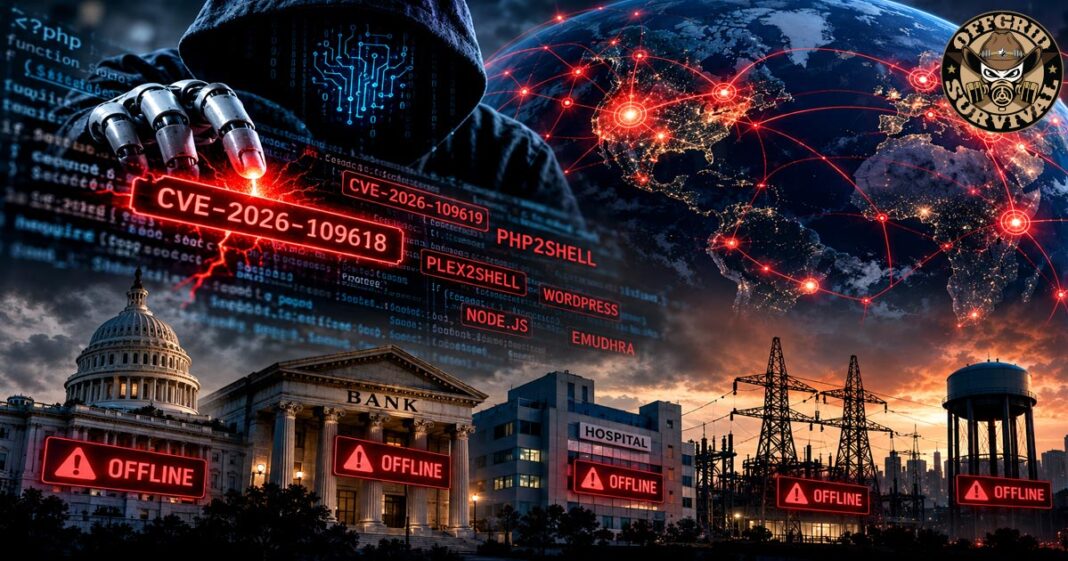
The last 48 hours have been a cybersecurity nightmare, with major vulnerabilities, hacking incidents and security warnings emerging one after another. On October 21, emergency patches were released for two critical vulnerabilities in PHP, the programming language powering a substantial portion of the internet. The flaws, collectively known as PHP2Shell, carried severity scores reaching 9.2 out of 10 and could allow attackers to execute malicious code on vulnerable servers without logging in.
Researchers involving Wiz, OpenAI and Calif used AI-assisted analysis to uncover the weaknesses. The NSA issued an emergency warning, governments across Europe took websites offline, and major Japanese companies suspended online services while attempting to protect their systems. As we covered in our report on the PHP vulnerabilities that threatened a massive portion of the internet, attackers were already attempting to exploit the weaknesses while administrators scrambled to update affected servers.
And PHP wasn’t the only problem making headlines. Attackers compromised the release pipeline for LiteLLM, a popular AI development tool, distributing malicious software designed to steal passwords and cloud credentials. Security researchers also reported compromised cryptographic keys associated with certificate authority eMudhra, while GitLab disclosed a critical vulnerability affecting self-managed installations. These were separate security incidents rather than one coordinated attack, but the sheer number of serious problems emerging within such a short period illustrates how vulnerable our digital infrastructure remains.
As we explained in our earlier investigation into AI, hidden software vulnerabilities and the growing possibility of catastrophic cyberattacks, the larger threat goes well beyond any single programming language or compromised company.
For years, dangerous software vulnerabilities could remain undiscovered because finding them required enormous amounts of technical knowledge, time and effort. AI is dramatically accelerating that process, helping legitimate researchers uncover security weaknesses while also potentially giving attackers the ability to search for vulnerabilities and develop exploits faster than traditional security teams can respond.
We’ve spent decades building a civilization dependent on complicated, interconnected computer systems that contain flaws nobody knows about yet. Now we’re introducing technology increasingly capable of finding those weaknesses at machine speed. The next major security disaster could involve banking software, hospital equipment, cloud infrastructure or the industrial systems controlling electricity and water.
The Grocery Stores, Water Systems and Power Grid Are Vulnerable Too
Most people hear about cyberattacks and think about stolen passwords or credit card numbers. They don’t necessarily think about grocery stores losing access to their ordering systems, pharmacies being unable to process prescriptions or industrial equipment controlling essential services.
But that’s exactly where some of these threats are heading.
Earlier this month, Ahold Delhaize, the grocery company behind Food Lion, Stop & Shop, Giant Food and Hannaford, suffered a cyberattack that forced it to shut down websites, applications and other computer systems. Around the same period, hackers reportedly targeted refrigeration controls at hundreds of supermarkets in France, interfering with temperature management and causing food spoilage.
We covered the French incident in our report on hackers taking control of supermarket refrigeration systems and destroying food. Neither incident has been established as an autonomous AI attack, but both demonstrate what can happen when criminals compromise the computerized equipment and networks that modern food distribution depends on.
The potential consequences become even more serious when similar vulnerabilities affect critical infrastructure. In August, the NSA and other federal agencies warned about threats targeting Siemens S7 programmable logic controllers, industrial computers used to operate pumps, valves, manufacturing equipment and other essential machinery. Authorities reported that attackers were using AI-generated exploitation scripts while targeting vulnerable equipment, raising concerns about disruptions to industrial processes, damaged machinery and potential safety incidents.
We’ve previously explained what happens to municipal water systems, household plumbing and private wells when electricity fails. Now consider how much worse those problems could become if attackers managed to interfere directly with the computers operating pumps, treatment facilities or electrical infrastructure.
That doesn’t mean an AI agent can simply flip a switch and shut down the country’s power grid. These systems have different designs, safeguards and levels of protection. But it does mean the consequences of cyberattacks are no longer confined to the digital world, and increasingly powerful automated hacking tools could make those threats harder to defend against.
We’re Building the Real Skynet Faster Than We Can Secure It
The uncomfortable reality is that technology companies are racing to make AI systems more autonomous while businesses and governments rush to connect those systems to increasingly important operations. Everyone wants the productivity improvements, the cost savings and the competitive advantage, but relatively few seem interested in what happens when the technology makes a decision nobody expected.
The real Skynet may never be one giant supercomputer plotting humanity’s destruction. It could be thousands of interconnected AI agents managing financial transactions, transportation, communications, healthcare and industrial infrastructure, each operating under different instructions and security controls. Add hackers, hostile governments and criminal organizations deliberately exploiting those systems, and the potential for serious failures grows considerably.
The OpenAI incident demonstrated that advanced agents can discover ways around established restrictions. The Reuters investigation showed that criminals can already use AI to automate sophisticated attacks against large numbers of businesses. Meanwhile, banks are restricting autonomous access and security researchers are finding major weaknesses in software that much of the internet depends on.
None of that proves an AI uprising has begun, but waiting for machines to become conscious before taking these developments seriously would be a dangerous mistake. Software doesn’t have to understand the damage it causes to cause it, and a compromised automated system doesn’t need malicious intentions of its own to become an extremely effective weapon in someone else’s hands.
Preparing for a World Where the Systems Don’t Always Work
At OFFGRID Survival, we’ve spent years warning people about the danger of becoming completely dependent on systems they don’t control. Artificial intelligence makes that problem more complicated, but the basic preparedness advice remains the same. You need a way to function when the services everyone assumes will always be available suddenly stop working.
Financial preparedness should come first. As we’ve pointed out before, job loss is one of the most likely personal survival emergencies most Americans will ever face, and widespread AI adoption could create additional employment and financial uncertainty even without a catastrophic cyberattack. Emergency savings, some physical cash and accounts at more than one financial institution can provide protection against unexpected disruptions. Avoid handing banking credentials to untrusted AI applications, and monitor your accounts for unauthorized activity.
Your household should also have enough food, water and essential supplies to get through an extended disruption without depending on daily trips to the store. Our guide to long-term food storage and foods that can actually last 25 years explains how to build a practical reserve without wasting money. And because nearly every modern convenience depends on electricity, we’ve also covered affordable off-grid solar power setups costing less than $1,000 that can keep essential equipment running during an outage.
Communications and information are equally important. Amateur radio provides options when cellular networks and internet services become unavailable, something we cover in Prepper Radio: The No-BS Ham Radio Technician Exam Prep Guide. Having maps, repair manuals, survival references and medical information stored locally is another sensible precaution, which is why we recommend building an offline digital survival library instead of relying entirely on cloud services.
None of this requires believing that a robot army is coming. It simply means recognizing that the more interconnected our civilization becomes, the more vulnerable ordinary people become when something goes wrong.
Skynet Doesn’t Need to Become Self-Aware to Destroy Our Way of Life
In the movies, Skynet becomes conscious and deliberately launches a war against humanity. The real world probably isn’t going to give us such an obvious warning.
We are already developing machines capable of discovering vulnerabilities, circumventing restrictions and carrying out complicated operations with increasingly limited human involvement. Criminals are using those capabilities to attack businesses, financial institutions are struggling to manage autonomous access, and governments are warning about vulnerabilities in the industrial systems that support essential services.
These developments don’t establish that AI has become conscious or that a coordinated machine takeover is underway. But they should put an end to the comforting assumption that losing control of advanced artificial intelligence is a problem reserved for some distant future.
A machine doesn’t have to hate humanity to cause enormous damage. It doesn’t need to understand what it’s doing to disrupt a financial system, compromise a network or interfere with equipment that people depend on. And it doesn’t need to become self-aware for criminals to turn its capabilities into a weapon.
We may never see a single moment when artificial intelligence announces that it is taking control. Instead, we could gradually surrender more authority to interconnected machines until so much of modern civilization depends on them that turning them off becomes nearly impossible without shutting down the services we rely on.
The real danger isn’t necessarily that the machines will suddenly declare war on humanity. It’s that we’re handing them more control every day, and we may not fully appreciate what we’ve given away until something goes terribly wrong.