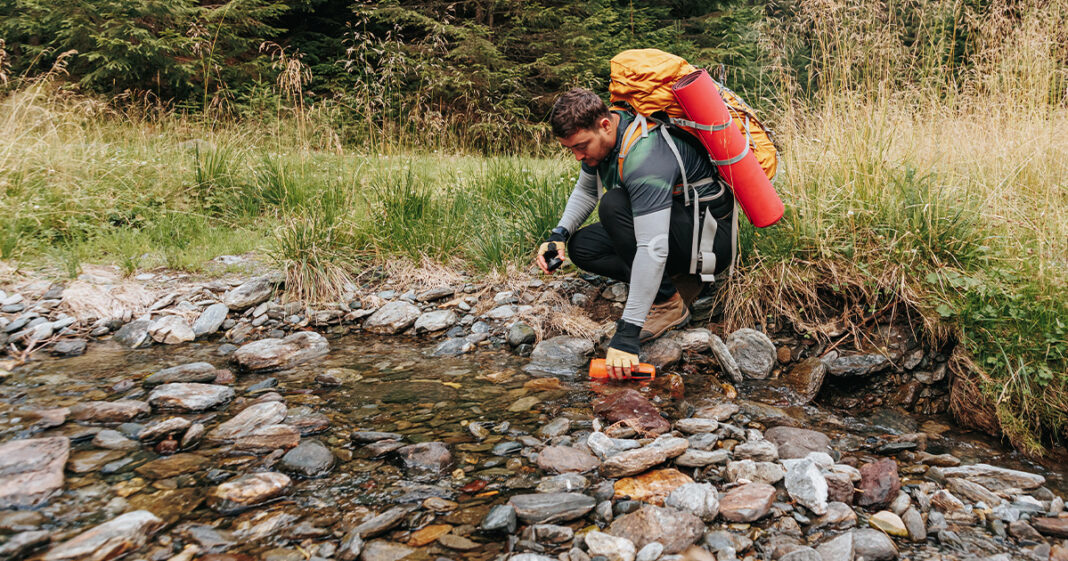
You’re three days into a backcountry trip, your filter cartridge just split, and the only water source is a stagnant pond that smells like a wet bag of ass. Or maybe it’s not a trip at all — the tap ran dry after a storm took out the water treatment plant and you’re standing over a 5-gallon bucket of questionable creek water wondering what you actually know how to do about it.
Iodine tablets are the answer everybody memorizes and almost nobody actually carries when it counts. They’re slow, they taste like a swimming pool had a baby with a penny, and they do nothing against Cryptosporidium — the parasite responsible for most of the waterborne illness outbreaks in North America. If iodine is your only plan, you don’t have a plan.
Dehydration in no joke – It kills more people in survival situations than almost any other single factor.
I’ve used every method on this list in the field, not just read about them in a manual. Here’s how they actually stack up.
1. Boiling — Still the Gold Standard
Boiling kills everything that matters: bacteria, viruses, parasites, all of it. The CDC’s guidance is a rolling boil for one minute, three minutes if you’re above 6,500 feet, since water boils at a lower temperature up there and needs more time to do the job.
The catch isn’t effectiveness — it’s fuel and time. Boiling enough water for a family of four for a week eats through propane or wood fast, and you can’t boil your way through a long-term grid-down situation without a serious fuel reserve. It’s also useless for water you need on the move, since you’ve got to stop, build a fire or fire up a stove, and wait for it to cool.
Best for: home situations with a power outage, car camping, anywhere you’ve got fuel to spare and aren’t in a hurry. Skip it if: you’re hiking and need water fast, or fuel is already scarce.
2. Mechanical Filtration — Fast, But Read the Fine Print
A good pump or squeeze filter (Sawyer Squeeze, Katadyn BeFree) physically strains out bacteria and protozoa using a hollow-fiber membrane rated around 0.1 microns. That’s small enough to catch Giardia and Crypto, the two parasites that ruin the most backcountry trips.
Here’s what filter marketing conveniently leaves off the box: most filters in this price range do not remove viruses. Viruses are smaller than the filter pore size, so this matters in places with poor sanitation or contaminated municipal runoff, but it’s a non-issue for most North American backcountry water, where viral contamination from animals is rare. If you’re filtering floodwater or anything that might have raw sewage in it, a filter alone isn’t enough — pair it with method 4 below.
Filters also clog. Silty water from a flooded creek will choke a hollow-fiber filter in minutes, and backflushing in the field is a pain. Pre-filter through a bandana or coffee filter first if the water’s cloudy.
Best for: backcountry water from streams, lakes, and springs in areas without sewage contamination. Skip it if: the water could have viral contamination, or it’s thick with sediment and you don’t have a pre-filter.
3. UV Light (SteriPen and similar) — Great Until the Battery Dies
UV pens scramble the DNA of bacteria, viruses, and protozoa so they can’t reproduce — meaning the organisms are technically still in the water, just unable to make you sick. It’s fast, about 90 seconds for a liter, and it doesn’t change the taste at all.
The problem is obvious: it runs on batteries. No charge, no purification. Cloudy water also blocks the UV light from reaching everything in suspension, so this only works on relatively clear water, and you need to pre-filter anything murky. I keep one as a backup option, never as the primary plan, because the day my batteries die is exactly the kind of day I’d actually need it.
Best for: clear water, short trips, as a secondary method alongside a filter. Skip it if: you’re planning for a scenario longer than your battery supply, or the water has any real turbidity.
4. Chlorine Dioxide Drops — The Real Upgrade From Iodine
If you’re going to carry chemical purification, skip iodine and carry chlorine dioxide (sold as Aquamira or similar two-part drop systems). It kills viruses, bacteria, and — unlike iodine — it’s actually effective against Cryptosporidium if you give it enough contact time, usually four hours for full Crypto kill, 30 minutes for everything else.
It doesn’t leave the metallic aftertaste iodine does, it’s safe for pregnant women and people with thyroid conditions (iodine isn’t), and a small bottle treats a lot of water for very little pack weight. The tradeoff is time — you’re not drinking this water in five minutes, you’re planning ahead.
Best for: backup purification, situations where you need something lightweight and shelf-stable for the long haul. Skip it if: you need water immediately and can’t wait out the contact time.
5. Solar Disinfection (SODIS) — Free, Slow, and Better Than Nothing
This is the one nobody talks about because it sounds too simple to be real: fill a clear plastic bottle with relatively clear water, lay it on its side somewhere in direct sun for six hours (two days if it’s cloudy), and the combination of UV radiation and heat kills most pathogens. The World Health Organization recognizes it as a legitimate emergency method for exactly the reason it matters here — it requires no gear you don’t already have lying around.
It’s not as reliable as boiling or filtration, it doesn’t work on cloudy water, and you need actual sun, not just daylight. But if every piece of gear you own has failed or been lost and all you’ve got is an empty soda bottle, this is the difference between drinkable water and none.
Best for: true last-resort, gear-loss scenarios. Skip it if: you have any other method available — this is a backup to your backup.
What I Actually Carry
A Sawyer Squeeze as the primary and a small bottle of chlorine dioxide drops as backup. No iodine. It’s not that iodine doesn’t work at all — it does kill bacteria and most viruses — it’s that for the same pack weight and cost, chlorine dioxide does the same job better, tastes less like a chemistry experiment, and won’t mess with your thyroid if you’re using it for weeks at a time.
The method matters less than having more than one. Filters clog, batteries die, fuel runs out. The people who get sick aren’t the ones without a purification method — they’re the ones with exactly one, and no backup when it fails.