
When it comes to emergency communications there’s a lot of advice out there on what types of emergency radios you should carry in your bugout bags. But sadly, the recommendations are usually coming from people who have little to no experience in emergency communications – and most of them have no experience with ham radio.
I’ve been a Licensed Ham Radio operator for over 20 years now, I’ve had numerous radios and talked to people from around the globe; I’ve done so on equipment that ranged from high-tech top of the line gear to cobbled together radio parts and antennas that looked like some sort of mad science fair project. I’m not telling you this to brag, I just want you to know that when I recommend a product, or in this case tell you to stay away from a product, I do so from experience.
The Preppers Radio: The Infamous Baofeng Ham Radio
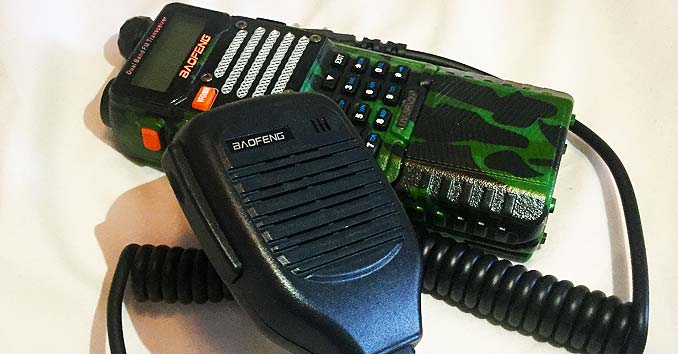
Baofeng Radios are infamous in the prepping community. Go to almost any prepping website and you will see read an article from someone telling you how you need these little radios in your bag, claiming they are the perfect prepping radio: BULLSHIT!
Buying Preparedness gear isn’t something that should be taken lightly, and counting on some cheaply made Chinese crap is only asking for trouble.
Listen, I really wanted to like these radios; I mean who wouldn’t want a radio that often times sells for a tenth of the price of the big boys? But when it comes to preparedness, price is often a reliable indicator of what you can expect.
Baofeng Review from a Real Ham Radio Operator
I planned on doing a couple of videos showing real-world tests, showing you what you can expect from these radios during an emergency; but why bother? When you are shipped multiple units that won’t even reliably hold the battery pack without duct taping it to the radio, is there really even a point to going any further? Is that a radio that you would really trust in an emergency situation?
Baofeng has some of the worst quality control issues that I have ever seen. The radios are mass produced in China, and performance is really a crapshoot from radio to radio.
- The radios suck as transmitters and the power output widely varies from radio to radio. (Transmit power is rated at 5 Watt; according to my meter it’s putting out about 3)
- The receiver filtering is BAD! In A/B testing against other brands (Yaesu, Icom, & Kenwood) with identical power and antenna setups, you quickly realize how little the Baofeng actually picks up.
- Factory Antenna if Horrible! I knew that going in so I ordered a Nagoya Whip Antenna which did help.
- Baofeng Battery Packs are apparently notorious for not fitting the actual radios! Even during normal operation, the battery will not stay in the radio tight enough to maintain constant power. There are actually websites dedicated to modding the battery pack so it will fit, but again, why bother? If you have to mod a brand new battery pack to fit the radio, is it really a radio that you can count on during an emergency? And because I noticed a few people in the comments claim this isn’t a manufacturer battery — IT IS! The battery came directly from Baofeng, sealed in the box with the radio. I’ve had 3 factory batteries that would not fit right without shaving them down and rigging them to prevent them from falling out during a hike.
Baofeng Alternatives: Ham Radios that Preppers can actually count on!
When it comes to buying a radio that is specifically for preparedness purposes I recommend sticking with the big three: Kenwood, Yaesu, or Icom. Yes, the radios are more expensive, but the quality control doesn’t get much better. I also recommend looking for something that is specifically made for outdoor use in the elements, like the below Yaesu Radios.
- Yaesu VX-6R Submersible Amateur Ham Radio Transceiver (144/222/440)
- Yaesu Original FT-65 – I own these radios, and these are my go-to bug out bag radios!
For more information on Ham Radio and Emergency Communication, check out these articles:
- Prepper Radio: The No-BS Ham Radio Technician Exam Prep Guide Your Key to Passing the Amateur Radio Technician License Test and Taking Your Emergency Communication Skills to the Next Level
- Emergency Communications When TSHTF
- Ham Radio Cheat Sheet
- Situational Intel: Knowledge is Power during a Crisis
- Ham Radio FAQs
- The ¼ Wave Droopy Ground Plane 2 Meter Antenna


You say:
The radios suck as transmitters and the power output widely varies from radio to radio. (Transmit power is rated at 5 Watt; according to my meter it’s putting out about 3)
I ask: Was the battery old? Was it fully charged? Anybody can make power, it’s the RX side that makes a great radio.
You say:
The receiver filtering is BAD!
I ask:
What do you mean? Are you talking selectivity or sensitivity? Do know the difference? How did you do the test? The selectivity on my UV-82 is excellent and the RX sensitivity measured less than -110 dBm. Astounding for a radio at this price. I know it’s not the UV-5R, but you seem to be lumping all Baofengs together.
You say:
Baofeng Battery Packs are apparently notorious for not fitting the actual radios!
I ask:
“Apparently”? You find one aftemarket extended battery that doesn’t fit and you make a blanket statement against all Baofeng radios? That’s irresponislbe. I own 4 Baofengs and all the batteries fit properly…and oh, by the way, they’re Li-Ion intead of the Ni-Cads.
The Baofeng UV-82 is an astoundingly good value. Buy many while you can. This kind of quality at this price point won’t last forever.
I have the UV5R and it works fine, though to be honest its pretty complicated for me. I programmed it with the Chirp software but have no clue how to use the damn thing… So now studying for my Amateur Ham license which hopefully will help me understand the functions. I met with a friend who is a Ham expert level and he taught me all about antennae systems so that’s makes total sense which allowed me to build a telescopic mobile mast with a car antennae mount on the top, gives me better range. Another item I would recommend is the ‘The Dummies Guide To Ham Radio’ it makes learning about HAM/Comms much more understandable.
Not for nothing, but I also own 2 Baofengs…..UV5R and the BF-F8HP… both work great for me and my situation. I hit repeaters 30-40 miles and have talked to others over 50 miles away via repeater. Rubber duck junk, so I made 2 meter ground plane from stuff I had laying around and stuck it on 2 pieces of PVC pipe, threw away the rubber duck and have made great contacts. For what it is worth…have a nice day
The problem I see with most preppers, even if they are licensed HAMs, is that they choose VHF/UHF type radios. These radios will be totally useless during a SHTF scenario, except for very short range communications. The problem is that to be effective with a VHF/UHF radio is that you will need a functioning repeater for any type of usable range. You should pick High-Frequency (HF) radios, since you don’t need a repeater. Plus any type of broadcasts that you would want to receive/monitor will be in the shortwave bands. So radios with the ability to transmit and receive 30 MHz and below is your best bet. You should also have a radio that is capable of transmitting and receiving in the 27 MHZ citizen band frequencies, since people are more likely to have these radios than Amateur band radios.
The Dayton tests are not valid.
1) The tests were conducted by connecting the radios directly to the analyzer. The radios were certified with the antenna attached. Attach the antenna then make the readings and they pass.
There was no data collected on whether the radios tested were actually FCC certified versions or “knock offs”. Yes, the Chinese (king of the knock offs) radios are now being knocked off…Karma?
The amount of spurious RF in the environment at Dayton precludes the PROPER scientific measurement of the Baofeng radio AS CERTIFIED because measuring the emmissions in a non controllable environment (not inside an RF “clean” room) is not possible in that environment.
To Pumpkin….the Baofeng is NOT “software defined” as you purport. Yes it uses a software MENU but that is not the definition of a “software defined” radio. I should know, I TEACH HAM radio.
Japsumo
I’m a HAM. An Amateur Extra (highest level). I teach HAM classes for Tech and General licenses. I’m also authorized to administer examinations for the licences (VE). AND I’m also the Vice President of the local HAM club.
I HIGHLY recommend the Baofeng radios to both new and old HAM’s alike. They’re inexpensive (no tears when you drop it in the field or it doesn’t come back when you loan it to a noob), effective, allow monitoring (not transmitting except in an emergency) of numerous services, and are a lot of bang for the buck.
I’ve made contact into a repeater 29 miles away on “high” power with just a Nagoya 771 antenna attached. I’ve also made it to that same repeater on “low” power with a homebrew vertical dipole and on “high” with both a barbed wire and a water (yes literally tubes of water) vertical dipole. I certainly wouldn’t have tried a $200 + radio on those experimental antenna. And when I say “made contact” with that repeater, I don’t mean just getting the squelch to open, I mean valid two way voice comms like checking in to a net and holding a conversation.
I am yet to have a single failure in any of my EIGHT Baofeng radios or their accessories. I have had a few other users that have had an issue but those were operator issues.
Perhaps you got fake radios from a knock off producer? Yes, the cheap Chinese Baofeng is being knocked off. LOL
their compliance has absolutely NOTHING to to with QC so smell the coffee, the FCC Compliance is based soley on their ability of them being able to be programmed right out of the box for frequencies the government wants restricted from the private citizens and nothing more.
The two UV-5R HTs that I have work fine and the large batteries fit just fine. This video is pure FUD!
The Baofeng UV-5R is the best HT on the market for the price. I have it plus a 35L bag and my Taurus PT22 pistol. With this firearm and the UV-5R I am ready to take on any mission!
Hi, Ihave some issues with my BF-F8HP ( incorrect display reading at third digit of the display ( left to right). but the voice and the frequencies are operables. If I write 136000 de display show 131000 and other errors. can you help me with this. Thanks
131000 is out of its frequency range of 136-174Mhz and 400-520Mhz
so you recommend sticking with the big 3: Kenwood, Yaesu, or Icom. Guess what most Kenwood, Yaesu, and Icom are made in china. You’re just an elitist asshole who looks down on people that don’t have a lot of money to spend on just higher priced red chinese radios. When you get to the fema camps everybody is going to steal your cornbread.
It’s $20 and that doesn’t make anybody any less uninformed. It’s nobody’s fault that today’s technology can grind out a near-universal UV5R for 20 bucks.
Without vacuum tubes.
i can’t find any value in Baofeng. I bought 2x Baofeng UV-82 and i instantly regret that decision. 1 station operates on 446.025 MHz on TX but display frequency is 436.500Mhz and 145.250 – cant even TX on 2m (the second TX button does not work at all) 2nd station does not even transmit (tested on wideband scanner coz radio communication was not possible to establish with my HAM friends); both of them are plain deaf on RX.
Chinese cheap crap -not factory set set-up properly for fail safe start use of or they are faulty in operations. These stations must be “persuaded” into proper operation before use – not for beginner at all in fact not for anyone at all except for some who intentionally want to run into problems. (there is a reason why good stuff is expensive, that would not happen with other brands like Yayesu, Icom, Kennwod etc … just to name some) !
These radios suck. Tried to program some frequencies to memory, very difficult. Of you domt move quickly the menu closes and you loose your chance. My Yaesu FT-65R was easy to progam. Typical Chinese junk. Luckily I got this radio for free. DO NOT BUY ONE.Get Japanese