
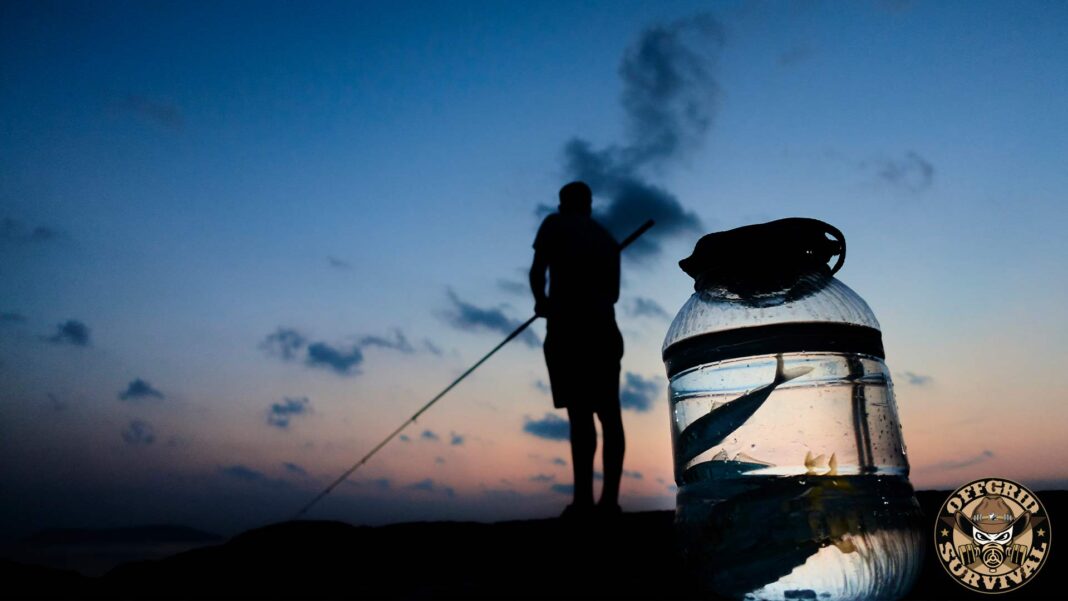
In a survival situation, every little bit of food you can capture adds to your chances of staying alive. If you’re in an area with fish, one of these small pop bottle funnel traps can be a great way to catch small minnows for either bait or food if conditions are really bad. It’s not going to land you a trophy catch, but it doesn’t need to. Passive traps work while you’re doing something else — building shelter, gathering firewood, treating water — instead of standing at a creek bank hoping a fish takes your hook.
I’ve been using these types of minnow traps for as long as I can remember. They’re a great way to catch bait, they’re really easy to make, and they’re pretty much free — a great way to recycle those old water bottles instead of packing in dedicated trap gear you might not need. The whole design works on one principle: it’s easy for a fish to swim in, and hard for it to swim back out. That’s the entire mechanism, and it’s why this thing has been reinvented by campers, soldiers, and broke college kids with a creek nearby for decades.
How to Make the Plastic Bottle Fish Trap
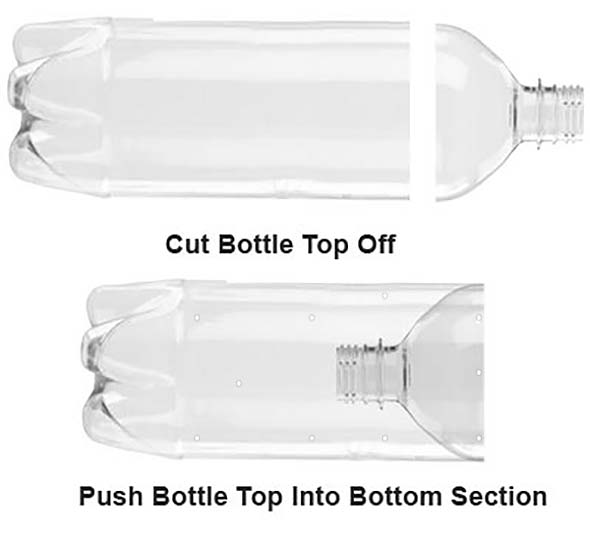
- With a sharp knife, carefully cut off the top of the pop bottle (as shown above). You can use pretty much any kind of plastic water bottle to make this type of trap.
- Shove the head or cone of the bottle into the body of the bottle, point first, so it forms a funnel pointing inward. To further secure the head, poke a couple holes through the cone and use a bit of fishing line to tie the sections together so it doesn’t pop back out under pressure.
- Throw in a couple small rocks to anchor the bottle to the bottom, poke a couple small holes in the bottle so it doesn’t float, and add some small scraps of bait or insects to attract the fish.
- Place the bottle in some shallow water and secure it with some line, tied off to a stake, root, or rock on the bank so you don’t lose it to current. Once the fish swim through the funnel chasing the bait, they won’t be able to find their way back out.
- The more of these you can set, the better your odds of catching enough to actually matter. One trap is a curiosity. Five or six traps spread across a stretch of creek is a food source.
That’s the entire build. No fancy materials, no specialized tools — just a knife, a bottle, and something sharp enough to poke a few holes. You can build one of these in under five minutes once you’ve done it a couple times, which makes it one of the better skills to actually practice at home before you need it in the field.
A Few Things That Make These Work Better
The basic design above will catch fish. These tweaks, pulled from people who’ve been running these traps for years, make it catch more of them with less hassle.
Use a clear bottle, not a colored one. Fish key in on visual contrast and movement, and a clear bottle lets light and bait scent through more naturally than a tinted one. If you’ve got a choice between a clear soda bottle and a green or brown one, take the clear bottle every time.
Cut the funnel opening larger if you’re after bigger fish. The standard pop-bottle neck is built for minnows and small bait fish. If there’s something bigger swimming in your stretch of water, cut the funnel mouth wider, and cut it in a zig-zag or jagged pattern rather than a clean circle. The irregular edges make it harder for a fish to back its way out once it’s inside, the same way a barbed hook works against a straight one.
Use swivels instead of fishing line to attach the funnel cone, if you have them. A couple of small fishing swivels let you twist the cone free to dump your catch and rebait, instead of cutting line and rebuilding the whole trap every time you check it. If you’re setting multiple traps and checking them daily, this small change saves a real amount of time and gear over a few days.
Bacon works as well as anything for bait, and it holds up in water longer than most scraps. If you’re trying to attract crawdads instead of fish, it works there too.
Don’t abandon your traps in the field. They’re cheap and disposable by design, but a forgotten trap doesn’t stop working just because you walked away from it. Pull your traps when you’re done with a site, or at minimum cut them open so they can’t keep catching and killing fish nobody’s going to eat.








how are you suppose to keep the minnow in the tap with out the top coming off and you loose all your bait? then what do you do?
I have used these for several years, have a couple in the garage now. They work great for bait fish, around the end fitted togather, you need to poke a couple holes and I use fishing swivals to hold them together and tie a rope to, also add some small rock so it will sink, and if someone steals it, it’s no big loss, it’s free.
Crawdads… the fresh water lobster is all I have to say. They also make good bait so putting in some bacon or something like that to attract them is a good idea. As for keeping the top on, use your heads people. Poke some holes in it and tie it on.
Placement, place the bottom of the bottle facing up stream and hold the bottle down with rocks. Fish swim against the current for the most part. As for the fish staying in the bottle, they have to find that little hole to swim back out of and that is nearly impossible for them to do. Unless you are starving, don’t worry about some getting away.
WOW,,, Thats all I can say.. Good Idea. May have to try this next time we go fishing.
My jaw just dropped. I used to make these as a boy to catch minnows for bait for larger fish. I taught lots of people how. Damn that was 20 years ago.
I just tested it this weekend with my son, and it works great…
I have some experience with traps but this is a NEW and effective way of catching bait for larger fish.
Is this for catching bait? :)
I make this trap when I take my son camping he loves this idea and the fact that no matter how bad the fishing is we always catch something in the bottle trap. It’s a good way to start kids out slow and it’s exciting to them and keeps them interested
I’m Going To try a 2 Litter Bottle and Also A3 Liter Bottle This weekend When I Take My Son fishing.I Put Out Minnow Traps And I’ve Had 3 Stolen So Far This Year.How Can Someone Steal A Trap.Are Times That Ruff That Someone Steal A Kids Minnow Trap 3 Different Times From 3 Different Locations.I Mean If You Steal The Bottle Traps Carma Will Get Them.I’ll Keep You Posted Of My Catch Of Minnows And Fish From My Bottle Traps And Hopefully I’ll Catch The Person Who Stole My Traps.
Another note is that for this to be most effective, you need to find a little eddy where the current is less strong than the rest of the river or even flowing in the other direction (even better if there is weeds or other structure in the area). This is where the flow is less strong and the minnow can hide from predators and take shelter.
I’ve used this, with success, to catch our corn snake when it had escaped.
Thanks for the tip, I tried it out and it worked really well. Caught some small fish good for bait.
We used old tires for cat fish back in 1950’s they like to hide in them just tie a rope or cable strong enought to pull it back out of the water fine a good place leave it for a few days pull it out of the water lots of times you will have a large cat fish in it;
I’ve used these for years to catch bait. Today I made one out of a large kitty litter container. As the container is white and not clear we shall see how it works. large entrance is nice, but it might be too big