
Most hikers get into trouble for one reason: they fail to adequately prepare themselves for their adventure. Ask anyone who does search and rescue for a living, and they will tell you that 9 times out of 10, most rescues could have been prevented with just a little bit of pre-planning and preparation.
When you are planning a hike, even a short day hike, preparation is the key to staying safe. The good news is that almost none of this preparation is expensive or complicated. It’s mostly a handful of habits, repeated every time, that turn “missing for days” into “found within hours.”
Leave a Detailed Trail Plan with a Family Member or Friend
One of the best ways you can prevent becoming another statistic is by telling someone where you’re going and when you expect to return home. Should something happen, and you fail to return home at the agreed upon time, that person should immediately call the local search and rescue team to notify them of where you were hiking.
The numbers back this up clearly. In U.S. national parks, the overwhelming majority of lost hikers are found within the first 12 to 24 hours, but only when search and rescue knows roughly where to start looking. A trail plan is what turns “my friend hasn’t texted back” into a search team heading to the correct trailhead within the hour instead of a guessing game across an entire mountain range.
Your Plan Should look something like this:
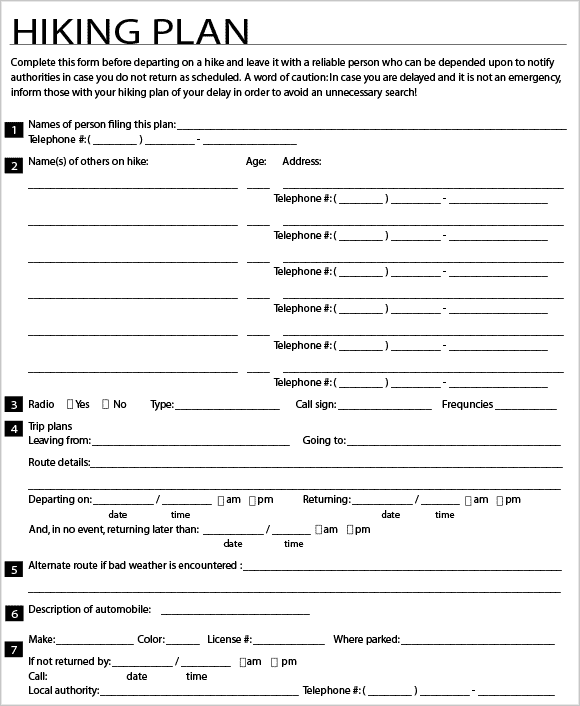
A printable version can be downloaded here…
Fill it out completely, not just the basics. A vague “going hiking, back tonight” text gives search and rescue almost nothing to work with. A real trail plan with a specific route, a specific return time, and a specific person responsible for raising the alarm is the difference between a fast, targeted search and a slow, broad one.
Leave a Detailed Trail Plan in your Vehicle
One of the first places search and rescue teams often search is the vehicle you left at the trailhead. Often, concerned hikers will report a vehicle that’s been left abandoned for a long period of time. It’s a good idea to leave an extra copy of your plan in the vehicle so search and rescue teams know exactly where they should be looking and who they are looking for.
Your plan should include:
- Your Departure Date & Time
- Your Expected Return Date & Time
- Your Starting Point
- Your Destination
- Your Intended Travel Route
- Any Alternate Plans that you may have
- Any communications gear you have including phone numbers or frequencies that you use.
- And Any Medical Conditions you have.
A few additions worth including that go beyond the basics: a description of your vehicle and license plate (helps confirm at a glance whose car has been sitting too long), a description of what you’re wearing and what gear you’re carrying (color of jacket, pack, tent if applicable — all genuinely useful to a search team scanning terrain), and emergency contact information for anyone who should be notified beyond the person holding your plan.
Study Your Trail
Before ever stepping foot on the trail, you should have a pretty good idea of what that trail looks like, and what’s physically required to successfully complete the hike. Most trails are rated, and can be found by searching numerous online hiking databases.
You should also have a topo map, and know how to use it. These maps can give you a wealth of knowledge including terrain, difficulties, waterways, vegetation and alternative routes.
Don’t stop at the official trail description, either. Look for recent trip reports from other hikers, since conditions change season to season and even week to week — a creek crossing that was easy in spring trip reports might be a serious obstacle after a heavy rain, and a trail rated moderate by an old guidebook might be dramatically harder if a recent fire or storm damaged sections of it. Recent firsthand accounts catch exactly the kind of detail that official trail ratings miss.
It’s also worth knowing your elevation profile, not just your mileage. A 6-mile hike with 500 feet of elevation gain is a completely different undertaking than a 6-mile hike with 3,000 feet of gain, even though the distance on paper looks identical. Underestimating elevation gain is one of the most common reasons hikers end up moving far slower than planned and finishing well past their intended return time.
Dress for Success
Don’t underestimate the importance of your clothing. Make sure you select clothing that is based on your environment and the weather you expect to encounter.
In a survival situation the clothes on your back, combined with what’s in your bag, will be your primary source of shelter and protection. Clothing is your first line of defense against the elements and is something that should never be overlooked.
Layering is the practical version of this advice. A base layer that moves moisture away from your skin, an insulating mid-layer, and a weatherproof outer shell let you adjust to changing conditions throughout the day rather than committing to one outfit that’s either too hot at the trailhead or too cold at the summit. Even on a forecast that looks warm and clear, pack at least a lightweight rain shell and an extra warm layer — mountain weather changes faster than people expect, and a sunny morning at the trailhead doesn’t guarantee the same conditions a few thousand feet up or a few hours later.
If you become lost, stay calm and stay put
If you become lost: stop, relax and analyze your situation. If you believe you can make your way back to an identifiable location then do so. However, if you cannot find your way back to the right trail, immediately stop hiking to prevent wandering further away on an unknown path.
If you have a radio or a cell phone, now is the time to try to call search and rescue. If you can’t get a hold of anyone, staying put and relying on your original rescue plan is probably going to be your best option.
The data on this is consistent and worth taking seriously: most lost hikers in national parks are located within the first 24 hours, and survival odds drop sharply the longer a search drags on. Staying put and staying calm maximizes your chances precisely because it keeps you in a predictable, findable location instead of expanding the search area every hour you keep moving. The best thing you can do is remember that rescue is probably on the way, and then make yourself as visible as possible to the search and rescue teams.
While you’re staying put, use the time productively. Build or improve a shelter if conditions call for it, signal at regular intervals rather than constantly (to conserve energy and any battery-powered signaling devices), and stay near, but not directly on, any water source you’ve found, since water sources are a natural place searchers will check.
Cell Phones: Unless you’re going far into the backcountry, a cell phone is still an extremely useful tool for signaling for help. A meaningful share of search and rescue calls involve someone using a cell phone, even from areas with spotty signal, since a text message can sometimes get through where a call won’t. If you regularly venture into areas where your normal cell phone is out of range, you should consider purchasing a satellite phone. When your fancy iPhone is out of range, something like the SPOT device will allow you to make calls in even the most remote parts of the world.

One detail worth knowing from people who actually do this work: turn your phone off, not just to airplane mode, while you’re not actively trying to use it. Constantly searching for a signal drains a battery fast, and that battery may be the only thing standing between you and being able to send your location once you do find a signal or reach high ground. Check in periodically rather than leaving it on and searching continuously.
Ham Radio: In most areas of the country, you can usually hit some sort of repeater with a 2-meter radio. If you frequently hike out in the backcountry, you may want to consider becoming a licensed ham radio operator.
Personal Locator Beacons: If you frequently venture out into the backcountry, you should consider purchasing a Personal Location Beacon or a SPOT device that can be activated in an emergency. These devices will relay your position to a worldwide network of search and rescue satellites that will immediately notify search and rescue teams that you are in danger and where you are located. Unlike a cell phone, these devices work essentially anywhere on the planet with a clear view of the sky, which makes them genuinely worth the investment if you spend real time in areas without cell coverage.
You should also consider carrying the following signaling devices:
- Flashlights
- Reflective materials (an emergency blanket is a great dual purpose signaling device)
- A small signaling mirror
- An Emergency Whistle, which can be used to alert nearby search teams to your location.
A whistle in particular deserves more credit than it usually gets. Three sharp blasts, repeated at intervals, is the universally recognized distress signal, and a whistle carries dramatically farther than a shouting voice for a fraction of the physical effort — something that matters a great deal if you’re injured, exhausted, or both.
The Ten Essentials
Beyond trip planning and signaling gear, it’s worth carrying a baseline kit on every hike, even short, familiar ones, since most people who get into serious trouble didn’t plan to be out longer than a few hours in the first place. A version of this list has been taught for generations by groups like the Boy Scouts, and it still holds up:
- Map and compass (and the knowledge to use them)
- A full water bottle, plus a way to treat more if needed
- A flashlight or headlamp
- Trail snacks beyond what you think you’ll need
- Lightweight rain gear
- A pocket knife
- Insect repellent
- Sun protection
- A basic first aid kit
- A reliable fire starter
None of this is expensive or heavy, and carrying it on every hike, not just the long or remote ones, is what actually prevents a short, familiar trail from turning into an unplanned night out. Most people who end up needing search and rescue weren’t on some epic multi-day trek — they were on a short, “I’ll be back before dark” hike that didn’t go according to plan.
A Few Final Habits Worth Building
A handful of smaller habits round out the picture and consistently show up in accounts from people who’ve actually needed rescue, or who do the rescuing:
Tell someone the real plan, not the optimistic one. If there’s a real chance you’ll extend the hike, take a side trail, or change your route once you’re out there, build that into the plan you leave behind rather than relying on a single fixed route. Search teams work from what you told them, not what you actually decided to do once you were on the trail.
Don’t rely entirely on a phone for navigation. Battery drains faster than expected, especially in cold weather, and a cracked screen or unexpected dunk in a creek can take it out of commission instantly. A paper map and the basic ability to read it is a backup that doesn’t depend on electronics at all.
If you leave the marked trail, mark your own path back. A lightweight spool of brightly colored cord or biodegradable trail tape, used sparingly and removed on your way back out, can make the difference between confidently retracing your steps and wandering in increasingly less certain circles.
Hike with a full stomach and stay hydrated throughout, not just when you feel thirsty. A small accident or wrong turn can become genuinely dangerous fast once fatigue, dehydration, and poor decision-making start compounding each other.
If something does go wrong, controlling panic matters as much as any piece of gear. Stopping to think clearly, rather than reacting immediately, is consistently what separates a manageable situation from one that gets worse. A light source and a reliable way to start a fire go a long way toward keeping your morale, and your body temperature, stable while you work through what to do next.



There are also web sites to review before you go.
They test and advocate personal gear and locator’s as well. Equipped.com is one such site written by Doug Ritter. Hope it helps you get away from it all and stay safe.
i always let someone know when i go on a solo hike. and i take a camelbak full of water and enough supplies to survive a night out.
Leave your iPod at home…
I highly suggest taking a course if you’re not familiar with reading maps. A topographical map and a compass can get you out of most situations.
I couldn’t agree more, this has come in handy for me out on the AT more than once!
That’s a serious hiking plan. But I think it’s a good idea. Knowing land navigation is a must have skill as is reading maps. It many cases, people can avoid getting lost by not leaving the trail and looking at a trail map before hand, or better yet bringing a trail map.
Great stuff – I REALLY like the plan and the notification info
Include in your study of the trail interviews with people who’ve done that particular trail. Their account of their hike will give some kind of perspective.
All good info. I add be prepared for bad weather with at least a cheap, lightweight poncho, and above all, keep your mind clear by drinking water and resting as needed.
A small accident can become life threatening when things get bad.
Some of us prefer hiking off of the beaten paths or pre used trails. Compass, several layers of clothingfor varying weather conditions some on you & some in the vehicle for after the hike,a fullish stomach in you& lightweight food that doesnt attract predators on you, lighter, tp, mosquito frequency or chemical mosquito repellant, & walkie talkies if in a group where cell phones have no reception…compass, magnifyer, ultrasonic mosquito repellant, flashlight, are all handy apps to have on a celphone but if you bring it be sure to have it ziplocked in a watertight bag & extra battery or charger to replace energy all the apps suck out of phone battery in hours whereas older phones with less apps could last days or weeks. Dressing in layers also somewhat protects against ticks & other insect bites. A pager attatched to a DCcar or AC charger with inverter could be a gr8 invention for all those people who lose cellphones hiking like others lose remotes in couches …
& if bound to hike 500ft or more off of known tails, bring a lengthy lightweight ball of colored rope to anchor on the vehicle or tree nearest trail exit & unravel as you go to be able to re-ravel it out instead of getting lost…some forests easy to do that in & are littered by plastic ribbons previous hikers used to mark their way
Hi kids!! I am that search and rescue person that comes to get you. This is excellent information!! Please, please fill out this kind of form and leave it with a friend and with your car. We often communicate with the victim by cell phone, sometimes text works when a call won’t. We’ve done third party info, lost person texting friend who then contacted us. I’m in the mountains of NC and I can promise you the 80 degree day becomes the 40 degree night with rain often. It’s safest to assume and prepare for getting lost, with clothes, food, and water. Also remember to turn your phone off till you need it, so there will be battery!
Great stuff at your site !! I might suggest you all get a copy of the Boy Scout manual. As a Scout Master we teach our boys to always carry the “ten essentials” when they go into the woods:
Compass/map
full water bottle
flashlight
trail snacks
light rain gear
pocket knife
bug spray
sun block
basic 1st aid kit
fire starter
If you carry and know how to use these things, you will always come out in one piece !!
It happens all the time, in the news, people go out in the wild by themselves not thinking something could happen with no phone no may to contact anyone. The only thing they have to do is just tell someone where you going and how to find you. How easy is that.
Would also recommend taking magnesium fire lighting equipment. Fire is as important as water, 1. Can serve as a beacon. 2. Will keep you warm and dry.3. Providing you have a container will sterilise water for drinking.
great advice for day hikers, but a true off-gridder/survivalist is already prepared to survive in all weather conditions and speaking for myself I’d rather walk until I reach the edge of the earth than call the ‘authorities’ for help with anything… (they can go screw!)
shut up
Just as the three most important things for a successful business is ” Location, Location, Location” the three most important things if lost is “Don’t Panic, Don’t Panic, Don’t Panic” easier said than done. But you must control your panic and nothing helps more than to have some kind of light source and a method to build a fire. Always atleast have your “Bic” and even a key chain light will be better than nothing. Trekker Out.