
A couple of things happened Friday that, taken separately, probably looked like just more noise coming out of the Middle East. Saudi Arabia shut down its East-West Crude Oil Pipeline after drones launched from Iraq struck targets along the line Thursday morning in the Riyadh and Medina regions. Fires broke out, several people were reportedly injured, and US officials told CNN that pump stations along the pipeline had been hit. Satellite imagery later showed a smoke plume between Medina and Mahd Al-Dhahab.
The Saudi Energy Ministry says the shutdown is precautionary while crews assess the damage. Nobody has claimed responsibility for the attack, and Saudi Arabia says Iraq’s prime minister asked the kingdom to hold off on retaliating for the time being.
At roughly the same time, Houthi fighters were finishing their sweep of Yemen’s Red Sea coastline. They took the port of Mokha on Thursday and Perim Island on Friday, putting them directly in the middle of one of the most important shipping lanes on earth. Perim sits in the Bab al-Mandeb Strait, about 16 miles offshore.
Then diesel hit $6.05 a gallon nationally.
Those events may look unrelated when you see them scattered across three different news stories. They aren’t.
Saudi Arabia has shut down its vital East-West crude oil pipeline
The Strait of Hormuz has been effectively closed since the war with Iran began in late February. Before that happened, roughly 20 percent of the world’s oil moved through that narrow waterway. That disruption has now been hanging over the global energy market for roughly six months, and Saudi Arabia’s East-West pipeline became one of the main ways of keeping crude moving despite the closure.
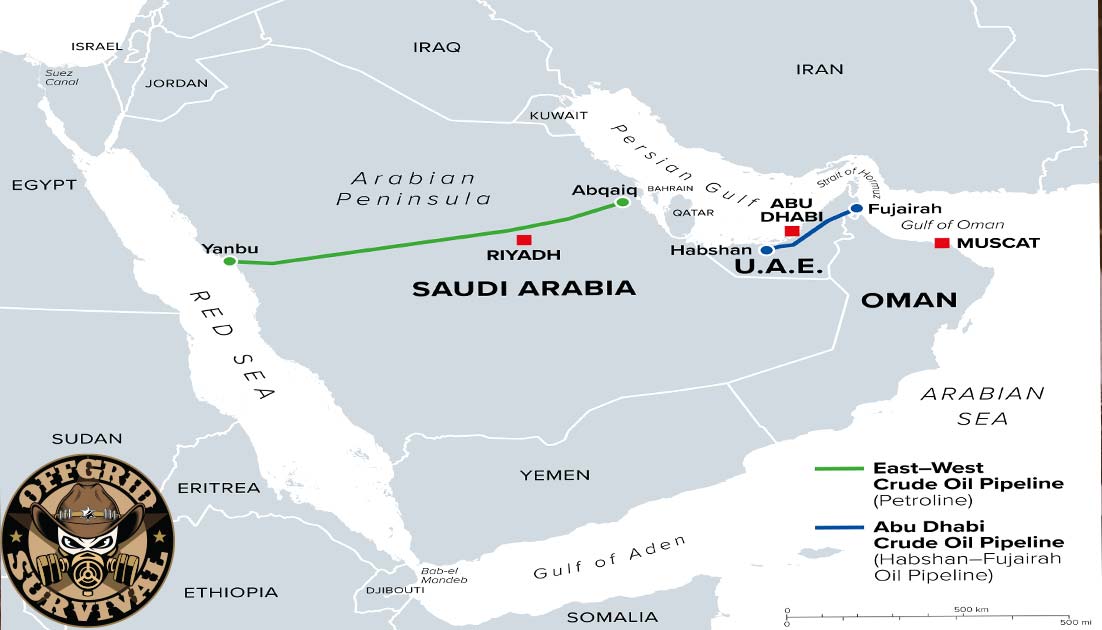
The pipeline stretches roughly 745 miles from Abqaiq in Saudi Arabia’s Eastern Province to the Red Sea port of Yanbu. Its capacity is around 7 million barrels per day, and the Saudis had reportedly been pushing roughly 5 million barrels a day through it. That’s oil that otherwise would have been loaded onto tankers in the Persian Gulf and sent through Hormuz.
Reuters estimated the amount moving through the pipeline represented roughly 4 to 5 percent of global oil supply. Aramco’s CEO said last month that the line had done more to cushion the loss of supply through Hormuz than the emergency oil releases from strategic reserves.
That’s why this attack matters so much. This wasn’t just another pipeline somewhere in the Saudi desert that could easily be bypassed. The East-West line was the bypass. It was the backup route being used because the primary route through the Persian Gulf had already been compromised.
Saudi Arabia still has options, but none of them replace the pipeline cleanly. The kingdom can draw crude already sitting in storage tanks on the western side of the country, and additional barrels can move through Egypt using the Suez Canal and the SUMED pipeline. Both routes are slower, more expensive, and neither gives the Saudis another 5-million-barrel-per-day escape hatch.
This is also happening after Saudi crude exports had already fallen to a 13-year low. Production dropped 23 percent between July and August, and the kingdom told OPEC that its August output was the lowest since 1990. The world’s largest oil exporter is producing at levels we haven’t seen since the first Gulf War, and now the route that was helping it work around Hormuz has been hit.
Yemen is making the problem even worse
The other part of this story is happening on the Red Sea.
The Houthis declared a maritime blockade of Saudi Arabia on July 20 and have spent the weeks since attacking Saudi ships and energy infrastructure. Traffic through Bab al-Mandeb reportedly dropped around 24 percent in the week following the declaration. Earlier this week, Houthi attacks struck energy facilities and other civilian targets inside Saudi Arabia, injuring more than 70 people according to the Saudi government.
Now they control Mokha and Perim Island. A Houthi military spokesman said this week that ships can safely pass through the strait as long as they aren’t Saudi vessels, which creates another very obvious problem for Riyadh.
Saudi oil that can’t leave through Hormuz has been pushed west through the East-West pipeline. If that pipeline stays offline and crude is somehow moved to the Red Sea by other means, Saudi ships still have to move through waters where an armed group has openly declared them legitimate targets.
Ahmed Nagi of the International Crisis Group told CNN that the Houthis are now positioned to expand their reach around the strait while also making it harder for a ground operation to approach them from that direction. If Bab al-Mandeb ends up effectively closed to Saudi shipping, the United States could find itself escorting ships through the Red Sea while simultaneously trying to keep shipping lanes open around Hormuz.
Mohammed bin Salman is reportedly pushing President Trump to take military action against the Houthis. Iranian officials, meanwhile, spent the weekend celebrating the developments.
Oil markets certainly noticed. Brent crude closed Friday at $104.44 a barrel, up more than 8 percent for the week and above $100 for the first time in months.
Diesel is where this starts hitting everybody
Gasoline prices get most of the headlines because every driver sees the number flashing at them from the gas station sign. The national gasoline average reached $4.30 on Thursday, which is already taking a real bite out of household budgets.

Diesel is the bigger economic problem.
Diesel reached an all-time national record of $6.05 a gallon Friday, according to AAA. It was $5.85 the week before. A year ago it was around $3.70, and in late February, before the current Middle East crisis began, it was roughly $3.76. You’re looking at an increase of about 63 percent in twelve months, and so far there isn’t much evidence that the pressure is letting up.
We already saw how quickly the market can move. Back in March, diesel jumped from roughly $3.01 to $5.37 in about two weeks, the fastest increase since Russia invaded Ukraine in 2022.
The problem is that diesel isn’t simply another consumer expense. It’s built into almost everything you buy.
Long-haul trucks burn diesel, as do many of the refrigeration units attached to those trucks. Freight rail depends on it. So do tractors, combines, irrigation pumps, construction equipment, ambulances, fire apparatus, school buses, heavy generators, and much of the equipment keeping farms, warehouses and infrastructure operating. Heating oil comes out of the same basic part of the petroleum barrel, which means winter demand eventually starts competing directly with transportation demand.
When gasoline gets expensive, at least some consumers can cut back. People cancel trips, combine errands, stay home more often or put off unnecessary driving. Eventually demand responds to the price.
A farmer can’t simply decide not to harvest because diesel costs too much. A trucking company can’t tell the grocery store that half the food will arrive this week because fuel got expensive. A family heating a house in Maine can’t decide January would be a good month to stop buying heating oil. A huge portion of diesel demand is tied to things that still have to happen regardless of price, which is exactly what makes a shortage so damaging.
The inventory situation is what makes this considerably more concerning. US distillate stocks, the pool that supplies diesel, heating oil and related fuels, have fallen below the levels we saw during the shortage scares of 2022. That period produced shortage headlines and isolated supply problems in several markets. Current inventories are already below that floor.
At the same time, American diesel exports have surged because countries that normally depend on Middle Eastern fuel are now competing for product from somewhere else. Ukraine has also spent months attacking Russian refineries, adding another layer of pressure because Russia is the world’s second-largest diesel exporter after the United States.
Two wars on two different continents are now pulling against the same fuel market.
Where Americans are going to feel it
August CPI came in at 3.4 percent year over year and 0.4 percent for the month. Gasoline alone accounted for roughly a third of that monthly increase. Gasoline prices are up 27.4 percent from a year earlier, fuel oil is up 52 percent, and airfare is more than 23 percent higher than it was last August as jet fuel costs work their way into ticket prices.
The wholesale numbers may be even more important. The Producer Price Index rose 5.4 percent year over year in August, accelerating from 4.8 percent in July. When producer prices are increasing much faster than consumer prices, businesses are usually absorbing some portion of those increases themselves. They can do that for a while. Eventually margins get squeezed far enough that somebody raises prices.
We were already watching the same pattern back in August when the national debt crossed $40 trillion and the dollar’s buying power kept sliding. Brent was around $91 a barrel at the time and tanker traffic through Hormuz was already running well below normal. Three weeks later, Brent is over $104 and the pipeline being used as Saudi Arabia’s primary workaround has been shut down.
Fertilizer is another part of this that hasn’t received nearly enough attention. Roughly a third of global fertilizer trade normally passes through the Strait of Hormuz. The World Bank’s fertilizer index climbed more than 12 percent during the first quarter, and the bank is projecting an increase of better than 30 percent for the full year. Urea prices jumped 56 percent between March and mid-April, and surveys this spring found a significant number of American farmers saying they couldn’t afford a full fertilizer load for this year’s crop.
That doesn’t necessarily show up at the supermarket tomorrow morning. Agriculture works on a much longer clock. Farmers who cut fertilizer applications can end up with lower yields, which means tighter supplies and higher food prices when those crops finally reach the market. What happened to fertilizer prices this spring could still be working its way into grocery prices throughout 2027.
The Strategic Petroleum Reserve isn’t in a great position to absorb another major shock either. The administration released 172 million barrels this year during the Hormuz closure, and by late July the reserve had fallen to roughly 308 million barrels, the lowest level since 1983. A big portion of the emergency cushion was already used dealing with the first phase of this crisis.
Then there’s the Federal Reserve. The Fed meets next week and is reportedly considering its first rate increase in almost three years. The problem is that higher interest rates don’t fix this kind of inflation. They don’t repair damaged Saudi pump stations, reopen Hormuz or remove the Houthis from Perim Island. Interest rates can reduce demand by making borrowing more painful, but that means squeezing an economy that is already getting hit by higher fuel and food costs.
That’s how you end up with the ugly combination nobody wants: rising prices, weakening growth and policymakers using tools that don’t really address the source of the problem.
We’ve seen versions of that before. The 1970s weren’t caused by one single oil shock or one bad policy decision. Problems stacked on top of other problems, and it took years to unwind them.
This energy crisis is also hitting an economy that was already carrying plenty of baggage. Borrowing costs are near levels we haven’t seen since before the 2008 financial crisis, federal interest expense is consuming an enormous share of the budget, and employment numbers have repeatedly been revised in the wrong direction. We covered some of that in America Is About to Hit $40 Trillion in Debt and The Next Financial Crisis May Already Be Taking Shape.
None of those things automatically means the economy collapses. But add record diesel prices and an increasingly fragile fuel supply to an economy already dealing with expensive debt and persistent inflation, and the risk starts looking very different.
The timing couldn’t be much worse
One thing that has helped keep the situation from becoming even uglier is that American refineries have been running near capacity for much of the year. Unfortunately, we’re now heading directly into the part of the calendar when many of those refineries start shutting units down for scheduled maintenance.
September and October are refinery maintenance season. EIA expects refinery crude inputs to fall below 16 million barrels per day on average in October. That means less finished fuel coming out of the system at exactly the same time distillate inventories are already unusually low.
After that comes heating season.
Heating oil and diesel compete for the same part of the barrel. When cold weather arrives in the Northeast, every gallon going into someone’s home heating tank is a gallon that isn’t available somewhere else in the distillate market. The colder the winter, the harder that competition becomes.
EIA pauses its weekly heating oil price survey between April and September and resumes reporting October 7. The final reading from the week ending March 30 was $5.535 a gallon nationally. A typical household in the Northeast can burn somewhere between 800 and 1,050 gallons during a heating season, so even relatively small price increases become thousands of dollars very quickly.
Put a cold December together with thin inventories, refinery maintenance and two active military conflicts affecting major oil shipping routes, and there isn’t much room for another surprise.
What I’d be doing right now
This isn’t about panicking because oil crossed $100 or running out tomorrow morning to fill every container in the garage. It’s about recognizing that fuel is becoming one more weak point in an economy that already has very little room for error. If you haven’t looked at your overall economic preparedness in a while, start with our guide to preparing for an economic collapse. Then start looking specifically at how exposed your household is to higher fuel and heating costs.
Lock in your heating costs where you can. If your home runs on heating oil or propane, call your supplier and find out what contract or price-lock options are available before winter demand really starts. The same goes for firewood and pellets. Waiting until the first major cold snap is when everybody else starts making the same phone calls, and that’s usually the worst possible time to be shopping for fuel.
If you’re storing fuel, don’t get stupid with it. Use approved containers, keep them properly labeled, and know the residential storage limits where you live. Many jurisdictions put fairly low limits on how much gasoline can legally be stored at a residence. Fuel should be kept out of living areas and away from furnaces, water heaters, ignition sources or anything else capable of producing a spark. Use stabilizer when appropriate, rotate stored fuel regularly, and don’t discover during an outage that the gasoline you saved turned into varnish six months ago.
Start stockpiling what you can into the pantry. Freight and fuel surcharges don’t appear at the grocery store all at once, which is why people tend to underestimate what’s coming. Transportation costs can take months to work through supply chains, while fertilizer and agricultural costs can take an entire growing season. Buying extra quantities of food you already eat is a lot more sensible than panic-buying later. Rice, beans, oats, pasta, canned protein, cooking oil, coffee and salt aren’t exciting, but they’re exactly the kind of things that become noticeably more expensive when transportation and agricultural costs rise.
If you grow food, start thinking about next spring now as well. Seeds, fertilizer, soil amendments and equipment aren’t going to become cheaper if this continues.
Reduce the fuel you waste before prices force you to. Keep tires properly inflated, replace dirty filters, stay on top of vehicle maintenance and combine trips when it makes sense. None of that is going to turn $6 diesel back into $3 diesel, but wasting 10 percent more fuel than necessary gets expensive fast at these prices. If you operate a diesel truck or equipment for work, run the actual numbers now instead of assuming you’ll figure it out later. A 30-gallon fill at $6 a gallon is $180. A 300-gallon tank is $1,800.
Create some room in your finances. Higher fuel, food and utility costs arriving at the same time as higher borrowing costs is exactly how families get trapped. Pay down variable-rate debt where you reasonably can and keep some physical cash available at home. Payment networks depend on electricity and communications infrastructure, and both can become unreliable during larger regional disruptions.
Build relationships locally before things get tight. During a real disruption, one of the most useful resources you’ll have is usually another person who owns something you don’t. Somebody nearby has a chainsaw, a woodstove, a well, a tractor, extra fuel cans or the ability to repair equipment. Regional shortages are rarely distributed evenly, and people who already know and trust each other have a much easier time solving problems than strangers meeting for the first time during an emergency.
Where this leaves us
The Strategic Petroleum Reserve is sitting near a 43-year low. Distillate inventories have fallen below the levels that caused shortage worries in 2022. The world’s largest oil exporter is producing at roughly 1990 levels while both of its major export routes are under pressure. Refineries are heading into seasonal maintenance, winter demand is coming, and two separate wars are putting pressure on the same global fuel supply.
The energy situation in the Middle East is getting far more serious than most people seem to realize. According to The Kobeissi Letter, Saudi Arabia’s East-West pipeline was shut down Friday following recent attacks, potentially putting roughly 4 million barrels per day of oil exports at risk. At the same time, the Bab el-Mandeb Strait is facing the threat of closure, which could jeopardize another 9 million barrels per day, while the Strait of Hormuz is reportedly operating at only around 20% of its pre-war capacity, disrupting as much as 15 million barrels per day of normal oil flows.
Add it all together and nearly 30 million barrels per day of oil movement is either already disrupted or potentially at risk. There is some overlap between those routes, so you cannot simply treat all 30 million barrels as lost production, but the scale is still enormous when compared with a global oil market that consumes roughly 100 million barrels per day. If even a fraction of those threatened flows remain offline for an extended period, the effects could quickly spread well beyond crude prices into diesel, transportation, food costs, manufacturing and nearly every part of the economy that depends on cheap, reliable energy.