
Most people building a bug-out bag or planning a long backcountry trip pack a water filter, a fire kit, and enough food to get by, and they never give salt a thought. On a cool weekend trip that works fine. The average American diet carries far more sodium than the body needs, so a few days of low intake does no real harm. It stops working when you are sweating hard in the heat for days, drinking filtered creek water, and eating whatever you can catch or forage. Wild game, fish, and plants carry very little sodium, while your sweat pours it out of your body all day long.
Salt is the mineral you are most likely to run short of in a long-term survival situation, and most people will not recognize the symptoms until they are already in trouble.
Your Body Needs Very Little Salt Until You Start Sweating
While it’s often demonized in the media, sodium controls how your body holds and moves water, and your nerves and muscles cannot fire without it. The American Heart Association puts the amount the body needs to function at under 500 mg of sodium per day, which is less than a quarter teaspoon of salt. That number is why doctors spend most of their time telling people to cut back. For someone sitting at a desk, running low on sodium is almost impossible.
That 500 mg figure assumes you are not losing much through sweat, and the AHA says so directly. The group notes that its 1,500 mg daily guideline may not apply to people who lose large amounts of sodium in sweat. Someone hauling a pack, cutting firewood, or building a shelter in summer heat is exactly the person that warning is about. The guidelines you see on food labels were written for office workers, and they do not describe your situation once you are working outside all day.
You Can Sweat Out Ten Days of Minimum Sodium in One Afternoon
How much sodium you lose depends on two things: how much you sweat and how salty that sweat is. Both numbers vary a lot from one person to the next. Across published research, sweat sodium runs from about 200 mg per liter to over 2,300 mg per liter, with the average athlete landing around 950 mg per liter. Typical sweat rates during exercise run between half a liter and two liters per hour.
Run the math on a normal hot day in the field. Say you sweat one liter an hour for eight hours while hiking out under a load, and your sweat is average at 950 mg per liter. That comes to roughly 7,600 mg of sodium gone by evening. That is more than fifteen times the bare minimum, and more than three times the 2,300 mg daily limit printed on the back of every cereal box. If you are a salty sweater, the kind who ends the day with a white crust on his hat brim, the number can climb much higher.
Now compare that loss to what wild food puts back. Raw venison carries about 55 mg of sodium per 100 grams, which works out to roughly 250 mg in a full pound of meat. You would need to eat about 30 pounds of lean deer meat to replace one hard day of sweating, and nobody is doing that. Trapped and foraged food will keep you alive on calories, but it will not keep up with your salt losses in the heat.
Plain Water Without Salt Has Put Hikers in the Hospital
Seriously! The National Park Service has been treating it for decades. In 1993, doctors reported four cases of symptomatic low blood sodium in Grand Canyon hikers, the first ever documented in recreational hikers in a wilderness setting. The authors believed most cases came from sweat losses being replaced with plain water, and concluded that wilderness hikers may need electrolyte replacement just like endurance athletes. You can read the original case report here.
A later study of summer hikers treated at the canyon found worse results. Of 44 patients who had blood drawn, 7 had dangerously low sodium with real symptoms: 3 had grand mal seizures, and 2 more had other major nervous system problems. These were not ultramarathon runners. They were ordinary people on a hike who drank what they thought was the right amount of water. The full study abstract is on PubMed.
In 2015, researchers published the first known death. A woman collapsed on the rim shortly after a five-hour hike into the canyon, during which she reportedly drank large amounts of water. She never regained consciousness and died of severe brain swelling less than 24 hours later. Her death is documented in Wilderness & Environmental Medicine.
Low sodium is not only a salt problem, and that matters for how you prevent it. Researchers now understand exercise-associated hyponatremia as mainly a result of drinking too much, combined with the body holding onto fluid during intense exertion. The mainstream medical consensus treats overhydration as the dominant cause, and sodium replacement as a supplement to sensible drinking, not a replacement for it. Salt helps, but it does not give you license to force down gallons of water you are not thirsty for.
The warning signs are easy to confuse with heat exhaustion. Nausea, vomiting, headache, and dizziness showed up in both groups and did not predict sodium levels, while seizures and mental confusion were what separated low sodium cases from heat exhaustion. That creates a real problem in the field, because the standard treatments for the two conditions are essentially opposite. If someone in your group becomes confused or has a seizure after a long day of drinking plain water, and they are not burning up with a high body temperature, stop pushing fluids on them and get them to medical help.
Salt Has Started Revolutions and Gotten Frontiersmen Captured
People have always understood what salt is worth, even when they had no idea what sodium was. In pre-revolutionary France, the crown ran a salt tax called the gabelle, and in much of the country households were required to buy a set amount of overpriced government salt every year. Smugglers who got caught could be sent to the galleys. Resentment over that tax fed the anger that boiled over in 1789, and the revolutionary government abolished it in 1790.
On the American frontier, salt was worth risking your life for. In February 1778, Daniel Boone was leading a party of men boiling brine into salt at the Lower Blue Licks in Kentucky when Shawnee warriors captured him. Settlers at Boonesborough needed that salt to preserve enough meat to survive the winter, and the job was important enough to send men miles from the fort in the dead of winter. Long before that, archaeological evidence shows salt was being processed from mineral springs in the ancestral Cherokee lands well before European contact, according to the Society of Ethnobiology.
In 1930, Gandhi walked about 240 miles to the coastal village of Dandi and picked up natural salt from the beach in defiance of the British salt monopoly. Thousands of Indians followed his lead, and the march became one of the defining moments of the independence movement. Every one of these stories comes back to the same fact. Whoever controls access to salt controls something people cannot live without, and knowing where to find it yourself takes that power back.
Where to Find Salt in the Wild
Meat, Blood, and Organs Animal food is the most dependable sodium source for most people in a long-term situation, but lean muscle meat is the weakest part of the animal. Blood carries far more sodium than the meat does, because blood plasma holds sodium at roughly the same concentration as your own body. Traditional hunting cultures around the world cooked blood into stews, sausages, and puddings for exactly this reason. If you are field-dressing game and letting the blood drain into the dirt, you are throwing away the saltiest part of your kill. Collect it in a clean container and cook it thoroughly before eating. Fish are low as well, with raw wild Atlantic salmon listing only 44 mg of sodium per 100 grams.
Seawater, Boiled or Sun-Dried Never drink seawater, and ignore any old advice about diluting it. NOAA explains that human kidneys can only produce urine less salty than seawater, so getting rid of the salt from a drink of seawater means urinating out more water than you took in. Drinking it pushes you further into dehydration, and in a survival situation that can kill you. The NOAA explanation is here.
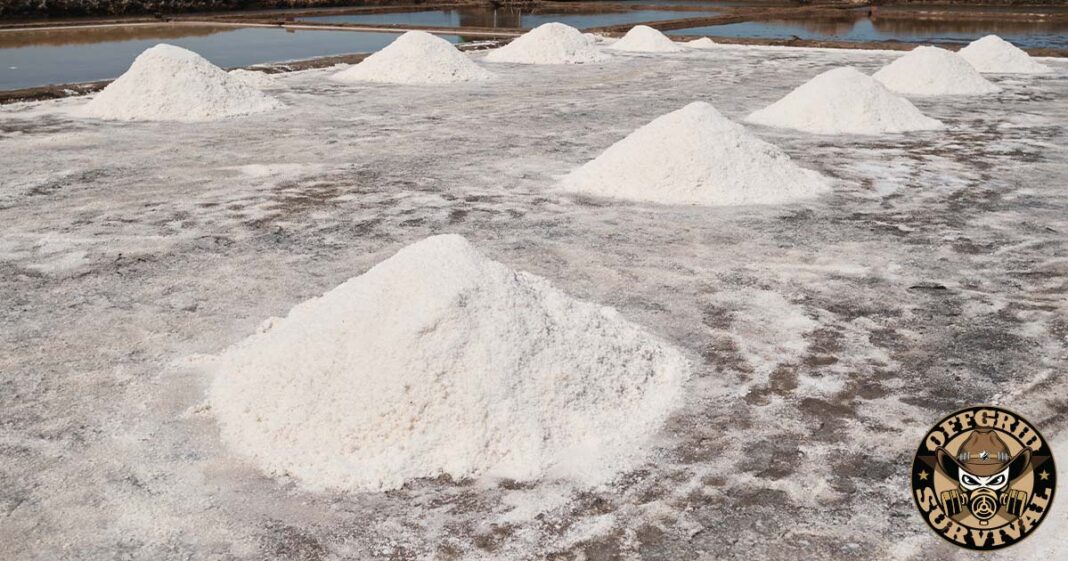
Seawater is still one of the richest salt sources on earth if you evaporate the water off. Average seawater holds around 35 grams of dissolved salts per liter. One liter boiled down leaves you roughly 35 grams of salt, which is about five to six teaspoons worth. That is enough to cover several hard days of sweating from a single pot of water.
Collect water from open coastline away from harbors, boat traffic, storm drains, and river mouths, and strain it through a bandana or cloth to catch sand and debris. Boiling the full liter away takes a lot of firewood, so the smarter method is to boil it down to a thick slurry and let the sun finish the job in a shallow pan or on a flat rock. Also check rock depressions above the high tide line, where splashed seawater dries into natural salt crust on hot days. Sea salt made this way carries magnesium and sulfate along with sodium chloride, which gives it a bitter edge and can loosen your bowels if you eat too much of it at once.
Salt Springs and Mineral Licks Animals know where the salt is, and they will lead you to it. A natural lick is usually a patch of mineral-heavy soil or a seep where game trails converge from several directions, and the ground is often trampled bare and pocked with hoof prints. You can dissolve lick soil in water, let the dirt settle out, pour off the clear liquid, and boil it down. Animals urinate and defecate around these sites, so boil anything you collect before it goes in your food.
In farm country, you will also find salt blocks set out for cattle. A plain white block is essentially sodium chloride, while red or brown mineral blocks contain added trace minerals formulated for livestock. Keep in mind those blocks belong to somebody, and in a real emergency a rancher is far more likely to trade you salt than to forgive you for taking it.
Hickory Root This one gets repeated in almost every survival book, and it deserves some honesty. The method is to dice hickory roots, boil them in water for a long time, remove the roots, and keep boiling until the water is gone, leaving a black substance used as a salt substitute. Many readers first ran into it in My Side of the Mountain, where the boy baits a deer trap with a homemade salt lick made by boiling hickory roots. What you get is a dark, tar-like mineral residue, not the clean white salt crystals some older guides describe.

Nobody has published solid numbers on how much sodium hickory residue actually contains, and plant minerals are generally dominated by potassium rather than sodium. That is the reason wood ash was historically called potash. Treat hickory residue as a seasoning that adds some minerals to bland food, not as a reliable way to replace what you lose sweating. The Cherokee made long use of hickory in this way. Hickory nut ash was used to prepare hominy and cornmeal and for seasoning, and burned hickory nutshells in the Eastern Woodlands date back to 8,700 BCE.
Coltsfoot Ash Coltsfoot is a common roadside weed with a long history as a wild salt substitute. A book from the Smithsonian’s National Museum of the American Indian describes the ash from burned dry leaves as a salt substitute used by many indigenous peoples of North America. The leaves are dried, rolled tight, burned over a container, and the salty ash is crumbled onto food in small amounts. Because ash is alkaline, use it by the pinch.
Coltsfoot comes with a real health warning that most survival articles skip. The plant contains pyrrolizidine alkaloids that can damage the liver, with much higher levels in the root than in the leaves or flowers, and Germany banned coltsfoot in 1992 after an infant death was linked to it. Misidentification makes it worse. In one documented case, a toddler developed serious liver disease after his parents mistakenly gathered a different, alkaloid-heavy plant believing it was coltsfoot. If you use it, use leaves only, be certain of your identification, keep it short-term, and never give it to children or pregnant women. There is no reliable data on how much of the alkaloid content survives burning, so do not assume fire makes it safe.
Desert Plants In the Southwest, indigenous people of the Sonoran Desert region burned juniper, saltbush, and dried beanstalks for use as salt or seasoning. Saltbush grows in alkaline desert soil and can taste noticeably salty. Like other plant ash, it is a flavor and mineral supplement, and it will not replace a day of heavy sweat loss on its own.
Garden Vegetables Older articles often list celery and carrots as salt sources, and those numbers fall apart under simple math. A medium stalk of celery holds around 30 mg of sodium, so you would need to eat roughly 17 stalks just to reach the 500 mg daily minimum. That is before accounting for a single drop of sweat. Vegetables are good food, but they are not a salt plan.
Pack an Ounce of Salt So You Never Have to Forage It
Every method above takes time, fuel, and skill, and several of them deliver very little sodium for the work. The cheapest insurance in your entire kit is a small waterproof container of plain salt. A single teaspoon of table salt holds about 2,300 mg of sodium, according to the FDA. Five teaspoons weighs roughly one ounce and holds more than 11,000 mg of sodium, which covers several brutal days in the heat for less weight than a granola bar.
Store it in a hard screw-top vial or a sealed pill bottle, not a plastic sandwich bag that will split and let rain dissolve your supply. Electrolyte tablets and capsules work too, but read the label for the actual milligrams of sodium per tablet, because some brands put in very little. Bouillon cubes pull double duty by salting your water and making wild game taste like real food. Beyond keeping you alive, salt also cures meat and fish, helps tan hides, and baits deer and other animals to your location.
When you are sweating hard, eat salty food along with your water instead of drinking plain water by the gallon, and drink to thirst rather than forcing fluids. Learn two wild salt sources that actually exist in your region before you need them, and never drink seawater under any circumstances. Salt costs a couple of dollars at any grocery store, and running out of it in the field can leave you confused, seizing, or dead on a trail with a full water bottle in your hand.
For more on the rest of your survival food and water plan, cehck out The Best Portable Survival Water Filters, How to Purify Water Without Iodine Tablets, Survival Food: 60+ Long-Term Emergency Foods You Can Buy at the Grocery Store, and Fat Storage Is the Biggest Problem in Long-Term Food and Nobody Talks About It.







Awesome little tip
It may also be possible to obtain sodium in your diet by boiling rocks.