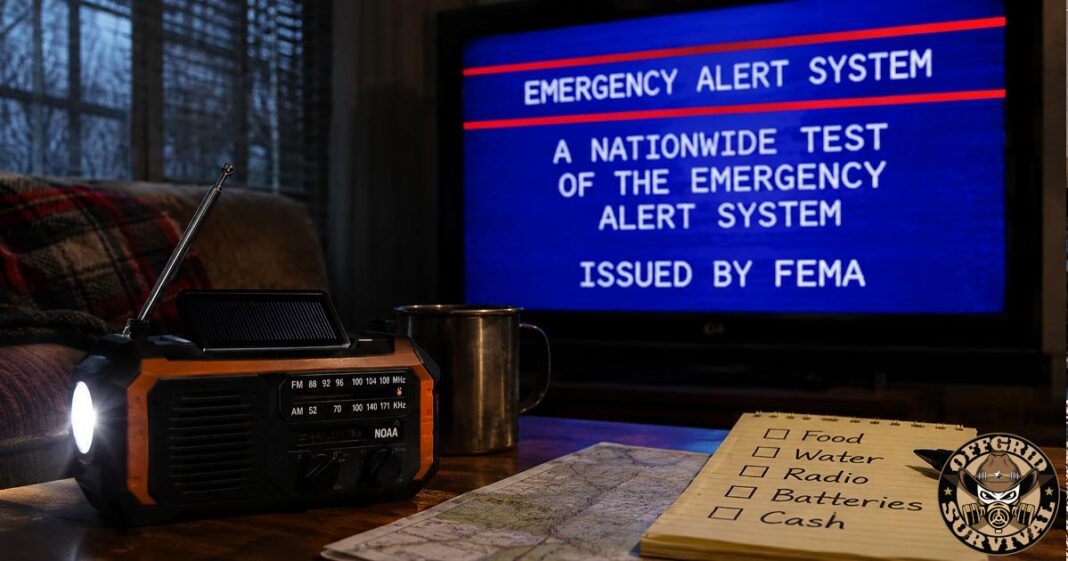
The federal government is preparing to test the emergency broadcast system designed to warn the entire country during a national crisis. The test comes as the Pentagon prepares military bases for extended disruptions and governments overseas urge citizens to stockpile food, water, cash, and emergency radios.
On Tuesday, November 17, the federal government will interrupt television and radio programming across the United States to test the emergency warning system that would be used to address the American public during a catastrophic national emergency.
At approximately 2:20 p.m. Eastern, 11:20 a.m. Pacific, FEMA and the Federal Communications Commission will activate the nationwide Emergency Alert System, sending a message through thousands of television stations, radio broadcasters, cable systems, and satellite providers. Regular programming will be interrupted, the familiar emergency warning tones will sound, and a federal message will inform Americans that the government is conducting a nationwide test.
The interruption is expected to last about a minute. FEMA says there is no emergency and no action is required from the public. If the test cannot proceed November 17, the government has designated December 3 as its backup date.
But the timing deserves attention, particularly considering what has been happening in the United States and overseas during the last several weeks.
As we recently reported, the Pentagon has been preparing military installations to operate for up to 90 days without outside support, while Britain, Japan, and Finland have been pushing emergency preparedness measures aimed at keeping their populations alive and functioning when normal services are disrupted.
Now FEMA is preparing to test the system that would allow Washington to interrupt normal broadcasting and deliver a warning across the entire country.
The government calls it a routine exercise. Federal law requires nationwide testing at least once every three years, and the test was announced in September. There is no evidence that the November 17 activation is connected to an imminent attack or a specific national threat. Nevertheless, the growing emphasis on emergency communications, infrastructure failures, and civilian preparedness is something Americans would be foolish to ignore.
The Emergency Broadcast System Built for America’s Worst Day
Most Americans recognize the Emergency Alert System from severe weather warnings, tornado alerts, and the occasional interruption of a television program. But the nationwide system being tested next Tuesday serves a much more serious purpose.
According to FEMA, the Emergency Alert System provides the President with the ability to address the American people during a national emergency. Its infrastructure is designed to distribute emergency messages across thousands of broadcasters and communications providers, giving federal authorities a way to reach the population when the country faces an extraordinary crisis.
We’re talking about the kind of national emergency where Americans need immediate instructions from the federal government. A devastating attack, a widespread infrastructure failure, or another catastrophe serious enough to require national emergency communications.
The technology runs through FEMA’s Integrated Public Alert and Warning System, known as IPAWS. The system distributes emergency messages electronically to participating broadcasters, which then relay those alerts to the public. It also maintains a traditional broadcast relay system that provides another way to distribute warnings when internet-based delivery fails.
During a real national emergency, a message could be distributed through the Emergency Alert System even when normal television or radio programming is underway. That’s the entire point of having a national warning system.
And while the public is being told not to worry about next week’s activation, the government is testing something that Americans should understand before they ever need it.
This Time, Your Cell Phone Won’t Be Included
There is another interesting difference between next week’s test and the nationwide test conducted in October 2023.
Your cell phone isn’t supposed to receive an alert.
Unlike the 2023 exercise, which included Wireless Emergency Alerts sent to mobile devices, the November 17 test will focus exclusively on traditional television and radio broadcasting, including cable and satellite systems.
FEMA says the purpose is to evaluate how participating broadcasters receive and retransmit national emergency messages. The test will originate through the internet-connected IPAWS system, with traditional over-the-air broadcasting providing a secondary distribution method.
The Government Has Already Found Serious Problems With the System
The Emergency Alert System has been tested nationally before, and previous exercises have exposed weaknesses that could have serious consequences during a real crisis.
The first nationwide test in 2011 experienced numerous technical problems, including failures to receive the alert and problems with audio quality.
The system improved considerably by the time the government conducted another nationwide test in 2016, but the FCC still identified equipment problems, configuration errors, and failures to properly receive or retransmit the emergency messages.

According to the FCC’s report, approximately 95.4 percent of reporting participants successfully received the 2016 test. The agency also documented problems that prevented some broadcasters from delivering messages correctly, including issues with equipment maintenance and the distribution of multilingual alerts.
Those problems are the reason the system requires repeated testing.
But they also raise an uncomfortable question. If a national emergency occurred tomorrow, how confident should Americans be that every part of the government’s warning infrastructure would function as intended?
An alert that never reaches a broadcaster, a station operating without backup power, or a family without a working radio could mean the difference between receiving critical instructions and having absolutely no idea what’s happening.
No nationwide warning system can guarantee that every American will receive every message. The government is responsible for maintaining that infrastructure, but ultimately every household needs a way to receive information when normal communications fail.
Millions of Americans May Never See the Emergency Warning
There is another problem with FEMA’s nationwide emergency alert system that deserves considerably more attention, especially as millions of Americans abandon traditional television and radio.
The system was designed around a country where people watched broadcast television, subscribed to cable, and listened to AM/FM radio. That’s no longer how much of America gets its news and entertainment.
Today, millions of households rely almost entirely on streaming services like Netflix, Amazon Prime Video, YouTube, Hulu, and other internet-based platforms. They may own several televisions, but that doesn’t mean any of those televisions are actually connected to the traditional broadcast system FEMA is preparing to test.
And here’s the disturbing part. Those streaming services generally aren’t required to interrupt their programming with the federal Emergency Alert System messages that traditional broadcasters must carry.
That means a family watching Netflix during a genuine national emergency might never see the warning that is simultaneously interrupting television and radio stations across the country. Someone watching YouTube, playing video games, or streaming a movie could remain completely unaware that Washington had issued an emergency message.
This isn’t some hypothetical flaw that only survivalists are worried about. The FCC itself has acknowledged the problem.
In a 2025 proceeding examining the nation’s emergency warning systems, the agency warned that Americans are increasingly turning to streaming services, gaming consoles, social media, and other digital platforms that may not be capable of interrupting their content to deliver emergency warnings. The FCC raised concerns that this shift could prevent the country’s emergency alert infrastructure from reaching the people it was designed to protect.
Think about that for a minute. The federal agency responsible for overseeing the nation’s emergency broadcasting system has already acknowledged that the way Americans consume information is changing faster than the government’s ability to warn them.
And the November 17 nationwide test isn’t going to include Wireless Emergency Alerts on smartphones, either. FEMA is specifically limiting this exercise to the traditional Emergency Alert System.
So while television and radio stations across the country interrupt their programming with a warning from Washington, millions of Americans watching streaming services may not even know the test happened.
During an actual national emergency, authorities could also activate cellular alerts and other warning systems. But those systems aren’t guaranteed to reach everyone, particularly during a major power outage, cyberattack, or telecommunications failure.
That’s why owning an emergency radio is no longer some outdated survivalist obsession. For people who have completely abandoned broadcast television and traditional radio, it may be the only independent way they can receive critical information when internet and cellular networks stop working.
The government can build the most sophisticated emergency warning system in the world, but it won’t do you much good if you have no way to receive the message.
America, Britain, Japan, and Finland Are All Preparing for Major Disruptions
The November 17 test would be easy to dismiss as another routine government exercise if it weren’t happening against a backdrop of increasingly serious emergency preparedness efforts around the world.
Over the last several weeks, we’ve been documenting a series of developments involving the United States, Britain, Japan, and Finland. Although the governments involved have cited different threats, their preparedness efforts share an important assumption: normal infrastructure and emergency services may not be available when people need them.
In the United States, military planners have been working toward making installations capable of surviving extended disruptions to outside utilities and supply networks. The Pentagon’s 90-day resilience objective reflects a recognition that installations cannot simply assume civilian power systems, fuel deliveries, communications, and other essential services will remain available during a major crisis.
In Britain, government preparedness campaigns have urged citizens to keep emergency food, drinking water, cash, and basic supplies. Officials have also emphasized the importance of battery-powered or wind-up radios, particularly during situations where electricity and digital communications are unavailable.
Japan has been urging households to maintain enough emergency supplies to survive independently for at least three days, and preferably a week. Japanese officials have pointed to the country’s serious earthquake and natural disaster risks, including the potential consequences of a major earthquake capable of disrupting transportation, electricity, and water supplies across heavily populated regions.
Finland, meanwhile, has been examining the lessons of Russia’s war in Ukraine and what that conflict reveals about keeping a modern country functioning during prolonged military threats. Its emergency preparedness efforts have addressed supply disruptions, infrastructure attacks, civilian resilience, and the importance of maintaining essential services during a national crisis.
Finland’s emphasis on printed preparedness information is particularly relevant. When electricity and internet access disappear, a printed emergency guide remains available. A website or smartphone application may not.
None of these developments establishes that the governments involved are responding to the same classified intelligence or preparing for one particular event. But taken together, they demonstrate how seriously national governments are treating the possibility of prolonged disruption.
And now, in the middle of those preparations, the United States is testing the emergency broadcast infrastructure intended to reach Americans during a national catastrophe.
You can call it coincidence, routine emergency planning, or simply governments doing the work they should have been doing for decades. Whatever explanation you prefer, the underlying threats are real enough that governments are spending money and resources preparing for them.
Don’t Wait Until the Government Tells You There’s an Emergency
The November 17 test should be a reminder to take an honest look at your own emergency preparedness. You don’t need to believe that a nuclear war or nationwide cyberattack is imminent to recognize that depending entirely on government services and fragile infrastructure is a dangerous gamble.
At an absolute minimum, every household should have a working emergency radio that can receive AM/FM broadcasts and NOAA Weather Radio, along with enough batteries or an independent power source to keep it operating during an extended outage. Find your local emergency broadcast stations and write down their frequencies. Don’t assume you’ll be able to look that information up on your phone after a disaster has already started.
Families should also maintain enough food, drinking water, medications, and essential supplies to survive without outside assistance. Three days is better than nothing, but we’ve long recommended preparing for at least two weeks, with a longer-term supply plan whenever possible. Keep some cash available, maintain alternative ways to cook and provide basic lighting, and make sure your family knows what to do if cellular communications stop working.
Most importantly, don’t confuse government preparedness with personal preparedness. The Pentagon may be planning to keep military installations operating independently for 90 days, but that doesn’t mean the government is going to keep your refrigerator running, deliver groceries to your neighborhood, or make sure your family has drinking water during a prolonged emergency.
On November 17, FEMA will interrupt television and radio programming across the country to make sure its national warning system still works. Most Americans will hear the tones, ignore the message, and go right back to whatever they were doing.
That’s their choice.
But with governments around the world openly preparing for infrastructure failures, major disasters, cyberattacks, and prolonged emergencies, it would be incredibly shortsighted to assume that the emergency warning system will only ever be used for another test.
The time to prepare for a national emergency is before that warning becomes real.
Related coverage: First America and Britain, Now Japan and Finland Prepare for Major Emergencies