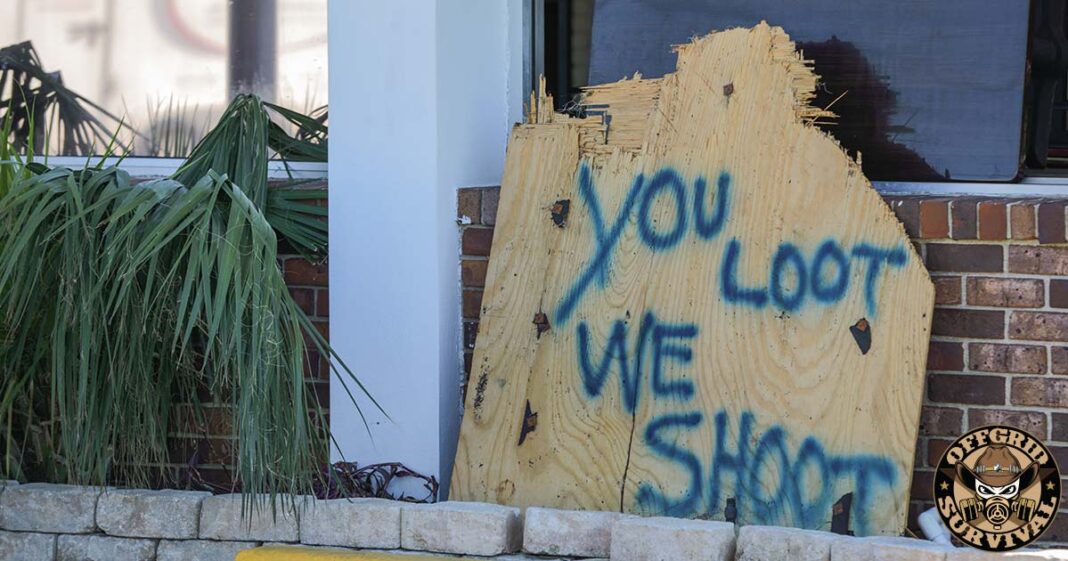
Everybody who preps spends their first dollars in the wrong place. Water filters, food buckets, a generator, maybe a gun and a few boxes of ammo. All good. All necessary. But almost nobody preps for the thing that’s actually going to try to hurt them, and it isn’t the hurricane, the blackout, the earthquake, or the empty grocery store. It’s people. People who didn’t prep, people who prepped for all the wrong things, and people who were always a little rotten and just needed the lights to go out to finally show you who they really were.
The disaster itself is the easy part. A disaster is weather and physics, and you can plan for weather. What you can’t plan for so easy, and what nobody wants to think about, is what your fellow human beings turn into about seventy-two hours after the trucks stop rolling and the faucet runs dry.
I want to walk through this the honest way, using stuff that actually happened, not Hollywood and not doom-for-clicks. Because the real story is bad enough on its own, and the guys who lived through it will tell you the same.
What We Already Know Happens, Because It Already Happened
You don’t have to guess about any of this. We’ve watched it play out on our own soil.
When Katrina drowned New Orleans in 2005, the storm was over in a day. The hard part lasted weeks. Stores got cleaned out, some by desperate people grabbing food and water, some by folks hauling off TVs and DVD players through waist-deep water. There were carjackings and burglaries. In one neighborhood, Algiers Point, residents formed armed groups and there were actual gun battles in the streets. A psychotherapist who lived through it said the hurricane was a breeze compared to the crime and terror that came after.
Now here’s the part that matters just as much, because I told you I’d give it to you straight. A lot of the worst stories out of Katrina were flat-out lies. The tales of babies being raped in the Superdome, bodies stacked in freezers, mass murder at the Convention Center, most of that never happened. Officials confirmed only a single killing at those sites, and the panic got fanned by rumor and by the city’s own leadership running their mouths to the press. That matters because in a collapse, fear itself becomes a weapon, and it makes scared people do stupid, dangerous things. Two lessons in one event. The crime is real. And the story about the crime gets bigger and dumber than the crime itself, which is its own hazard.
And there’s a third lesson from Katrina that every prepper should tattoo somewhere. While regular citizens were arming up to protect what was left of their homes, the government went door to door and took their guns. Legally owned firearms, confiscated from law-abiding people in the middle of the worst lawlessness of their lives. Think hard about what that means for how loud you want to be about what you own.
A Three-Day Storm and a Yearlong Collapse Are Two Different Animals
Here’s where people get it twisted. Most of us have only ever seen the short version. The power’s out for four days, it’s tense, then the lights come back and everybody goes back to normal. That short-term event mostly brings out cooperation, neighbors helping neighbors, with a rotten minority working the edges. That part is true and I won’t pretend otherwise.
The long version is a different beast entirely, and for that you have to listen to people who actually lived it.
There’s a guy who writes under the name Selco who survived a year inside a Bosnian city under siege in the nineties. No power, no water, no gas, no medical help, no police, nothing. Just armed groups protecting their own homes. He’ll tell you that when it kicked off, most of the neighbors had maybe a few days of food in the house. He’ll tell you it took a month or two, and then the gangs formed and started tearing through everything. The hospitals turned into slaughterhouses. His line that sticks with me is simple and cold: first the weak perish, then the rest fight.
Then there’s Fernando Aguirre, a lot of people know him as FerFAL, who lived through Argentina’s economic collapse in 2001. Not a war. An economy that fell apart. What he describes is a country where home invasions, express kidnappings, and armed robberies became a normal Tuesday. People who still had jobs and a working car got hit in planned ambushes on their way to work, because having anything at all made you a target. He watched the price of a hammer go up between the aisle and the register.
Two different countries, two different disasters, same ugly arc. Order doesn’t vanish all at once. It drains out over weeks, and every week that passes, more previously-normal people cross a line they swore they never would.
Your Neighbor Is the Threat You’re Not Looking At
When people picture the SHTF bad guy, they picture a gang, a looter, some faceless mob. That’s the obvious threat. It’s not the one that’s most likely to get you.
The one most likely to get you is Dave from three houses down. The guy who mows his lawn on Sundays and coaches Little League and has never done a bad thing in his life. Because Dave didn’t prep. Dave’s got a wife, two kids, and a dog, and on day five of no food and no water, Dave is looking at his hungry children and doing math he never thought he’d have to do. Dave isn’t a criminal. That’s exactly what makes him dangerous. A criminal is running a cost-benefit thing you can predict, like we’ve talked about before. A desperate father who has run completely out of options and is watching his kids suffer has no cost-benefit anymore. He’s got nothing to lose, and a man with nothing to lose is the most unpredictable, most dangerous animal on earth.
And here’s the gut-punch. If Dave knows you prepped, if he ever saw the pallets come off the truck, if your kid ever told his kid you’ve got a basement full of food, then when Dave hits the bottom, he already knows exactly whose door to knock on. You didn’t just fail to help him by prepping quietly. You became his plan. His hungry kids are now standing between you and him, and he is coming to your house, because in his mind he’s not a robber, he’s a dad. Try reasoning with that.
That’s not a reason to hate your neighbors or turn on people. Community is going to save more lives than any bunker, and I’ll get to that. It’s a reason to be smart, right now, about who knows what you have.
Desperation Unlocks the Stuff You Thought Was Unthinkable
A collapse doesn’t just create new threats. It supercharges every threat that was already there and quietly holding itself back.
The wife-beater down the street was held in check by the fact that cops might show up. Take the cops away for good and see what he becomes. The creep everybody kind of avoids was kept on a leash by consequences. Remove consequences and the leash is gone. The addict who used to just steal car stereos is now willing to do a whole lot worse to get what his body’s screaming for. Every predator we’ve talked about across these articles, the mugger, the con man, the home invader, they all operated inside a world with rules and risk. Erase the rules and erase the risk, and they don’t get a little bolder. They come completely off the chain.
And then there’s the brand-new category, the people you’d never have flagged in a million years. The nice ones. The regular ones. Because starvation and watching your family suffer will take a decent person to places a decent person swears they’d never go. FerFAL and Selco both say the same thing in different words: the line between a civilized person and a desperate animal is about three missed meals wide. Not everyone crosses it. But way more people cross it than you’d ever believe from where you’re sitting right now with a full fridge.
Keep Your Mouth Shut: OPSEC Is a Survival Skill
Operational security. It’s a fancy military term for a dead-simple idea: shut up about what you have and what you’re doing.
This is where preppers screw up the worst, and it’s an ego thing. You put in the work, you built something you’re proud of, and you want to talk about it. You post the shelf of food buckets. You tell your buddy at work about your bug-out plan. You show your brother-in-law the safe. You mention the solar setup to the neighbor. Every single one of those is a withdrawal from your own survival account, and you’ll never see the cost until the day it comes due.
Because here’s how it works. In good times, nobody cares about your food storage. In bad times, every person who ever heard about it becomes a liability, and worse, a broadcaster. Your coworker who thought you were a little nuts for prepping? On day six he remembers, and he tells four other desperate people where the food is, because now he’s desperate too. You didn’t just tell one guy. You seeded a map to your house in the head of everybody he’ll ever panic-talk to.

The rule is boring and absolute. The people who need to know what you have are the people under your own roof who are surviving with you, and that’s it. Not your friends. Not your extended family, until the moment they’re standing on your porch as part of your plan. Not the internet. Especially not the internet. Loose lips have gotten more preppers robbed than bad locks ever will.
Be the Gray Man
The gray man idea is straight out of the mouth of someone who survived the real thing. Ask anyone who has been through it and they will tell you that if it all kicked off tomorrow, they would make himself look exactly like everyone else. Desperate. Fearful. Hungry. Not the guy with the full belly, the clean clothes, the confident walk, and the bulging backpack. The invisible guy. The one nobody looks at twice because he looks like he’s got nothing worth taking.
That’s the whole thing. When everybody around you is starving and you look well-fed, you’re a screaming billboard. When everybody’s filthy and scared and you’re clean and calm, you stand out, and standing out in a collapse gets you followed home. Being the gray man means blending into the misery around you instead of floating above it. Dirty up. Dress down. Don’t flash gear. Don’t open a fat wallet or a full bag in front of hungry eyes. Don’t let anybody see you’re armed unless you’ve already decided the moment’s come to use it, because remember Katrina, even the authorities may come looking to take your guns, and every desperate person around you is doing the math on who’s worth robbing.
I’ve written before about the gray man approach and carrying discreet so you don’t scream “prepper” walking down the street. In a real collapse that stops being a style choice and becomes the difference between getting left alone and getting picked.
Don’t Invite Trouble
Once the grid’s down, you can give yourself away without ever saying a word. Your house starts talking for you, and you’d better know what it’s saying.
The smell of cooking food travels a shocking distance when every other house on the block is cold and dark and hungry. Fire up a nice dinner and you might as well ring a bell. The roar of a generator when the whole neighborhood is silent announces two things to everyone within earshot: that house has power, and that house has fuel. Lights blazing behind the curtains when every other window is black is a beacon that says we’ve got batteries, we’ve got a setup, come see what else we’ve got. Even the everyday stuff gives you up. Taking out full trash bags of packaging when nobody else has anything to throw away. Your kids looking healthy and fed on a street full of hollow faces.
None of this means you sit cold and starving in the dark to blend in. It means you’re deliberate. Cook low and slow and at odd hours. Black out your windows completely before you run a single light. Bury or burn your trash. Keep the generator for when you truly need it, and think hard about muffling it or running it in short bursts. Keep the kids close and quiet. The goal is for your house to look just as broke and miserable as every other house on the block, because the moment yours looks different, it becomes the target. Situational awareness isn’t just for the street, and I’ve laid out how to actually build that mindset if you’ve never trained it.
If You Have to Run, Don’t Announce It
Sometimes staying isn’t the play. If your area turns into a free-fire zone, if the threat’s too big to hold off, you bug out. But how you leave can turn you into a target just as fast as anything else.
The family loading up the truck with totes and gas cans and gear, in broad daylight, in front of a whole street of people who have no plan and nowhere to go, is telling every one of those people two things: we’ve got supplies, and we won’t be here to defend this house much longer. You just painted a bullseye on your vehicle for the road and your empty house for the block. If you’re going, go quiet, go smart, and ideally go before it gets bad enough that everybody’s watching. The person who leaves early and calm beats the person who panic-flees in the middle of the mob every time. I put together a full bug-out and evacuation breakdown that’s worth reading long before you need it.
And kill the fantasy of the lone cabin in the woods while you’re at it. FerFAL watched this play out for real in Argentina, and the isolated retreat, the place way out where nobody can bother you, turned out to be the most dangerous spot of all. Why? Because out there, when the home invaders come, there’s no neighbor to hear you, no help coming, ever. The families who did best weren’t the hermits. They were the ones inside a community where everybody knew each other, where a stranger stood out, where the neighbors looked out for one another. Isolation feels safe. In a real collapse it’s a trap. Numbers and trusted people around you are worth more than distance.
The Stuff Nobody Thinks About
A few things that slip past even people who’ve thought hard about this.
Bartering will get you killed if you’re careless with it. The second you trade away food or ammo or medicine, the person you traded with now knows you have a supply of it. You just showed your hand. Trade small, trade rarely, and never let anyone see the size of what you’re sitting on.
Your kids and your mouth are the two biggest leaks in your whole operation. Kids talk. They tell friends everything, and those friends have hungry parents. Teach them young that what’s in the house stays in the house. And you, the confident prepper who likes being the guy with answers, are just as bad when you can’t resist telling somebody how ready you are.
Charity can make you a mark. Helping people is right, and I’m not telling you to let your neighbors starve. But understand that the moment you hand food to a stranger at your door, you’ve confirmed you have food to give, and some of the people you help will come back, and not always alone. Think through how you help before the day comes. Helping from a distance, through a trusted group, is a whole lot safer than becoming the known soft touch with the full pantry.
And the person you turn away matters too. Say no wrong, with contempt, humiliating a desperate man in front of others, and you may have just made an enemy who comes back to settle it. In a world with no cops and no consequences, how you treat people, even people you can’t help, is its own kind of security.
You Don’t Want to Learn the Hard Way
Here’s what all of it comes down to. The disaster is going to be the same for everybody. What separates the people who make it from the people who don’t is almost never the storm. It’s how ready you were for what the storm did to the people around you.
Prep your water and your food and your defense, absolutely. But prep your mouth, your habits, and your head just as hard. Stay quiet. Stay gray. Stay aware. Build a small circle of real people you’d trust with your life, because you might have to. And never, ever fall for the idea that the folks on your street would never turn, that it couldn’t get that bad here, that people are basically good so it’ll all work out.
People are basically good. Right up until they’re hungry, terrified, and watching their kids go without. Then people are basically whatever they have to be. Plan for that version of your neighbor, and pray you never meet him.