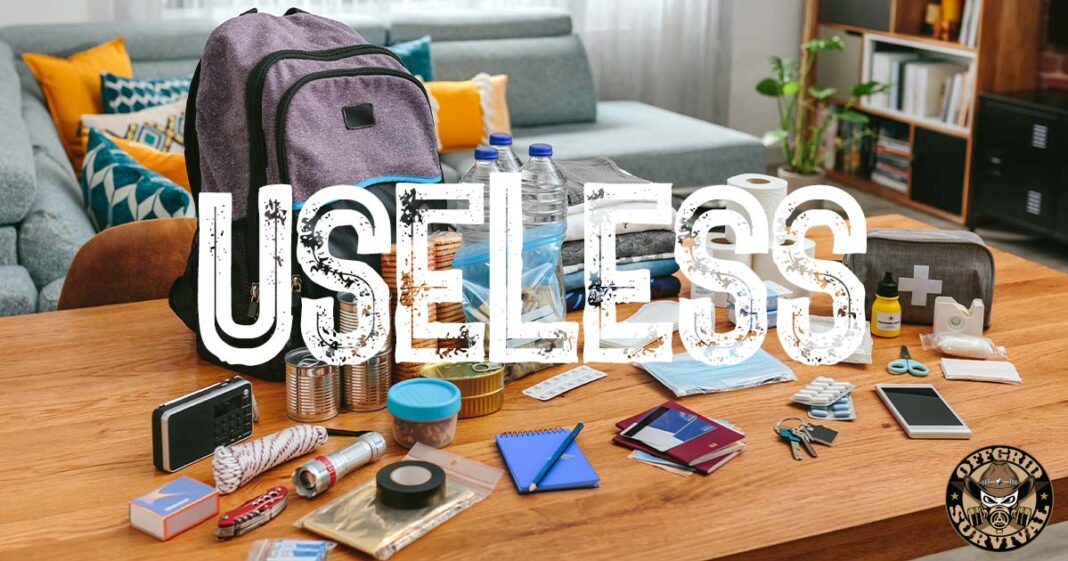
Open five articles promising the “ultimate survival kit” and you will usually find the same collection of gear listed in almost the same order. A ferro rod, some paracord, a Mylar blanket, a tactical flashlight, a folding saw, a multitool, a filter straw, waterproof matches, a whistle, a compass, a first-aid pouch and some kind of hollow-handle knife stuffed with fishing line.
The lists look similar because the writers are copying one another. It is not because those same twelve items happen to be the right answer for every climate, household and emergency in the country.
Most of the people producing these articles have never carried the completed kit farther than the distance between their desk and the shipping box. They have not dragged it up a hill, slept beside it in freezing weather, tried to light a fire with it in the rain or discovered that the flashlight advertised at 10,000 lumens lasts fifteen minutes before dropping to a dim glow.
The survival-gear industry has become flooded with articles written to rank in search results and earn a commission. “Best survival kit” is a valuable search term, so websites look at whatever page currently ranks at the top, rearrange the same products, attach affiliate links and call the result a field-tested guide.
Google now specifically distinguishes between legitimate product reviews and thin summaries written by people who have never handled the product. That distinction exists because fake firsthand reviews have become common across the internet. Survival gear is especially vulnerable to this garbage because a recommendation is not merely helping someone choose a blender or a pair of headphones. The buyer may eventually depend on the product during a blackout, vehicle breakdown or night spent outdoors.
A shopping list is not a survival kit. A kit is a collection of decisions based on where you live, how far you travel from home, what the weather can do, how much weight you can carry, who depends on you and what is actually likely to go wrong.
No generic product list can make those decisions for you. And no piece of gear can replace actual real world experience and training!
Specifications Are Not the Same as Experience
You can usually tell whether somebody has used a piece of gear by the details they include.
A writer copying a product page tells you a knife has a five-inch blade, a full tang and 1095 carbon steel. Someone who has actually carried the knife tells you whether the handle creates hot spots, whether the sheath holds the knife securely when crawling, whether the edge chips, how quickly the steel rusts in humidity and whether the grip becomes dangerous when covered in rain, sweat or blood.
The same problem appears in flashlight reviews. A manufacturer may advertise 10,000 lumens, but that number often describes a temporary turbo setting that lasts seconds or minutes before heat forces the light to reduce its output. What matters during an emergency is how many hours the light runs at a brightness you can actually use.
Fire starters receive the same lazy treatment. The article repeats that the rod produces sparks at 3,000 degrees, as though that number tells you whether the included striker works. It does not tell you whether the striker is a thin piece of soft metal that loses its edge after a handful of uses, whether the rod is large enough to grip with cold hands or whether the supplied tinder will light after sitting in damp air.
A writer who has used the gear talks about failure. A writer who has not used it talks about features.
Once you learn to recognize that difference, a large percentage of online survival reviews become easy to dismiss.
The Customer Reviews May Be Fake Too
Most people understand that a list could be biased, so they check the customer reviews before purchasing. That sounds responsible, but online reviews are becoming another unreliable layer in the buying process, since much of the internet has been taken over by AI bots.
A 2026 analysis by Pangram Labs examined front-page reviews attached to 500 Amazon bestsellers and identified 909 reviews, approximately 3 percent of the total, as likely machine-generated with high confidence. Of those AI-generated reviews, 74 percent gave the product five stars, compared with 59 percent of reviews believed to have been written by people.
Even more concerning, 93 percent of the suspected AI-written reviews displayed Amazon’s “Verified Purchase” badge.
That badge is supposed to indicate that a real person bought the product through Amazon. Most shoppers interpret it as evidence that the reviewer owned and used the item. Instead, a machine-generated review may sit near the top of the page wearing the same trust signal while praising a product nobody actually tested.
The result is a completely broken verification process. You read an article written by someone who never used the gear, then confirm the recommendation by reading glowing reviews that may not have been written by a person.
That is not research. It is one piece of marketing copy validating another.
Cheap Survival Kits Are Cheap for a Reason
U.S. Customs and Border Protection seized more than 78 million counterfeit items during fiscal year 2025. Had the merchandise been genuine, CBP estimated its retail value at more than $7.3 billion. A large share of the seized products originated in China and Hong Kong.
Counterfeiting is not limited to fake handbags and watches. CBP regularly warns about counterfeit automotive components, electronics, medications, batteries and safety products made with inferior materials and little quality control.
That same manufacturing system feeds the $39 “250-piece survival kit” sold online with a photograph of mountains on the box.

Do the math. Nobody is manufacturing a dependable compass, knife, multitool, flashlight, folding saw, water filter, fire steel, first-aid kit and another 240 useful pieces, placing them in a case and shipping them to your front door for $39 while still making a profit.
The box is not an unbelievable bargain on quality equipment. It is filled with the cheapest objects a factory can produce that resemble survival gear long enough to look convincing in a photograph.
Some of those items may function well enough to open a package or entertain a child in the backyard. That is not the same as functioning when cold, wet, exhausted or injured.
Counterfeit Water Filters Can Make You Sick Without Warning
Water filtration is where cheap gear stops being merely disappointing and becomes dangerous.
Sawyer has published a standing counterfeit warning after fake Sawyer Mini filters appeared through third-party online marketplace sellers. The counterfeit products reportedly used Sawyer branding, packaging and UPC codes, making them difficult for the average buyer to distinguish from the real product.
Sawyer cannot guarantee the performance of a filter it did not manufacture. That means the buyer may believe contaminated water is being filtered when the product has never been independently tested or built to the company’s standards.
In a separate enforcement case, Customs seized thousands of counterfeit water filters carrying unauthorized NSF certification logos. Testing found that some failed to remove lead and other contaminants. Other industry testing has reportedly shown counterfeit filters adding contaminants such as arsenic to water that was clean before it passed through the filter.
That is the worst possible type of equipment failure because it is silent.
If a filter cracks or refuses to pass water, you know immediately that you need another option. You can boil the water, use chemicals or find a different source. A counterfeit filter may produce clear, cold water that tastes completely normal while allowing pathogens or chemicals to pass straight through.
You do not discover the problem until days later, when your family develops vomiting or diarrhea and begins losing water faster than it can be replaced. In a normal situation, that means a miserable trip to urgent care. During a widespread emergency, there may be no clinic, no functioning pharmacy and no clean tap available.
Buy filtration equipment directly from the manufacturer or an authorized dealer. The small amount saved through an unknown marketplace seller is not worth betting your health on an unverified filter.
Fake Batteries Can Leave You in the Dark
Counterfeit lithium-ion batteries create a similar problem.
Legitimate 18650 cells manufactured by established battery companies generally hold between approximately 2,600 and 3,500 milliamp-hours. That range reflects the physical limitations of a cell of that size.
When a listing advertises a 9,800 mAh 18650 battery, it is not selling a technological breakthrough. It is lying.
Independent testing of batteries carrying those exaggerated labels has found actual capacities as low as 800 to 1,100 mAh. A cell marketed as holding nearly 10,000 mAh may provide about one-tenth of that amount.
Put those batteries in a headlamp and the consequences become obvious. You packed the light because you expected it to last through a twelve-hour night. Instead, the battery may begin fading after an hour or two. The failure does not happen while you are reading the listing. It happens while changing a tire beside a dark highway, searching a damaged house or trying to navigate unfamiliar ground.
Low-quality lithium cells also present a fire risk. Poor internal construction, damaged insulation, false protection claims and counterfeit wrappers can turn a disappointing battery into a dangerous one.
Purchase batteries from established battery retailers or authorized distributors, not sellers offering impossible capacity numbers and a pack of twelve cells for the price of two legitimate ones.
Physics does not care how good the deal looked.
There Is No One-Size-Fits-All Survival Kit
Even if every component were genuine, the idea of one universal survival kit would still fail because different emergencies require completely different equipment.
A summer kit in the Mojave should place water, electrolytes, shade, sun protection and lightweight clothing near the top of the list. Heat and dehydration can become serious within hours. A heavy axe, bulky wool blanket and folding saw may only increase the wearer’s heat load.
A winter kit in northern Minnesota needs insulation, dry socks, dependable fire-starting equipment, dense calories and a shelter system capable of holding heat. The danger is not dehydration in the afternoon. It is hypothermia before morning.
A get-home bag for someone commuting eighteen miles across a city should include walking shoes, water, a phone battery, cash, basic medical supplies, weather protection and a paper map. A folding saw and fishing kit are unlikely to help that person cross an urban area.
Someone living in a rural area forty minutes from the nearest highway may need vehicle recovery equipment, more water, additional food, fuel, tools and a larger medical kit because assistance may be hours away.
Those four people live in the same country and need four different kits.
Personal circumstances change the list even more. Someone who takes insulin, seizure medication, anticoagulants or blood-pressure drugs has priorities no generic checklist can predict. A person who wears glasses may benefit more from a spare pair than from every tactical gadget in a preassembled kit.
Add an infant, a toddler, an elderly parent or a dog and the water, food, pace, medical needs and overall load all change.
Most “ultimate survival kits” quietly assume the buyer is a healthy adult male traveling alone with no prescriptions, dependents or physical limitations. That does not describe most households.
Water Weight Destroys the Fantasy
Government recommendations generally call for storing at least one gallon of water per person per day for a minimum of three days. That water is meant to cover drinking and limited sanitation.
A gallon of water weighs approximately 8.34 pounds. Three gallons weigh just over 25 pounds.
That means one adult’s recommended three-day water supply weighs more than 25 pounds before adding food, clothing, shelter, medical supplies or any of the equipment found on the usual survival checklist.
For a family of four, three days of water weighs more than 100 pounds.
That is not a backpack load. It is vehicle cargo or shelter-in-place storage.
The number forces a decision most listicles avoid. Are you carrying all the water you need, treating water as you travel or remaining at home with stored water? Each choice requires different equipment and assumes different conditions.
A filter straw and a 32-ounce bottle do not solve the water problem unless you know there will be a usable water source along your route. Large parts of the country do not have clean streams conveniently spaced beside every road. Water may be contaminated by sewage, fuel, agricultural chemicals, industrial runoff or salt. Many popular backpacking filters remove biological threats but do not remove every chemical contaminant.
The CDC recommends working toward a two-week household supply where space permits, with additional water for pets, pregnant women, sick family members and hot climates. Two weeks for a family of four equals 56 gallons, weighing approximately 467 pounds.
That is the honest scale of household water storage.
It takes floor space, strong shelving, proper containers and a rotation plan. It is far less exciting than a tactical pouch, which is probably why affiliate-driven articles rarely spend much time on it.
There is no commission attached to filling food-grade containers from the tap.
Gear You Have Never Tested Does Not Belong in Your Plan
Buying equipment is the beginning of preparedness, not the end.
Load your bag exactly as you intend to carry it and walk the real distance you might need to cover. Do not walk around the block and call it a test. Wear the shoes you would actually have available and travel on the same types of roads, sidewalks, trails or desert terrain you would face during an emergency.
Within several hours, the bag will start telling you what the product descriptions did not.
A shoulder strap may press against a nerve when the pack is fully loaded. A bottle may fall out of the side pocket when you bend over. Boots stored for years may have dry-rotted soles that separate after several miles. A cheap zipper may jam under tension. The completed load may weigh eleven pounds more than you estimated.
Eleven extra pounds may not seem important while lifting the bag in your bedroom. Carry it for eighteen miles and it can determine whether you arrive home or stop halfway.
Test every individual item under realistic conditions. Use the ferro rod outside in wind and drizzle. Determine whether your tinder will light after becoming damp. Run the flashlight until the batteries die and record how long it provides usable light. Drink through the water filter and check the flow rate. Tune the emergency radio to actual stations in your area.
Open the first-aid kit instead of leaving it sealed. Many preassembled medical kits contain hundreds of pieces only because every adhesive bandage, alcohol wipe and cotton swab is counted separately. The impressive 250-piece kit may contain little more than cheap bandages, tiny rolls of tape and a pair of useless scissors.
Check expiration dates. Replace medications that have expired. Add items appropriate to your training and the injuries you are realistically likely to encounter.
The middle of an emergency is not the first time you should discover that your flashlight has a complicated lockout mode, your radio cannot receive local stations or your folding stove requires a fuel canister you forgot to pack.
Build YOUR CUSTOM KIT around the Emergencies You Are Likely to Face
Start by writing down the three emergencies most likely to affect your home, workplace and normal commute.
For many households, that list will include a multi-day power outage, severe weather, wildfire, earthquake, house fire, flooding or a vehicle breakdown. Someone with a long urban commute may need to prepare for walking home when roads or public transportation shut down. A rural household may need to plan for being cut off from emergency services.
Build for those problems before spending money on exotic scenarios.
A kit for a power outage should include lighting, charging, safe cooking options, water, temperature control and whatever is necessary to keep medical equipment operating. A house-fire evacuation bag should prioritize identification, medications, important documents, clothing, cash, keys and supplies for children or pets.
A vehicle emergency kit needs water, road flares or warning lights, weather protection, tools, recovery equipment and footwear suitable for walking. A wilderness kit may need navigation, shelter, fire and water-treatment equipment.
Some gear can serve several purposes, but the priorities will not be identical. The bag should reflect how you live instead of how an online store wants you to shop.
Buy fewer products and buy dependable versions. Purchase critical equipment from the manufacturer or an authorized seller. There is nothing wrong with inexpensive gear when failure merely causes inconvenience. The cheap plastic spoon does not need military specifications.
A filter, flashlight, battery, tourniquet or climbing component is different. Those are not the places to gamble on an unknown seller and a suspiciously low price.
Maintain the Kit or It Will Quietly Rot
A survival kit is not a permanent object. Food expires, water containers leak, batteries discharge, medications age and clothing becomes inappropriate when the season changes.
Write the date on consumable items as they go into the bag. Inspect batteries at least twice each year and remove anything leaking, swollen or damaged. Rotate food before it becomes stale. Replace water according to the container manufacturer’s recommendations and inspect stored containers for cracking or contamination.
Change clothing as temperatures change. A bag packed for July may be dangerous in January. Children outgrow clothing quickly, and medications change as prescriptions are adjusted.
Take the entire kit apart at least twice a year. Make sure every item still works, still fits and still deserves its place. Remove gear you repeatedly carry but cannot identify a realistic use for.
Use the Ready.gov checklist as a starting point, not as a finished answer. The government list provides a reasonable baseline, but only you know your household’s medications, physical limitations, pets, climate and transportation needs.
A bag that has been opened, tested, criticized and repacked several times is far more valuable than a factory-sealed kit with “250 pieces” printed on the box.
False Confidence Is the Most Dangerous Thing in the Box
The greatest cost of a bad survival kit is not the money wasted on cheap gear. It is the belief that the problem has been handled.
Someone reads an article, spends a few hundred dollars, puts the kit in a closet and checks preparedness off the list. The box remains sealed for five years while the batteries die, adhesives dry out, medications expire and low-quality tools corrode.
That person feels prepared because the product was marketed as complete.
The factory that assembled the kit was focused on reducing its cost. The website recommending it was focused on earning a commission. The marketplace seller was focused on getting the order shipped before the customer noticed the brand name was misspelled.
None of them will be standing beside you when the flashlight fails, the knife handle cracks or the water filter passes contaminated water.
Survival capability cannot be purchased in one transaction. It is built through use.
Buy one honest item at a time. Test it. Learn what it can and cannot do. Carry the finished bag far enough to find the problems. Use the gear in bad weather. Allow cheap equipment to fail on an ordinary Saturday when the truck is parked nearby and the house is still warm.
A person who spent a wet afternoon failing to light a fire and then corrected the problem is better prepared than someone who owns five untouched ferro rods.
One of them learned while failure was merely frustrating. The other will learn when failure matters.
Stop buying the fantasy of preparedness. Build a kit for your actual life, test every critical item and make sure the equipment works before the day you need it.