
Most people’s bug-out route plan is an app on their phone and a vague idea that they’ll head north.
That’s not a plan. That’s a hope.
When a real evacuation event hits — grid down, roads starting to clog, cell service already degrading — is not the time to open Google Maps and start thinking about where you’re going. By then, every decision you make is slower, more emotional, and less accurate than it would have been if you’d done this work on a quiet Saturday afternoon. The people who get out clean are the ones who already drove the route, already know the choke points, already have a printed document in the bag that anyone in the family could follow at 2 AM without a signal bar.
This is how you build that document. The methodology comes from the same route assessment process used in government and military operations, adapted for civilian bug-out planning. You don’t have to be a soldier to use it — you just have to be willing to do the work before you need it.
Why Your Current Route Plan Is Probably Broken

Let’s start with the most common version of a “bug out route plan” and why it fails.
Version one: highway to the cabin. Fastest route, works fine in normal conditions. During a major regional evacuation — hurricane, wildfire, grid failure — every other person within 100 miles has the same idea. Highways become linear parking lots within 2–4 hours of a major trigger event. Katrina showed this in graphic detail in 2005. The contraflow lane system on I-10 — designed specifically for mass evacuation — turned into a 100-mile traffic jam that stranded people for 8–12 hours with no fuel, no water, and the storm closing in. If you’ve never read a serious analysis of what large-scale urban evacuation actually looks like, this is the moment.
Version two: I’ll figure it out. No documentation, no alternate routes, no idea what the terrain looks like between home and the bug-out location. One bridge washes out, one road closure from a downed powerline, one wrong turn in an unfamiliar area at night, and the plan collapses entirely.
Version three: it’s all on my phone. Dead battery. No signal. App requires internet. Congestion re-routes you onto a road that’s underwater.
A real bug-out route plan is a printed, tested, documented set of at least three routes from every starting point you might be at when the trigger event happens — not just your home.
That last part is what almost everyone misses.
Step One: Identify Every Starting Point
Where will you be when SHTF?
If the answer is “home,” you’ve only planned for one scenario. What if you’re at work? At your kids’ school? On a commute 40 miles in the wrong direction? At a family member’s house across town?
Your route plan needs to account for every realistic starting location. For most people that’s 3–4 points: home, workplace, your most common travel corridor, and wherever you spend weekends. Each of those starting points needs its own set of documented routes to your bug-out location.
This sounds like a lot of work. It is. It’s also the difference between a plan that functions when the trigger event catches you away from home — which is statistically likely — and one that only works in the easy scenario.
At the same time you’re identifying starting points, lock in your end point. This should already be decided as part of your overall bug-out location planning. If you don’t have a specific destination, you don’t have a route — you have a direction. A direction is not enough.
Step Two: Map Your Territory Before You Map Your Routes
Before you start drawing lines on a map, you need to understand the ground those lines cross. This is called area familiarization, and it’s the step most people skip entirely because it requires getting off the computer and actually going out there.
Start with maps — plural. Google Maps for general familiarity. Satellite imagery for terrain and vegetation. A printed USGS topo map for elevation, water features, and off-road detail. A county road map for small roads that don’t appear on consumer navigation apps. DeLorme state atlas books cover most of the U.S. and are worth having for any region you plan to travel through. These go in your bug-out bag. Phones break, lose charge, and lose signal. Paper doesn’t.
As you study the maps, identify and mark the following categories of locations along any potential route corridor:
Starting points and end points — already covered, but mark them clearly on every map with the same notation so anyone on your team can orient immediately.
Rally points — pre-planned locations where your group reconvenes if you get separated. These should be easy to identify, off the main road, and known to everyone who might be on the route. A gas station, a specific road intersection, a distinctive geographic feature. Not “the park” — “the picnic shelter at the east end of Riverside Park on Highway 42.” Specific.
Go-points — friendly locations along the route: homes of trusted people, rural churches with water and shelter, hospitals (in a medical emergency), fuel stations, known supply caches. Mark them. Know which ones are likely to still be operational under various scenario types.
No-go points — areas to actively route around: high-density population centers that will become chaotic early, known gang territories, flood plains, areas with no resupply options for extended stretches, neighborhoods where people visibly having supplies will draw the wrong kind of attention. Mark these as clearly as the go-points.

Choke points — this is the category most civilian planning completely ignores and it may be the most important one. A choke point is any location where your route narrows to a single passable corridor: a bridge over a river, a mountain pass, a tunnel, a road through a canyon, a low-lying stretch that floods. In a high-traffic evacuation scenario, choke points become complete stops. In a security scenario, choke points are ambush locations. You need to know where every choke point is on every route and have a bypass option for each one — even if the bypass adds 30 minutes.
Water crossings — separate from choke points because they have their own considerations. Know which bridges are rated for heavy vehicles if you’re in a loaded truck. Know which streams are fordable on foot or by 4WD at normal water levels. Know which ones become impassable after rain. This matters enormously for secondary and tertiary routes that use smaller roads.
Water sources — rivers, streams, municipal water access, known springs. Mark these for resupply, especially on walking routes. Our full breakdown on water planning for bug-out scenarios covers how much you need to carry and how to treat what you find — but you need to know where to find it first.
Fuel — mark every fuel station along each route. Then assume at least half of them will be closed, out of fuel, or overwhelmed with vehicles in the first 24 hours of a major event. Plan your fuel needs with the assumption that you’ll find half of what you expect.
Terrain association markers — visible landmarks that tell you exactly where you are when you’re on the ground: a water tower, a distinctive rock formation, a highway overpass, a church steeple. These matter enormously at night, in bad weather, or in unfamiliar territory. When you’re tired, stressed, and trying to navigate off-route, a landmark you recognized in advance is worth more than a GPS coordinate.
Step Three: Build at Least Three Routes
You need a minimum of three documented routes from each starting point to your destination. Three is the minimum because redundancy is the point.
Primary route — your fastest, most reliable option under normal conditions. Probably uses major roads for at least part of the trip. Acceptable for a short-notice, low-chaos evacuation where infrastructure is still mostly functional.
Secondary route — avoids major highways and population centers. Uses state routes, county roads, and rural roads. Slower, but passable when the primary is gridlocked or compromised. This is your go-to for any scenario where you have reason to believe major roads will be contested or jammed.
Tertiary route — your worst-case option. Passable by 4WD or on foot. Follows fire roads, utility right-of-ways, railroad right-of-ways, or forest service roads. Likely adds significant time and distance. This is the route you use when the first two are cut off.
For each route, analyze every area of interest you mapped and decide whether it’s an asset or a liability along that specific path. The same fuel station might be a go-point on your primary route and a no-go point on your secondary if it sits in a neighborhood that will deteriorate quickly in a crisis.
Try to have your routes use different terrain where possible. A primary that follows river valleys and a secondary that follows ridgelines means one weather event or one flooding scenario won’t take out both simultaneously.
One more thing nobody plans for: what happens if your vehicle breaks down mid-route? Decide now. Know where the nearest mechanic is along each route who might have parts and fuel during a partial-infrastructure scenario. Know which sections of each route are walkable if you have to abandon the vehicle. Have a breakdown kit in the vehicle: fix-a-flat, a basic tool kit, a tow strap, jumper cables or a jump pack, spare oil and coolant. Prepping your vehicle before you need to bug out goes hand in hand with having a route to run.
Step Four: Document Each Route Leg by Leg
This is where the plan becomes a document someone else could actually follow. That’s the test: could your spouse, your teenager, your bug-out partner run this route without you and make it to the destination? If the answer is no, the documentation isn’t done.
Each route gets two things: a map and a written route list. They should be able to stand alone — someone using only the map should be able to navigate; someone using only the written list should also be able to navigate. Cross-reference them, but don’t make either dependent on the other.
The map should show the full route overview and then each individual leg with sufficient detail to identify turns and waypoints. Print it. Laminate it if possible. Include a grid or coordinate system. Mark your go-points, no-go points, choke points, and water sources in distinct colors. Keep the symbology simple and write a legend directly on the map — if you’re handing this to someone under stress at night, they don’t have time to remember your color-coding system from memory.
The written route breaks the trip into legs — one leg per turn or significant waypoint. Each leg entry should cover:
Where you are and how to confirm it. Not just “turn at the gas station” — “turn left at the intersection of County Road 12 and State Route 44, northeast corner has a grain elevator visible from 200 yards. Grid coordinate: [your coordinate here].” Specific enough that someone who has never run this route can confirm their location before committing to the turn.
Direction and distance. Both the turn direction (right, left, straight) and the cardinal bearing (heading northwest). Distance to the next waypoint. Approximate time at normal travel speed and at reduced/foot speed.
Notes about what to expect. Is this stretch known for flooding after rain? Is there a school on this road that creates traffic at certain hours? Is there a section with no cell service? Is there a point where you lose line-of-sight to your last terrain association marker? Is there a stretch where you’re visible from the highway you’re trying to avoid? These notes are the difference between a usable plan and a GPS printout.
What tells you the next leg is coming. “Right turn comes up 0.8 miles after the bridge — watch for the yellow farmhouse on the left as your cue.” This is especially important at night or in bad weather when distances are hard to judge by feel.
Step Five: Run Every Route Before You Need It
This is non-negotiable. A route that exists only on paper has never been tested against reality, and reality will find the gaps.
Drive every route — all three, from every starting point. Do at least one leg of each after dark. Check every fuel station: is it still there? Is it likely to be open during a regional emergency or is it a small independent station that closes unpredictably? Is the bridge you’re counting on actually rated for a loaded truck? Does the dirt road on your tertiary route become impassable mud after a week of rain?
Take photos at every turn, every waypoint, every terrain association marker. Attach them to the relevant leg of your written plan — right next to the text, not in a separate section. Under stress, a photo of exactly what the intersection looks like is far more useful than a written description.
Time each leg. Know how long the primary route takes in normal traffic and estimate how much that grows in evacuation-volume traffic. Know how long the secondary takes at reduced speed. Know roughly how far you can walk each route in a day if it comes to that. Testing your physical capability against your route is a step most people skip until they’re two miles in with a 40-pound pack and realize they overestimated themselves significantly.
When you’ve run the routes, update the documentation with everything you found that wasn’t on the map. Then run them again six months later. Roads change. Businesses close. New construction creates choke points that didn’t exist before.
Step Six: Integrate the Route Plan Into Everything Else
A bug-out route plan doesn’t exist in isolation. It’s one piece of a system, and the system only works when the pieces fit together.
Your bag is built around your route. What water sources are on your route determines how much filtration capability you need. What your tertiary walking route covers determines how much weight you can realistically carry. What friendly locations exist along the way determines how much food you need to carry vs. what you might resupply. Our breakdown on bug out bag essentials gives you the framework — your route fills in the specifics.
Your communications plan keys off your rally points. Emergency communication during a disaster is built around the specific rally points you’ve pre-identified on each route. Those locations need to be documented in your comms plan with the same precision as in your route plan, so that when your group is separated and communications are degraded, everyone is converging on the same specific physical location.
Your cache locations follow your route. If you’ve run your routes and identified a section that’s 30 miles from any resupply option — or a choke point where you might be stuck for hours — that’s where a pre-positioned cache of water, food, and fuel makes the most sense. A buried cache, a storage unit on route, an arrangement with a trusted contact at a property along the way: all of these flow directly from the route assessment.
Your vehicle prep is route-specific. What your tertiary route requires tells you exactly what your vehicle needs to handle it. If that route crosses a creek ford, you need to know the ground clearance required. If it climbs a steep unpaved grade, you need to know your vehicle’s limits. Prepping your bug-out vehicle without knowing your routes is just spending money. Do the route work first.
What It Looks Like When It’s Done
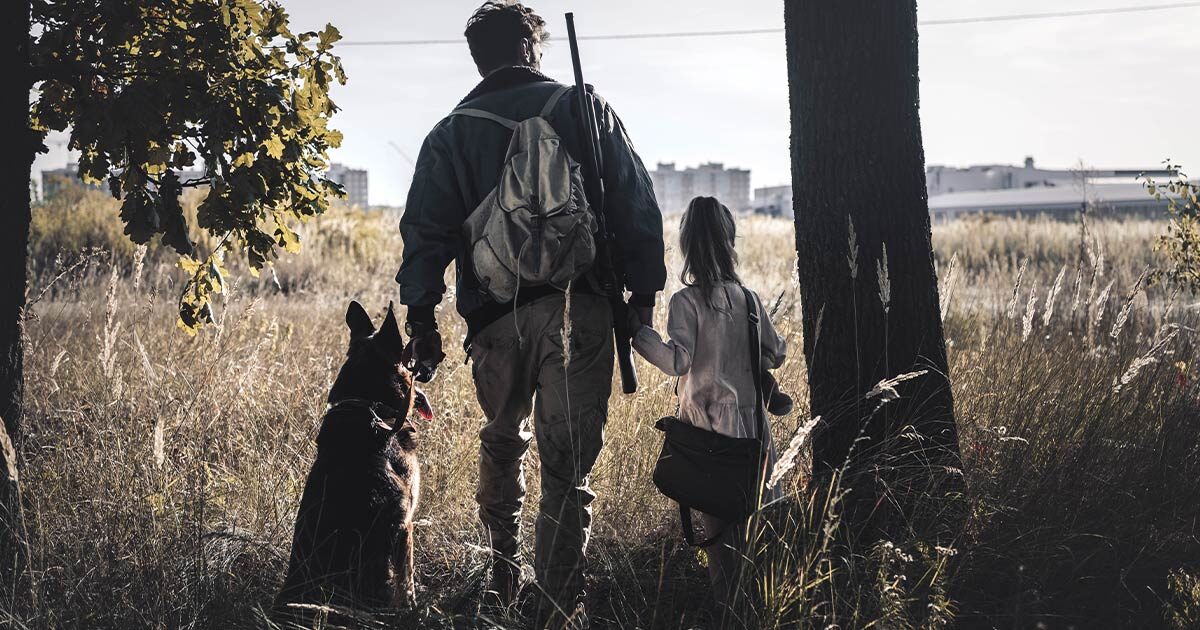
Your finished bug-out route plan is a physical binder or weatherproof document set that lives in your bug-out bag or vehicle. It contains:
A territory overview map with all starting points, the destination, all three routes marked in different colors, and all points of interest symbolized clearly with a legend.
Individual route documents — one per route — each containing a route overview map, a leg-by-leg written plan with photos at each waypoint, estimated times at normal and reduced speed, and a section of notes covering known hazards, seasonal conditions, and what to do if that route becomes compromised mid-run.
A contact and rally sheet listing every rally point by name and precise description, with the designated frequency and check-in schedule for radio communication at each one.
A supplies cross-reference noting what cache locations exist along each route and what’s stored there.
Make at least three copies. One stays in your primary bug-out bag. One goes in the vehicle. One goes somewhere else — with a trusted family member, at your workplace, at your bug-out location itself. A plan that burns with your house or gets left behind in a 60-second departure doesn’t help you.
Hand that binder to someone who has never seen it and ask them to drive your secondary route from your workplace to your bug-out location.
Watch what they struggle with. Fix those parts.
Then do it again at night.
When someone who has never been briefed on your plan can execute it cleanly in the dark, the plan is done. Until then, it’s a draft.