
Food prices haven’t slowed down, and they’re not going to. The average American household now spends close to $520–$540 a month on groceries alone, and food eats up roughly 12.9% of total household spending — more than it did a decade ago. For a family of four on the USDA’s Moderate-Cost Plan, that’s pushing $1,430 a month just to keep the kitchen stocked.
That math makes a lot of people assume prepping is a luxury. It isn’t. What happens during predictable disasters shows just how fast a grocery store shelf empties when a hurricane, ice storm, or regional power outage hits — usually within 24 to 72 hours. And that’s before you factor in the bigger picture: the federal government’s actual financial position is far worse than the headline $39 trillion number suggests. Once you add unfunded Social Security and Medicare obligations, independent budget analysts put total federal liabilities somewhere between $120 trillion and $175 trillion. That’s not a hot take — it’s the Treasury’s own actuarial math.
None of that means panic. It means plan. And the good news most people never hear is this: done right, building an emergency food supply doesn’t cost you more money — it saves you money. This guide walks through exactly how, with real numbers, a sample budget, and the storage math you need to make a stockpile that actually works when you need it.
Why Your Emergency Food Plan Needs to Start Now, Not Later
Three things are true at the same time right now, and together they make food storage a higher priority than it was even five years ago:
Grocery prices aren’t reverting. Beef, coffee, cocoa, and several other staples have seen well above-average price increases in 2026, partly driven by tariffs on imported goods. Waiting for prices to “come back down” before you start stockpiling is a losing strategy — you’re paying tomorrow’s higher price for the privilege of having less time to prepare.
Supply chains are thinner than people assume. Most grocery stores carry roughly 72 hours of on-shelf inventory at any given time. There’s no deep warehouse out back. A regional disruption — a trucking strike, a fuel shortage, a bad winter storm — empties shelves fast, and restocking isn’t instant.
Most households have zero buffer. The average American household spends $6,545 a month and saves very little of it. If a job loss, illness, or supply shock hits, there’s no slack in the system. A stocked pantry is one of the cheapest insurance policies you can buy, because unlike most insurance, you actually get to use it.
Six Proven Tips That Will Help You Save Money & Guarantee You Have Food When the SHTF
These are the core strategies. We’ve expanded each one below with real numbers, because “buy in bulk” without a price reference isn’t useful — and we added six more tips and a sample budget further down for people who want to go deeper.
1. Buy a Food Dehydrator
A quality food dehydrator like the Excalibur Dehydrator is one of the highest-return tools in a prepper’s kitchen. Mid-range dehydrators run $80–$250, and a single season of dehydrating garden surplus or sale-priced produce typically pays that back within a year.
The trick is timing: buy fruits, herbs, and vegetables when they’re in season and on sale, then dehydrate them for year-round storage. Properly dried and stored produce holds for 6 months to 1 year in an airtight container, longer in the freezer or with an oxygen absorber. If you hunt or keep a garden, this is even more valuable — homemade jerky and dried meat store without refrigeration and cost a fraction of store-bought versions.
2. Learn How to Can Your Own Food
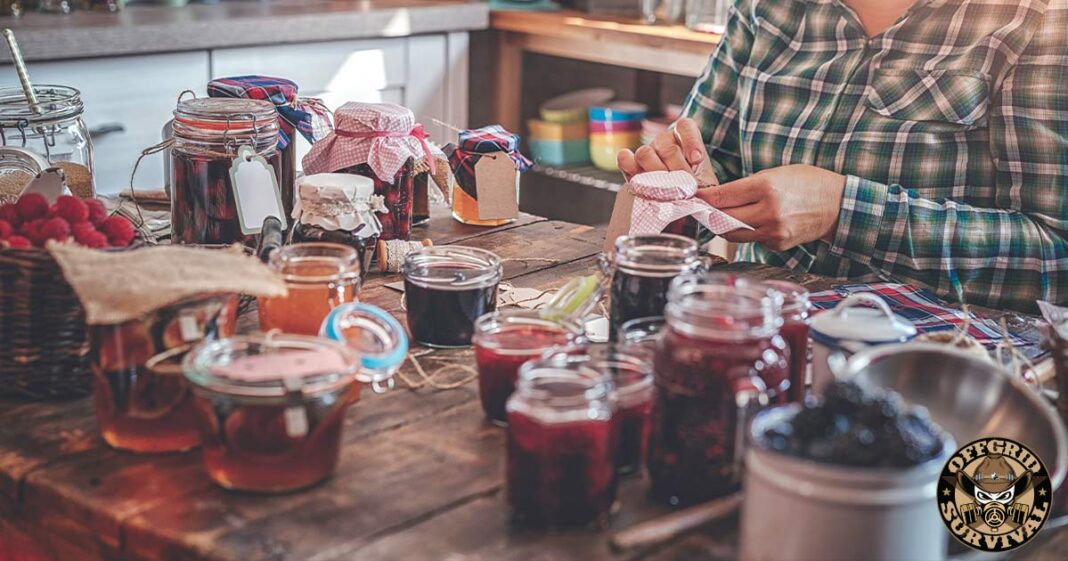
Canning follows the same money logic as dehydrating: buy low, preserve high. A basic canning setup (water bath canner, jars, lids, jar lifter) runs $60–$120 to get started, and properly canned food stores for 1–5 years depending on contents and storage conditions.
Check out our full walkthrough on Canning with the Boiling Water Bath Method for a step-by-step on safe canning technique — this matters, because improperly canned low-acid foods carry a real botulism risk. Pressure canning is required for meats, vegetables, and other low-acid foods; water bath canning is fine for high-acid foods like fruit, jam, and pickles.
3. Establish a Preparedness Budget
Before you buy anything, write down a real number. A written budget does three things: it tells you how much you can safely spend without hurting your monthly cash flow, it shows you where you’re overspending elsewhere, and it gives you a target instead of an open-ended guilt trip every time you walk past the canned goods aisle.
A reasonable starting point for most households is 5–10% of your existing grocery budget redirected toward storage food each month, not an additional expense on top of it. For more on this, see our top tips for prepping on a budget and our reader-sourced list on being prepared without breaking the bank.
4. Buy Your Food in Bulk — the Right Way
Bulk bins at your local grocery store often beat big-box “bulk” retailers like Costco or Sam’s Club on a per-pound basis for dry goods like rice, beans, oats, and flour. Watch for sales and stock up when prices dip.
Don’t buy directly from the bins if you can avoid it. Most bulk bins are restocked from 5–10 lb bags, and many stores will sell you those bags directly at a steeper discount than scooping it out yourself. Ask. Many stores also offer case discounts on canned goods — if you’re going to buy 12 cans of something you use regularly, buying the case is almost always cheaper per unit than buying them individually, even off the shelf.
5. Rotation Is the Key to Saving Money
A stockpile you forget about is money rotting on a shelf. The “buy it and forget it” approach is the single most common mistake preppers make, and it’s also the most expensive one — expired food is a 100% loss.
The fix: rotate your stock into your normal diet. Buy foods you already eat, store them, and use the oldest stock first (FIFO — first in, first out). This guarantees fresh food on hand at all times and means you’re never throwing away money. For a system to manage this, read our guide on inspecting and rotating your emergency supplies.
6. Learn to Cook & Bake From Scratch
This might be the highest-leverage tip on the list. Research on household food spending consistently shows that cooking from scratch and meal planning cuts food costs by 15–20%, sometimes much more, compared to relying on pre-packaged and convenience foods.
From a survival standpoint, this skill matters even more: when the SHTF, the convenience aisle is the first thing to disappear. Learning how to cook healthy homemade meals from low-cost, shelf-stable staples — rice, beans, flour, oats — does double duty: it cuts your everyday grocery bill now, and it makes sure you can actually feed your family during a long-term emergency, not just open cans until they run out.
Six More Ways to Stretch Your Prepping Dollar
The original six tips cover the fundamentals. These cover the gaps — the stuff most prepping guides skip.
Shop the international aisle for spices and staples. Bouillon, rice, dried chiles, and spices are frequently 30–50% cheaper in the international foods aisle than the same product (sometimes the same brand) on the “regular” spice shelf. This is one of the most reliable, repeatable savings in any grocery store.

Use dollar stores strategically. Stores like Dollar Tree have expanded their shelf-stable food selection significantly. They won’t replace bulk staples like rice and beans, but for canned goods, spices, and pantry basics, you can build meaningful stock on $20–$40 a week.
Vacuum seal everything that isn’t already sealed. A vacuum sealer ($50–$150) dramatically extends shelf life on dried beans, flour, pasta, and rice by keeping out moisture and oxygen — both of which are what actually spoil dry goods, not time itself. Double-seal flour specifically; the fine powder tends to interfere with the first seal.
Track expiration dates visibly. Write the date in large marker on every can and container, and organize stock so the oldest items are easiest to reach (front of shelf, lowest-numbered bin, whatever system works for you). This single habit eliminates the single biggest source of wasted prepping money: forgotten, expired stock.
Don’t stockpile snack food. Chips, crackers, and most packaged snacks have a real shelf life of about 6 months before the fats go rancid. Money spent here is money spent on food that won’t be usable when you actually need it. Put that budget into shelf-stable staples instead.
Buy your medication a week early, every refill. Many insurance plans allow early refills. Banking that extra week, refill after refill, builds a meaningful medication buffer over a year without costing you anything extra out of pocket — this is one of the few preps that’s genuinely free.
Shelf Life at a Glance: What Actually Lasts
Not all “long-term food storage” is equal. Here’s a realistic reference for how long common staples actually last under proper storage conditions (cool, dry, sealed):
| Food | Shelf Life (properly stored) |
|---|---|
| White rice | 25–30 years (sealed, oxygen-absorbed) |
| Dried beans | 10+ years (sealed) |
| Rolled oats | 10–20 years (sealed) |
| Honey | Indefinite |
| Salt | Indefinite |
| Home-canned vegetables | 1–3 years |
| Home-canned meat (pressure canned) | 2–5 years |
| Dehydrated fruit | 6 months–1 year (longer frozen) |
| Freeze-dried meals (commercial) | 25–30 years (sealed) |
| All-purpose flour | 1–2 years (vacuum sealed), 6–8 months (bag) |
| Pasta | 1–2 years |
The pattern is clear: dry staples sealed away from oxygen and moisture last decades, while anything with natural moisture or fat content has a real clock on it. Build your stockpile’s foundation on the left side of that range.
Sample 3-Month Starter Budget
If you’re starting from zero, here’s a realistic way to build a basic stockpile without blowing up your monthly budget. This assumes redirecting $40–$60 a month of your existing grocery spend, not adding new money:
- Month 1 ($50): 25 lbs rice, 10 lbs dried beans, 5 lbs salt, basic vacuum sealer
- Month 2 ($50): Canning starter kit, case of canned vegetables on sale, cooking oil (long shelf life options like coconut or olive oil)
- Month 3 ($50): Oats, honey, powdered milk, first aid/medication buffer (use the early-refill trick above)
By the end of three months, for roughly $150 total, you have the core of a real food reserve — and you haven’t added a dime to your normal monthly spending, because it came out of money you were already going to spend on food.
Frequently Asked Questions
How much emergency food should I actually have on hand? Most preparedness organizations recommend a minimum of a 2-week supply per person as a baseline, with 3 months as a solid intermediate goal and a full year as the long-term target for serious preppers. Start with 2 weeks and build from there — don’t let the size of the long-term goal stop you from starting this week.
Is bulk freeze-dried food worth the cost compared to home storage? Commercial freeze-dried meals carry a 25–30 year shelf life and require zero skill to prepare, but they cost significantly more per calorie than home-stored rice, beans, and canned goods. They’re worth it as a bug-out or no-cook backup layer, not as your entire food storage strategy.
Do I need a generator to store food safely? No — most of what’s covered here (rice, beans, canned goods, dehydrated food) is shelf-stable at room temperature and needs no refrigeration at all. That’s the point. A stockpile built around shelf-stable staples works through a power outage instead of being ruined by one.
What’s the single biggest mistake new preppers make with food storage? Buying it and forgetting it. Expired, unrotated stock is the most common way prepping money gets wasted. Build rotation into your normal grocery routine from day one.
Pick One and Start This Week
Twelve tips on a page is overwhelming. Twelve tips in your kitchen, one at a time, is just how prepping actually happens. Grab a marker and date your cans tonight, or check what’s on sale in the bulk bins this weekend — the stockpile builds itself once you stop waiting for the “right time” to start.
Most people who never prep aren’t broke. They’re just still waiting for that right time.






Another money saving idea is to purchase spices, dried herbs, and seasonings in the spanish or asian aisle in your local grocery store. We were looking at the Knorr Chicken Bouillon powder in an 8oz jar.It was $5. This was at Cash n Carry, a restaurant supply store. On the next aisle was all the mexican food supplies. There was a 4.4lb container of Knorr Chicken Bouillon powder on that shelf for $4.85. The only difference was the label was ALSO printed in Spanish. Also, today, we bought a 15oz container of ground black pepper for $2.78 and just down the aisle was a small container for $2.98. Again, the only difference is that the label is bilingual. Just some ideas on saving money.
I just started selling the shelf reliance (food rotation shelving ans freeze dried food shown) and it has made a huge difference. Was super excited to see it featured on your site!
would like more information on shelving.
I have recently learned how to bake homemade bread. I have gotten away from pre-packaged meals and gone to scratch cooking. I grew up 45 min from agrocery store so I was already used to my parents purchasing long term & them having a garden to can things. I have recently started my own 1st garden and am using this first year as trial and error to try & refresh waht I learned as a child. (I am 42) Our own SHTF happened twice-2009 hubby was laid off for two and a half months, and this past Nov 2012, our 11 year old son passed away and the last thing I wanted to do was go to a store. With my meager amount of preps (just started last fall) I did not have to leave my home & face people to feed our other two children complete, home cooked meals. It’s the everyday shtf that people don’t realise can happen any time unexpectedly.
i am so sorry for your loss. i have an 11 year old son and reading your post, i just cannot begin to imagine your pain. i just had to say that i am so sorry that you had to experience this. my prayers are with you and your family.
Thank you for your kindness.
GOOD INFO. THESE ARE ALL HOW OUR ANCESTORS DID IT SO WE CAN TOO. BETTER TO HAVE IT AND NOT NEED IT IS MY WAY. NOT TO MENTION THE MONEY YOU CAN SAVE AND ITS A HEALTHIER WAY TO EAT.
SIR..EXCUSE THE CAP’S, BUT I AM OVERWHELMED AND A 58 YR OLD MAN WITH A A LARGE GROW ADULTS AND GRANDKIDS, AND DAUGHTERS WITH MED’S ISSUES.. HOW DO I GET THE ADULTS TO UNDERSTAND THAT “ITS GOING TO HIT THE FAN!!!! HELP PLS..
A REALLY GOOD VIDEO TO PURCHASE IS : CHARLIE DANIEL’S BEHOLD A PALE HORSE. ITS KIND OF A PRIMER ABOUT EVERYTHING ALL OF US HAVE BEEN STUDYING. BROKEN DOWN IN EASY RELAX PRESENTATION SO THAT EVEN JOE SIX-PACK AND BERTHA BAG OF DOUGHNUTS SHOULD UNDERSTAND IT. SHOW IT TO FAMILY, FRIENDS AND NEIGHBORS. beholdapalehorse.tv
I do all of that except have a budget. I buy a little each week. I can buy on sale and with coupons as cheaply as in bulk. Besides, there is not bulk place anywhere near here that I know of. Yet, with all of this, I am not a prepper, just someone who prepares for food prices to rise.
I agree with Tricia, we’ve saved alot just by buying spanish brands. it’s kind of sickening, they should be the same price but anyway….
start small and build..shop sales. I’ve found incredible deals at dollar stores and the like.
only buy what you like to.eat, same as gardening. don’t grow something you’ll never eat, best use your money more wisely.
Sick and Tired…My heart aches for you…the loss of a child compounded with other difficulties. I am praying for you and your family…God’s peace and grace
Thank you for your kindness.
Rob you hit the nail on the head about people forgetting to use their food. I have gone into houses where they have canned foods that are years outdated and they tell me this is their food supply if something happens. While it may still be good it is a much smarter idea to rotate and use the existing stockpile. You can increase it as you, but make sure to use the older food stores to make sure you get the most out of your money.
Agree totally. I have bought and canned extras for quite some time. Recently had a TIA (mini stroke) while I was driving (could have seriously injured someone) so I have to depend on others to drive me. Haven’t been to a store in over two weeks, could go forever on what I have stored and what I can harvest.
Dollar stores like the “Dollar Tree” and others are a budget minded preppers best friend! You can get started prepping for $20 or less a week by shopping at this type of store!
I do most of my shopping at Dollar Tree. They have greatly expanded their food items and I do about $40 a week there. That lets me stock up on a large amount of food on the cheap.
What I found that works for me RE: Food storage. With a sharpie ink marker, write the expiration date in larger numbers on every can, bottle bag and container. Then lay all your food out in a room and get 5 larger plastic bins. Separate your food in 5 piles with the food that keeps the longest (exp dates) in bin #5, and newer dates in the lower number bins, in order so the food that expires first put in bin #1, this way you only need to look in #1 bin and you will never let any food spoil or go bad. Organization is key. The other great thing about large plastic bins with covers is, they stack and if I need to bug out, I can fit all 5 bins of food in my vehicle with in a few minutes… Storing them all loose on a shelves, is crazy, and if you have to leave you are screwed. I also have been doing a lot of canning..write the dates of canning on the lid. I also have a 5 gal bucket with a pottie loo seat lid and cover, and it’s filled with toilet paper in a large plastic bag, and I collect and save smaller plastic grocery bags that act as liners when I need to go..double bag if necessary.. I also spray painted the bucket, camo colors, in case I needed to place it in the woods without it being discovered. Think ahead, survive and thrive…Good Luck All!!
Another thing you might want to think about is medication. Most insurance companies will let you get your meds one week early. By the end of the year ….if you save this week of meds…you should have a small stockpile of meds in case of an emergency.
Food Prepping is costly I have put up alot of rice & dried beans, vac packed and stored in food grade buckets with seals. I also grow a garden and can everything I can. I have vac packed pasta, spices, etc. Also have over the last year purchased alot of canned dehydrated foods in which case I found it the cheapest at Walmart. I raise my own meat chickens and pork, have laying hens and hope to add a few head of cattle next year. It’s sad that alot of people just don’t get it but when you try to explain it to them they just say they’ll come to your house since your prepping in which case I explain I’m prepping for my family not them. I try to explain when things get bad grocery stores will be the first to be looted and emptied.
A few things that have been learned the hard way:
Dried beans are a good staple to acquire. BUT, the packaging they come in doesn’t make it to the level of being poor. Vacuum and seal, i.e. Food Saver, to keep the humidity away from the beans.
Save “PETE” bottles. Look at the recycle triangle on the bottom of bottles. If it has “PETE” near the triangle, keep the bottle. PETE stands for Polyethylene terephthalate. It does not let oxygen permeate the bottle. When you open a vacuumed bag of beans, pour the unused beans into a PETE bottle. They will last longer than just hanging around in a plastic bag.
Sale items at Safeway, and most other grocery stores, will beat the prices at Costco, Sam’s, etc.
Don’t store flour in the paper bags they come in. Ambient moisture WILL permeate the paper. Store in vacuum seal bags. A two pound bag of flour fits nicely into a one gallon vacuum seal bag. AND, double seal the bag! There will generally be enough flour sucked up when vacuuming to make the first sealing leak a little. Seal a second time towards the opening.
Don’t waste time storing junk food, as in “snacks”. The shelf life of snacks is maybe six months. After that they are only fit for the compost pile.
Like “WhoWuddaThunkIt” says, mark the sealed bags with month/year at least.
The Food Saver bags are fairly expensive, but I make up “pre-made meal” bags. They have all the dry ingredients in them and are generally big enough to hold the liquids needed to make a meal. Saves having wash another item.
Vacuum seal some cash. Won’t help against inflation but will keep paper money dry.
Vacuum seal batteries. Not all your batteries in one bag but whatever quantity required. Flashlight needs three AAA’s, vacuum seal three AAA’s in one bag.
Learn how to re-size the vacuum bags so you don’t use a gallon bag for a small item.
Vacuum seal bags make a good way to pack a BOB. Keeps things organized. And dry.