I’ve done a lot of desert hiking over the years, and I once watched the temperature drop 60 degrees in about four hours. Clear sky at noon, snow flurries by sundown. Nobody warned me. Nobody could have — that’s just what weather does in open country, and it’s exactly why “check the forecast and pack a jacket” isn’t actually a severe weather plan.
Most hikers get hurt by weather not because a storm caught them off guard, but because they saw it coming and didn’t take it seriously until it was already on top of them. The sky doesn’t usually go from blue to deadly in one move. It gives you signs first — you just have to know what you’re looking at.
This is where reading the weather becomes a survival skill, not a hobby.
Why Weather Kills More Hikers Than Almost Anything Else on the Trail
Wildlife attacks make headlines. Falls make headlines. But lightning, hypothermia, flash floods, and heat stroke quietly account for a huge share of backcountry deaths and rescues every single year, and they barely get talked about because there’s no dramatic photo to go with them. A bear encounter is rare and over in seconds. A storm system can chase you for hours, and it doesn’t care how experienced you are.
The National Weather Service has tracked lightning fatalities for decades, and the pattern is consistent: most victims are doing something outdoors — fishing, golfing, working, or hiking — when they’re struck, not huddled inside during a warning. Flash floods move with similarly little mercy. A slot canyon can fill with a wall of water from a storm that’s dropping rain twenty miles upstream, under a sky that’s still blue directly above you.
That’s the core problem with severe weather in the backcountry: by the time it’s obviously dangerous, your options have already shrunk.
Read the Sky Before You Read Your Phone
Cell service dies the second you drop into a canyon or climb behind a ridge, so the forecast you checked at the trailhead is the last update you’re getting. After that, you’re reading the sky with your own eyes, and most hikers never bothered to learn how.
Building cumulus clouds are your early warning system. Puffy white clouds that stay flat and scattered through the morning are normal fair-weather cumulus — no concern. But watch what happens by early afternoon. If those clouds start stacking vertically, building tall and dark at the base, you’re watching a thunderstorm assemble itself in real time. In mountain country, this isn’t subtle once you know to look for it; a clear morning can build into towering cumulonimbus by 1 or 2 PM with startling speed.
Wind shifts mean something. A sudden gust of cool air hitting you from a direction the wind wasn’t blowing before is often outflow from a storm cell, sometimes one you can’t even see yet over a ridge. Treat a cold gust on a hot day as a starting gun, not a relief.
The smell of rain on dry ground — petrichor — can reach you well before the clouds do, especially in desert terrain where storms announce themselves with wind and dust before a single drop falls.
Distant thunder counts, even if you can’t see lightning. Sound travels roughly one mile every five seconds. Count the gap between flash and rumble, divide by five, and you’ve got your distance in miles. If you can’t see the flash but you hear the rumble, the storm is still close enough to matter — sound carries a lot further than visibility does in mountain terrain.
The 30-30 Rule Isn’t Optional, It’s Math
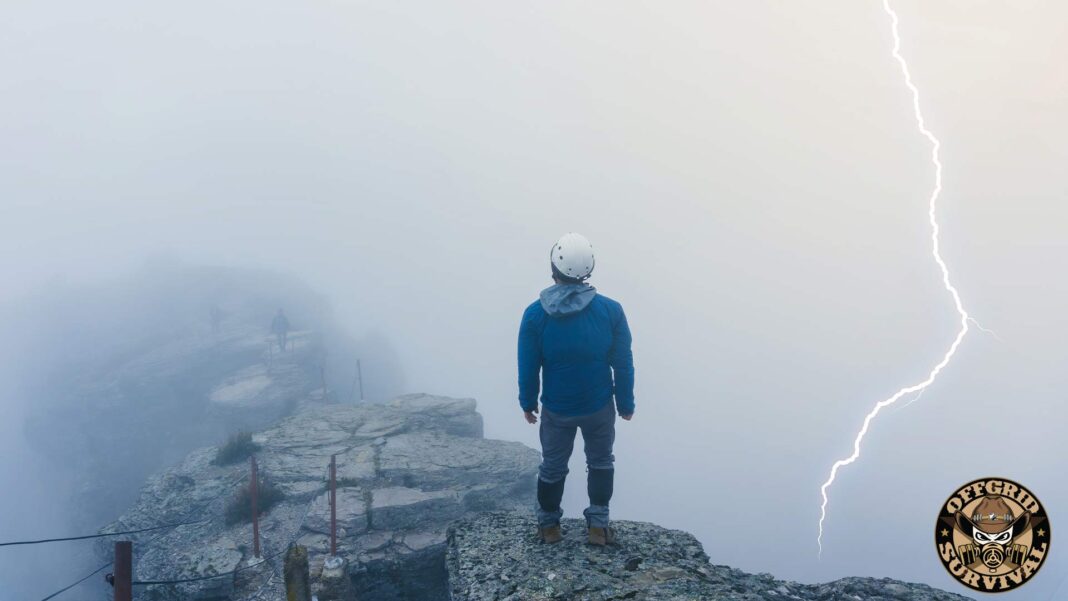
Search and rescue teams and the National Weather Service teach a simple rule for lightning: if the time between the flash and the thunder is 30 seconds or less, the storm is within about six miles, and that’s close enough to kill you. Get to shelter immediately, and don’t come back out until 30 minutes after the last thunder you hear.
This rule gets ignored constantly because people want to finish the summit, finish the loop, finish the photo. Lightning doesn’t negotiate. A bolt can strike from a storm that’s still ten or more miles away under what looks like clear sky directly overhead — meteorologists call these “bolts from the blue,” and they’re not rare enough to bet your life on.
If you’re caught above treeline when a storm builds, get below it immediately. Ridgelines, summits, and isolated tall trees are the worst places to be. Spread your group out by at least 15 feet so a single strike can’t take out everyone at once, get into a crouch on your pack or a foam pad to minimize ground contact, and stay off wet rock faces, under rock overhangs, and away from anything metal — trekking poles included.
Flash Floods Don’t Need Rain Where You’re Standing
This is the one that surprises people. A flash flood can hit a canyon, wash, or slot under a perfectly clear sky, because the storm dumping water happened in higher terrain miles away and the runoff is now funneling straight at you. Desert hikers especially underestimate this — dry washes look stable and solid right up until they aren’t.
Signs you’re in a flash flood zone: steep canyon walls, a narrow channel, debris lines on the rock well above the current water level, and a forecast anywhere upstream that mentions thunderstorms. If you hear a sound like a freight train or rushing water that wasn’t there a minute ago, or you see the water in a stream go from clear to muddy, don’t wait to confirm what’s happening. Move to high ground immediately, perpendicular to the flow, not back the way you came down the canyon.
Never camp in a wash or dry riverbed, even if it hasn’t rained in weeks and the sky is clear at your camp. The storm that kills you doesn’t have to be your storm.
Heat Doesn’t Look Like an Emergency Until It Is
Heat-related illness builds slowly and then collapses fast, which is part of what makes it dangerous — there’s no single dramatic moment where you realize you’re in trouble. Watch for heavy sweating, weakness, nausea, and headache as early warning signs of heat exhaustion. If sweating stops, skin gets hot and dry, confusion sets in, or the person stops making sense, that’s heat stroke, and it’s a medical emergency that needs immediate cooling and rescue, not a “let’s push on to the trailhead” decision.
Hydration matters, but so does electrolyte replacement — drinking gallons of plain water while sweating out salt can actually make things worse. Hike during cooler hours when you have the option, and don’t assume a high-elevation trail keeps you safe from heat; thin air and intense UV at altitude can cook you just as fast as a desert floor, just by a different mechanism.
Cold Doesn’t Need Snow to Kill You
Most people picture hypothermia as a blizzard problem. It isn’t. The most dangerous hypothermia conditions are wet and 30-50°F — cold enough to pull heat from your body fast, warm enough that hikers don’t take the threat seriously and skip the rain gear. Add wind on top of wet clothing and your body can lose heat far faster than the air temperature alone would suggest.
Know the signs of hypothermia: uncontrollable shivering at first, then — and this is the part that kills people — the shivering can stop as the body’s defenses start shutting down, followed by confusion, slurred speech, fumbling hands, and poor decision-making. That last one is the cruelest part of hypothermia: it impairs the exact judgment you need to recognize you’re hypothermic and do something about it. If someone on your trip starts making strange decisions or seems “off” in cold, wet conditions, treat it as a medical situation immediately, not a mood.
Know What Your Specific Terrain Throws at You
Generic weather advice only gets you so far, because the threat profile changes completely depending on where you’re actually hiking. A storm system that’s a minor inconvenience in the Smokies can be lethal in the open alpine zones of the Rockies. Treat the terrain type as part of your forecast, not just the temperature.

Desert and canyon country (Southwest US): Flash floods are the dominant threat, followed closely by extreme heat. Monsoon season — roughly July through September in the Southwest — turns slot canyons into death traps with almost no warning at ground level. Afternoon thunderstorms build daily during this window with mechanical regularity; if you’re hiking canyon terrain in summer, plan to be out of narrow channels by early afternoon, full stop.
Alpine and high mountain terrain: Lightning exposure is the big one, since you’re often above treeline with nowhere to hide. Mountains also build their own weather — a clear valley floor doesn’t tell you anything about what’s happening at 11,000 feet. Afternoon thunderstorm buildup is common enough in mountain ranges through summer that experienced climbers plan entire summit attempts around being off exposed ridgelines by noon or 1 PM, well before storms typically mature.
Eastern forests and the Appalachians: Dense tree cover means less lightning exposure but worse visibility for spotting storms building, plus a higher risk of falling limbs and trees in high wind. Tornado-spawning supercells aren’t limited to the open plains — they reach into wooded terrain too, and a forest gives you almost no warning compared to open country where you can watch a wall cloud organize from miles away.
Coastal trails: Watch for rapid wind shifts and fog banks that can roll in and erase visibility in minutes, along with king tides and storm surge if your route runs anywhere near tidal zones. A trail that’s dry at low tide can be underwater faster than most hikers expect.
Northern and high-elevation routes, even in summer: Don’t assume warm-weather gear covers you. Snow above treeline is possible essentially year-round at high elevation, and a summer storm that drops temperatures 20-30 degrees combined with wind and wet clothing is a textbook hypothermia setup, regardless of what the calendar says.
The point isn’t to memorize all of this. It’s to actually research the specific hazards of your specific route before you go, instead of assuming “severe weather” means the same thing everywhere. It doesn’t.
When the Group Doesn’t Agree, the Mountain Doesn’t Care Who’s Right
Here’s a problem nobody puts in the gear list: severe weather decisions usually get made by groups, and groups are bad at making fast, conservative calls under pressure. Someone wants to push for the summit. Someone else is nervous but doesn’t want to be the one who “ruins the trip.” This dynamic has ended hikes badly more times than any single piece of missing gear.
Decide your weather turnaround triggers before the trip, while everyone’s calm and nobody’s invested in a specific outcome. “We turn around if we hear thunder,” or “we’re off the ridge by 1 PM no matter what,” agreed on at the trailhead, is a plan. The same idea proposed for the first time while clouds are building overhead is just an argument waiting to happen, and arguments cost time you don’t have.
Give one person actual authority to call it — not as an insult to the rest of the group, but because committees are slow and storms aren’t. If that person says turn around, the group turns around, no debate held at 11,500 feet with a wall of cumulonimbus closing in. Save the debate for the trailhead, after, over a beer.
Packing the Right Gear Isn’t Optional Weight
Prevention beats reaction every time, and prevention starts at the trailhead, not when the clouds build. Once you know what kind of weather you’re likely to face, your gear list should answer it directly.
Rain protection. At minimum, carry an emergency rain poncho or a real rain shell — not a “probably fine” attitude. A tarp shelter is one of the best lightweight options for backpackers who want real protection from rain and wind without tent weight; a quality silnylon or Dyneema tarp can be deployed in under a minute and weighs a fraction of what a comparable tent does.
Layers for temperature swings. A 60-degree swing isn’t an exaggeration, it’s a Tuesday in a lot of terrain. Pack for the coldest and wettest version of your trip, not the forecast’s best-case scenario.
A way to monitor changing conditions. A small NOAA weather radio is worth the few extra ounces on any multi-day trip, since cell signal is gone the moment you drop into most canyons or valleys.
Navigation that doesn’t depend on visibility. A map and compass you know how to use matter more in a whiteout or sudden fog than any app, because your phone’s GPS doesn’t care that you can’t see ten feet in front of you — but you do.
A real first aid kit, sized for the trip length and the number of people with you, with supplies for both heat and cold injuries.
None of this is exotic gear. It’s the stuff that turns a survivable weather event into a non-event, and the stuff that’s missing from most day-hiker’s packs precisely because the day started out looking fine.
Plan the Trip Before the Trip Plans You
Good pre-trip planning is honestly half the battle in severe weather survival, and it happens entirely before you put boots on dirt. Check forecasts from a real source — NOAA and the National Weather Service give you actual meteorological data, not just an icon — and look several days out, not just the morning of. For longer trips, study historical weather patterns along your specific route. Are you crossing terrain known for flash floods? Afternoon thunderstorm cycles? Sudden high-wind events? That information exists, and it’s usually one search away.
Tell someone your route and your expected return time, and stick to it. File it the way you’d file a flight plan, because in a lot of ways, that’s exactly what it is.
Build in a turnaround time and actually honor it. The summit will still be there next month. You won’t necessarily get a second chance at the storm that catches you a half-mile from the top with no cover in any direction.
When the Sky Turns, Your Job Is to Get Small and Get Low
If a storm builds while you’re exposed and shelter is more than a few minutes away, your priority shifts from “finish the hike” to “survive the next thirty minutes.” Get off ridgelines and summits. Get away from isolated trees, water, and anything metal. If you’re caught in open terrain with absolutely nowhere to go, find the lowest point around — a depression, a low spot between rocks, anywhere that isn’t the highest object nearby — and wait it out in a crouch, feet together, off the ground if you can manage it.
This isn’t the moment to keep moving toward the trailhead “to get it over with faster.” Movement across exposed terrain during an active lightning storm is how people get struck mid-stride. Stop, get low, get small, and let the storm pass through. It almost always will, faster than it feels like in the moment.
The sky was clear when I started that desert hike. It was 60 degrees colder by the time I finished it. I didn’t get hurt, but only because I’d seen enough fronts roll through open country to recognize what the wind shift meant before the temperature did.
If you’re building out the rest of your kit for trips like this, our guides on planning a backcountry adventure and choosing a survival backpack are good next stops — and if you’re logging serious miles on trails like the PCT, AT, or CDT, severe weather isn’t a maybe. It’s a when.