
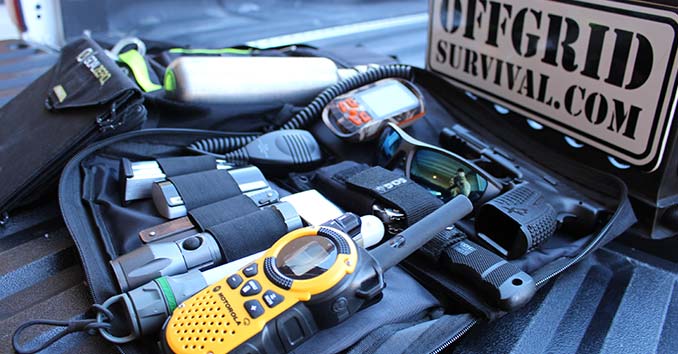
You’re hundreds of miles from home, enjoying a weekend of relaxation when all of a sudden disaster strikes; you’re stuck in a new area, with people you don’t know, and you have no way to get home; what do you do?
Well if you’re like most people you’ve probably never even considered the possibility. While I know many of the people who follow this site have a plan in place for while they are at home, not many people plan for disasters and crisis situations while away on vacation. If you travel a lot or are planning any future trips, you need to have a plan in place.
Planning for disasters that strike while you’re away from home
If disaster strikes while you’re away, your survival will likely depend on your pre-trip planning and the supplies you have with you when trouble strikes.
While some people might consider this overkill, reasoning that they are going on vacation to get away from their worries, a little bit of planning could save you a whole lot of misery should the worst happen while you’re away from home.
The first you need to do is research the area you’re going to.
- Research what types of disasters are most common in that area.
- Find out what areas of town have the most problems, the highest crime rates, and have potential hot spots for trouble during a crisis.
- Put together a list of emergency services, hospitals, embassies if you’re overseas, safe zones, and a well thought out list of evacuation routes.
Building your Travel Bug Out Bag
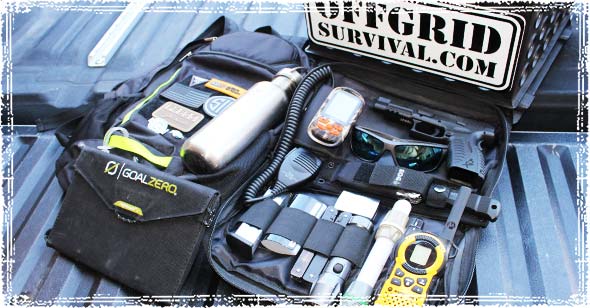
Just like with any type of emergency bag, what you carry is largely going to depend on your personal situation and your overall level of preparedness training. To determine the types of things you need, I advise first conducting a thorough threat assessment on your travel plans and the areas you plan on traveling through.
These types of threat assessments can give you a good idea of what you need to prepare for, and will give you clues to what you may need to bring in your bugout bags. Check out our article on conducting threat assessments. While the article is geared towards general threat planning, much of the information can be used to analyze the threats you may face during a travel related crisis.
Most of what you pack is going to depend on what you found out during your threat assessment, but in general, there are some things that you need to consider bringing.
Local Maps of the Area & GPS Devices: No matter where you are going, you want to have maps of the area and evacuation routes ready to go should something happen. A little bit of pre-trip planning goes a long way should the worst happen, and having these maps can put you ahead of the crowds that will be clogging up local evacuation routes.
- Have a local paper map of the areas you are traveling through.
- Save PDF maps or Google Maps to your phone and tablet devices.
- Carry a GPS; while these devices can fail during a large-scale disaster, they are good for finding quick backup routes when they’re working.
Communication Gear: Every good bug out bag/get home bag should have multiple communication devices and contact methods. The ability to communicate and gather localized threat information during a disaster is something you should never overlook.
- Have a Plan: Before you leave, put together a list of emergency contacts. Have a point person who can help coordinate rescue efforts should things go bad.
- 2 Meter Ham Radio: For localized disasters, where traditional methods of communication have failed, there is no better tool than a good 2 Meter Ham Radio. If you haven’t looked into the many benefits of Ham Radio, I advise seriously looking into it.
Personal Defense: This is a category where you are going to have to be careful; it’s also a category that you need to take seriously. While local travel laws may dictate exactly what you can and can’t carry, you need to carry something.
- Check out our article on traveling with firearms.
- Thoroughly research local self-defense laws and find out what you can legally carry.
- If traveling through areas where carrying a firearm presents a problem, check out our article on alternative weapons and improvised weapons.
Always Carry Cash & Know Where to Hide it: When Special Forces and government contractors deploy into dangerous areas, they often carry local currency with them as part of their emergency gear. The ability to bribe local officials, buy last minute supplies, or even just check into a hotel room makes paper currency an important addition to any bag.
Make sure you carry emergency cash in a couple of different locations, and if you’re traveling abroad make sure you have both American dollars and the local currencies in every area you plan on traveling through.
Other Emergency Items that I usually take when I travel:
- A good travel water filter like the Katadyn Pocket Water Microfilter
- N95 Dust Masks
- A Door Wedge
- These 7 Urban Survival Tools
- A Good First-Aid Kit
- A Small Solar Charger & Electronic Adapters
- My Normal Everyday EDC Gear

One of your best written articles I have ever read. I especially agree with learning how to hide cash on your person. Something as simple as a hollowed out chaptstick tube or a old small flashlight.
Good article. My work requires me to travel all the time. I’m in a different country almost every week that I made 2 EDC kits. 1 fore my home country and 1 that’s always in my carry on. then I have supplementary gear for my check-in.
Don’t forget the weather and the terrain. If it’s a cold country, an extra layer or heat pads. A sports cooling towel works as a scarf in cold weather or as a cooling device in a hot climate.
I know some people might think this is silly but I bought a nail drill. One of those little hand held drills that work like a rotary tool for nail care. I have used them successfully on wood and find it a nice portable option to shape wood on the go if you did need to. It has multiple attachments like a dremel tool and takes two AA batteries which are fairly common. I realize some people would just use their knife or a nail file but this makes that kind of work a lot quicker.
These are great “know how’s” especially when you’re an outdoor person. This can also be very beneficial in times when disaster strikes at your very door steps. Knowing how to prepare and what materials we need is actually pretty useful.
Communication gear, this is something that I don’t have yet, but, really, I don’t think I will get it.
Late to this thread, but I’m looking for some input. I’m going to be traveling a bit for business and am trying to put together an emergency kit. My scenario is a trip to LA when a major earthquake hits. The kit has to be small and light enough that I can take it in carry on as I want to have it with me in an airport. It will stay in the rental car while I am at a client site in case the disaster happens and I’m not able to access my hotel room. Traveling by air also means no knives or guns. Thoughts?