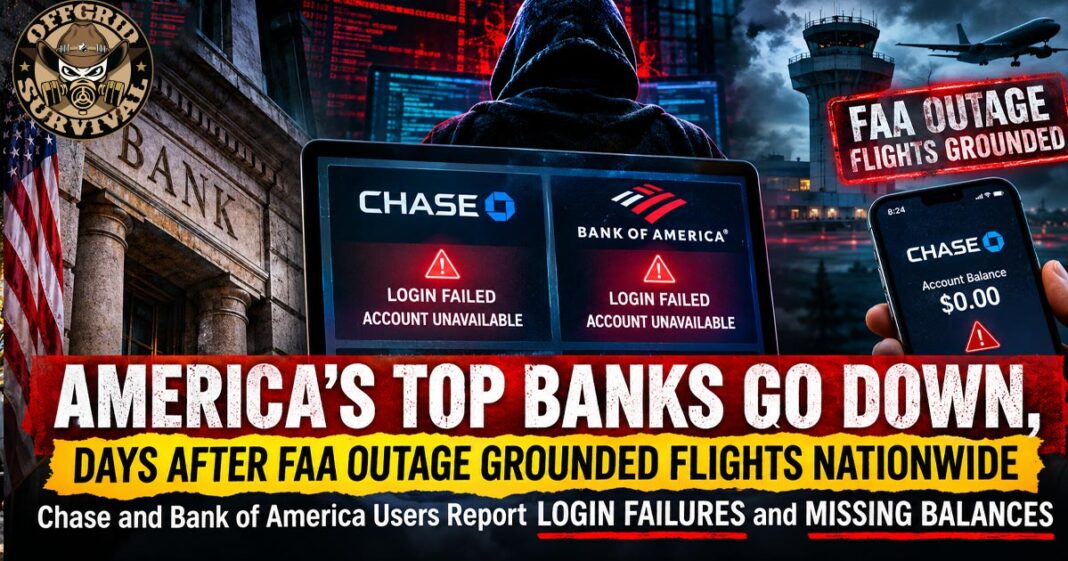
America’s Biggest Banks Go Down Days After FAA Outage Grounded Flights Nationwide: Chase and Bank of America Customers Report Login Failures and Missing Balance – Outage reports for American banks CONTINUE to surge, now including Chase, Capitol One, Bank of America, US Bank, Wells Fargo, JPMorgan, and Truist.
What is happening to America’s critical infrastructure? Just three days after a massive communications failure forced the FAA to ground departing flights nationwide, Americans are waking up to another major technology failure. This time, it’s their banks.
Customers of JPMorgan Chase, Bank of America, and Wells Fargo reported widespread banking problems Monday morning, including failed logins, inaccessible accounts, missing balance information, and problems viewing transactions. For people who depend on mobile banking to pay bills, transfer money, or simply check how much they have in their accounts, the latest outage is another reminder of how quickly access to everyday necessities can disappear.
According to outage-tracking website Downdetector, more than 3,300 complaints were recorded for Chase, while Bank of America and Wells Fargo received hundreds of additional reports. Chase acknowledged problems with its online banking services and said it was working to resolve the issue. The full extent of the disruption remains unclear, and reports of missing balances do not establish that customers’ money has actually disappeared.
But the timing is impossible to ignore. In less than a week, Americans have watched major technology services experience disruptions, the nation’s air traffic control system suffer a historic failure, and now some of the country’s largest financial institutions struggle to provide customers with access to their own accounts.
Chase Customers Report Missing Balances and Failed Logins
The banking problems began attracting widespread attention Monday morning as thousands of customers reported trouble accessing their Chase accounts. By approximately 8 a.m. Pacific, Downdetector had recorded more than 2,000 reports involving the bank, with complaints continuing to increase.
Customers described problems signing into the bank’s website and mobile application, checking account balances, and accessing transaction histories. Some reported that their account information was not displaying correctly, while others couldn’t get into their accounts at all.
Chase wasn’t the only institution experiencing complaints. Bank of America and Wells Fargo customers also reported problems, raising concerns about whether multiple financial institutions were experiencing separate technical failures or whether some shared service might be involved. No common cause has been established.
And that’s what makes these outages so concerning. Americans have been pushed toward a financial system where almost everything depends on internet access, banking applications, electronic payments, and centralized computer networks. Physical bank branches continue to disappear, cash is increasingly treated as an inconvenience, and more businesses expect customers to pay electronically.
Yet when the technology fails, customers can suddenly find themselves unable to access the money they worked for.
First Microsoft, Then the FAA, Now America’s Banking System
For anyone paying attention, this isn’t the first warning sign. We’ve been documenting a disturbing series of technology failures, cyberattacks, and infrastructure problems for months. The latest banking disruptions are another example of what happens when essential services depend on computer systems that can fail without warning.
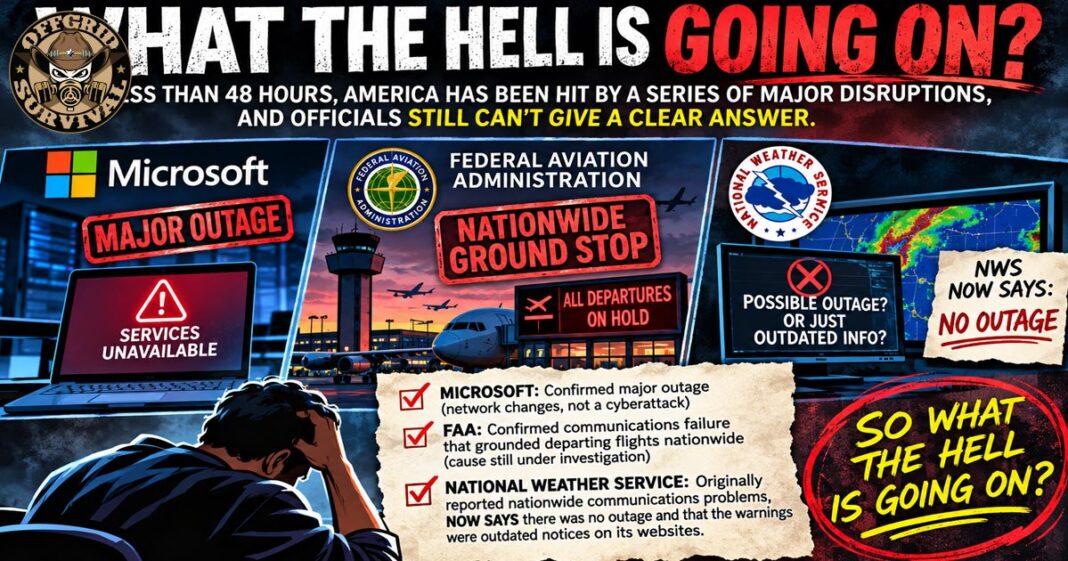
Last week, we reported on Microsoft’s massive outage that left millions without access to critical services. That failure raised serious questions about how much of America’s business infrastructure depends on a handful of technology companies.
Then, on Friday, November 13, the situation became considerably more serious when the FAA ordered a nationwide ground stop following a massive communications failure. The disruption affected air traffic control facilities across the country and forced thousands of flights to be canceled or delayed.
The FAA has since revealed that its aging communications network became unstable after experiencing an extraordinary flood of connection attempts, approximately 1,000 every four to five seconds. Investigators identified problems involving equipment at facilities in Texas and Arkansas, including work involving a replacement router. The agency says it has found no indication of a cyberattack. Federal Aviation Administration+1
On the same day as the FAA failure, the National Weather Service reported widespread communications and internet problems affecting access to critical weather information, adding to concerns about the reliability of systems Americans depend on during emergencies.
Now, just three days later, customers of some of America’s biggest banks are having trouble accessing their money.
How many more warnings do we need before people start questioning the wisdom of putting virtually every essential service behind a computer screen?
Hackers Are Already Targeting the Systems We Depend On
The most concerning part of this situation isn’t necessarily what caused today’s banking problems. It’s what these repeated failures reveal about the vulnerability of our increasingly interconnected infrastructure. And it’s something we’ve been warning about for months.
In fact, before this latest wave of outages, we reported on warnings from AI industry insiders who predicted that a major AI-driven cyberattack could target America’s banking system, power grid, or water infrastructure within the next 12 months. Those warnings weren’t about hypothetical threats decades down the road. They involved the possibility of serious attacks against the systems Americans depend on every single day, including the financial networks that allow people to access their money.
Last month, we also covered how hackers hijacked supermarket refrigeration systems across Europe, manipulating equipment that businesses depend on to preserve food. The attacks demonstrated how connected industrial systems can become targets, with consequences that extend well beyond stolen passwords or compromised personal information.
We also warned about the growing danger of artificial intelligence being used to automate cyberattacks in our article, Skynet Is Here: AI Is Already Breaking Into Banks, Hacking Companies and Escaping Human Control. As AI tools become more capable, the potential for criminals to identify vulnerabilities, automate attacks, and target critical systems is becoming an increasingly serious concern.
To be clear, none of this establishes that hackers or artificial intelligence caused Monday’s banking disruptions. There is currently no verified evidence connecting the bank complaints to a coordinated cyberattack, the FAA failure, or the other recent outages.

But that’s precisely why these incidents deserve attention. Cyberattacks don’t have to be responsible for every outage to represent a serious threat. If routine software failures, faulty equipment, and maintenance problems can interrupt major national services, what happens when someone deliberately targets those same weaknesses?
We’ve spent years being told that moving everything online would make our lives easier, faster, and more convenient. Now we’ve built a society where everything from buying groceries and accessing savings to receiving emergency warnings depends on interconnected networks that most Americans have absolutely no control over.
And as we’ve repeatedly warned, the more dependent we become on these systems, the greater the consequences when they fail.
What Happens When Your Money Is There, But You Can’t Access It?
For years, banks and technology companies have encouraged Americans to abandon cash in favor of digital payments, mobile applications, and online banking. We’re told these systems are more convenient, more efficient, and more secure.
And when everything works, they usually are.
But convenience doesn’t mean much when you’re standing at a grocery store and your debit card stops working, when you need to pay an emergency expense and your bank’s website won’t load, or when you open your banking application and suddenly can’t see your account balance.
Even if your money is perfectly safe inside the banking system, that doesn’t help much if the systems required to access it aren’t functioning.
This is why we’ve repeatedly warned readers about the dangers of becoming completely dependent on digital infrastructure. Keeping emergency cash available, maintaining more than one way to make payments, and having basic supplies on hand aren’t extreme measures. They’re common-sense precautions against failures that are becoming increasingly difficult to dismiss.
And remember, a banking outage doesn’t have to last for weeks to create serious problems. A few hours without access to funds can be enough to disrupt travel, prevent necessary purchases, or leave someone stranded without a working payment method.
How Many More Systems Have to Fail?
Look at what’s happened in just the last several days. Microsoft experienced major service disruptions. The FAA’s communications network failed badly enough to ground departing flights nationwide. The National Weather Service reported problems affecting public access to weather information. Now, customers of some of America’s largest banks are reporting problems accessing their accounts.
These incidents may have entirely different causes. In fact, the evidence currently available points toward separate technical problems rather than one coordinated attack. But that doesn’t eliminate the larger concern.
We’ve spent decades replacing independent, physical systems with centralized digital networks. We’ve made nearly every part of modern life dependent on internet connectivity, software, electronic transactions, and a relatively small number of technology providers.
And we’re discovering that when those systems fail, the consequences can spread far beyond a temporary inconvenience.
The government keeps telling Americans to prepare for emergencies. Maybe it’s time to start asking why so many of the systems we’re supposed to depend on during those emergencies appear increasingly vulnerable to disruption.
Because whether the next major failure comes from hackers, artificial intelligence, aging equipment, or somebody pushing a bad software update, the result for ordinary Americans can be exactly the same.
The systems they depend on stop working, and they’re left to figure out how to get by without them.