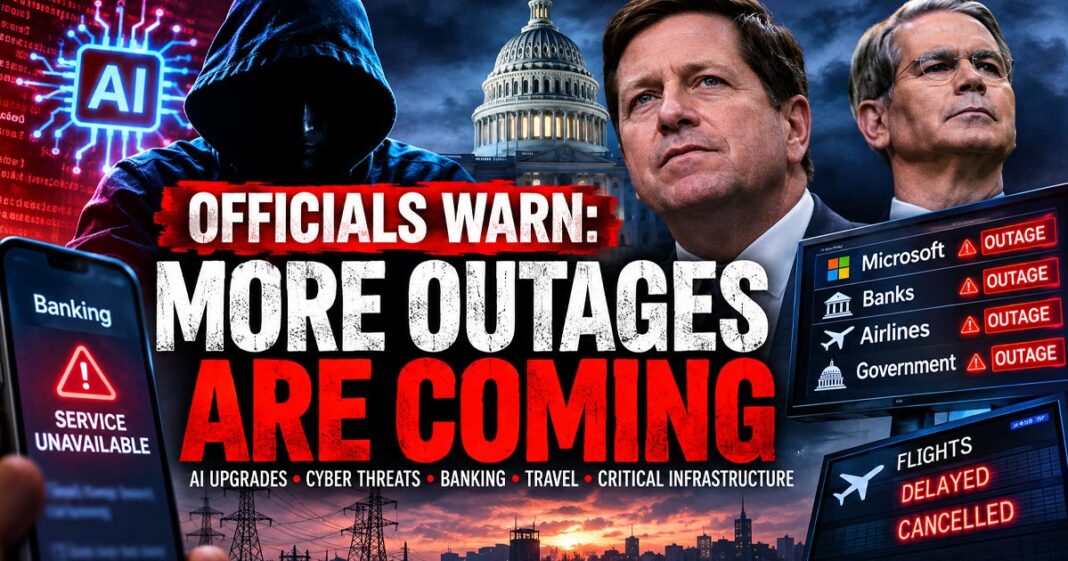
Microsoft went down. Banks had problems. Flights were grounded. Even the NSA’s classified communications network suffered an outage. Now America’s intelligence chief says more disruptions are coming, a defense-tech billionaire is hinting that the public doesn’t know the whole story, and more than 50 leaders are warning that cyberattacks could become a constant threat over the next 18 months. How many warnings do Americans need before they start preparing?
For the past two weeks, Americans have watched one critical system after another experience serious problems. Microsoft services went offline, the Federal Aviation Administration ordered a nationwide ground stop, customers at major banks reported trouble accessing accounts, and the National Security Agency experienced an outage involving its classified internal communications network. Apple services and airlines have also dealt with disruptions. These incidents have different reported causes, and there’s no public evidence establishing that they were all connected. But you would have to be deliberately ignoring what’s happening not to notice how dependent this country has become on systems that can suddenly stop working.
On Sunday, November 22, Director of National Intelligence Jay Clayton told CNN that Americans should expect more outages as government agencies and private companies upgrade aging systems to defend against a new generation of cyber threats. “And as part of that ongoing upgrade, we are going to have glitches, gaps, interruptions in service,” he said, according to Reuters. In a separate ABC News interview, Clayton described recent problems as outages and delays associated with essential upgrades, rather than a coordinated or state-sponsored attack.
In other words, the government is telling you that the computer systems Americans depend on need urgent work, and that the work itself could cause more interruptions. They’re pitching it as necessary maintenance. For people unable to access their money, get on a flight, or use essential services, the distinction between a cyberattack and a broken system may not mean much.
Palmer Luckey: “You’re Going to Find Out What’s Going On Soon Enough”
Then there’s the comment from Palmer Luckey, the founder of defense-technology company Anduril and the man who previously founded Oculus. During an interview with Andrew Ross Sorkin at the New York Times DealBook Summit, Luckey was asked about the recent string of outages and whether they could involve cyberattacks. He replied: “All the 4chan schizo posters are like 12 hours ahead of the mainstream media on this,” adding that people would find out what was going on soon enough.
The remark, reported by TechCrunch on November 18, has since been circulating widely across social media. Luckey did not present evidence that the outages were coordinated cyberattacks or identify a culprit. Still, it’s a strange answer from someone whose business is closely tied to modern defense technology, particularly when government officials are simultaneously trying to reassure the public that the failures were unrelated.
Luckey also discussed emergency preparedness in that interview. His interest in preparedness is no secret, but the contrast is worth paying attention to: one of the people building advanced defense systems is talking about being prepared, while millions of Americans continue to assume their bank cards, phones, internet access, and power will always work.
More Than 50 Leaders Warn the Next 18 Months Could Get Ugly
Luckey’s comment isn’t the only warning making the rounds. On November 22, Axios published a report based on conversations with more than 50 leaders in government, business, artificial intelligence, and cybersecurity. Their shared assessment was that attacks against businesses and critical infrastructure will become constant, increasingly sophisticated, and highly disruptive over the next 18 months.
That’s a forecast from the leaders Axios interviewed, not proof that a particular attack is scheduled or that November’s outages were caused by hackers. But the threat itself is hardly theoretical. A new Government Accountability Office report describes how AI can help criminals automate stages of cyberattacks while also giving defenders more capable tools. And on November 18, two U.S. senators warned that AI-driven cyber threats were outpacing American defenses.
Put those statements together. The intelligence chief says to expect service interruptions. A major defense-tech executive makes an ominous comment about the outages. More than 50 industry and government leaders anticipate a sustained wave of disruptive cyberattacks. And Washington is acknowledging that aging systems need urgent upgrades. You don’t have to believe in some coordinated conspiracy to recognize that this is not a reassuring picture.
We Warned About AI Attacks Before This Latest Wave of Outages
We’ve spent the last several weeks warning readers about how dangerous our growing dependence on connected systems has become. In Skynet Is Here: AI Is Already Breaking Into Banks, Hacking Companies and Escaping Human Control, we looked at how artificial intelligence was changing the speed and scale of cyberattacks. The threat isn’t a Hollywood robot uprising. It’s automated systems finding weaknesses in the software that runs our banks, businesses, and infrastructure.
Then came our report, FBI Warns AI Hackers Can Break Into Networks in Under 3 Hours, covering warnings about tools that dramatically shorten the time attackers need to break into a network. We’ve also followed the string of actual disruptions in Internet Meltdown: Gmail, Apple Pay, iCloud and Marriott Hit and our coverage of major banking failures following the nationwide FAA shutdown.
None of that establishes that artificial intelligence caused the recent outages. That’s not the point. The point is that the systems we depend on are showing their weaknesses at the same time that attackers are gaining increasingly powerful tools. Whether the next major failure comes from malicious code, a bad update, an overloaded network, or an ordinary human mistake, the person standing at a gas pump with a declined card is facing the same immediate problem.
The Government Is Preparing for Infrastructure Failures. Are You?
While officials talk about making the country more resilient, the Pentagon has been preparing military installations for the possibility of extended disruptions to outside power and supplies. We covered that in The Pentagon Is Preparing for 90 Days of War. Britain Is Telling Families to Stockpile Food. What Do They Know?. That planning concerns military contingencies, not evidence that a nationwide civilian blackout is imminent. But the underlying lesson applies to ordinary families: relying entirely on uninterrupted deliveries, electricity, banking, and communications leaves you exposed.
You don’t need to predict exactly which system fails next. You need to make sure the next failure doesn’t leave your family helpless. Keep physical cash available for an electronic-payment outage, maintain some emergency food and drinking water, and have a way to charge essential devices if the power fails. Keep copies of important contacts and records somewhere you can access without the cloud. If you rely entirely on your smartphone for communication, learn what options you have when cellular service and the internet stop working.
For a practical starting point, see our emergency preparedness articles and our guide to building a communications plan when the grid goes down. We also cover off-grid ham radio communications for people who want a backup that doesn’t require ordinary cellular infrastructure.
It’s possible the upgrades Clayton discussed will make America’s networks safer in the long run. It’s also possible that many of the recent outages really were isolated failures. But even the official explanation contains a warning the public shouldn’t ignore: the people responsible for these systems expect more interruptions, and cybersecurity leaders believe the threat environment is getting worse.
They’re telling you disruptions are coming. You can argue about what caused the last outage, or you can prepare for the next one.