Whenever you venture out into the wilderness… heck, whenever you venture out anywhere, it’s a wise idea to carry some type of survival kit.
If you find yourself in a sticky situation, a basic survival kit could be a life saver. What goes into your survival kit will depend on your location and the most likely disaster scenarios that you’ll face, but in general there are a couple of items that everyone should consider adding to their kit.
This is really the companion idea to building a large survival kit for your home or vehicle. A large kit is about sustaining yourself over days or weeks if real trouble hits. A small kit is about something different: covering the handful of things most likely to actually go wrong on an average day — a cut, a wrong turn, a sudden need to start a fire or signal for help — in something small enough that you’ll genuinely carry it every time, not just when you remember to.
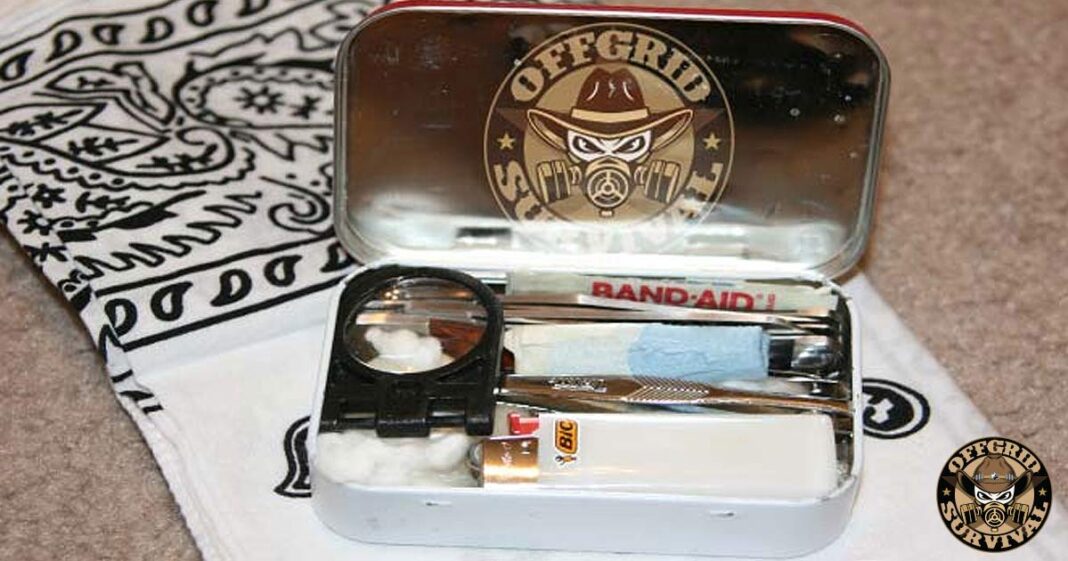
That last part matters more than people think. The best survival kit in the world does nothing for you sitting in a drawer at home. An Altoids tin, a small fanny pack, or even a water bottle with a few essentials tucked inside can all work as the container — the size isn’t really the point. The point is that it’s small enough, light enough, and unobtrusive enough that you actually have it on you when something happens.
Here are a couple ideas to get you started:
A Way to Make Fire
Matches, a small Bic lighter, or a fire steel are all small enough to fit in even the smallest kits. Also don’t forget some tinder or something that can take a spark.
Fire is the single highest-value item in a small kit relative to its size, because it solves several problems at once — warmth, water purification, signaling, and a real morale boost if things have gone sideways. A small Bic lighter is the easiest, fastest option in good conditions and costs almost nothing, which is exactly why it earns the top spot here rather than something flashier. A fire steel is worth including as backup precisely because it doesn’t depend on fuel running out or staying dry the way a lighter does — it’ll still throw a spark after a dunk in a creek that would kill a disposable lighter outright.
Don’t skip the tinder. A lighter or fire steel without something that actually catches a spark easily is far less useful than people assume. A small wad of cotton ball soaked in petroleum jelly, a few commercial tinder cubes, or even a bit of dryer lint sealed in a tiny zip bag all take up almost no space and dramatically improve your odds of getting a fire going on the first or second try, rather than burning through your matches on tinder that won’t catch.
A Small Pocket Knife
Besides an everyday-carry fixed blade, it’s worth tucking a smaller pocket knife inside your kit as well.
A second, smaller blade dedicated to the kit means you’ve always got a cutting tool even if your primary knife is lost, broken, or simply not on you that day — pants pockets get emptied, jackets get left in cars, and a knife living permanently inside your kit removes that single point of failure. It doesn’t need to be large or expensive. A simple folding blade that holds an edge and locks open securely covers the vast majority of what you’d actually use it for: cutting cordage, processing tinder, basic food prep, or first aid if it comes to that.
Cordage
A small spool of dental floss works well in a compact kit. It’s lightweight, strong enough to make traps or fish with, and useful for a lot more than most people expect from something meant for your teeth.
Floss earns its place here because of how much utility it packs into almost zero weight and space. Braided into a few strands, it makes surprisingly capable cordage for lashing gear together, rigging a small shelter, or setting a simple snare. Unspooled, it doubles as serviceable emergency fishing line for smaller fish. It’s worth being honest about one common claim, though: floss is a poor choice for actually suturing a wound closed. It’s thin enough to cut through skin and cause more irritation and tissue damage than it prevents, so save it for cordage, securing a splint, or holding a bandage in place rather than as a stand-in for real sutures. If wound closure is genuinely necessary and you don’t have proper supplies, holding the edges together with butterfly closures or tape and getting to real medical care is the safer call.
A short length of paracord, even a few feet, is worth adding alongside the floss if you have the room. It’s much stronger for anything load-bearing — securing a shelter, hauling gear, or anything where floss would simply snap.
Sharp Things
A couple of needles, some fishing hooks, and even a small scalpel blade are all things that fit nicely into a compact kit.
This category is really about precision tools that take up almost no volume but solve specific problems your knife and floss can’t. A needle paired with your cordage turns into a real repair kit — closing a torn pack strap, fixing a blown-out boot seam, or securing a bandage. Fishing hooks, paired with your floss as line, give you a genuine, low-effort way to procure food if you’re stuck somewhere with water nearby — set a line and let it work passively while you handle other tasks. A small scalpel blade is sharper and more precise than most pocket knives for fine work like cleaning a wound, removing a splinter, or other detailed first aid tasks where a bulkier blade is the wrong tool.
A Few More Worth Adding
The original short version of this list covers the essentials, but a few more items are worth squeezing in if your container has any room left:
A small signal mirror or a strip of aluminum foil. Both weigh almost nothing and can be seen from a genuinely long distance in good light, which makes them disproportionately valuable for something this compact.
A few feet of duct tape, wrapped around a pencil stub or a spare lighter rather than carried as a full roll. It handles gear repairs, blister prevention, and a dozen other small jobs that would otherwise need a dedicated tool.
A small whistle. It carries much farther than your voice for a fraction of the effort, and three short blasts is the universally recognized distress signal almost anywhere in the world.
A tiny LED flashlight or a couple of glow sticks. Even a few lumens makes a real difference if you’re caught out after dark, and modern micro-lights are small enough to add real capability without meaningfully adding bulk.
A folded square of heavy-duty aluminum foil doubles as a small cooking surface or a way to boil a small amount of water over a fire if you don’t have a metal container with you.
How a Small Kit Fits Into a Bigger Preparedness Plan
It’s worth being clear about what a small kit is actually for, because it’s easy to either over-rely on one or dismiss it as too minimal to matter. A small kit isn’t meant to replace a proper large survival kit at home or in your vehicle — it’s meant to cover the gap between “I’m at home with everything I own” and “something just happened and I have nothing on me.” Most emergencies people actually run into day to day are small and short — a cut while hiking, a wrong turn that costs an extra hour, a car breakdown on a back road — and a pocket-sized kit is sized correctly for exactly that range of problems.
The relationship between the two kits is really about layers. Your small kit lives on your body or in your immediate bag, so it’s there the instant something goes wrong, no matter where you are. Your large kit lives at a fixed point — home, vehicle, cabin — and is there to sustain you once you’ve either gotten back to it or bugged in. Neither one replaces the other, and treating your small kit as if it should somehow cover everything a large kit does is how people end up with bulky “everyday carry” setups they stop actually carrying. Keep the small kit small. That’s the entire point of it.
Maintaining and Rotating Your Kit
A kit you build once and never look at again slowly turns into a kit full of things that don’t work. Lighters run dry from slow fuel evaporation even if they’re never used. Adhesive on tape and bandages degrades over time, especially if the kit lives somewhere with real temperature swings, like a car. Floss and cordage are durable, but a kit that’s been sitting in a hot glovebox for two summers is worth a quick check before you trust it.
A simple twice-a-year check, tied to something easy to remember like daylight saving time changes, is enough to catch most of this. Flick your lighter to confirm it still sparks and has fuel. Check that any tape or adhesive bandages haven’t dried out or lost their stick. Make sure nothing’s rusted, and that anything sharp is still sharp. This takes a few minutes and meaningfully increases the odds that your kit actually works the one time you need it to, rather than failing at the worst possible moment because a five-year-old lighter ran dry sometime around year two.
Building Around Your Specific Risk
What goes into your kit should shift based on where you actually spend your time and what’s actually likely to go wrong there. Someone hiking in the desert Southwest has a very different priority list than someone whose small kit mostly lives in a glovebox for winter driving in a cold climate — sun protection and signaling matter more in one scenario, warmth and visibility matter more in the other. Build the core list first, then adjust around the specific risks of your actual environment rather than copying someone else’s kit wholesale.
The container itself matters less than people assume, as long as it’s something you’ll actually carry. An Altoids tin is popular because it’s genuinely pocket-sized and rigid enough to protect what’s inside, but a small zippered pouch, a water bottle with room to spare, or even a dedicated pocket in a daily bag all work just as well. The test isn’t whether it looks impressive — it’s whether it’s small enough that carrying it becomes a habit rather than a chore.
One Kit Isn’t Enough
A single small kit living in your favorite jacket pocket only helps you on the days you’re wearing that jacket. The real value of a small, cheap kit is that you can afford to build several and place them wherever you actually spend time, rather than trying to remember to transfer one kit between bags, cars, and coats. A kit in your daily bag, a second one in your vehicle’s center console, and a third clipped to a hiking pack or stashed in a coat you wear seasonally costs very little extra to assemble once you’ve already worked out what goes in one.
This redundancy matters more than people expect, because the moment you actually need a survival kit is rarely the moment you planned ahead enough to grab the right bag. A kit that only exists in the backpack you didn’t bring today isn’t doing you any good. Build two or three cheap versions rather than one expensive, comprehensive one, and the odds that you have something useful on hand when it counts go up considerably.
Want some more ideas? Check out our list of 101 items that our readers carry in their survival kits for a much deeper breakdown of what people actually pack, in both small and large formats.