
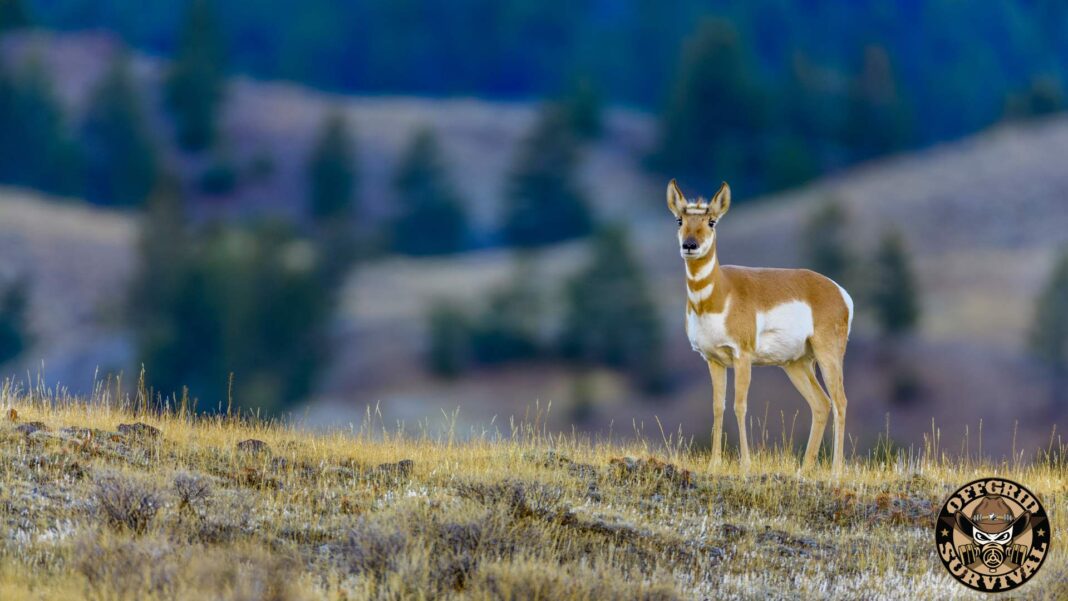
In a wilderness survival situation, animals can provide you with not only food but valuable knowledge of the environment around you. Animals are the ultimate experts at survival. They’ve spent their entire existence adapting to the exact terrain you’re standing in, and if you know how to read them, they’ll hand you information you’d otherwise have to learn the hard way.
Most people walking through the woods see animals as background noise. A bird call here, a rustle in the brush there, nothing worth a second thought. That’s a mistake. Every animal in that environment is running its own constant threat assessment — checking for weather, predators, food, water — and broadcasting the results whether it means to or not. Learn to read the broadcast and you’ve got a free early warning system.
Animals Can Signal When Bad Weather Is Coming
Some animals seem to know exactly when bad weather is about to hit, often hours before you’d see it coming yourself. When birds are flying high, the weather is most likely clear. Once you see them dive down and start flying closer to the ground, that’s usually a solid indicator that bad weather is on the way.
A lot of animals can sense changes in barometric pressure. For birds, the drop in pressure causes discomfort flying at high altitudes, so they instinctively drop closer to the ground right before an incoming storm system moves in. This isn’t folklore — it’s physics acting on their bodies the same way it acts on yours, just with more sensitive equipment.
If birds and bees disappear completely from an area, there’s almost certainly a storm coming. The pressure drop tells them to get back to the hive or nest and hunker down before the front arrives. Livestock does something similar — cattle bunching up and facing away from an incoming wind, or grazing animals heading for low ground and tree cover before a storm hits, are both worth paying attention to if you’re trying to read the sky without a radio.
Insects matter here too. A sudden, complete silence from crickets and cicadas in the evening can mean a temperature or pressure shift is underway. None of these signs alone is gospel, but stack two or three of them together and you’ve got a forecast that beats guessing.
Animals Can Signal When Danger Is Near
Animals make an excellent early warning system, especially when larger predators might be in the area. Birds in particular act like miniature alert systems and will tip you off to incoming problems long before you’d notice them yourself.
Blue Jays will squawk at just about any threat, including anything moving around the woods — including you. They’re the tattletales of the forest, and they don’t care who they’re ratting out. A flushed pheasant, quail, or grouse makes a lot of noise breaking cover. If you didn’t flush it, something else did, and that something is now between you and wherever it just came from.
The flip side matters just as much. Most animals will go quiet or freeze if something’s not right in their environment. A forest that goes suddenly silent — no birdsong, no squirrel chatter, nothing — is telling you something is moving through that the animals don’t like. Using the same logic, if you thought you heard or saw something but the normal background noise of the woods picks back up in that direction, it’s a reasonable bet it wasn’t a person or a large predator. Animals don’t relax around real threats. If they’ve relaxed, the threat has likely moved on.
This works both ways, too. If you’re trying to move quietly yourself — evading rather than alerting — watch what your own presence does to the local wildlife. If you’re causing every bird in a quarter mile to go off like a car alarm, you are not being as stealthy as you think you are.
Animals Can Help You Find Sources of Food and Water
Just like people, animals require food, water, and shelter to survive, and they tend to set up shop close to all three. By watching what native animals are doing, you stand a much better chance of locating water and food sources yourself instead of wandering blind.
Even if you don’t physically spot the animals, they leave signs that point you in the right direction. Converging animal tracks, consistent bird flight paths at dawn and dusk, and swarming insects can all lead you to a nearby water source. Tracks that all funnel toward one point and fan back out are a map, if you bother to read it. Game trails work the same way — animals don’t waste energy, so a well-worn trail through brush is almost always heading somewhere useful, whether that’s water, a feeding ground, or a bedding area.
Some animals, like coyotes, will dig holes in areas where groundwater sits close to the surface. Watching for these seep holes can give you a strong starting point for digging your own water-collecting seep, which can save you hours of guessing in dry terrain. Bird activity at dawn and dusk is another tell — most species water twice a day, and a steady flight path repeating at the same time each morning and evening is worth following back to its source.
A Word of Warning:
Most animals will eat a little bit of almost everything that’s out there, including plants that are toxic to humans. So while watching wild animals can hand you valuable knowledge about your environment, don’t assume that because an animal eats something, it’s safe for you to eat too. Different species process toxins differently — what a squirrel can handle without issue can put you in the ground. Always test unfamiliar plants yourself, using a proper edibility process, before you eat anything based on what you watched an animal eat.
Building This Into an Actual Habit
None of this works if it’s something you only think about once you’re already lost. The people who actually use animal behavior to navigate and survive are the ones who’ve trained themselves to notice it on every hike, every hunt, every walk through the woods — not just when things go wrong. Start paying attention now, on low-stakes trips, and the pattern recognition will already be there if you ever need it for real.
Carry a small notebook if you have to. Note what the birds were doing when the weather turned. Note which direction the deer trails ran relative to the creek. None of this is complicated, but all of it is perishable if you never practice it. The skill isn’t watching animals — anyone can do that. The skill is noticing what they’re telling you before you need the information.
Resources for Finding and Procuring Food in the Wild:
- Survivalist Guide to Traps: There are hundreds of different types of survival traps and snares you can use to procure wild game. The best traps are usually simple to make and can be built with natural materials if you know what you’re doing.
- Plastic Bottle Fishing Traps: Find out how to make a quick and easy fishing trap for capturing small bait fish and crawdads.
- How to Catch Multiple Fish in a Survival Situation: Learn how to make a simple trotline, a type of passive fish trap that can catch multiple large fish at the same time.




As an example of what we can learn from the animals, for one of the best techniques for keeping warm & building emergency shelters, go look at a squirrel’s nest.
Im having a real hard time out here in the world,I had a business partership split that left me high-and-dry….and now Im having a real hard time getting back on my feet,Im alone with very few friends and family,Im worried that I might become homeless,and I just don’t know how to handle that. If i find myself homeless,I would try and go to the wilderness some where,any tip on the wilderness thing? thanks Mike.
hey mike my name is jeremiah. Im going out in the wilderness my self here in a while and am looking for someone to go with me. get back to me if your interested.
Yaaay my generation found an open mind :)
Hello Jeremiah,
My name is Don and I am always looking to head out into the woods. I am in florida.
don, what part of florida are you in,
im in jacksonville
yoooo I’m like super couple years late man……. Yall alive ?? Or what’s up because I’m trying to train and servive the wild and maybe live in wilderness hit me up man if y’all still there or something I need this and I want this ….. Hit me up
Man up get any job u can find and work your ass off giving up is not a option
Hey, it’s a tough economy and it isn’t easy to find a job. He’s asking for advice helpful advice on wilderness survival which makes sence he would come here. No one wants to here your Bulls**t. And screw your “man up” crap I bet half the girls on here are tougher than you.
i think if u do that u need to do some survival reserch like books and videos and learn what u can use out in nature to aid in ur survival like porcupines they are slow and die easy so thats like 40 pounds of meat right there i would recomend 2 books 98.6 degrees by cody lundin and survive by les stroud also top 5 things to bring 1 a knife 2 shelter 3 a way to boil water 4 a way to make fire and 5 a way to hunt or fish
good luck Mike
Mike,
Having lived a great deal of time homeless, I know a bit on surviving such a situation.
1. Swallow your pride. Pride will not feed you, cloth you, keep you dry. Stand tall, keep your head up but know when to accept help. Work at McDonalds, temp jobs, any place that will pay you.
2. Know your area. Stay in the city if you do not know the wilds, stay in the wilds if you do not know the cities. Know what resources are available to you. Know where the free resources are, food, shelter, clothing and medical care. If something is not available for free, learn where you can get it as cheap as possible. It was not uncommon, in my travels, to hit the dumpsters of grocery stores when I could not find food elsewhere and was seldom hungry for long.
3. Travel as light as you can. It makes upkeep easier and less to keep an eye on. If you have to stay in a shelter you will want to be able to protect what you have from others wanting it more. When looking for or working you will not be burdened as much with your possessions or worry about keeping them in a safe place.
4. Avoid the shifters. These are people who shack up together for as long as they can before they are evicted. Do not agree to paying half unless you know they are good for it. Support yourself and yourself only.
5. Volunteer. An odd thing to add to this list but volunteering can get you quite a bit. During my time Homeless in Seattle, I volunteered to do security watch at the shelters I stayed in. This got me in while the others stood in long lines and I was never turned away as others had been. If I missed a day, I didn’t have to start over because they knew I was worth my salt, so to speak and when perks were available, I was always included in them because of my willingness to volunteer.
6. Do not dwell on the past and what you had. This is one of two serious problems newly homeless face, the other is keeping to old ways. What you had is no more, dwelling on it will keep you from looking forward and dealing with the present. What you did in the past cannot be done in the present. Hitting up Starbucks because you have a few extra bucks, smoking packs a day, eating only name brands, dressing in the best only. Doing this will not only drain anything you may may have, but it will also fuel the feeling of loss you will be hit with when you cannot keep it up.
7. And stay away from drugs and alcohol. If you have to stay in a shelter, you will see all too well the logic behind this.
I hope you never need to use this advice and things improve.
This is very good advice.. Word fore word.. I’ve been there.. Have a Blessed Day.!!!
look for hotels with ‘happy hours’ like Holiday Inn, whereyou buy one drink (coke/7up is OK) and sit around for two hours gobbling up their tacos or other offerings.
I wonder what job you had in the past and how you could use those skills to find work. There are free resources out there as well to help you with you and assistance with gas to get to interviews, JobCorps also here in Florida there is a website called Employflorida.com that has thousands of jobs available and you can post your resume.
also, what about extended family? It seems its always been a punchline how, for instance, Chinese families live in a one room apartment but there are 8 people living there. My point is, as a nation, we need to realize that we have a responsibility to take care of our own. We need to learn to be ‘uncomfortable’ for the sake of the bigger picture. A two bedroom apartment or home can fit a family of 12!! If every adult in that situation had a job that paid $8/hr. And lets say there are 6 adults..thats $48/hr being brought into the home! If we focused more on bringing our elderly parents, siblings and their families together we could work together and hopefully chip away at the enormous amount of poverty that is flowing over this country like a tsunami. Government jobs have grown and taxes will have to go up to pay those salaries, so as a people we need to say enough and stop relying on big brother, whomever he may be, and start at home.
Good luck and please find, dig, beg for other options than hitting the streets. You can be so much more than that.