Russian Media Report a Second Plague Death as the Kremlin Tells People to Trust Only Official Statements
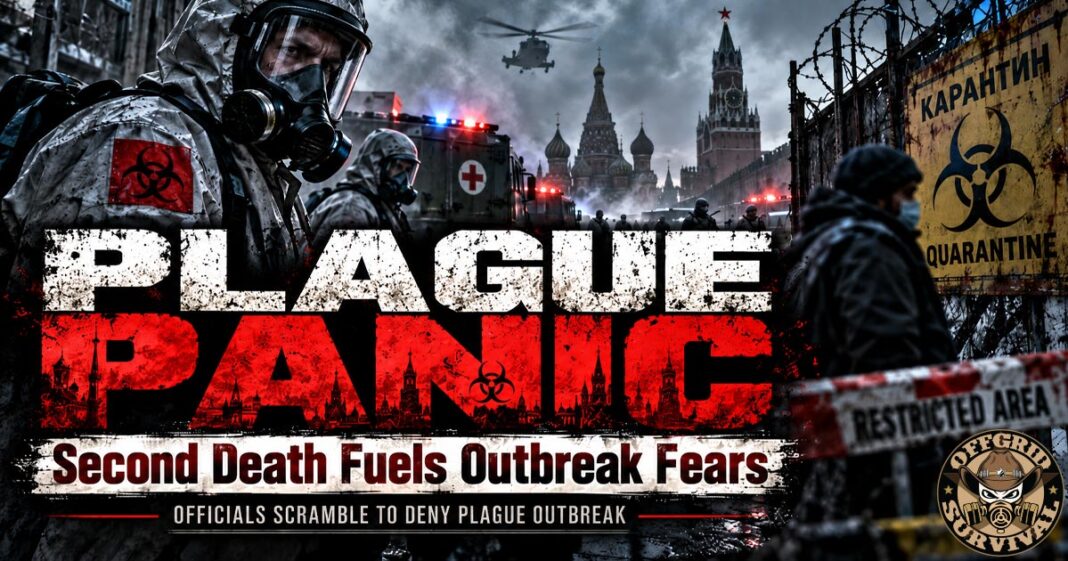
Russian media are reporting that a second person has died in Siberia’s Irkutsk region after a suspected plague infection. According to local journalists cited by the Daily Mail, the unnamed victim died in the isolation ward of the Irkutsk district hospital, the same place 28-year-old lab technician Daria Shipilova died last week. Russian authorities haven’t confirmed it, and the original local reports have reportedly been taken down.
That is where this story starts getting a hell of a lot more interesting.
At this point, nobody outside Russia can honestly tell you there is a widespread plague outbreak. There is no evidence of that. What we do know is that one young laboratory worker is dead, a second death is now being reported, nearly 200 contacts were placed under medical observation, local warnings have been deleted, Russian media outlets have pulled stories, and the Kremlin is telling people to trust only official government statements.
For anyone who remembers how governments handled COVID, that should sound familiar.
For Americans, the direct risk is still low. There are no confirmed cases outside the Irkutsk area, and health officials have not identified evidence of a wider outbreak. But even Secretary of State Marco Rubio acknowledged why Washington is watching this closely. While noting that travel between Russia and the United States is limited, Rubio warned that if something like this gets out, “it could quickly spread.” He said there is no reason for panic, but plenty of reason to keep a close eye on what Russia is actually dealing with.
The lesson here isn’t that you need to panic over some plague outbreak thousands of miles away. The lesson is that when something ugly starts spreading, governments almost always spend the first few days arguing over the wording while regular people are trying to figure out whether they should be worried.
And with pneumonic plague, a few lost days actually matter.
What Russia Is Saying Versus What Is Actually Happening
When we covered Shipilova’s death on Sunday, Russia’s federal health agency was calling it “pneumonia of unknown etiology,” nearly 200 of her contacts were under medical watch, and officials said none of them had tested positive. That official line hasn’t changed. Irkutsk Gov. Igor Kobzev says no new cases have turned up from the institute. Almost everything else has gotten murkier.
- A reported second death. Local independent journalists say a second person died in the isolation zone of the Irkutsk district hospital. There’s no name, no official confirmation and no independent verification yet.
- Disappearing news. According to The Insider, the federal channel REN TV deleted all five of its plague stories on October 2. The town of Baikalsk posted a Telegram warning on October 3 telling residents to stay away from Shelekhov because of unofficial information about a confirmed plague case, then deleted it about two hours later.
- The Kremlin’s message. Kremlin spokesman Dmitry Peskov told the public to ignore unofficial claims and stick to the state health watchdog, according to The Insider as reported by the Daily Star.
- Masks at the smelter. On October 3 the head of the Irkutsk aluminum plant told employees to wear masks because of “contradictory information about plague,” then edited the post to take out the word plague, the Irish Times reported.
- The neighbors aren’t waiting. Mongolia, Kyrgyzstan and Uzbekistan have tightened health controls at their end.
- Washington is watching. The State Department says it’s monitoring the case, and President Trump said the U.S. is willing to help Russia.
Some headlines are already screaming that the “Black Death” has returned, while others are throwing around theories about a Russian bioweapons accident.
Then came the Kremlin’s contribution: ignore unofficial information and trust the state health authorities.
Maybe Russia is right. Maybe this is an isolated laboratory exposure and officials are trying to stop a bunch of internet bullshit from turning into panic. That is absolutely possible.
But deleting stories, rewriting warnings and telling the public that only government-approved information should be trusted is about the worst possible way to convince anyone that there is nothing to worry about.
Even Russia’s neighbors apparently aren’t completely comfortable with the situation. Mongolia, Kyrgyzstan and Uzbekistan have reportedly tightened health controls, while the U.S. State Department says it is monitoring developments.
Governments Have Played This Game Before
The bacteria involved here, Yersinia pestis, is the same one behind the Black Death. Between 1347 and 1351 it killed somewhere between a third and half of Europe. Nobody is saying that’s what’s happening now, because antibiotics changed the math. But antibiotics only work if doctors know what they’re treating, and the big plague outbreaks since then share a pattern: officials who decided the truth was worse for them than the disease.
Moscow, 1771. Plague came north from the Russo-Turkish war and killed between 52,000 and 100,000 people in Moscow alone, up to a third of the city. Doctors argued over whether it was even plague while it spread, and when the crackdown finally came, the city exploded in what’s still called the Plague Riot.
San Francisco, 1900. When plague turned up in Chinatown, California Gov. Henry Gage denied it existed and went after the doctors who found it, mostly because he was worried about what it would do to the state’s business. The outbreak dragged on for four years and more than 100 people died.
Manchuria, 1910. A pneumonic plague outbreak, the same lung form suspected in Irkutsk, spread along the railways in the dead of winter and killed around 60,000 people. It was finally stopped by hard quarantines and by doctors pushing everyone into masks, which is pretty much the same playbook we’d use today.
And as we wrote Sunday, Russia has its own record here. The 1979 Sverdlovsk anthrax leak was blamed on bad meat for over a decade, and in 2009 a Saratov medical student was arrested for blogging about pneumonic plague rumors. Deleted news stories in Irkutsk fit right into that history.
Why We Are Paying Attention
In a normal year, a plague scare in Siberia would be a strange headline and not much more. This isn’t a normal year. Diesel hit a record $6.53 a gallon and the country is heading into winter about 600 million gallons short. At that price, filling the tanks on one long-haul semi runs well over $1,000, and every dollar of it ends up on your grocery receipt. Russia and China have both stopped exporting diesel, and in Texas 16 trucking companies have already gone bankrupt.
Now picture quarantines on top of that. In 2020 the shelves emptied while fuel was cheap and the trucks were running fine. As we wrote last month, the supply shocks from COVID never fully went away. Even a scare that triggers travel limits and panic buying would land on a system with no slack left in it.
Medicine has the same weakness. In late 2022 the FDA put children’s amoxicillin on its shortage list, and parents drove from pharmacy to pharmacy trying to find it. Most of America’s generic antibiotics depend on ingredients made in China and India. If people start hoarding antibiotics over plague headlines, the pharmacy shelf is the first thing to go empty.

And just like the script played out during COVID, Israel is already claiming to have a vaccine. In fact, Israeli researchers say they were already working on an mRNA vaccine against pneumonic plague. In 2025, scientists from Tel Aviv University and the Israel Institute for Biological Research reported 100 percent protection in animal tests after two doses. It is not an approved human vaccine, but researchers explicitly cited the threat of plague being used as a biological weapon as one reason for developing it.
How to Prep for What Is Coming
Even if this whole thing fizzles out and turns out to be an isolated incident, the larger problem isn’t going away. The world gets crazier by the day, and we now live in an age where governments, universities and private labs routinely experiment with some of the nastiest diseases on the planet. As long as human beings are screwing around with pathogens that can kill people faster than governments can admit there is a problem, another laboratory accident, outbreak or deliberate release isn’t some science-fiction scenario. Eventually, something is going to get out.
And none of this is helped by the disturbing number of powerful people who seem perfectly comfortable talking about humanity as a problem to be managed, populations as numbers on a spreadsheet, and ordinary people as acceptable collateral damage in the name of some larger agenda. You don’t have to buy into every population-control theory floating around the internet to recognize that putting increasingly powerful biological technology into the hands of governments, militaries and scientists comes with risks that didn’t exist for most of human history.
Maybe Irkutsk ends here. Hopefully it does. But preparedness isn’t about betting your family’s safety on everything working out. It’s about accepting that sooner or later something will go wrong, and making sure you’re not standing in a packed grocery store fighting over the last case of water when everybody else finally realizes it.
Stock six to eight weeks of food. Past outbreaks have tended to roll through a community in about that time, and a quarantine or a trucking slowdown is exactly when you don’t want to be in a crowded store. Focus on what keeps: Long-Term Food Storage: What Actually Lasts 25 Years, and don’t skip fats and oils, which is where most food storage falls short.
Get your prescriptions ahead. Ask your doctor about a 90-day supply of anything you take every day. When drug supply tightens, the people who refill last wait longest. More in Most Prepping Plans Assume You Are Healthy and Alone.
Understand doxycycline before you buy into the hype. The CDC lists doxycycline as one of the antibiotics used to treat bubonic plague and to protect people after a close exposure, typically a seven-day course for someone who was within six feet of a pneumonic plague patient. It’s cheap and common, and some doctors will prescribe a course to keep on hand for travel or emergencies, so it’s worth asking yours. Don’t use fish antibiotics and don’t treat yourself for a bad cough. Pneumonic plague usually needs hospital care with IV antibiotics, it can kill within a day.
Keep masks and gloves on hand. Pneumonic plague spreads through respiratory droplets, the same way COVID did. A box of N95s is cheap now and won’t be later. Our pandemic prep guide covers the rest of the list.
Have a way to get news nobody can delete. When Russian outlets started pulling stories, people in Irkutsk were left guessing. A shortwave or ham radio gets you sources outside your own government. Start with our Ham Radio FAQ and Situational Intel: Knowledge is Power during a Crisis.
Build a cash cushion. Quarantines close workplaces fast. Job Loss Is the Most Likely SHTF Event You’ll Ever Face lays out a 90-day plan.
Maybe the official version turns out to be completely accurate.
We hope it does.
But preparedness has never been about waiting until CNN, the CDC, the White House or the Kremlin finally gives you permission to take something seriously. It is about recognizing when something doesn’t smell right, paying attention to what is happening outside the official press release and making sure your family doesn’t have to fight over the last case of bottled water when everyone else finally figures it out.
Related OFFGRID Survival Coverage
- Russian Lab Worker Dies After Suspected Plague Exposure as Nearly 200 Are Quarantined
- Pandemic Outbreaks: How and When to Prepare for a Pandemic
- How to Survive: Preparing to Survive Pandemics, Disease Outbreaks and Disasters
- Diesel Hits a Record $6.53 as America Heads Into Winter 600 Million Gallons Short
- World’s Biggest Fuel Suppliers Are Hoarding Diesel: China and Russia Both Stop Diesel Exports
- “Repeated and Persistent Supply-Side Shocks” Are Here to Stay
- Long-Term Food Storage: What Actually Lasts 25 Years
- Best Survival Books