
Most Americans go about their daily lives completely blind to what’s humming beneath them. They flip a switch. The light comes on. They assume someone, somewhere, has it handled.
Nobody has it handled.
The fact is, our nation’s power grid is old, dangerously antiquated, and more vulnerable to attack and failure than at almost any point in its history. We’ve been warning readers about this for years — urging people to put grid failure at the top of their threat list — but lately the situation has taken on a whole new level of urgency. Liberal politicians seem determined to destroy what little energy independence we had left, spiking oil and gas prices while leaving the infrastructure that actually delivers that power to rot.
And the enemies — foreign and domestic — know exactly what they’re doing.
From terror groups probing substation vulnerabilities to nation-states developing EMP capabilities to the near-certainty of a major solar weather event, the threats aren’t theoretical. They’re in the queue.
Whether it’s a natural disaster, a geomagnetic event, or a deliberate attack, it is only a matter of time before something cripples this nation’s power grid.
Whether that’s a low-level terror attack targeting physical infrastructure, an electromagnetic pulse (EMP) detonated at altitude, or a coronal mass ejection (CME) that we never saw coming — the result is the same. The lights go out. And when they go out in a city of millions, what happens next is not a power outage.
It’s a collapse.
A Hodgepodge of Antiquated Equipment and Technology
Our grid isn’t one thing. It’s a patchwork — a stitched-together mess of interconnected power generation plants, transmission facilities, distribution nodes, and over 400,000 miles of electric transmission lines, some of which date back to the 1880s.
Read that again. Some of the wire carrying electricity to American homes is older than the automobile.
The U.S. Department of Energy has confirmed that 70% of U.S. transmission lines are more than 30 years old. The average age of the large power transformers that handle 90% of U.S. electricity flow is more than 45 years. These are not components you can order off a shelf. Lead times for replacement transformers run 12 to 24 months under normal conditions — longer if global supply chains are disrupted by the very disaster that knocked them out.
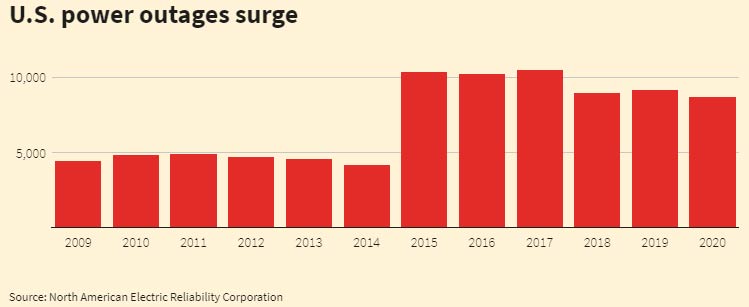
The failure numbers are already trending in the wrong direction. Power outages between 2015 and 2020 averaged 9,656 per year — more than double the average of 4,609 during the previous six-year period. That doubling didn’t happen by accident. It happened because the system is aging faster than it’s being replaced, and the political will to fix it simply doesn’t exist.
The Water Problem Nobody Wants to Talk About
Beyond the wires themselves, there’s a crisis quietly unfolding in the Southwest that directly threatens electrical generation — and almost no one in the mainstream media is connecting the dots.
Throughout the Southwestern United States, enormous amounts of electricity come from hydroelectric generation. Hoover Dam alone can produce 2,080 megawatts — enough to power roughly 1.3 million homes. But liberal politicians, in their relentless pursuit of their climate agenda, have mismanaged and in many cases deliberately allowed the reservoirs feeding these plants to draw down to critical levels.
Lake Mead and Lake Powell — two of the largest reservoirs in the country — have both come perilously close to “dead pool” status, the point at which water can no longer flow through the dam’s penstocks to generate electricity at all. When that happens, it’s not a rolling blackout. It’s a permanent shutdown until water levels recover — and that could take years.
This isn’t an accident. It’s what happens when ideologues run energy policy.
How Likely Is a Complete Shutdown of Our Power Grid?
The political class doesn’t want to answer this question honestly. So let’s let their own words do the work.
In 2013, during a congressional hearing on national security, Congresswoman Yvette Clark (D-NY) testified that the likelihood of a severe geomagnetic event capable of crippling the electric grid is 100%.
Not “possible.” Not “a concern.” One hundred percent.
Congressman Trent Franks (R-AZ), speaking at the International Electric Infrastructure Security Summit, put it even more bluntly: “We are only one act of madness away from a social cataclysm unlike anything our country has ever known.”
These are not fringe voices. These are sitting members of Congress — people with access to classified threat briefings — and both of them were saying the same thing. The grid will fail. The only question is whether it fails gradually through neglect or catastrophically through an attack or solar event.
The government knows. They’ve known for decades.

They just haven’t told you what that actually means for life in a city.
The EMP and Solar Flare Threat: Not If, When
Let’s separate the two threats here, because they’re related but distinct.
The EMP Threat
An electromagnetic pulse attack — typically from a nuclear device detonated at high altitude — would generate a massive burst of energy that fries unshielded electronics across thousands of square miles. It doesn’t require a direct hit on any city. A single detonation over the central United States could theoretically take out the majority of the country’s grid simultaneously.
Multiple nations possess this capability today. Russia. China. North Korea has been actively pursuing it. The concern isn’t whether the technology exists — it clearly does. The concern is the window of temptation that opens every time adversaries perceive American weakness.
And that window has been wide open.
The Solar Flare Threat
The solar threat is different because it’s not a matter of political will or deterrence. The sun doesn’t care about treaties. It will fire a major coronal mass ejection at Earth again — it’s done it before, and the physics guarantee it will do it again.
In 1859, the Earth was struck by what became known as the Carrington Event — a solar flare so powerful it could be observed with the naked eye. It destroyed telegraph infrastructure across the globe. Operators received severe electrical shocks. Telegraph paper burst into flames. Induced currents were so strong that some operators could send messages even after disconnecting their power supplies.
That was 1859. The most sophisticated electrical system on Earth at the time was the telegraph.
Now imagine a Carrington-scale event hitting a civilization that runs on microprocessors.
NASA scientists have calculated that a direct hit from a solar event of that magnitude would cause upward of $2 trillion in damage in the first year alone. Recovery, by their best estimates, would take a minimum of four years. And those four years would fall hardest on the places least equipped to handle them — Urban centers!
Why Cities Will Become Deathtraps
This is the part that the emergency management community doesn’t want to say out loud, because there’s no good answer to it.
Cities are systems built on total dependency. Every calorie of food, every gallon of clean water, every dose of medication, every emergency service — all of it flows through infrastructure that runs on electricity. Knock the power out for more than 72 hours and the cascade begins.
Water treatment plants stop purifying. Sewage systems fail. Hospital backup generators run out of fuel. ATMs and payment systems go dark, which means the supply chains that feed grocery stores stop moving — and those stores didn’t have much to begin with. The average grocery store carries roughly 72 hours of inventory. Three days. That’s it.
Former CIA Bureau Chief Claire Lopez has stated that within one year of a major EMP attack, an estimated 9 out of 10 Americans would be dead — because the country simply cannot support its current population in urban centers without functioning electrical infrastructure.
Frank Gaffney of the Center for Security Policy has said the same thing, citing the identical 90% mortality estimate.
Are those numbers frightening? Yes. Are they designed to cause panic? No. They’re a straightforward engineering and logistics reality: 330+ million people cannot be fed, watered, and kept alive when the systems that feed, water, and keep them alive stop working.
Most cities DON NOT have a failsafe. They have dependencies.
When one link breaks, they all break.
What the Government Will and Won’t Be Able to Do
The first step to surviving this is understanding one uncomfortable truth: the government will not be able to help you during a catastrophic grid failure.
Not because they don’t want to. Because the scale of the problem is simply beyond anything the emergency management apparatus has ever planned for. FEMA’s own documentation acknowledges that its systems are designed for regional disasters — a hurricane, a tornado outbreak, a major earthquake in one city. The agency has no realistic contingency for a nationwide grid collapse.
Look at how emergency management handled COVID — a crisis with weeks of warning, enormous federal resources, and no immediate threat to food or water infrastructure. They still couldn’t coordinate basic supply chains or communicate coherently.
Now imagine those same people trying to manage nine simultaneous Category 5 hurricanes across every major city in the country.
That’s roughly the scale of what a complete grid failure means.
FEMA can move generators and MREs to a disaster zone. There is no “outside” to bring supplies from when the disaster is everywhere.
Emergency management personnel would be overwhelmed within hours — not days. First responders would eventually stop responding as their own families face the same crisis. National Guard units would splinter as soldiers returned home to protect their own. The command and control infrastructure that allows government to function at all runs on the same grid as your refrigerator.
NO ONE IS COMING! Plan accordingly.
What Can You Do to Protect Yourself?
Step one is awareness. You’ve already taken it by reading this far. Understanding the real scope of the threat — not the sanitized version — is what separates people who survive extended infrastructure failures from people who don’t.
Step two is distance. If at all possible, get out of high-density population centers now, before a crisis makes it impossible. Urban survival during a catastrophic grid failure isn’t a challenge — it’s a death sentence. The population density that makes cities economically efficient makes them physically unsurvivable when supply chains stop. Millions of people competing for a finite and rapidly dwindling supply of food, water, and medicine is not a problem that individual preparedness can solve.
Step three is a bug-out plan. If you can’t leave permanently, you need a rural bug-out property or retreat location and a practiced plan to reach it before the roads become impassable. The window between when a major grid event happens and when the roads turn into a parking lot is measured in hours — not days. If you haven’t worked out your bug-out route in advance and tested it, you don’t have a plan. You have an intention.
Step four is stockpiling. This is non-negotiable. You need at minimum a 30-day supply of food and water, and realistically a 6-month to 1-year supply if you’re serious about surviving a long-term grid failure. Start with 60+ long-term survival foods available at any grocery store — these are the basics that give you a foundation before you start getting into freeze-dried meal programs and bulk storage.
Water is the immediate constraint. A person needs about 1 gallon per day minimum just for drinking and basic sanitation. For a family of four, that’s 120 gallons per month — which is a lot of weight and a lot of storage space, but it’s not optional. Municipal water treatment stops the moment grid power fails.
Step five is skills and communication. Gear and food only go so far. The ability to stay informed during a crisis — situational awareness — is what allows you to make good decisions instead of reactive, panicked ones. A ham radio setup puts you in contact with other prepared people and lets you monitor emergency traffic when cell networks are down or overloaded. Check out Prepper Radio: The No-BS Ham Radio Technician Exam Prep Guide for a straightforward path to getting licensed and operational.
Shielding Your Electronics from EMPs, CMEs, and Solar Flares
Not every electronic device will survive an EMP or a major CME — but not every device is equally vulnerable, either. Devices that are powered off and disconnected have some natural protection. Devices plugged into the grid at the moment of a pulse are likely toast.
What you can do:
Faraday bags and cages are the most practical solution for storing backup electronics — ham radios, emergency GPS devices, backup communication gear, and spare electronics you want to preserve. Quality EMP shielding bags provide tested shielding and are small enough to store without a dedicated room or workshop.
Surge protectors offer some protection against CMEs and normal power surges, but they will not protect against a direct EMP. Think of surge protectors as your everyday baseline — not your EMP strategy.
Whole-house surge suppression at the breaker panel adds another layer and is inexpensive relative to the cost of replacing every appliance and device in a home. It won’t make your home EMP-proof, but it gives you a fighting chance against the electromagnetic noise that precedes and follows major solar events.
Solar power and off-grid energy are your longer-term plays. If the grid goes down indefinitely, the only people with electricity are the ones who generate their own. Understanding how many solar panels and batteries you actually need to run a home is information worth having before you need it — not after. Top solar generators and emergency power solutions are also worth reviewing now, while you can still order what you need.
The key point: protect your backup gear in Faraday shielding, and assume that anything plugged into the grid at the moment of a major event is gone.
The Clock Has Been Running for a Long Time
Here’s what keeps getting lost in these conversations: the threat isn’t new. The warnings aren’t new. The vulnerability isn’t new.
What’s new is how exposed we’ve allowed ourselves to become.
Back in 1989, a geomagnetic storm caused by a solar event knocked out the entire Hydro-Québec power grid in under 90 seconds, leaving 6 million people without power for 9 hours. Transformers were damaged as far away as New Jersey. That was a moderate event — nowhere near Carrington scale. The grid was less interconnected then. The consequences of that same event today would be orders of magnitude worse because the systems are more tightly coupled, the dependencies run deeper, and the average American has zero buffer between them and the infrastructure they depend on.
The Carrington Event was 1859. Solar scientists say an event of that magnitude has roughly a 12% chance of hitting Earth within the next 10 years. That’s not a fringe estimate — it’s from a study published in the journal Space Weather by physicist Pete Riley.
One in eight. In the next decade.
That’s not a distant theoretical. That’s a number that belongs in every preparedness plan on the planet, right next to hurricane probability and earthquake risk.
Sitting members of Congress have testified under oath that this will happen. NASA has modeled the damage. Intelligence officials have estimated the death toll.
And the average American’s plan is to see if the light comes back on.
Preparedness Resources
- Prepper 101: Your Survival Guide to Getting Started
- Emergency Preparedness Checklist — applies to all disasters and all threat types
- 60 Long-Term Survival Foods and Supplies at the Grocery Store — the foundation of any serious food stockpile
- Emergency Evacuation Planning: 60+ Preparedness Resources for Bugging Out — the complete resource checklist for getting out when it counts
- Best Portable Survival Water Filters — because municipal water stops the moment the grid does
- Top Solar Generators, Power Packs, and Emergency Solar Solutions — generate your own or go dark
- The Ultimate Situational Survival Guide: Self-Reliance Strategies for a Dangerous World — step-by-step home safety plans, evacuation routes, supply stockpiling, and financial preparedness
- Prepper Radio: The No-BS Ham Radio Technician Exam Prep Guide — stay informed when every other communication network goes silent
The grid won’t give you a warning. It won’t send a notification or a news alert or a government advisory with time to spare. When it goes — whether from a solar event, a coordinated attack, or simple catastrophic failure — it will go without ceremony, in the middle of an ordinary Tuesday, when most people are thinking about dinner.
The time you have to prepare is the time before that Tuesday.




wonderfully written article! I am so glad I live in a small, tight-knit community deep in the rockies!
I appreciate your views and opinions. To be honest I am doing well to pay for one house. A very modest house at that.
Best of luck to you all during these sad economic times.
You might look into staying with friends and family that live out in the country. I have a friend from work that will be bugging out to my place if problems arise.
this is one emergency that is easy to do a limited test of.pull the breakers to the house for 3 or 4 days and see what needs come up that you did not think of just on your own trip back to the stone age,something will come up that will suprise you
If your a Camper type person, you will NO problem existing,
the people who rely on everything electronic will have a very hard time at life.
even being an experienced camper isn’t going to help if you don’t have reliable water or food stockpiled.
and you will have to be well armed, extra vigilant about laying low, avoiding detection and self protection.
If you haven’t read the book, “One Second After” you should. It’s written by a history professor who studied seige situations. It’s not the best writing, but gives ideas of what is likely to happen after an EMP. A lot of libraries have it surprisingly.
Great book. Although I have no idea why food was so scarce when they lived next to a major reservoir. Fish, amphibians and birds would be abundant..
possibly knowledge and/or experience?
Great Book!
To vulnerable.
We have property in The Bahamas for sale and might have what you are looking for.
We have an affordable, very safe, and resourceful location on what is called a Family Island. It is a fairly remote location with only a few other neighbors that share miles of beach and rolling hills. The property has spectacular views of ocean and the beach is just steps away.
The Island consists of mostly fisherman and farmers: Locally grown food (with a 12 month growing season), wild game, and world-class fishing are the way of life. We have all modern amenities with out all of the modern problems.
The property is ready to build with roads and utilities, also perfect for off-the-grid. We can help you with building approvals and other needs to help your transition to the Island and getting your new home built.
We are willing to work something out for you to secure this property (if it is what you’re looking for) while in transition. We also provide two weeks free at our Vacation Rental Beach House for property buyers.
If you would like to know more about this property and what we can do for you then please contact us.
Good article – we are preparing our barn (my man-cave) to be 100% off-grid just in case our house solar, generator, and water fail.
When the Western and Southwestern U.S. is out of water, where are they going to get it? Answer: the Midwest and South.
In addition, the water “mis-management” will cause a mass migration to the water sources. Food staples and medical supplies will dwindle to almost nothing.
As a result, people will kill their neighbors for food and water; this is in the future…two to five years out… maybe sooner.
Ofcourse this is exactly what the eco terrorists and Socialist/Communists want to happen.
330 million people in the U.S. On average a person needs about One gallon of clean water per day to survive–that’s over 10 billion gallons per month minimum.
Thanks for listening.
Out here.